What Is the Best Stone for an Outdoor Kitchen? We Explain.
An outdoor kitchen isn't just an appliance and a countertop. It's the heart of your backyard, the central hub for laughter-filled evenings, weekend barbecues, and quiet morning coffees. It's a significant investment in your home and your lifestyle. And at the very core of that investment—both functionally and aesthetically—is the stone you choose. It's the surface that will endure sizzling pans, spilled wine, blazing sun, and unexpected downpours. It has to perform. It has to last. And it has to look incredible while doing it.
Here at Modern Yardz, we've designed and built countless outdoor living spaces, and we can tell you this with absolute certainty: the countertop decision is one of the most pivotal moments in the entire process. It dictates so much of the project's final feel and long-term durability. The question we hear constantly is, "What is the best stone for an outdoor kitchen?" The answer, honestly, isn't a single material. It's the material that's best for you. It depends on your climate, your cooking style, your maintenance tolerance, and your budget. So, let's walk through the options together, drawing on our team's years of hands-on experience.
Why Your Stone Choice Is So Much More Than Just Looks
It’s easy to get lost in the sheer beauty of natural stone. The swirling veins of marble, the speckled depths of granite—they’re captivating. But for an outdoor application, beauty has to be backed by brawn. A material that thrives inside your home can face a catastrophic failure when exposed to the elements 24/7. We’ve seen it happen.
Here’s what really matters:
Durability and Weather Resistance: Your countertop will be bombarded by UV rays, which can cause fading and degradation in certain materials. It will experience thermal stress, expanding slightly in the heat and contracting in the cold. It needs to withstand rain, humidity, and maybe even frost without cracking, staining, or warping. This isn't just a suggestion; it's a non-negotiable requirement.
Heat Tolerance: This is an outdoor kitchen. Hot pans, sizzling grills, and even wood-fired pizza ovens are part of the equation. The stone must be able to handle direct and ambient heat without scorching, cracking, or discoloring. Some materials, particularly engineered ones with resins, just can't take the heat.
Stain and Etch Resistance: Marinades, red wine, lemon juice, grease—your countertop will see it all. Porosity is the enemy here. A porous stone will absorb liquids, leading to stubborn stains. Acidic substances can cause etching, which is a chemical reaction that dulls the surface of certain stones like marble. You need a material that can be sealed effectively or is naturally non-porous.
Maintenance Commitment: Let’s be realistic about how much time you want to spend babying your countertop. Some stones require annual sealing and specific cleaners, while others can be wiped down with soap and water and forgotten. Your willingness to perform routine maintenance is a huge factor in finding the right fit.
Choosing the right stone is about creating a space that works for you, not a space you have to constantly work on.
The Heavy Hitters: A Breakdown of Top Natural Stones
Natural stone has been the go-to for millennia for a reason. It's timeless, durable, and each slab is a unique piece of art crafted by the earth. For outdoor kitchens, a few contenders consistently rise to the top.
Granite: The All-Around Champion
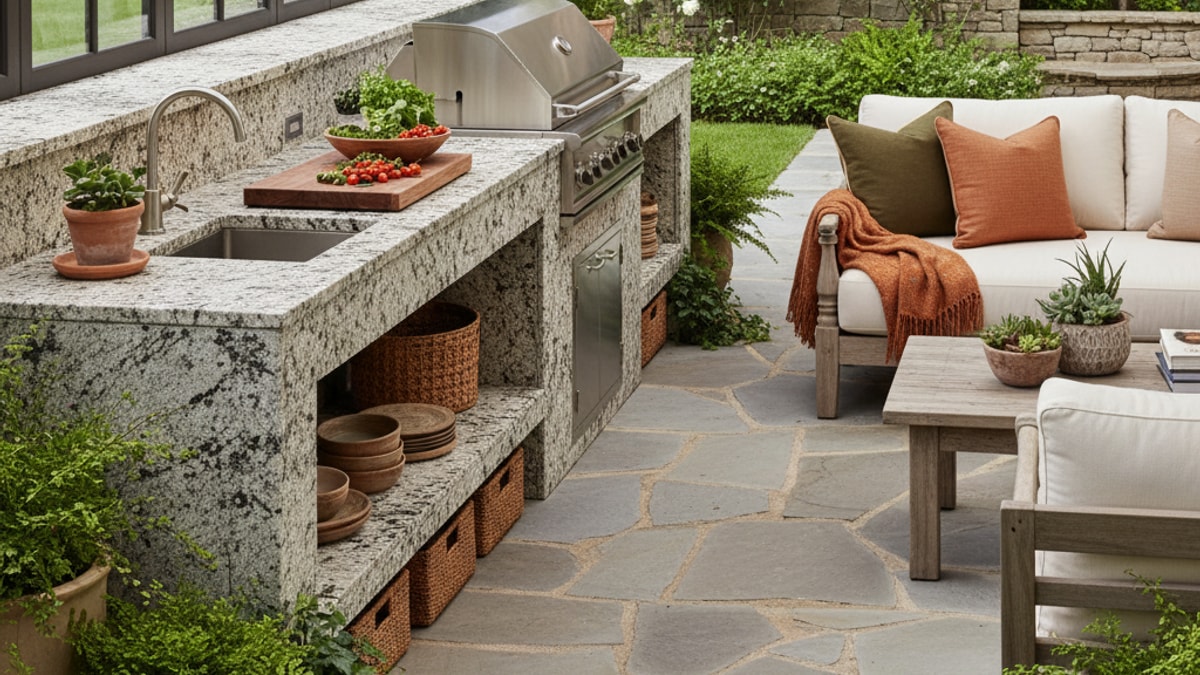
If there’s a default, tried-and-true answer, it's granite. It's incredibly popular for a reason. Granite is an igneous rock, forged in immense heat and pressure, which makes it naturally suited for a kitchen environment. We've found that its sheer variety is a massive draw for clients; you can find slabs ranging from deep, uniform blacks to whites with dramatic, flowing veins of quartz and mica.
Pros: It's exceptionally durable and resistant to scratches and heat. You can place a hot pan directly on it without a second thought. When properly sealed, it stands up well to stains. And because it's a natural material, its colors are baked-in, so to speak, making it highly resistant to UV fading.
Cons: Granite is porous. We can't stress this enough: it must be sealed. An unsealed or poorly sealed granite countertop will drink up oils and liquids, leaving permanent marks. This isn't a one-time task; it typically needs to be resealed every year or two, especially in an exposed outdoor setting. The cost can also be significant, depending on the rarity of the slab you choose.
Our team's take: Granite is a fantastic, reliable choice. The key to success is committing to that simple sealing schedule. Do that, and you'll have a beautiful, functional surface for decades.
Soapstone: The Understated Workhorse
Soapstone has a completely different vibe than granite. It's softer, with a moody, matte finish that can range from light gray to a deep, charcoal black. It’s primarily composed of talc, which gives it that signature soft, 'soapy' feel. But don't let the name fool you; it's a formidable material.
Pros: Soapstone is chemically inert and non-porous. That means it's naturally antibacterial and won't stain. Acidic foods like lemon juice won't etch it. It’s also completely heatproof—it's often used in chemistry labs for this very reason. Many people love that it develops a natural patina over time, darkening and adding character to the space. It’s a living finish.
Cons: Its softness is its biggest drawback. It can and will scratch more easily than granite. While minor scratches can often be sanded or oiled out, it's something to be aware of. To achieve and maintain that deep black color, it needs to be regularly treated with mineral oil, especially in the first year. Otherwise, it will remain a lighter, sometimes uneven gray.
Our experience shows that clients who choose soapstone are looking for character. They embrace the scratches and the evolving color as part of the stone's story. If you want a pristine, unchanging surface, this might not be for you.
Quartzite: The Marble Look-Alike with Muscle
This is where things can get confusing. Quartzite is not the same as quartz. Quartzite is a natural metamorphic rock formed when sandstone is subjected to intense heat and pressure. The result is a stone that often has the stunning, delicate veining of marble but with the brawn of granite.
Pros: It's harder and more durable than granite, making it exceptionally resistant to scratching. It's also highly resistant to UV rays, so its color won't fade in the sun. For homeowners who dream of a white, marble-like outdoor kitchen but dread the maintenance, quartzite is often the perfect answer.
Cons: Like granite, it's porous and absolutely requires sealing to prevent stains. The main issue we see in the industry is mislabeling. Some suppliers will incorrectly label a soft marble as a quartzite, leading to a disastrous outcome for an unsuspecting homeowner. It's critical to work with a reputable supplier and fabricator. It's also on the higher end of the price spectrum.
Engineered Stones: Can They Handle the Great Outdoors?
The world of engineered stone has exploded, offering incredible consistency and design possibilities. But can these man-made materials, which are superstars indoors, really hold up outside? The answer is a very firm 'it depends'.
Quartz: The Indoor Star with an Outdoor Problem
Quartz countertops (the engineered kind) are made from about 90-95% crushed natural quartz blended with polymers, resins, and pigments. This creates a completely non-porous and incredibly durable surface that's a dream for indoor kitchens. No sealing, no staining. Simple, right?
Well, the problem is the resin. The binders that hold the stone together are typically not UV-stable. When exposed to direct, relentless sunlight, that resin can yellow, fade, or become brittle over time. Most quartz manufacturers will explicitly void their warranty if the product is installed outdoors. Our team is very clear with clients about this limitation. We’ve seen beautiful indoor kitchens extended to a covered patio with quartz, but for a fully exposed setup? It’s a huge risk.
That said, some brands are now developing 'outdoor-rated' quartz lines with advanced UV-resistant resins. These are still relatively new to the market and often come at a premium, so it's essential to do your homework and confirm the warranty details.
Porcelain and Sintered Stone: The Technological Titans
This is where modern technology really shines. Porcelain slabs and sintered stones (like Dekton or Neolith) are created by fusing minerals together under immense heat and pressure, mimicking the process that creates natural stone but in a hyper-controlled environment. The result is a material that is almost indestructible.
Pros: These materials are about as close to zero-maintenance as you can get. They are non-porous (so no stains), unfazed by UV light (no fading), impervious to heat (you can't scorch them), and incredibly difficult to scratch. They come in a vast array of colors and patterns, convincingly mimicking everything from concrete to marble to wood.
Cons: The two main drawbacks are cost and fabrication. This is often the most expensive option on the market. Also, because the material is so hard and dense, it requires specialized tools and expertise to cut and install. A less-experienced fabricator can easily chip or crack the edges during installation. It’s not a DIY-friendly material by any stretch of the imagination.
For a truly bulletproof, modern aesthetic in your Outdoor Kitchens SAN Diego project, sintered stone is an unparalleled choice, but it requires a commitment in both budget and professional installation.
Pig PICKING At South Texas Outdoor Kitchens
This video provides valuable insights into What Is the Best Stone for an Outdoor Kitchen, covering key concepts and practical tips that complement the information in this guide. The visual demonstration helps clarify complex topics and gives you a real-world perspective on implementation.
The Comparison: Which Stone Wins for Your Lifestyle?
To make it easier, we've broken down the key attributes of the top contenders in this table. Remember, 'Best' is relative to your priorities.
Material
Durability (Scratch)
Heat Resistance
Stain Resistance (Sealed)
UV Resistance
Maintenance Level
Relative Cost
Granite
High
Excellent
High
Excellent
Moderate (Sealing)
Mid to High
Soapstone
Low to Medium
Excellent
Excellent (Non-Porous)
Excellent
Moderate (Oiling)
Mid to High
Quartzite
Very High
Excellent
High
Excellent
Moderate (Sealing)
High
Porcelain
Very High
Excellent
Excellent (Non-Porous)
Excellent
Very Low
High to V. High
Sintered Stone
Excellent
Excellent
Excellent (Non-Porous)
Excellent
Very Low
Very High
Marble
Low
Good
Low (Porous & Etches)
Good
Very High
High
Standard Quartz
High
Poor to Medium
Excellent (Non-Porous)
Poor
Very Low
Mid to High
Beyond the Countertop: Stone for Your Kitchen's Structure
The countertop gets all the glory, but the body of your outdoor kitchen island is just as important. The structure needs to be built from materials that can support the immense weight of the stone and withstand the elements. We typically build a frame from galvanized steel or concrete block and then clad it in a material that complements the overall design.
This is where you can create incredible texture and depth. A popular choice is a stacked stone or stone veneer that mimics the look of a solid masonry wall. This can be coordinated with other hardscaping elements in your yard. For instance, the stone veneer on your kitchen could match the material used for your Seat Retaining Walls, creating a powerful, unified design language throughout the space. Similarly, the ground plane is crucial. Selecting the right materials for the patio floor, like high-quality Pavers SAN Diego, ensures a stable, beautiful foundation for your entire outdoor living area.
Putting It All Together: A Cohesive Outdoor Design
Your stone choice shouldn't be made in a vacuum. It’s a key piece of a much larger puzzle. The best outdoor kitchens feel like a natural extension of both the home and the surrounding landscape. The color and texture of your stone should complement your home's exterior, your patio material, and even the foliage in your garden.
Think about the overall atmosphere you want to create. A sleek, dark gray sintered stone works beautifully in a modern design, perhaps under one of our custom Patio Covers Pergolas SAN Diego. A warm, earth-toned granite might be perfect for a more traditional or rustic space, especially when paired with the warm glow of nearby Fire Features. And don't forget illumination. Proper Landscape Lighting SAN Diego is critical for both functionality and ambiance, highlighting the texture of your chosen stone and making the space usable long after the sun goes down.
This is where a holistic approach to landscape design becomes invaluable. Seeing how all the elements—from the kitchen to the pool to the plantings—will interact is key to creating a space that is truly special. If you're feeling overwhelmed by the choices, that's what we're here for. Our design team can help you navigate these decisions and create a cohesive vision for your entire backyard. The first step is a simple conversation, so feel free to BOOK MY FREE CONSULTATION to discuss your project with our experts.
Ultimately, the best stone for your outdoor kitchen is one that you'll love looking at and using for years to come. It's a choice that balances the practical demands of an unforgiving environment with the aesthetic desires that make a space feel like your own. By understanding the true properties of each material, you can make an informed decision that will be the foundation of countless wonderful memories made right in your own backyard.
Frequently Asked Questions. Here are some common questions. Find the answers you're looking for below.
Can I use tile for my outdoor kitchen countertop?
While it's possible, our team generally advises against it. Grout lines are porous, difficult to keep clean, and can crack with temperature fluctuations and settling, leading to water intrusion and damage over time. A solid slab is a far more durable and hygienic option.
How often do I need to seal outdoor granite countertops?
For an outdoor kitchen, we recommend sealing granite at least once a year. Due to direct sun and rain exposure, the sealer can break down faster than it would indoors. A simple water test—sprinkling water on the surface to see if it beads up—can tell you when it's time to reseal.
What's the most budget-friendly stone option?
Generally, common types of granite will be more budget-friendly than quartzite, soapstone, or sintered stone. However, pricing varies dramatically based on the specific slab's color and rarity. Poured-in-place concrete can also be a cost-effective alternative.
Does dark-colored stone get too hot in the sun?
Yes, absolutely. Dark stones like black granite or deep gray soapstone will absorb significant heat from the sun and can become very hot to the touch. If your kitchen is in full, direct sun, you may want to consider a lighter color or ensure the area is shaded by a pergola or patio cover.
Can I use the same stone for my countertop and a pizza oven surround?
Yes, provided you choose a heat-resistant natural stone like granite, soapstone, or quartzite. These materials can handle the high temperatures radiating from a pizza oven. We would not recommend engineered quartz for this application due to the resins it contains.
What is 'etching' and which stones are prone to it?
Etching is not a stain, but a chemical reaction that dulls a stone's surface. It happens when acidic substances (like lemon juice, vinegar, or wine) come into contact with calcium carbonate in the stone. Marble is highly susceptible to etching, which is a key reason we don't recommend it for outdoor kitchen work surfaces.
Is concrete a good option for outdoor countertops?
Concrete can be an excellent, highly customizable option. When properly formed, sealed, and reinforced, our [Concrete SAN Diego](https://www.modernyardz.com/services/concrete-san-diego) countertops are extremely durable. They must be sealed meticulously to prevent staining and can develop hairline cracks over time, which some people feel adds to their rustic character.
How do I protect my stone countertops in the winter?
If you live in an area with freezing temperatures, covering your outdoor kitchen is a great idea. Use a heavy-duty, waterproof grill or furniture cover that extends over the entire countertop. This prevents water from seeping into the stone's pores, freezing, and potentially causing cracks.
What's the real difference between quartzite and quartz?
It's a common point of confusion. Quartzite is a 100% natural metamorphic rock quarried from the earth. Quartz is an engineered product made of crushed stone (mostly natural quartz) mixed with resins and pigments. The key difference for outdoor use is that quartzite is naturally UV-stable, while the resins in most quartz are not.
Can you build a stone bar top as part of the kitchen?
Absolutely. A multi-level design with a bar-height seating area is a very popular feature for our [Outdoor Kitchens SAN Diego](https://www.modernyardz.com/services/outdoor-kitchens-san-diego) projects. We can use the same stone as the main countertop for a cohesive look or a complementary material, like a thick wood slab, for contrast.
How thick should my outdoor kitchen countertop be?
For outdoor applications, we typically recommend a stone thickness of at least 3cm (about 1.25 inches). This provides better durability, stability, and a more substantial, high-end look appropriate for an outdoor structure. Thinner 2cm slabs are more common for indoor use.
Does soapstone really scratch that easily?
Soapstone is softer than granite, so yes, it can be scratched by knives, heavy pans, or even belt buckles. However, many people see this as part of its charm. Minor scratches can often be buffed out with fine-grit sandpaper and a bit of mineral oil, making it a uniquely 'repairable' surface.



.webp)
.webp)