Plumbing Your Outdoor Kitchen: A Pro's Perspective on Doing It Right
An outdoor kitchen is more than just a grill on a patio. It’s a destination. It’s the heart of your backyard, the place where friends gather and memories are forged over sizzling food and cool drinks. But what truly elevates a simple barbecue station into a genuine, functional outdoor kitchen? The answer is often hidden underground and behind walls: plumbing. Running water, a working sink, and a direct gas line are the invisible workhorses that transform convenience into luxury. It’s the difference between constantly running inside for water and having everything you need right at your fingertips.
But let's be honest, figuring out how to plumb an outdoor kitchen can feel formidable. It’s a project that straddles the line between ambitious DIY and a call-the-professionals-now situation. There are codes to consider, materials to choose, and forces of nature—like freezing temperatures—to contend with. Our team has designed and built countless Outdoor Kitchens SAN Diego over the years, and we've learned that getting the plumbing right from the very start is a critical, non-negotiable element of success. It’s the foundation upon which the entire functionality of your outdoor living space rests. So, let's pull back the curtain and talk about what it really takes to get it done correctly.
Before You Dig: The Critical Planning Phase
Jumping straight to trenching is a recipe for disaster. We can't stress this enough: meticulous planning is the most important part of the entire process. A few hours with a notepad and a tape measure now can save you weeks of headaches and thousands of dollars later. It’s about thinking through the entire system before a single shovel of dirt is moved.
First, you need to become a student of your own property. Where are your existing utility lines? This includes water, sewer, gas, and even electrical or irrigation lines. You absolutely must call 811 or your local utility locating service before any digging. Hitting a gas or water line is not just an expensive mistake; it's a catastrophic safety hazard. Once you have a clear map of what’s already underground, you can plan your new plumbing routes with confidence.
Next, consider the layout of your kitchen. Where will the sink go? The grill? An ice maker or an outdoor dishwasher? The location of these appliances dictates where your supply and drain lines need to terminate. This decision-making process is a core part of our Landscape Design SAN Diego service, where we integrate functionality with aesthetics. We recommend creating a to-scale drawing of your desired layout. This helps visualize the flow of the space and ensures your plumbing stubs will end up in precisely the right spots within your cabinetry or island structure. It’s a simple step that prevents the awful realization that your sink's drain is six inches away from where the cabinet cutout is.
Finally, you have to investigate local building codes. This is a big one. Municipal codes will dictate everything from the required depth of your trenches to the types of materials you're allowed to use and whether you need backflow prevention devices. Some jurisdictions require licensed plumbers for any gas line work (which, frankly, we always recommend). Ignoring these codes can result in failed inspections, fines, and the heartbreaking task of having to tear out and redo your work. It's a grueling, expensive lesson that is easily avoided by doing your homework upfront.
The Two Pillars: Water Supply and Drainage
At its core, outdoor kitchen plumbing comes down to two things: getting clean water in and getting wastewater out. While it sounds simple, the execution requires precision. Let’s break down both sides of the equation.
Bringing Water to the Party: The Supply Lines
Your goal is to have both hot and cold running water at your outdoor sink. It's a game-changer for everything from rinsing vegetables to washing greasy hands. The most common method is to tap into your home's existing plumbing, usually from a nearby laundry room, basement, or crawl space. You'll need to run two separate lines from this source out to the kitchen location.
This means trenching. Your local code will specify the minimum depth for water lines, which is primarily to protect them from freezing. Even in milder climates, burying lines provides protection from accidental damage during future landscaping projects. A typical depth is around 18 to 24 inches, but you must confirm your local requirement.
When it comes to materials, you have a few solid choices. For years, copper was the standard, known for its durability. However, our team has increasingly found that PEX (cross-linked polyethylene) tubing is an outstanding choice for outdoor applications. It’s more flexible than rigid copper, making it easier to route around obstacles. Crucially, it has some ability to expand if water inside it freezes, making it far more resistant to bursting than copper or PVC. We often run the PEX lines inside a larger PVC pipe or conduit for an extra layer of protection as they run underground.
Regardless of the material, every outdoor water system needs a dedicated shut-off valve located inside the house. This is your master control. It allows you to completely turn off the water to the outdoor kitchen for maintenance, repairs, or winterization without affecting the rest of your home. We also install a drain valve at the lowest point of the system to make it easy to empty the lines before winter.
Getting Rid of the Gunk: The Drainage System
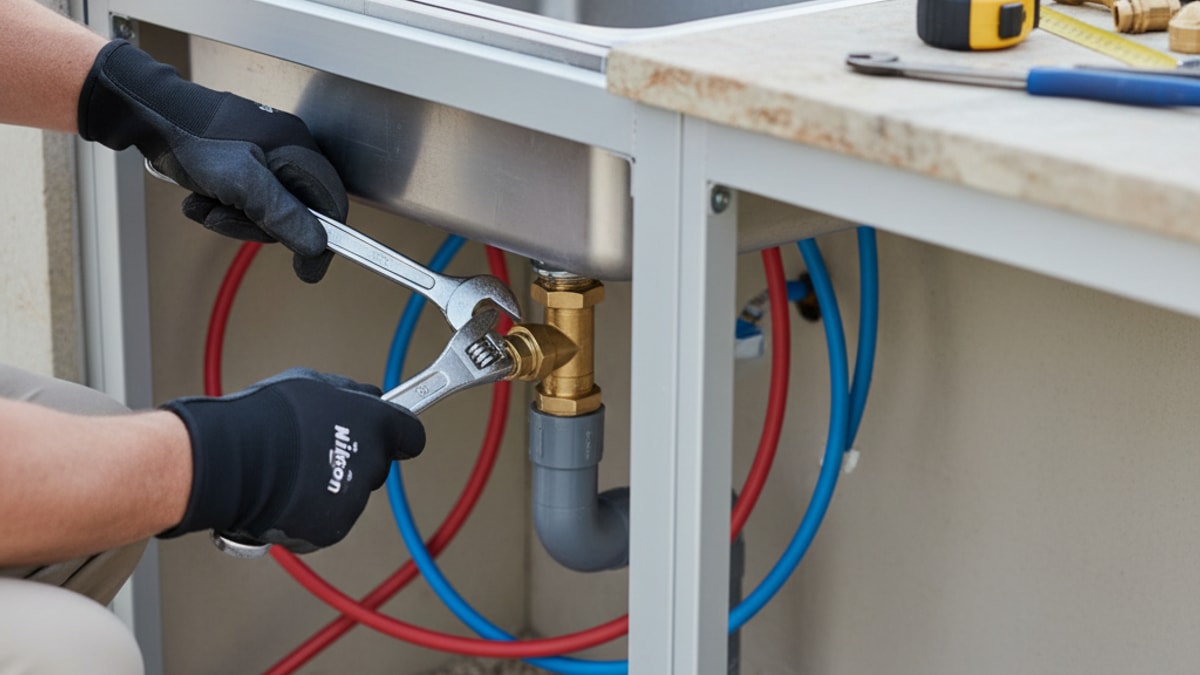
This is where things get more complex, and where we see the most DIY mistakes. An outdoor sink drain needs to function just like an indoor one, which means it requires a P-trap and proper venting to prevent sewer gases from escaping and to ensure smooth draining. You can’t just have the water dump out onto the ground or into a flower bed. That creates a soggy, smelly, bacteria-filled mess.
The gold standard is to connect the drain directly to your home's main sewer or septic system. This involves running a sloped drainpipe from the sink back to the house and tying it into an existing cleanout or drain line. The critical part here is the slope. Drain lines rely on gravity, and you need a consistent downward slope—typically a quarter-inch of drop for every foot of run—to keep waste flowing properly. Too little slope, and solids will settle and cause clogs. Too much, and the liquids will outrun the solids, with the same result. Getting this right is an art and a science.
What if tying into the main sewer line isn't feasible due to distance or obstacles? In some cases, a dry well or a French drain can be an option for gray water from a sink, but you must check if your local codes permit this. A dry well is essentially a large, buried pit filled with gravel that allows water to slowly percolate into the surrounding soil. It's not a solution for heavy waste and is definitely not suitable if you plan on having a garbage disposal. Our experience shows that a direct connection to the sewer is almost always the more reliable, long-term solution. It's the approach we take in our integrated projects, ensuring the entire system, from the Pavers SAN Diego patio it's built on to the plumbing within, is built to last.
Pipe Materials for Outdoor Water Lines
Choosing the right material for your water supply lines is a crucial decision that impacts longevity, cost, and ease of installation. Here’s a breakdown of the most common options our team works with:
Feature
PEX (Cross-Linked Polyethylene)
Copper
PVC (Polyvinyl Chloride)
Durability
Excellent. Resists corrosion and scale buildup. High flexibility prevents bursting from freezing.
Very Good. Extremely durable and long-lasting, but can corrode with acidic water.
Fair. Can become brittle over time with sun exposure and is susceptible to cracking if frozen.
Cost
Moderate. Less expensive than copper, but more than PVC. Fittings can add to the cost.
High. The most expensive option for both pipe and fittings.
Difficult. Requires soldering (sweating) joints, which demands skill and specialized tools.
Easy. Simple to cut and joins with solvent glue (primer and cement).
Freeze Resistance
Best. Can expand significantly without bursting, making it ideal for cold climates.
Poor. Rigid pipe will split or burst when water inside it freezes solid.
Poor. Very brittle in cold temperatures and will crack easily if frozen.
Primary Use
Hot & Cold Water Supply
Hot & Cold Water Supply
Cold Water Supply Only (Irrigation)
Our professional recommendation? For outdoor kitchens, PEX tubing is almost always the superior choice. Its flexibility and remarkable resistance to freeze damage provide a level of security and ease of installation that copper and PVC simply can't match for this specific application.
Naples Outdoor Kitchen FL
This video provides valuable insights into how to plumb an outdoor kitchen, covering key concepts and practical tips that complement the information in this guide. The visual demonstration helps clarify complex topics and gives you a real-world perspective on implementation.
Fueling the Fire: Gas Line Installation
Now, this is where it gets serious. While a mistake with a water line might lead to a leak and a muddy yard, a mistake with a gas line can have truly catastrophic consequences. For this reason, we are unflinching in our recommendation: unless you are a licensed and experienced professional, you should hire one for any natural gas or propane line installation.
The first decision is your fuel source. Will you be using portable propane tanks or connecting to your home's natural gas supply? Propane tanks offer simplicity but require monitoring and refilling. A direct natural gas line offers endless fuel on demand. It’s the ultimate convenience for a high-end outdoor kitchen featuring a large grill, side burners, and maybe even gas-powered Fire Features.
If you opt for natural gas, the process is similar to running water lines but with much stricter rules. You’ll need to tap into your home's existing gas meter or main line. A crucial calculation must be made to size the new line correctly. The pipe has to be large enough to supply adequate volume (measured in BTUs) to all of your outdoor appliances running simultaneously without starving your indoor appliances like your furnace or water heater. Undersizing the line is a very common error that leads to poor performance—a grill that just won't get hot enough is a frustrating experience.
The most common material for underground gas lines is black iron pipe or specialized polyethylene (PE) tubing. All underground metal pipes must be properly coated or sleeved to prevent corrosion. Once the line is run, it must be pressure tested. This involves filling the line with compressed air to a specific PSI, shutting it off, and letting it sit for a designated period (as required by code) to ensure there are absolutely no leaks, no matter how small. Every connection, every valve, must be perfect.
And speaking of valves, safety shut-offs are non-negotiable. There should be an accessible shut-off valve located near the appliances themselves, allowing you to quickly turn off the gas in an emergency. This is in addition to the valve at the main tap-in point. This level of detail is why professional oversight is so important for a safe and functional system.
Putting It All Together: The Installation Process
With a solid plan in hand, the actual installation becomes a methodical process of execution. It starts with carefully marking your trench paths based on your design and the utility locate markings. Renting a trencher is often a wise move, as it makes quick work of what would be days of back-breaking digging.
Once the trenches are dug to the proper depth and the bottoms are prepared with a layer of sand (to protect the pipes), you can begin laying your lines. It’s wise to run all your utilities—water, drain, gas, and any electrical conduit for Landscape Lighting SAN Diego—in the same trench where possible, ensuring they are properly spaced according to code. This minimizes disruption to your yard.
After the pipes are laid, connected, and—most importantly—pressure tested, the inspection can happen. A building inspector will verify that the depth, materials, and connections all meet local requirements. Only after the inspection is passed should you backfill the trenches. We recommend taking detailed photos and measurements of your utility lines before burying them. This creates a permanent record of their location for any future projects.
Finally, the stub-outs for water, drain, and gas are brought up through the patio or island foundation. This is a moment of truth, where the accuracy of your initial planning pays off. The pipes should emerge exactly where your design specifies, ready for the final connection of sinks, faucets, and grills. It's an incredibly satisfying milestone in the construction of your dream outdoor space.
Winterization and Maintenance: Protecting Your Investment
Your outdoor kitchen plumbing is a system that needs seasonal attention to prevent damage, especially from freezing temperatures. Proper winterization is the key to ensuring it works perfectly year after year.
The process is straightforward but must be done thoroughly. First, you shut off the dedicated water valve inside your home. Then, open the outdoor faucets to let all the water drain out. To ensure every last drop is removed, we use an air compressor to blow out the lines. By connecting the compressor to the drain valve, you can force compressed air through the pipes, pushing any remaining water out through the open faucets. This eliminates the risk of water freezing, expanding, and bursting a pipe.
Don't forget the drain lines. Pour a bit of RV-specific (non-toxic) antifreeze down the sink drain to protect the P-trap from freezing and cracking. Disconnect any hoses, and store them indoors. For your gas line, there's typically no winterization needed, but it’s a good time to inspect the shut-off valves to ensure they operate smoothly. This simple annual routine is the best insurance policy you can have for your outdoor plumbing investment.
Common Mistakes We See (And How to Avoid Them)
Over the years, our team has been called in to troubleshoot and repair many outdoor plumbing jobs that have gone wrong. Most of these issues stem from a few common, avoidable mistakes. Here's what we've learned to watch out for:
Ignoring Local Codes: This is the cardinal sin. Homeowners often assume outdoor work is less regulated, but plumbing and gas codes are there for safety and functionality. Failing to get a permit or follow the rules leads to failed inspections and costly rework.
Improper Drain Slope: We see this all the time. A drain line that is too flat or, worse, runs slightly uphill, will never work correctly. It will constantly clog and create foul odors. A quarter-inch per foot slope is the magic number.
Forgetting to Install Shut-Offs: Not having an interior shut-off valve for your water lines is a massive oversight. It turns a simple faucet repair into a major plumbing job that requires shutting off water to the entire house.
Undersizing Gas Lines: A homeowner buys a massive 80,000 BTU grill and connects it to a half-inch gas line that was sized for a small fire pit. The result is a weak flame and a disappointing cooking experience. Always calculate the total BTU load and size the pipe accordingly.
No Plan for Winter: People in warmer climates sometimes think they can skip winterization. But an unexpected cold snap can be all it takes to freeze and burst an unprotected pipe, leading to a significant leak and water damage. Every system needs a winterization plan.
Avoiding these pitfalls comes down to the same thing we started with: planning. A thoughtful design, a clear understanding of the requirements, and a commitment to doing it right the first time are what separate a successful project from a frustrating failure. It's about seeing the project holistically, where the plumbing is just one part of a larger system that includes the patio, the Patio Covers Pergolas SAN Diego, and the overall landscape.
Bringing a functional kitchen into your backyard is a transformative project. It fundamentally changes how you use and enjoy your outdoor space. While the plumbing is a complex and technical part of that transformation, it’s entirely achievable with the right knowledge and approach. Whether you take on parts of it yourself or bring in professionals to handle the entire scope, understanding the principles behind it empowers you to make smart decisions. A well-plumbed outdoor kitchen isn't just a convenience; it's the engine of countless future gatherings and a lasting investment in your home. If you're ready to explore what's possible for your own backyard, our team is here to help you design a space that's both beautiful and brilliantly functional. Why not BOOK MY FREE CONSULTATION today and let's start planning?
Frequently Asked Questions. Here are some common questions. Find the answers you're looking for below.
Can I just use a garden hose for my outdoor sink?
We strongly advise against it. Garden hoses aren't rated for potable (drinking) water and can leach harmful chemicals. A permanent installation with PEX or copper ensures you have safe, clean water for cooking and drinking.
How deep do I need to bury water and gas lines?
This is dictated by your local building codes and frost line. Generally, water lines are buried 18-24 inches deep, while gas lines often require 18 inches of cover. Always confirm the specific requirements in your area before digging.
Does my outdoor sink drain need a vent?
Yes, absolutely. Just like an indoor sink, an outdoor drain needs a vent to allow air into the pipe. This prevents a vacuum from forming and ensures water drains quickly and smoothly while also stopping sewer gases from escaping through the drain.
Is PEX or copper better for outdoor plumbing?
Our team almost always recommends PEX for outdoor water lines. It's more flexible, easier to install, and its ability to expand makes it far more resistant to bursting if it freezes, which is a critical advantage over rigid copper.
What's the biggest risk with DIY gas line installation?
The biggest risk is, without a doubt, a gas leak. An improperly sealed connection can leak flammable gas, creating a severe fire or explosion hazard. This is why we insist that gas line work should be handled by a licensed professional.
Do I really need a hot water line, or is cold enough?
While you can function with only a cold line, having hot water makes a huge difference. It's essential for properly washing hands, cleaning greasy grilling tools, and rinsing dishes, making your outdoor kitchen truly as functional as your indoor one.
Does my outdoor sink need a garbage disposal?
It's a matter of preference, but we generally advise against it. Food waste can easily lead to clogs in long underground drain lines and attract pests. It also puts a greater strain on your drainage system, especially if you're using a dry well.
What is a backflow preventer and do I need one for my outdoor faucet?
A backflow preventer is a device that ensures non-potable water from a hose or other source can't be siphoned back into your home's clean water supply. Most modern outdoor faucets (hose bibbs) have them built-in, and they are typically required by code.
How do I find my home's existing utility lines before I dig?
The safest and only correct way is to call 811 (the national "call before you dig" number) a few days before you plan to excavate. They will coordinate with local utility companies to come out and mark the approximate location of their buried lines on your property for free.
Can I run plumbing lines under a new paver patio?
Yes, you can and should. It's best to lay the plumbing lines in trenches before you install the patio base. We recommend running the pipes inside a larger PVC sleeve, which makes it possible to replace a line in the future without having to tear up your beautiful patio.
Is it better to connect to my sewer line or use a dry well?
Connecting directly to your home's sewer system is always the superior and most reliable option. A dry well is only suitable for small amounts of gray water and may not even be permitted by your local codes. A sewer connection handles waste effortlessly and permanently.



.webp)
.webp)