Metal Stud Gauge for Outdoor Kitchens: The Expert Breakdown
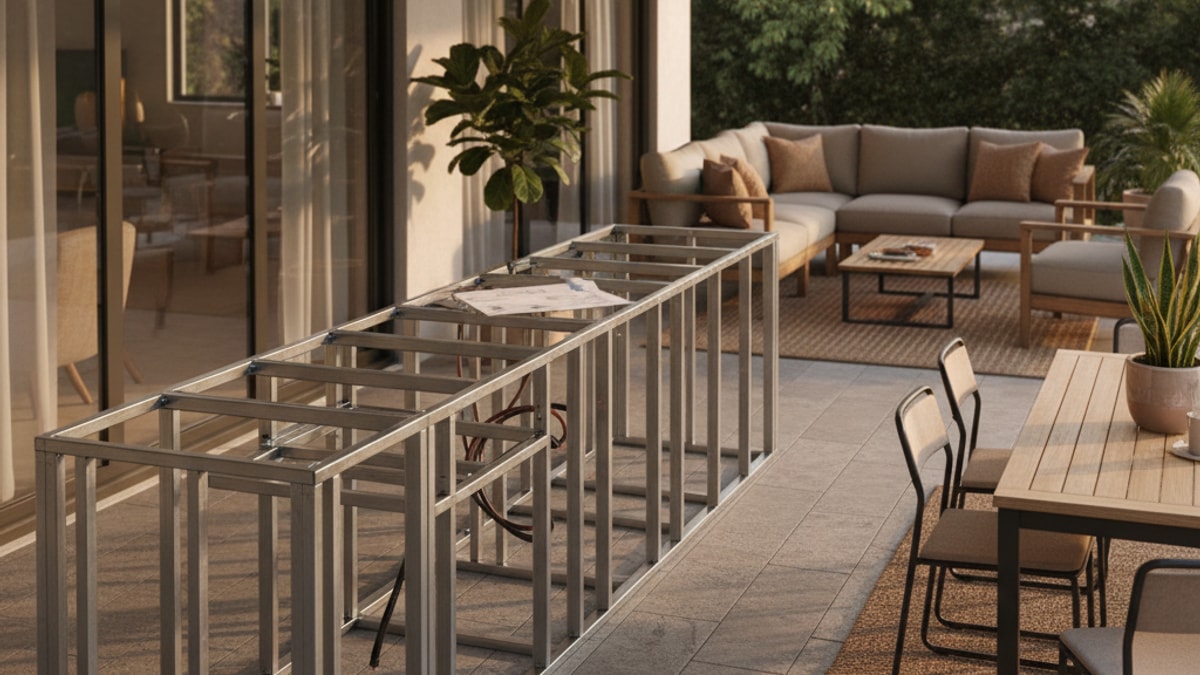
So, you're building an outdoor kitchen. You've probably spent countless hours dreaming about the grill, the countertop finish, maybe even a built-in pizza oven or a sleek beverage fridge. We get it. That's the exciting part. But before you get to the sizzle, we need to talk about the steak—the unseen, unflinching structure that holds it all together. The frame. And when it comes to framing an outdoor kitchen, one question stands above all others: what gauge metal studs should you use?
This isn't a trivial detail you can gloss over. The answer dictates the longevity, safety, and durability of your entire investment. Choose wrong, and you could be looking at catastrophic sagging, cracked veneers, and a structure that simply can't withstand the elements or the weight of your beautiful granite countertops. Our team has seen the unfortunate aftermath of poor framing choices, and frankly, it's a heartbreaking and expensive fix. We're here to make sure that doesn't happen to you.
Why Metal Studs Are the Unquestionable Choice for Outdoor Kitchens
Let's clear this up right away. For any outdoor construction, especially a kitchen that will be exposed to moisture, heat, and temperature swings, wood framing is a non-starter. It might seem cheaper or more familiar upfront, but we can't stress this enough: it's a recipe for disaster.
Wood rots. It swells and contracts with humidity, which can crack your stucco or stone veneer finishes over time. It's a five-star buffet for termites and other pests. And, of course, it's combustible—not exactly what you want surrounding a high-temperature grill. It’s a classic case of short-term savings leading to long-term regret.
Steel, on the other hand, is the undisputed champion for this application. Specifically, cold-formed galvanized steel studs offer a formidable list of advantages:
Impervious to Moisture and Rot: Galvanized steel will not absorb water, swell, or decay. Period.
Termite-Proof: Pests can't eat steel. This eliminates a massive potential headache right from the start.
Fire-Resistant: Steel is non-combustible, providing a critical layer of safety for a structure that literally houses fire.
Dimensionally Stable: Steel studs are manufactured to precise specifications. They are perfectly straight and won't warp, twist, or bow over time, ensuring your countertops stay level and your finishes remain intact.
Honestly, the debate is over before it even begins. For a lasting, low-maintenance structure, steel is the only professional choice.
Understanding Metal Stud Gauges: It's Simpler Than You Think
Okay, so we've established steel is the way to go. Now, let's demystify the term 'gauge.' It's a measurement of the thickness of the steel, but it works in reverse. This is the key takeaway.
A lower gauge number means thicker, stronger, and heavier steel. A higher gauge number means thinner, lighter, and more flexible steel.
Think of it like this: 16-gauge steel is a heavyweight champion, while 25-gauge is a lightweight contender. For building the structural frame of an outdoor kitchen, you need a stud with some serious muscle. Using a flimsy, high-gauge stud is like building a house on a foundation of cardboard. It just won't hold up.
The Critical Question: What Gauge Do We Recommend?
Here's the direct answer you came for. Our team's baseline, go-to recommendation for the vast majority of residential outdoor kitchen projects is 20-gauge structural steel studs.
Simple, right?
20-gauge hits the perfect sweet spot. It provides ample structural integrity to support heavy cement board, stone veneers, and most standard countertop materials like granite or quartz. It's robust enough to handle the weight of drop-in grills, sinks, and other common appliances without any deflection or sagging. It's also reasonably easy to work with—it can be cut with the right tools and is manageable for our construction crews.
For probably 80% of the Outdoor Kitchens SAN Diego projects we design and build, 20-gauge is the impeccable choice. It provides a rock-solid skeleton that ensures the finished product is not just beautiful on day one, but remains structurally sound for decades to come. We've found that this standard provides the necessary peace of mind without over-engineering (and over-spending) where it isn't necessary.
Metal Stud Framing, Drywall, Taping & T-Bar
This video provides valuable insights into What Gauge Metal Studs for an Outdoor Kitchen, covering key concepts and practical tips that complement the information in this guide. The visual demonstration helps clarify complex topics and gives you a real-world perspective on implementation.
When Thicker is Absolutely Better: Scenarios for Heavier Gauges
While 20-gauge is our trusted workhorse, there are specific situations where we absolutely insist on stepping up to a heavier gauge, like 18-gauge or even 16-gauge. These aren't judgment calls; they're engineering necessities based on the specific demands of the project. This is where professional experience becomes non-negotiable.
Here are the primary scenarios that demand a thicker, lower-gauge stud:
Exceptionally Heavy Countertops: Are you planning on a thick, monolithic slab of poured concrete for your countertop? Or perhaps an extra-thick 4-inch mitered edge on a massive granite island? This significant, concentrated weight requires a beefier frame. We'd immediately specify 18-gauge, or potentially 16-gauge for the horizontal supports, to prevent any possibility of long-term sagging.
Large Spans and Openings: If your design includes long, unsupported spans—say, for a bar-top overhang where people will be leaning—you need a more rigid frame. A 20-gauge stud might flex slightly over a long distance, but an 18-gauge stud will provide the unflinching rigidity needed to keep that bar top perfectly level and secure.
Mounting Heavy or Unique Appliances: Is a massive Argentinian-style wood-fired grill part of your vision? Or perhaps a heavy-duty commercial-grade power burner? These appliances can be substantially heavier than standard drop-in units. The sections of the frame supporting these beasts need to be reinforced, and moving to an 18-gauge stud is a smart, proactive measure.
Multi-Level Structures or Pergola Supports: If the outdoor kitchen frame is also intended to support a secondary structure, like one of the posts for our custom Patio Covers Pergolas SAN Diego, then the load calculations change dramatically. This is a situation for 16-gauge steel, without question. You are no longer just supporting countertops; you're supporting an entire overhead structure.
Let's Talk About Lighter Gauges: The 25-Gauge Trap
Now, this is where it gets interesting, and where we see a lot of DIY projects or less-experienced builders make a critical mistake. You'll find 25-gauge (sometimes called 'drywall studs' or 'interior studs') readily available at big-box hardware stores. It's cheap. It's lightweight and easy to cut. And it is absolutely, unequivocally the wrong choice for framing your outdoor kitchen.
We call it the 25-gauge trap.
25-gauge steel is designed for non-structural interior walls. Its job is to hold up drywall, and that's it. It has very little compressive strength and is notoriously flexible. Using it for an outdoor kitchen frame is asking for trouble. The weight of the cement board, the stone veneer, and the countertop will cause it to bow and flex. Over time, this movement will translate into hairline cracks in your grout and stucco, and in a worst-case scenario, a complete structural failure.
Let's be honest, saving a couple of hundred dollars on framing materials only to risk the integrity of a multi-thousand-dollar project is a terrible trade-off. Our philosophy is simple: the foundation has to be perfect. The frame is the foundation of your kitchen island. We exclusively use structural-rated studs (20-gauge or thicker) because it's the only way to guarantee a lifetime of performance.
Gauge Comparison: A Quick Reference Chart
To make this even clearer, our team put together a straightforward comparison chart. This should help you visualize the differences and understand why we make the recommendations we do.
Gauge
Thickness (Approx.)
Common Use Case
Load-Bearing Capacity
Our Takeaway
25
0.018"
Interior, non-structural walls (drywall)
Very Low
Avoid at all costs for outdoor kitchens. Flimsy and unsafe for this application.
20
0.033"
Structural framing, exterior walls, floor joists
Good
The professional standard. Ideal for most residential outdoor kitchen projects.
18
0.043"
Heavy load-bearing walls, high-stress areas
High
Upgrade for heavy tops or long spans. Provides extra rigidity and peace of mind.
For extreme loads. Necessary when the frame supports overhead structures or massive appliances.
Beyond the Gauge: Other Crucial Framing Considerations
Choosing the right gauge is the biggest piece of the puzzle, but it's not the only piece. A professional build considers every detail of the framing process to ensure a bulletproof result. It's this attention to detail that separates a good result from a great one.
Here are a few other elements our team obsesses over:
Stud & Track Spacing: The standard for framing is 16 inches 'on center.' This means the center of one vertical stud is 16 inches away from the center of the next. This spacing provides the right balance of support for the cement board sheathing, preventing it from flexing or cracking between studs. We never go wider than this.
Galvanization Level (G60 vs. G90): Galvanization is the zinc coating that protects the steel from rust. You'll see ratings like G40, G60, and G90. The number refers to the amount of zinc coating. While G60 is common, our preference, especially for coastal environments, is G90. It offers about 50% more protection and provides maximum corrosion resistance for a longer lifespan. It's a small upgrade that pays huge dividends in longevity.
Screw Selection: You can't just use any screw. Drywall screws are a definite no—they will rust out in a matter of months. We use specific self-tapping steel framing screws that are coated for exterior use. These screws are designed to pierce the steel and create a secure mechanical bond that won't loosen or corrode over time.
Proper Bracing: For larger islands or L-shaped kitchens, proper cross-bracing and the use of gussets in the corners is critical. This prevents the frame from racking (shifting out of square) and adds immense rigidity to the overall structure. It's a step that's often skipped in rushed jobs but is vital for a stable frame.
Don't Forget the Sheathing: The Armor for Your Frame
Once your beautiful, robust steel frame is complete, the next step is to give it its armor. This is another area where there is no room for compromise. You must use a cement-based backer board. Products like HardieBacker, Durock, or PermaBase are designed for this. They are dimensionally stable, waterproof, and provide a perfect substrate for your chosen finish, whether it's stone veneer, stucco, or tile.
Never, ever use drywall, green board, or any kind of wood-based sheathing like OSB or plywood. They will absorb moisture, swell, and disintegrate, taking your expensive finish along with them. The cement board is screwed directly to your steel studs, creating a solid, monolithic shell that's ready for the final touches. This integrated system, from the Concrete SAN Diego footings to the steel frame to the cement board, is what creates a truly permanent structure.
The Modern Yardz Approach to a Bulletproof Structure
When we undertake a project, we're not just building for today. We're building a space for a lifetime of memories. That's why we don't compromise on the fundamentals. The frame of your outdoor kitchen is the most important fundamental there is.
Our process is built on this principle. We start with a comprehensive Landscape Design SAN Diego plan that considers not just aesthetics, but the underlying engineering. We select the appropriate gauge steel for the specific loads of your project. We ensure every connection is secure, every corner is square, and every surface is ready for the stunning finishes that bring your vision to life. The frame is the unseen hero that makes everything else possible, from the perfectly laid Pavers SAN Diego at its base to the ambient glow from the integrated Landscape Lighting SAN Diego.
It might seem like a lot to consider. And it is. Getting the structure right is a blend of science, engineering, and hands-on experience. If you're feeling like the details are a bit much, that's perfectly normal. That's precisely why we're here. Let our team handle the technicalities so you can focus on the fun stuff. Feel free to BOOK MY FREE CONSULTATION and we can walk you through the entire process, from foundation to first cookout.
Ultimately, the gauge of the metal stud you choose is a direct reflection of the quality you demand. It's a decision that happens early in the process but has consequences that last for years. By choosing the right materials and the right team, you're not just building an outdoor kitchen; you're making a permanent addition to your home and lifestyle, a place where countless great meals and moments will happen. And that's an investment worth protecting from the ground up.
Frequently Asked Questions. Here are some common questions. Find the answers you're looking for below.
Can I use wood studs for my outdoor kitchen frame to save money?
We strongly advise against it. Wood is susceptible to rot, moisture damage, and termites, and it's combustible. Using steel studs is the only way to ensure a safe, durable, and long-lasting structure for an outdoor environment.
Is 25-gauge steel ever acceptable for an outdoor kitchen?
No, never for the structural frame. 25-gauge steel is a non-structural stud designed for interior drywall partitions. It lacks the strength to support countertops, appliances, and exterior finishes, leading to flexing and potential failure.
What is the standard spacing for metal studs in an outdoor kitchen?
The industry standard, and what our team always uses, is 16 inches on center. This spacing provides optimal support for the cement backer board and prevents any sagging or cracking of your exterior finish materials.
Do I need to use a special type of screw for steel framing?
Yes, absolutely. You must use self-tapping steel framing screws that are coated for exterior use. Standard drywall screws will corrode and fail quickly in an outdoor setting, compromising the entire frame.
When should I upgrade from 20-gauge to 18-gauge steel studs?
You should upgrade to 18-gauge (or thicker) steel if your design includes very heavy countertops like poured concrete, long unsupported spans for a bar, or if you're mounting exceptionally heavy appliances. It provides extra rigidity where it's needed most.
What is G90 galvanization and is it necessary?
G90 refers to a thicker zinc coating on the steel, offering superior rust and corrosion protection compared to the more common G60 standard. While not always strictly necessary, we highly recommend it, especially for coastal or very humid climates, to maximize the frame's lifespan.
What material should I use to cover the steel frame?
You must use a cement-based backer board, such as HardieBacker or Durock. This material is waterproof, stable, and provides the ideal substrate for applying stone, stucco, tile, or other masonry finishes. Never use drywall or wood sheathing.
How do you cut metal studs?
Our professional crews use several tools depending on the situation. A compound miter saw with a metal-cutting abrasive blade provides clean, square cuts. For smaller adjustments or on-site cuts, we may use circular saws with metal-cutting blades or aviation snips for lighter gauges.
Can a steel frame support a heavy pizza oven?
Yes, but it must be engineered correctly. A heavy pizza oven would require a frame built with 18-gauge or even 16-gauge steel, with additional vertical supports and bracing directly under the oven's footprint to handle the concentrated load safely.
Does a metal-framed outdoor kitchen need a concrete footing?
Yes, every permanent outdoor structure should be built on a proper concrete footing or slab. This provides a stable, level base and prevents the structure from shifting or settling over time due to ground movement or frost heave.
How much more expensive is 18-gauge than 20-gauge steel?
The material cost for 18-gauge studs is moderately higher than 20-gauge, but it's not a dramatic increase. When viewed as a percentage of the total project cost, the price difference for the material is a very small, worthwhile investment for the added strength and peace of mind.
Will the steel frame get hot from the grill?
The frame itself won't become dangerously hot if the grill is installed correctly using an insulated jacket, which is required by nearly all grill manufacturers for combustible enclosures. The jacket creates an air gap and a heat shield, protecting the surrounding structure, including the studs.



.webp)
.webp)