There’s a certain magic to cooking outdoors. The sizzle of a grill, the aroma filling the air, the joy of gathering friends and family in a space you’ve lovingly created—it’s an experience that’s hard to beat. As we design and build these incredible outdoor living areas, we see the excitement build with every paver laid and every appliance installed. But amidst the enthusiasm for choosing the perfect grill and countertop, there's a question our team gets asked constantly: do you need a hood for an outdoor kitchen?
It seems like a simple question, but the answer is surprisingly nuanced. It’s not just about smoke. It’s about safety, the longevity of your beautiful new space, and the overall enjoyment you'll get from your investment. Let's be honest, getting this wrong can have some pretty messy—and sometimes dangerous—consequences. We've seen it happen. So, drawing from our years of experience designing and constructing comprehensive outdoor environments, we're going to break it down for you, once and for all.
The Real Answer (and Why It’s Not So Simple)
So, do you need one? The short, professional answer is: it depends, but probably. We know, that’s not the straightforward 'yes' or 'no' you were hoping for. But the reality is, the necessity of a vent hood hinges on a few critical factors that are unique to your specific setup. It's a decision that moves from a 'nice-to-have' to a 'non-negotiable' based almost entirely on one thing: an overhead structure.
If your outdoor kitchen is situated under any kind of roof—be it a solid patio cover, a slatted pergola, a gazebo, or even the eaves of your home—then the answer shifts dramatically to an emphatic 'yes'. In these scenarios, a hood isn't just a luxury; it's a critical component for safety and preservation. For a completely open-air kitchen, far from the walls of your house with nothing above it but sky? You might be able to get away without one. But even then, there are compelling reasons to consider it. We've found that the decision ultimately comes down to protecting your investment, ensuring your family's safety, and creating a more pleasant cooking environment. It's a crucial part of the holistic Landscape Design SAN Diego process that considers how you'll actually live in the space.
When a Vent Hood Becomes Absolutely Essential
Let’s get into the specifics. There are several common scenarios we encounter where our team will always insist that a high-quality, outdoor-rated vent hood is a fundamental requirement. We can't stress this enough: skipping it in these situations is asking for trouble.
First and foremost is the presence of any overhead structure. This is the big one. When you build one of our custom Patio Covers Pergolas SAN Diego, you’re creating a defined outdoor room. It’s fantastic for shade and ambiance, but it also traps heat, smoke, and grease. Without a hood to actively capture and vent these byproducts, you're essentially creating a smokehouse right in your backyard. That beautiful tongue-and-groove cedar ceiling? It will become a sticky, discolored mess in short order. The smoke and airborne grease particles have nowhere to go but up, where they will condense and coat every single surface. It’s not a matter of 'if,' but 'when.'
Another critical factor is proximity to your home. Is your grill station built directly against an exterior wall? Even without a roof, the heat and smoke will billow up and stain your stucco, siding, or brick. We've seen beautiful homes permanently marred by dark, greasy plumes. Worse yet, if there are windows or doors nearby, that smoke can easily find its way inside, setting off smoke alarms and leaving a lingering, unpleasant odor throughout your house. A proper hood captures that exhaust at the source and directs it away, protecting your home's exterior and interior air quality.
The power of your grill also plays a massive role. The trend in Outdoor Kitchens SAN Diego has moved toward incredibly powerful, professional-grade appliances. We’re talking high-BTU grills, infrared sear stations, and side burners that rival indoor commercial ranges. These culinary workhorses produce a formidable amount of heat, smoke, and aerosolized grease. A standard grill might produce a manageable amount of smoke in an open area, but a high-performance grill creates a relentless, billowing output that absolutely must be managed, especially in a semi-enclosed space.
Finally, and this is a point that many homeowners overlook, there are building codes. In many municipalities, installing a cooking appliance under a combustible structure (like a wood patio cover) legally requires a vent hood that meets specific safety standards. It's not just a good idea; it's the law. Part of our job is to navigate these regulations to ensure your project is not only beautiful but also fully compliant and, above all, safe.
The Unseen Dangers of Poor Ventilation
Most people think a vent hood is just about managing smoke. That's part of it, for sure. But the real risks of forgoing proper ventilation are far more serious and insidious. Our experience shows the problems go much deeper.
Let's talk about fire. This is not hyperbole. When you cook, especially greasy foods like burgers or steaks, tiny particles of grease become airborne. Without a hood, these particles settle on the surfaces above and around your grill. They coat the ceiling of your patio cover, the rafters, the light fixtures. Over time, this builds into a highly flammable layer. All it takes is one significant flare-up from your grill to ignite that grease buildup, leading to a catastrophic fire that can spread to your home in seconds. A vent hood contains powerful baffle filters designed specifically to trap this grease before it can accumulate, dramatically reducing your fire risk.
Then there's the silent threat: carbon monoxide (CO). Grills, particularly gas and charcoal models, produce carbon monoxide as a byproduct of combustion. In a wide-open space, this isn't an issue as it dissipates harmlessly. But under a roof or in a space with walls on two or three sides, CO can accumulate to dangerous levels. It’s colorless and odorless, making it impossible to detect without a monitor. Proper ventilation is critical for pulling these harmful gases up and away from the breathing space of you and your guests.
Beyond the immediate safety hazards, there’s the slow, steady damage to your beautiful outdoor oasis. That gorgeous travertine countertop? It can become sticky and discolored. The custom stonework on your kitchen island? It will develop a grimy film that’s nearly impossible to clean. The expensive outdoor furniture you picked out? The cushions will absorb the smoky smell. A vent hood is an investment in protecting all the other investments you've made in your outdoor living space. It keeps things clean, pristine, and enjoyable for the long haul.
Are There Times You Can Safely Skip the Hood?
Yes, there are. We believe in providing honest, practical advice, and it's not always a one-size-fits-all solution. There are specific circumstances where a vent hood might be an unnecessary expense.
The primary scenario is a truly open-air kitchen. We’re talking about an island setup in the middle of a large patio, with no walls nearby and absolutely no overhead cover. Think of it as being more like a standalone grill on a deck. In this case, the smoke and heat have ample room to dissipate naturally into the atmosphere. Prevailing winds will usually carry the smoke away from your seating and dining areas, though this is never a guarantee.
This exception also typically applies to those using a more standard, lower-BTU grill. If you’re not working with a commercial-style flamethrower and your kitchen is fully exposed to the elements, the volume of smoke and grease is significantly lower and more manageable by mother nature. However, if you plan to do a lot of searing or cooking of fatty foods, you may still find that the smoke becomes a nuisance to your guests, even in an open area. It really comes down to how you plan to use the space. The moment you decide to add a structure for shade or rain protection, the equation changes completely, and a hood should be moved to the top of your list.
Hoods vs. Alternatives: A Professional Comparison
When considering ventilation, it's crucial to understand your options. A dedicated, outdoor-rated range hood is the gold standard, but it's helpful to see how it stacks up against other ideas people sometimes propose. Our team has seen various attempts at workarounds, and here’s our unflinching take on what works and what doesn't.
| Ventilation Solution |
Pros |
Cons |
Our Team's Take |
| Wall-Mount Hood |
Highly effective at capturing smoke, directs exhaust up and out, generally more affordable than island models. |
Requires the outdoor kitchen to be designed against a structural wall. |
This is the most common and effective solution. For any kitchen built against the home or a seating wall, it's the undisputed champion. |
| Island Hood |
Provides powerful ventilation for freestanding kitchen islands where a wall mount isn't possible. |
More complex and costly installation, can potentially obstruct sightlines across the yard. |
Absolutely necessary for covered island kitchens. The design must be carefully integrated to feel intentional, not like an afterthought. |
| Downdraft System |
Retracts out of sight when not in use, preserving a minimalist aesthetic and open views. |
Far less effective at capturing rising smoke and grease, struggles with high-heat grilling, can be clogged by debris. |
Honestly, we rarely recommend these for outdoor use. The physics of rising heat and smoke work against them, making them inadequate for most serious grills. |
| No Ventilation |
Lowest initial cost, simplest design for open-air spaces. |
Extreme fire hazard in covered areas, causes property damage from grease and smoke, potential health risks from CO. |
This is only a viable option for a fully open-air kitchen located a safe distance from any structure. It is never an option for a covered space. Period. |
Picking the Right Hood: What Our Designers Look For
If you've determined a hood is right for you, the next step is choosing the correct one. This isn't like buying an indoor hood; the demands of an outdoor environment are far more formidable. When we specify a hood for a project, we focus on a few key metrics to ensure it performs flawlessly for years.
First is power, measured in CFM (Cubic Feet per Minute). This rating tells you how much air the hood can move. Because outdoor spaces have cross-breezes and a lack of containing walls, outdoor hoods need to be significantly more powerful than their indoor counterparts. We typically look for a minimum of 1200 CFM, and often recommend even higher for larger grills or for clients who do a lot of high-heat cooking. An underpowered hood is almost as bad as no hood at all.
Next, we consider the size and capture area. A common mistake is buying a hood that's the same width as the grill. The laws of physics dictate that smoke and steam expand as they rise. To be effective, a vent hood must be larger than the cooking surface below it—ideally, extending three to six inches on each side. This creates a proper capture canopy that ensures the majority of the exhaust is drawn into the ventilation system.
Material is another non-negotiable for us. The hood will be exposed to rain, humidity, and temperature swings. It must be built to withstand the elements without rusting or corroding. We insist on high-quality 304-grade stainless steel as a minimum. For coastal areas with salt in the air, 316-grade (marine-grade) stainless steel is an even better choice for its superior corrosion resistance. It’s a small detail that makes a huge difference in the product's lifespan.
Finally, we look at the integrated features that enhance the user experience. Bright, built-in halogen or LED lighting is a must-have for evening grilling. It becomes a key element of the overall Landscape Lighting SAN Diego scheme, ensuring your cooking area is safe and functional after dark. Variable fan speeds and easy-to-clean baffle filters are also critical features that separate a great outdoor hood from a mediocre one.
The Modern Yardz Way: Seamless and Safe by Design
For us, an outdoor kitchen is more than just a collection of appliances; it's a fully integrated component of your outdoor living environment. That means ventilation is never an afterthought. It's a foundational piece of the puzzle that we solve during the initial design phase. We consider the airflow, the placement of seating areas, and the relationship between the kitchen and the home from day one.
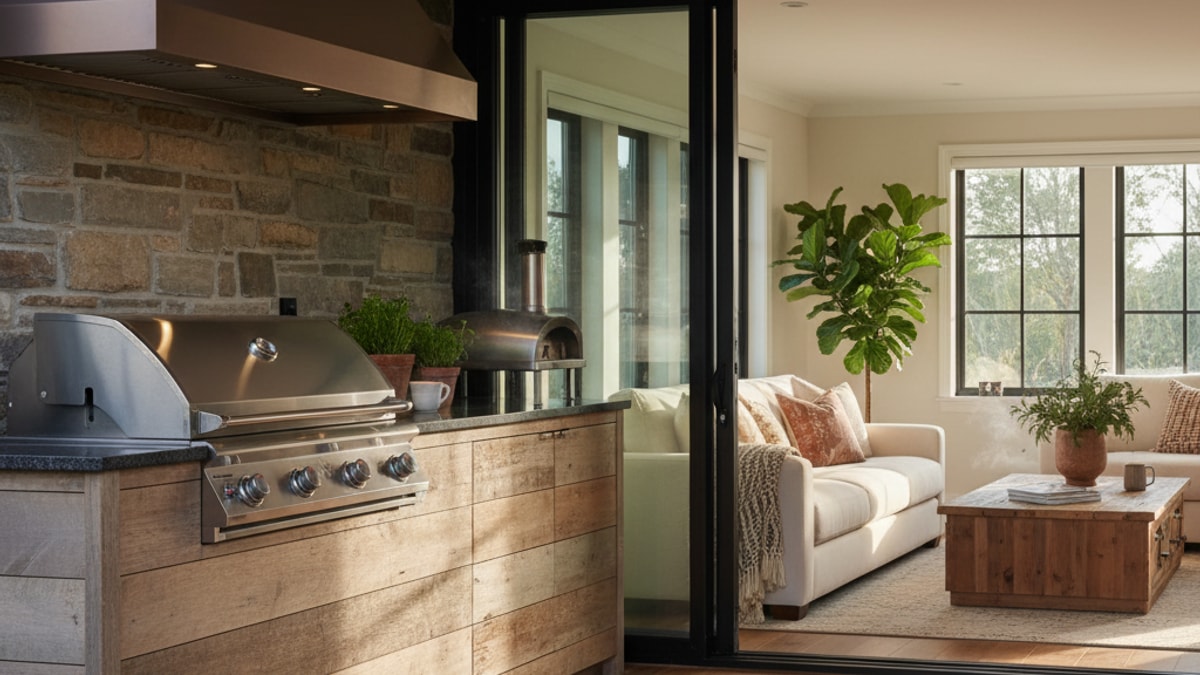
When we design your outdoor space, we're planning for how the ducting will be concealed within a patio cover structure, how the hood will complement the aesthetic of the stone and steel, and how it will function to make your cooking experience more enjoyable. It's about creating a cohesive system where every element works in harmony. This holistic approach is why homeowners trust us to build not just a feature, but a lifestyle. If you're ready to explore what's possible and want to ensure your dream kitchen is designed right from the start, we invite you to BOOK MY FREE CONSULTATION and speak with one of our design experts.
Ultimately, the decision to install a hood is about foresight. It's about understanding that the initial investment protects the much larger investment of your home and outdoor space. It’s about prioritizing the safety of your family and friends. And it's about ensuring that your beautiful outdoor kitchen remains a source of joy—not a maintenance headache—for many years to come.



.webp)
.webp)