Can Modular Outdoor Kitchens Be Moved? San Diego Portability Guide (2026)
Yes — modular outdoor kitchens can be relocated. Cost to move runs $0 (rolling carts) to $12,000+ (semi-permanent stone-faced units). Three system types compared with San Diego pricing.
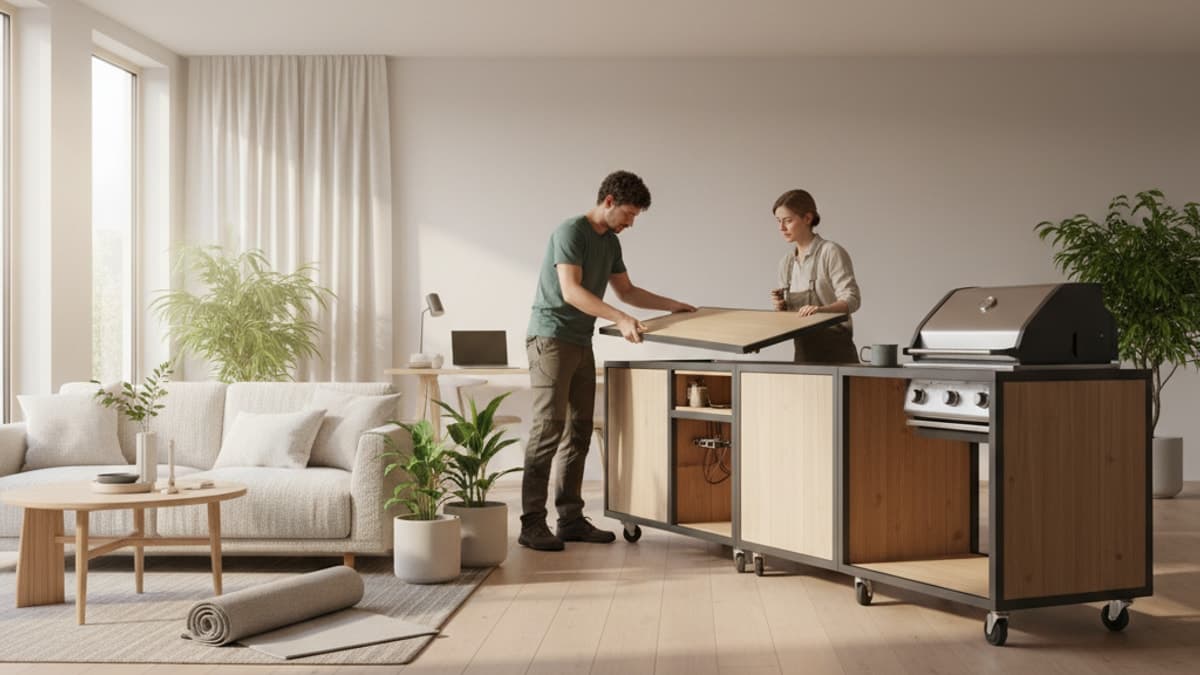
Yes, modular outdoor kitchens can be moved — but only certain types, and only with proper planning. Three categories exist:
- Fully portable cart-and-island systems roll on heavy-duty casters; you move them yourself in minutes, free
- Truly modular cabinet systems unbolt and relocate with utility hookups (gas, water, electrical) disconnected by licensed pros; $1,500–$5,000 to move in San Diego
- Semi-permanent stone-faced modules look identical to traditional built-ins but were assembled rather than mortared; they technically move but require professional disassembly at $4,000–$12,000+
For most San Diego homeowners considering a modular kitchen specifically because they may relocate, the truly modular cabinet system is the sweet spot — built-in aesthetic, real portability, and a $15,000–$35,000 investment you can take with you instead of leaving for the next owner.
Modern Yardz designs and installs outdoor kitchens across San Diego County under California Contractor License #1082881 — from Pacific Beach beach houses to Carmel Valley backyards to Carlsbad coastal lots. This guide walks the portability spectrum, real move costs, and the design decisions that determine whether your kitchen comes with you when life changes.
Can modular outdoor kitchens really be moved?
Yes — but the move difficulty depends entirely on the system type and the original install. The four variables that determine portability:
- Module material. Stainless steel cabinet systems are the lightest and most movable. Concrete, stone-veneer, or steel-framed modules with stone facing are 3–10x heavier per cabinet and require professional moving equipment.
- Utility connections. Natural gas grills, plumbed sinks, refrigerators, and integrated lighting all require licensed disconnect and reconnect. This is non-negotiable for safety and California building code compliance.
- Countertop type. Individual per-module countertops detach with the cabinets. A single sprawling slab of granite or quartz that spans multiple modules has to come off in one piece — a delicate, high-risk move that often requires a stone fabricator and specialized lifting equipment.
- Foundation integration. Kitchens sitting on existing pavers or a flat concrete pad move easily. Kitchens built into multi-level patios, flanked by integrated seat or retaining walls, or embedded in custom hardscape become major construction projects to extract.
The honest take: the easier you want it to move later, the more you should plan for portability at the design stage — not at the moving stage.
What's the difference between modular and built-in outdoor kitchens?
Two fundamentally different construction approaches:
- Traditional built-in: masonry-and-mortar construction on a permanent concrete footing. Cinder block or steel frame is built on-site, then faced with stucco, stone, brick, or tile. Appliances drop into precise cutouts. Permanent. Can't be moved without demolition.
- Modular: prefabricated cabinet modules manufactured off-site (stainless steel, polymer, or pre-cast concrete) that bolt or clip together on a level pad. Appliances install into standardized openings in the modules. Designed for assembly — and disassembly.
The visual difference at the finished stage is often imperceptible. Modern modular systems with stone-veneer cladding look identical to mortared masonry. The structural difference is everything.
In San Diego specifically, modular has gained share fast — partly because of the region's tight job market mobility, partly because outdoor kitchens see year-round use here (most months in PB, La Jolla, Encinitas, and Coronado are kitchen-friendly), making the $25,000–$50,000 investment worth protecting.
What types of modular kitchens are most portable?
Three tiers on the portability spectrum, ranked from most-movable to least-movable:
- Fully portable cart and island systems ($2,000–$8,000). Heavy-duty casters, often stainless steel construction, self-contained propane tanks. Brands include NewAge Products outdoor carts, Coyote Mobile Outdoor Carts, and various direct-to-consumer islands. Moves require zero professional involvement. Trade-off: less of the integrated, custom-built feel.
- Truly modular cabinet systems ($8,000–$25,000 DIY-installed; $15,000–$35,000 with pro install). Stainless steel cabinet modules that bolt together. RTA Outdoor Living, NewAge Outdoor Kitchen, and Sunstone are the dominant players. The cabinets are designed for assembly and disassembly. The countertop is the biggest constraint on portability — opt for sectional countertops over a single sprawling slab if you want easier future moves.
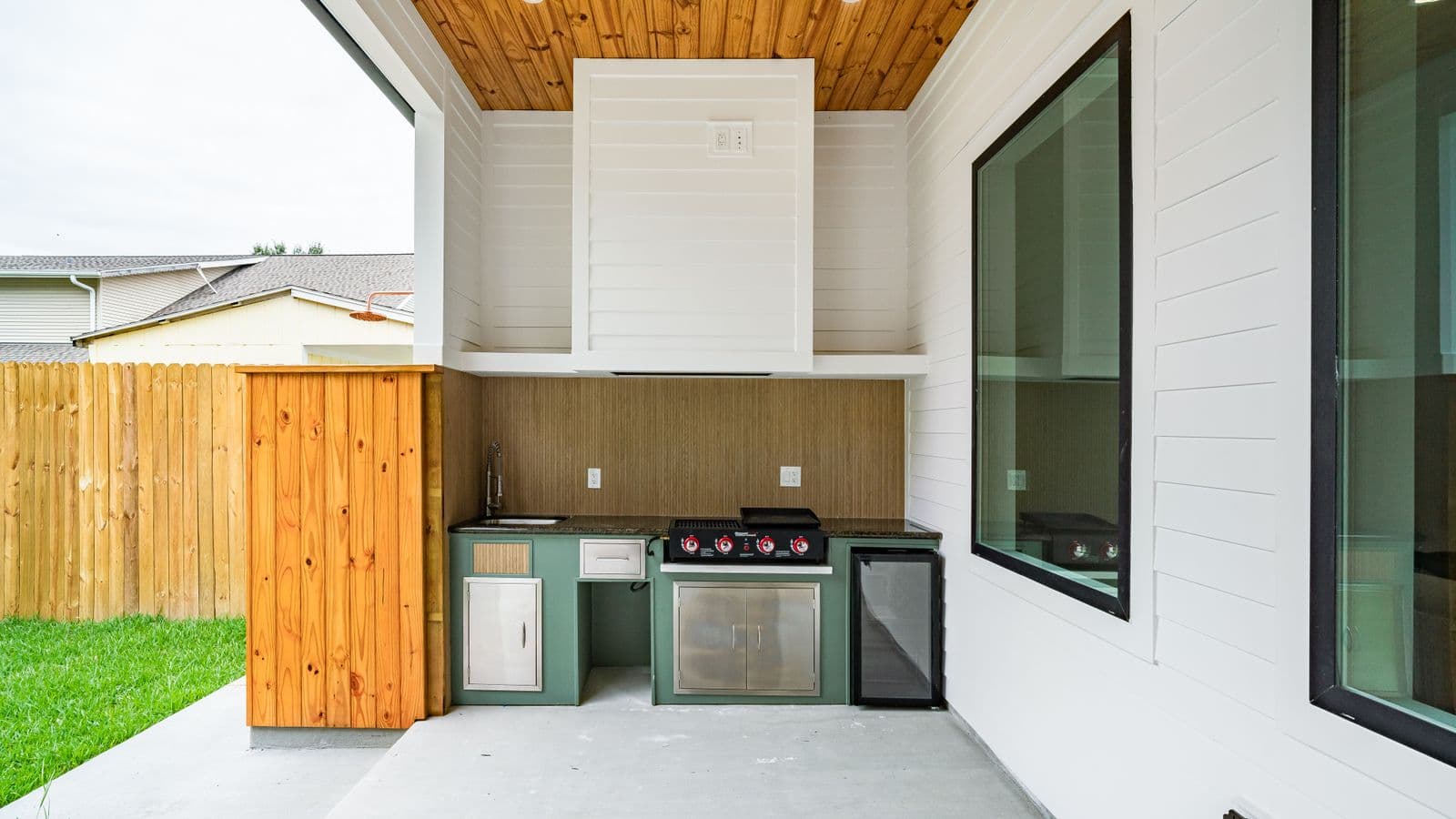
- Semi-permanent stone-faced modules ($20,000–$50,000+). Heavy concrete or steel frames designed to be finished on-site with stone, stucco, or tile. Brands like KalamazooModular and high-end custom modular builds. Visually identical to traditional built-ins. Technically modular — they're not mortared to the home — but moving them is a major undertaking that typically costs $4,000–$12,000+ for professional disassembly and reassembly.
For homeowners likely to relocate within 5–10 years, tier 2 (truly modular cabinet systems) is the sweet spot. You get the integrated aesthetic with real future-proof flexibility.
What does it cost to move a modular outdoor kitchen in San Diego?
Real ranges based on system type and complexity:
- Fully portable carts: $0 to $500. Roll it to a moving truck or hand-walk to a different patio.
- Truly modular cabinet system, intra-property move: $800–$2,500. Disconnect utilities, unbolt modules, reposition, level new pad, reassemble, reconnect.
- Truly modular cabinet system, residential move (out of one home, into another): $1,500–$5,000. Add packing, transport, and the new site's utility prep.
- Semi-permanent modular, residential move: $4,000–$12,000+. Heavy lifting equipment, larger crew, often a stone fabricator for countertop disassembly. Sometimes more expensive than buying a comparable new kitchen.
- Single-slab countertop relocation only: $800–$2,500 added to any tier above.
The break-even math: if your kitchen cost $25,000+ to build and the move is under $5,000, taking it with you almost always pencils. Below that, sometimes selling the kitchen with the home and starting fresh at the new address makes more sense — especially if the new property has a different layout or sun orientation.
What about utility connections — gas, water, electrical?
Non-negotiable: utility work requires licensed professionals. Per the CSLB's Building Official Information Guide, a C-27 landscape contractor may obtain the permits and contract for gas and electrical work when it is part of or incidental to an overall landscaping project. California code is strict on this for safety reasons.
- Natural gas line: licensed plumber or gas-certified contractor. Disconnect, cap, and pressure-test the line at the source. Reconnect at the new location. Typical cost: $400–$1,200 disconnect + reconnect.
- Water supply (sink): licensed plumber. Drain and cap the supply line. Reconnect with new flexible supply lines and check for leaks. Typical cost: $250–$700.
- Electrical (outlets, refrigerator, lighting): licensed electrician. Disconnect at the breaker, cap the wires, reconnect at new location. Typical cost: $300–$800. If the new location requires running new conduit or upgrading the circuit, add $500–$2,500.
- Self-contained propane systems: no licensed work required for tank disconnect. Just close the valve, disconnect the regulator, swap or relocate the tank.
The propane vs. natural gas decision at the design stage is one of the biggest factors in future portability. Natural gas runs cleaner and never needs a tank swap, but it ties the kitchen to a specific location's gas main. Propane gives you full mobility for the cost of monthly tank refills.
How do you handle the countertop during a move?
The most fragile and high-risk part of any modular kitchen relocation:
- Sectional countertops (each module has its own piece): low-risk move. Each section detaches with the cabinet. Pack with moving blankets and transport with the modules.
- Spanning slab countertops (single granite, quartz, or concrete piece spanning multiple modules): high-risk move. Requires:
- Removing the slab in a single piece (requires lifting equipment for slabs over 30 lbs/sq ft)
- Custom crating with foam padding, edge protection, and moving blankets
- Truck transport with the slab oriented vertically (laying flat causes mid-span cracks)
- Often a stone fabricator on both ends for disconnect and reconnect
- 5–15% replacement risk if mishandled
For homeowners who plan to move someday, design for sectional countertops at the start — even if a single slab looks more dramatic. Total cost difference at install is usually under $1,500 on a typical kitchen, and the future-proofing is worth it.
What's the step-by-step process for relocating a modular kitchen?
Eight steps, in order:
- Site assessment at both locations. Where it's coming from, where it's going. Confirm new pad is level and sized. Confirm new utility runs are accessible.
- Schedule licensed pros. Plumber for gas and water disconnect, electrician for electrical. Coordinate timing with the moving crew.
- Disconnect utilities. Pros shut off, cap, pressure-test. Drain water lines to prevent freeze damage.
- Remove and crate the countertop. If sectional, easy. If single-slab, crate with foam and edge protection.
- Disassemble modules. Photograph everything before disassembly. Label all hardware in resealable bags. Unbolt cabinets in reverse install order.
- Protect and transport. Wrap each module in moving blankets, secure with strap. Use furniture dollies — modules are heavier than they look.
- Site prep at the new location. New pad must be perfectly level (laser level, not eyeballed). Utility lines run before the kitchen arrives.
- Reassembly and reconnection. Place modules, level, bolt together. Install countertop. Pros return for utility reconnection and pressure-test.
For a typical truly-modular cabinet system on a residential move within San Diego County, plan on 2–3 days of work spread over a week to coordinate with the licensed trades.
Is a modular outdoor kitchen worth it if I'm not planning to move?
Often, yes. Three reasons modular still makes sense for permanent installs:
- Reconfiguration flexibility. Add a pool 5 years in? Want to expand the cooking surface? A modular kitchen shifts to accommodate the new design without demolition. A traditional built-in usually gets demolished.
- Faster install. Modular kitchens go from delivered to functional in 1–3 days. Traditional built-ins take 4–8 weeks for masonry, finishing, and cure.
- Easier service and replacement. Appliances live in standardized cabinet cutouts. Swap the grill, replace the fridge — straightforward. With built-ins, appliance changes often require masonry rework.
The cost difference at the high end (premium modular vs. premium built-in) is now often less than 10–15%. The flexibility benefit usually justifies the small premium.
Who should choose modular vs. traditional built-in?
Modular wins for:
- Renters with landlord permission to install — high-end portable carts let you take the investment with you
- Homeowners likely to relocate within 5–10 years (job mobility, growing families, downsizing plans)
- Designers who reconfigure their outdoor space periodically — modular adapts to new pool, patio cover, or hardscape additions
- Tight construction timelines where masonry work would push project completion past a major deadline (party, season change)
Traditional built-in wins for:
- Long-term homeowners staying in the home indefinitely with no anticipated reconfiguration
- Maximum custom integration with existing hardscape, walls, and architectural features
- Highest-end aesthetic where a particular stone, tile, or finish requires on-site masonry work that pre-fab modules can't match
How Modern Yardz designs modular kitchens for future flexibility
Our outdoor kitchen scope is integrated into our landscape design services — the kitchen, patio, pavers, patio cover or pergola, and fire features are designed together as one cohesive outdoor environment.
For modular kitchens specifically, we build in portability at the design stage:
- Sectional countertops by default unless the client specifically wants a single slab
- Propane line option as a "movable backup" even when natural gas is the primary supply
- Modular cabinet system selection based on the client's stay-or-move horizon
- Pad construction that's level and sized for future reconfiguration
For a typical mid-tier modular outdoor kitchen install in San Diego, our pricing lands at $22,000–$38,000 depending on cabinet count, appliance package, and countertop selection. Premium custom builds with high-end appliances (Lynx, Kalamazoo, Twin Eagles) and stone-veneer cladding run $45,000–$80,000+. Most homeowners bundle the kitchen into a larger backyard project for unified financing. See our complete outdoor kitchen services for related work.
Ready to design an outdoor kitchen that fits your life now and your move later? Book a free consultation — we'll walk the property and send a written line-item plan within 48 hours.
Start Your Free Design Consultation
Tell us about your project and we'll be in touch within 24 hours. No pressure, no obligation.
Common questions
- Can modular outdoor kitchens really be moved?
- Yes, but it depends on the system type. Fully portable cart and island systems move free in minutes. Truly modular cabinet systems unbolt and move for $1,500–$5,000 with licensed utility work. Semi-permanent stone-faced modules move for $4,000–$12,000+ with professional disassembly.
- What's the difference between modular and built-in outdoor kitchens?
- Built-in kitchens use masonry and mortar on a permanent concrete footing — they can't be moved without demolition. Modular kitchens use prefabricated cabinet modules that bolt together on a level pad — they can be disassembled and relocated. Visual finish is often identical.
- How much does a modular outdoor kitchen cost in San Diego?
- Fully portable carts: $2,000–$8,000. Truly modular cabinet systems (the most common): $15,000–$35,000 with pro install. Premium semi-permanent stone-faced modules: $20,000–$50,000+. Custom high-end builds with Lynx or Kalamazoo appliances: $45,000–$80,000+.
- Can I take my outdoor kitchen with me when I move?
- Yes if it's modular. Truly modular cabinet systems disassemble and relocate for $1,500–$5,000 in San Diego — significantly less than the $15,000–$35,000 install cost, so taking it with you almost always pencils financially. Built-in kitchens stay with the home.
- What's the best modular outdoor kitchen brand?
- RTA Outdoor Living, NewAge Outdoor Kitchen, Sunstone, and Coyote Outdoor Living are the dominant players in truly-modular cabinet systems. KalamazooModular leads the high-end semi-permanent category. Brand selection depends on appliance preferences, finish options, and budget tier.
- Do modular outdoor kitchens require a permit in San Diego?
- The kitchen modules themselves typically don't require a permit. The utility work (gas line, electrical, plumbing) does — California code requires licensed plumbers and electricians for those connections. Permits are also needed if you're building a new concrete pad or patio cover above the kitchen.
- How long does it take to install a modular outdoor kitchen?
- 1–3 days for a typical truly-modular cabinet system on a prepared pad. Add 1–2 weeks if pad construction is needed. Traditional built-in kitchens take 4–8 weeks for masonry, finishing, and cure. Premium semi-permanent modular installs run 2–4 weeks with on-site stone facing.
- Can I install a modular outdoor kitchen myself?
- Yes for the cabinet assembly portion. The modules are designed for DIY-friendly bolt-together installation. The utility connections (gas, water, electrical) require licensed professionals — this is California code, not just best practice. Most homeowners DIY the assembly and hire pros for the utility work.
- What's better for portability — natural gas or propane?
- Propane wins on portability. A self-contained propane tank moves with the kitchen and requires no licensed disconnect. Natural gas is cleaner-burning and never needs tank swaps but ties the kitchen to a specific gas line at a specific location. For movable kitchens, propane is usually the better call.
- Will my modular kitchen look as good as a built-in one?
- With modern stone-veneer-clad modular systems, the finished look is essentially identical to mortared built-ins. Stainless steel cabinet systems have a different aesthetic — sleek and contemporary rather than masonry-rustic — which appeals to a different design preference. Both can look premium.
- Do I need a level pad for a modular outdoor kitchen?
- Yes — perfectly level within 1/8 inch over the full footprint. Modular cabinets are designed to be plumb and aligned. An out-of-level pad causes the doors to bind, the countertop to sit unevenly, and the bolt connections to stress over time. Level the pad with laser levels, not eyeballed grading.
- Should I pick modular if I'm staying in my San Diego home long-term?
- Often still yes. Modular offers reconfiguration flexibility (pool addition, hardscape changes, appliance swaps) without demolition. The cost difference between modular and built-in is now under 10–15% at most price tiers, and the future-proofing flexibility usually justifies the small premium.
Ready to design your dream yard?
Tell us about your project. We'll send back a real plan, not a templated quote.
Book My Free Consultation→