A perfectly warm pool is the dream, isn't it? It’s that sweet spot where the water is so inviting you can slip in without a shiver, extending your swim season from a few short months into the better part of the year. When you decide to invest in a heat pump, you’re not just buying a piece of equipment; you’re buying more family time, more relaxation, and more memories. So, when that big, heavy box arrives, the temptation to tear it open and get it running by the weekend is powerful. We get it. As a team that specializes in creating complete backyard transformations with our Pools AND Spas service, we understand that excitement.
But here’s the thing we've learned after countless projects: the success of any installation, especially something as technical as a pool heat pump, hinges entirely on the prep work and a deep understanding of the process. It's a project that straddles the line between a manageable DIY task and a job best left to seasoned professionals. We believe in empowering homeowners with knowledge. So, whether you’re a die-hard DIYer ready for a challenge or you’re just trying to understand what’s involved before making a call, we’re pulling back the curtain. We’re going to walk you through how to install a pool heat pump, the way the pros do it, with the kind of insights you only get from being in the trenches.
Before You Even Unbox It: The Critical Prep Work
Honestly, the physical act of connecting a few pipes and wires is only a fraction of the job. The real craft lies in the planning. We've seen homeowners, full of weekend-warrior enthusiasm, unbox their brand-new, multi-thousand-dollar unit only to realize they have nowhere suitable to put it. Let's not let that be you.
First, let's talk location. This is non-negotiable. A heat pump works by pulling ambient heat from the air, so it needs to breathe. Cramming it into a tight, enclosed space is like asking a marathon runner to train in a closet. It just won't work. Our team recommends a spot with at least 24 inches of clearance on all sides and a completely unobstructed top. Keep it away from dryer vents, windows, and dense shrubbery. You also have to consider drainage. These units produce a surprising amount of condensation—gallons of it per day. You need to ensure that water has a place to go where it won't create a swampy mess or damage nearby structures.
And what about noise? While modern heat pumps are quieter than their predecessors, they still make noise. Think about its proximity to your patio, your bedroom window, or even your neighbor's property line. A little forethought here can prevent a lot of headaches later. It’s all part of a holistic approach to backyard design, something we live and breathe in our Landscape Design SAN Diego process. Every element should enhance the experience, not detract from it.
Once you’ve scouted the perfect location, you need a rock-solid foundation. We can't stress this enough: placing a heavy, vibrating piece of machinery on soft ground, pavers, or a rickety wooden platform is a recipe for disaster. The unit will settle, become unlevel, and put immense strain on the plumbing connections, leading to inevitable leaks and potential damage to the unit itself. The gold standard is a reinforced concrete pad. It needs to be perfectly level and substantial enough to support the unit's weight without shifting. This is often where a project’s true colors are shown; the quality of the foundation, like the work we do with our Concrete SAN Diego service, sets the stage for everything that follows. A solid pad ensures your investment is protected for years to come.
Tools and Materials: Gathering Your Arsenal
Walking into a project without the right tools is like trying to cook a gourmet meal with a plastic fork. It's frustrating and the results will be disappointing. Before you make a single cut, take inventory. Having everything you need laid out and ready will make the process infinitely smoother.
There are the essentials, and then there are the tools that just make life easier. We've broken them down for you. Think of this as your pre-flight checklist.
| Tool Category |
Essential Tools |
"Nice-to-Have" / Pro Tools |
| Plumbing |
PVC Pipe Cutter, PVC Primer & Cement, Tape Measure, Deburring Tool, Channel Lock Pliers |
Ratcheting PVC Cutter, Pipe Wrench, Level |
| Electrical |
Wire Strippers, Wire Cutters, Screwdriver Set (Insulated), Voltage Tester, Pliers (Needle-Nose & Linesman) |
Multimeter, Conduit Bender, Fish Tape |
| Foundation |
Shovel, Wheelbarrow, Concrete Mix, Trowel |
Concrete Mixer, Rebar Cutter, Power Screed |
| Safety |
Safety Glasses, Work Gloves |
Steel-Toed Boots, Knee Pads |
Beyond the tools, you'll need your materials. For plumbing, this means the correct schedule PVC pipe (typically Schedule 40), along with all the necessary fittings: couplings, 90-degree elbows, 45-degree elbows, and the components for your bypass loop (we'll get to that), which usually includes three-way valves or a series of ball valves and tee fittings. For the electrical side, you'll need the correct gauge of wire for your unit's amperage draw, weatherproof conduit, conduit fittings, and a new, correctly-sized circuit breaker for your home's main panel. Don't guess on this. The manufacturer’s manual will specify exactly what’s required. Read it. Then read it again.
The Plumbing Puzzle: Connecting the Water Flow
This is where theory meets practice. The goal is simple: divert water from your pool's filtration system, send it through the heat pump, and then return the newly heated water to the pool. Simple in concept, but execution matters. A clean, efficient plumbing setup not only looks professional but also maximizes your heater’s performance.
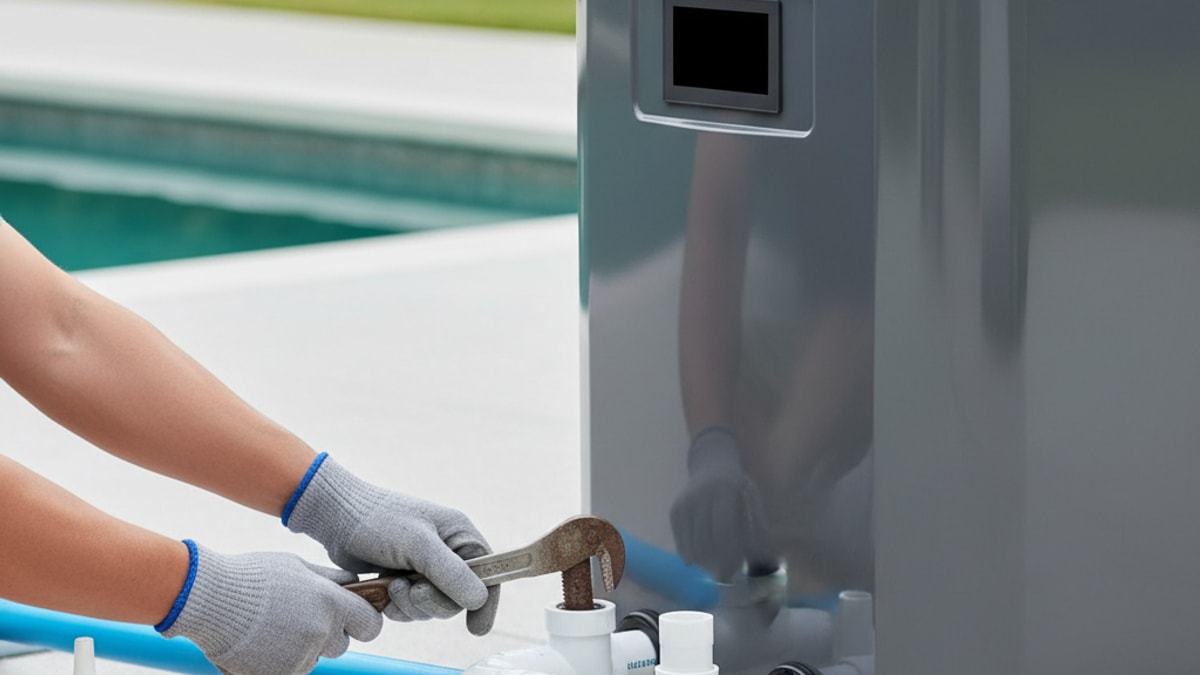
First things first: shut everything down. Turn off the power to your pool pump at the circuit breaker. This is a critical safety step. You don't want the pump kicking on while you're cutting into the pipes. Next, you'll need to identify the return line—the pipe that carries filtered water back to your pool. This is where you'll be performing surgery.
Your heat pump should be plumbed in after the filter and before any chemical feeder or salt chlorinator. Why? Because you want the cleanest possible water going into your heater, and you don't want highly concentrated chemicals flowing through its delicate internal components, like the titanium heat exchanger. Find a straight section of the return line after your filter and plan your cuts. Remember the carpenter's rule: measure twice, cut once. A mistake here can mean a frantic trip to the hardware store and a lot of wasted time.
Once you’ve made your cuts, it's time to dry-fit everything. Lay out your pipes and fittings to connect the main line to the heat pump's inlet and outlet ports. This is your chance to make sure everything lines up perfectly without any stress on the pipes. This dry run is a step amateurs often skip, and it shows.
Now, let's talk about something that separates a professional installation from a novice one: the bypass loop. A bypass is a plumbing arrangement that allows you to isolate the heat pump from the water circuit without shutting down your entire filtration system. It's absolutely essential for maintenance, servicing, or winterizing the unit. It also allows you to control the flow rate through the heater, which is critical for optimal performance. Trying to save a few bucks by skipping the bypass is a profoundly shortsighted decision. Trust us on this.
With everything dry-fitted, you can begin the permanent connections. Working one joint at a time, apply PVC primer (usually purple) to both the outside of the pipe and the inside of the fitting. The primer cleans and softens the plastic, preparing it for a solid weld. Immediately follow with a thin, even coat of PVC cement. Push the pipe into the fitting with a slight twisting motion and hold it firmly for about 30 seconds. A proper joint will have a small bead of cement visible around the edge. Let the joints cure for the manufacturer-recommended time before you even think about turning the water back on. Patience here is a virtue.
The Electrical Connection: Where DIY Gets Dangerous
Okay, let's have a frank conversation. Up to this point, a skilled and careful DIYer can handle the work. But this next part—the electrical hookup—is a different beast entirely. We mean this sincerely: if you are not 100% confident and experienced in residential electrical work, this is the point where you stop and call a licensed electrician. Period.
The consequences of a mistake here aren't just a leaky pipe; they're catastrophic. We’re talking about risks of fire, permanent damage to your expensive new equipment, and a genuine danger to anyone using the pool.
For informational purposes, here's what's involved. A pool heat pump is a high-power appliance and requires its own dedicated circuit run directly from your home's main breaker panel. You can't just plug it into an existing outdoor outlet. An electrician will run the appropriate gauge wire (specified by the manufacturer based on the unit's amperage and the distance of the run) through a protective conduit to the heater's location. They will install a new, correctly sized GFCI circuit breaker in your panel. This is a non-negotiable safety feature that can shut off the power instantly if it detects a fault, preventing electric shock.
At the unit itself, there will be an electrical whip connecting from a disconnect box to the heater's control panel. The connections inside must be secure and weatherproof. There's another crucial step called bonding. Bonding involves connecting all the metal components of your pool system (the heater, pump, ladder, etc.) with a solid copper wire. This equalizes the electrical potential of all the parts, preventing stray voltage and ensuring that the GFCI breaker can do its job effectively. It's a critical safety layer that is often overlooked in amateur installations.
Again, we can't stress this enough. The money you might save by doing the electrical work yourself is insignificant compared to the risks you're taking on. This is one area where professional expertise is worth every single penny.
The Final Steps and First Firing
With the plumbing cured and the electrical work professionally completed and inspected, you're in the home stretch. But don't get ahead of yourself. The final sequence of events is just as important as the first.
First, slowly reopen any valves you closed and allow the system to fill with water. You'll want to open the air relief valve on your pool filter to purge any air that entered the system during the plumbing work. Once a steady stream of water comes out, close it. Now, it's time to play detective. With the system full but the pump still off, walk around the entire equipment pad. Look closely at every single joint you created. Run your fingers over them. Are there any drips? Even a tiny, slow drip will become a bigger problem under pressure. If you find a leak, you'll have to drain the section, cut out the faulty joint, and redo it. It's a pain, but it's much better to find it now.
If everything is bone dry, you're ready to power up. Turn the circuit breaker for the pool pump back on. The pump will prime, and water will start flowing through your new plumbing and the heat pump. Do another leak check. The pressure can reveal leaks that weren't visible before. Listen for any strange noises.
Now for the moment of truth. Turn on the dedicated breaker for the pool heat pump. The unit should power on, its fans will start to spin, and the compressor will kick in. It will likely run through a short diagnostic sequence. Set your desired water temperature on the control panel. And then… you wait. A heat pump doesn't work like a gas heater; it's not instantaneous. Depending on the size of your pool, the power of your unit, and the starting water temperature, it can take 24 to 72 hours to reach your target temperature the first time. This is normal. Just let it do its thing.
Why a Professional Install is Often the Smarter Choice
We've laid out the steps, and as you can see, it's a formidable project. While it can be done, there are compelling reasons to entrust this work to a professional team. One of the biggest is the warranty. Many heat pump manufacturers will void their warranty if the unit isn't installed by a licensed HVAC or pool professional. That's a huge gamble to take on such a significant investment.
Beyond the warranty, there's performance. Professionals understand the nuanced hydraulics of a pool system. We know how to optimize the plumbing for the most efficient flow rate, ensuring your heater operates at its peak capacity. This saves you money on your energy bills over the life of the unit. We also ensure the unit is perfectly integrated into your backyard oasis. A heat pump isn't an isolated appliance; it's part of a system that might include sophisticated automation, Landscape Lighting SAN Diego, and other features. We make sure it all works together seamlessly.
Ultimately, it comes down to peace of mind. When we manage a project, whether it's installing a full set of beautiful Pavers SAN Diego or building a complex pool system, you know it's done right. You don't have to worry about leaks, electrical hazards, or performance issues. You just get to enjoy the result. If you're thinking about a new pool or a major backyard renovation that includes heating, we'd love to chat. You can BOOK MY FREE CONSULTATION and our team can walk you through how to create a space that's both beautiful and flawlessly functional.
Installing a pool heat pump is a major step toward unlocking the full potential of your pool. It transforms it from a seasonal luxury into a year-round source of joy and wellness. Taking the time to understand the process, respect the complexity, and make smart decisions about what to tackle yourself versus when to call in the experts is the surest path to a successful outcome. It's about getting the job done right, so you can spend less time worrying about your equipment and more time in that perfectly warm water.



.webp)
.webp)