A beautiful paver patio can completely transform an outdoor space. It’s the foundation for your backyard gatherings, the stage for your outdoor kitchen, and the quiet spot for your morning coffee. We’ve seen it time and time again here at Modern Yardz—a well-designed patio doesn't just add value; it fundamentally changes how you live in your home. And while the allure of a DIY project is strong, the path to a perfect paver patio is paved with details. Critical, non-negotiable details.
Our team has spent years perfecting the process, especially for the unique conditions we find across San Diego, from the coastal soils in Oceanside to the harder ground in Chula Vista. We’re not just laying stones; we’re engineering a durable, beautiful surface that has to withstand shifting ground, sun, and rain. This isn't just a guide. This is our playbook, refined over countless projects, showing you how to install patio pavers the way the pros do it. So grab a notebook. Let's dig in.
First Things First: Planning Your Perfect Patio
Before a single shovel hits the dirt, the most crucial work happens. Planning. Honestly, this is where most DIY projects go sideways. Rushing this stage is a recipe for a lumpy, shifting patio that you’ll be redoing in a few years. We can't stress this enough—take your time here.
First, think about function. How will you use this space? Is it for a sprawling dining set and grill, or a cozy nook for two chairs and a fire feature? The function dictates the size and shape. Use a garden hose or marking paint to lay out the perimeter on the ground. Live with it for a few days. Walk around it. Does it feel right? Is there enough room to pull out chairs? This simple step can save you a world of regret. Now, consider drainage. This is a big one. Water is the number one enemy of a paver installation. Your patio must have a slight, almost imperceptible slope—away from your house’s foundation. We typically engineer a slope of about 1/4 inch per foot. It doesn't sound like much, but it’s the difference between a dry, stable patio and a catastrophic, water-logged mess that undermines your home.
Next up is aesthetics. What’s the vibe? Modern, rustic, classic? The type of paver you choose sets the tone. There are countless options, from sleek porcelain pavers for a contemporary look to tumbled concrete pavers that mimic old-world cobblestone. We often recommend clients browse our Services page to get inspiration from different materials we've used in our landscape designs. Think about color, texture, and pattern. A simple running bond is classic and clean, while a herringbone pattern adds a dynamic, sophisticated flair. Don't forget to call 811 to have public utility lines marked before you plan your excavation. You absolutely do not want to discover a buried gas or water line with a pickaxe. It’s a free service, and it’s the law. Seriously. Do it.
The Foundation is Everything: Excavation and Base Prep
Here’s where the real work begins. If the planning stage is the brain, the base is the spine of your patio project. A weak base guarantees failure. A strong, meticulously prepared base means your patio will look fantastic for decades. It’s that simple.
The first step is excavation. You need to dig. And you probably need to dig deeper than you think. The final height of your pavers should be just slightly above the surrounding ground level to promote runoff. To get there, you have to account for the height of the paver itself (usually 2 3/8 inches), a 1-inch layer of sand, and a 4- to 6-inch layer of compacted base material. Here in San Diego, where we often deal with expansive clay soils, our team almost always recommends a 6-inch base. For a driveway? We’re going even deeper—sometimes up to 12 inches. So, for a standard patio, you're looking at digging out around 9 to 10 inches of soil from your final desired grade. It’s a formidable amount of dirt.
Once you’ve excavated the area to a uniform depth, it's time for the plate compactor. You need to compact the native soil—the subgrade—until it's firm and unyielding. This prevents the entire area from settling later. We've seen many projects fail because this step was skipped. Don't skip it.
Next, lay down a geotextile fabric. This is another pro tip that many DIY guides miss. This fabric acts as a separator between your soil and the gravel base, preventing them from mixing over time. It stabilizes the entire system and is especially critical in areas with clay soil. After the fabric is down, you’ll start adding your base material, typically a crushed stone aggregate. Add it in 2- to 3-inch layers (we call them lifts), watering each lift slightly and compacting it thoroughly with the plate compactor before adding the next. You should make at least two passes over each lift with the compactor. Your goal is to create a dense, interlocking, and absolutely solid foundation. This process is grueling, but it’s the most critical, non-negotiable element of the entire installation.
With the base fully compacted, it's time for the sand bedding. This is a 1-inch layer of coarse concrete sand that the pavers will sit in. To get it perfectly level (and with the correct slope), you’ll use a technique called screeding. Lay two 1-inch outside-diameter pipes parallel to each other across the base. Pour the sand between them, and then pull a straight 2x4 across the top of the pipes to level the sand perfectly. Remove the pipes and carefully fill in the voids. Now you have a perfectly smooth, sloped bed ready for pavers. And—let's be honest—this is a moment of great satisfaction.
Tools of the Trade: What You Actually Need
Having the right equipment makes a significant, sometimes dramatic shift in both the quality of the job and the strain on your body. You can get by with the basics, but a few key rentals can elevate your project from amateur to professional. Our team has a whole truck full of specialized gear, but for a DIY project, you can focus on the essentials.
Here's a breakdown of what we recommend:
| Tool Category |
Must-Haves |
Pro-Level (But Worth It) |
| Excavation & Prep |
Shovel, Pickaxe, Wheelbarrow, Tape Measure, Level, String Line, Stakes |
Skid Steer (for large areas), Laser Level, Transit |
| Base Compaction |
Hand Tamper (for small areas) |
Plate Compactor (rental is essential for any decent-sized patio) |
| Screeding |
2x4 Board, 1-inch Pipes |
Specialized Aluminum Screed Rails |
| Paver Laying |
Rubber Mallet, Trowel |
Paver Extractor Tool (for fixing mistakes) |
| Paver Cutting |
Hammer & Masonry Chisel (for rough cuts) |
Wet Saw with a Diamond Blade (rental for clean, precise cuts) |
| Finishing |
Stiff-bristled Broom |
Plate Compactor (with a protective pad for setting pavers) |
Honestly, though. Rent the plate compactor and the wet saw. Trying to compact a 200-square-foot base with a hand tamper is a truly soul-crushing experience, and you'll never achieve the required 95% compaction rate. And for cutting pavers to fit around edges or curves? A chisel gives you a rough, often imprecise break. A wet saw gives you a clean, factory-perfect edge. The difference in the final look is astounding.
Laying the Pavers: The Art of the Pattern
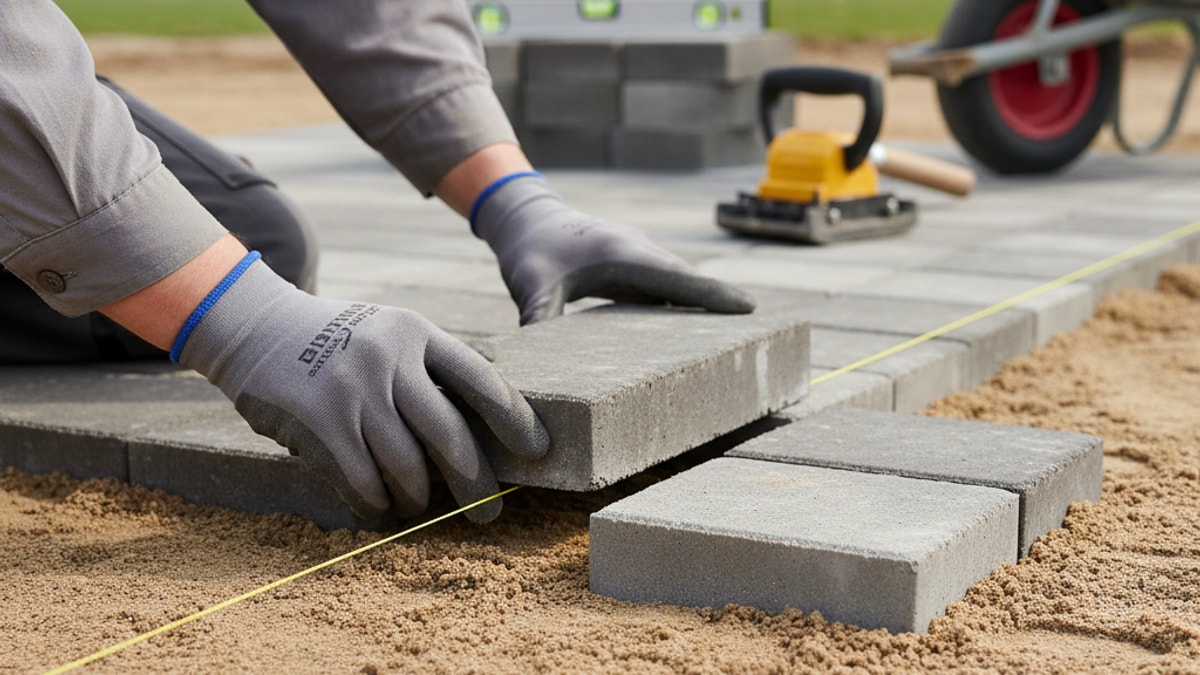
This is the part you've been waiting for. With your sand bed perfectly screeded, it's time to start laying pavers. It feels like the home stretch, but precision is still paramount. Start in a corner—preferably against a hard edge like the foundation of your house—and work your way outward. This helps keep your lines straight.
Place the pavers gently onto the sand bed. Don't slide them or press them down hard. Just set them in place, snug against their neighbors. Use string lines stretched along the edges of your layout to keep your rows perfectly straight. Check your lines every few rows. It’s incredibly easy for them to start drifting, and a small deviation in one row becomes a glaring, ugly curve after ten rows. Our team is meticulous about this—it’s a hallmark of professional work. You can learn more about our commitment to quality on our About page; it’s a core part of our philosophy.
Most paver patterns will require cuts, especially along the edges. This is where that wet saw becomes your best friend. Measure twice, cut once. Wear safety glasses and a mask—cutting pavers creates fine silica dust that you do not want to breathe. When you have all the pavers laid, you’ll notice they might have slightly different heights. That's normal. The next step will lock them all together.
Locking It All In: Edge Restraints, Sand, and Sealing
A paver patio is a flexible system; it's designed to move ever so slightly. What keeps it from moving apart is the edge restraint. This is a critical component that holds the entire field of pavers together. You can use specialized plastic or metal edging designed for pavers, or you can pour a concrete toe. The edging is installed around the entire perimeter of the patio and secured into the compacted base with long metal spikes. It should be invisible once you backfill with soil or mulch.
With the edging in place, it’s time to fill the joints. For this, we exclusively use polymeric sand. Unlike regular sand, polymeric sand has additives that, when activated with water, harden and bind the pavers together. This helps lock them in place, prevents weeds from growing in the joints, and deters ants. It’s a far superior product. Sweep the sand across the dry surface of the pavers, working it into every joint until they are completely full. Then, use a leaf blower (on a low setting) to blow any excess sand off the paver surfaces. Any sand left on top will harden into a hazy film.
Now, run the plate compactor—this time with a protective pad or a piece of plywood underneath it—over the entire patio. This crucial step settles the pavers into the sand bed, levels them out, and vibrates the sand deep into the joints. This is what creates that strong, interlocking final surface. After compacting, you may need to add a bit more sand to top off the joints. Sweep again, blow off the excess, and then you’re ready to activate the sand. Using a hose with a gentle shower nozzle, lightly mist the patio. Follow the sand manufacturer's instructions precisely—too little water and it won't harden, too much and you’ll wash the polymers out. Stay off the patio for at least 24-48 hours to allow it to fully cure.
One final consideration is sealing. While not strictly necessary for all paver types, a good quality sealer can protect your investment. It helps prevent stains from oil or wine, enhances the color of the pavers, and makes them easier to clean. We usually recommend sealing a few months after installation and then every 3-5 years after that.
Common Mistakes We See (And How to Avoid Them)
Over the years, our team has been called in to repair or completely redo countless DIY paver projects across San Diego. The mistakes are almost always the same. Here's what we've learned—and what you should watch out for:
- Inadequate Base Preparation: This is the number one killer of paver patios. Skimping on the depth, material, or—most commonly—the compaction of the base will lead to sinking, heaving, and a catastrophically uneven surface within a year or two. There are no shortcuts here.
- Poor Drainage: A patio that slopes toward the house is a nightmare waiting to happen. It can lead to foundation damage and basement flooding. Always ensure a positive slope away from any structures.
- No Edge Restraints: Forgetting or improperly installing edge restraints allows the pavers along the perimeter to creep outwards, creating wide, ugly gaps and destabilizing the entire patio.
- Incorrect Sand Usage: Using playground sand instead of coarse concrete sand for the bedding layer, or failing to use polymeric sand for the joints, will lead to shifting pavers, weed growth, and ant infestations. The right materials are not optional.
- Messy Cuts: Using a chisel for cuts that are visible results in a sloppy, unprofessional finish. Renting a wet saw is one of the best investments you can make for the final aesthetic of your project. It’s what separates the good from the great.
Building a paver patio is a major undertaking. It’s physically demanding and requires an almost fanatical attention to detail. If all of this sounds overwhelming, that's okay. Knowing when to call in a professional is a skill in itself. If you're looking for a perfect result without the back-breaking labor, that's what we're here for. You can always BOOK MY FREE CONSULTATION and our design team can walk you through the possibilities.
A properly installed paver patio is more than just a surface; it's an extension of your home, a place for connection and relaxation. It’s a project that, when done right, provides immense satisfaction and lasting value. Whether you decide to tackle it yourself or bring in our team at Modern Yardz, understanding the process is the first step toward creating the outdoor space you've always dreamed of. For more ideas and project showcases, feel free to explore our Blog. We’re passionate about creating beautiful, functional landscapes, and we love sharing what we’ve learned along the way.



.webp)
.webp)