You’ve done it. The pool is up, the water is sparkling, and the promise of summer fun is so close you can almost taste it. There’s just one final hurdle between you and that first glorious cannonball: the steps. And let’s be honest, that box of plastic parts and a cryptic, one-page instruction manual can feel more intimidating than inviting. It’s the final boss of the DIY pool setup.
Here at Modern Yardz, we’ve seen it all. We’ve been called in to consult on projects where the steps float, wobble, or just don’t fit right. It’s a common frustration. But getting this part right isn't just about convenience; it's a critical, non-negotiable element of pool safety. So, our team put their heads together to create the definitive guide on how to install above ground pool steps. We’re not just going to rehash the instructions in the box. We’re going to give you the pro insights we’ve gathered over years of designing and building complete outdoor spaces.
Before You Even Open the Box: The Prep Work We Swear By
Eagerness can be your worst enemy here. The temptation is to tear open the box and start assembling, but a little patience and prep work will save you a world of headache. We can't stress this enough: what you do before you touch a single screw is what separates a stable, secure staircase from a wobbly disaster waiting to happen.
First, think about placement. Where will the steps cause the least disruption to swimming lanes and pool games? You want easy access without creating an obstacle. Also, consider the ground outside the pool. Is it level? Is it firm? An unstable ladder on soft, squishy ground is a safety hazard. This is often an overlooked detail that has a massive impact on the overall stability of the entry system. A proper foundation is everything.
This is why, in our comprehensive Landscape Design SAN Diego projects, we plan for pool access from the very beginning. The entry point should feel like a natural part of the yard's flow. Often, this involves creating a dedicated landing pad. A small, level area made of professionally installed Pavers SAN Diego or a simple Concrete SAN Diego slab provides an impeccably stable base for the exterior side of your ladder. It's a small touch that makes a dramatic difference.
Once you’ve got your spot picked out, it's time for inventory. Lay out a tarp or an old blanket (to avoid scratching the parts or losing small screws in the grass) and unpack everything. Every single piece. Cross-reference each part with the list in your manual. It’s a tedious ten minutes, but discovering you’re missing a critical bolt halfway through assembly is infinitely more frustrating. Trust us on this.
Tools of the Trade: What You'll Actually Need
The manual might suggest you only need a screwdriver, but our experience shows a few extra tools make the job smoother, faster, and more secure. You’re not just assembling; you’re building something that needs to safely support people.
Here's the toolkit our team recommends:
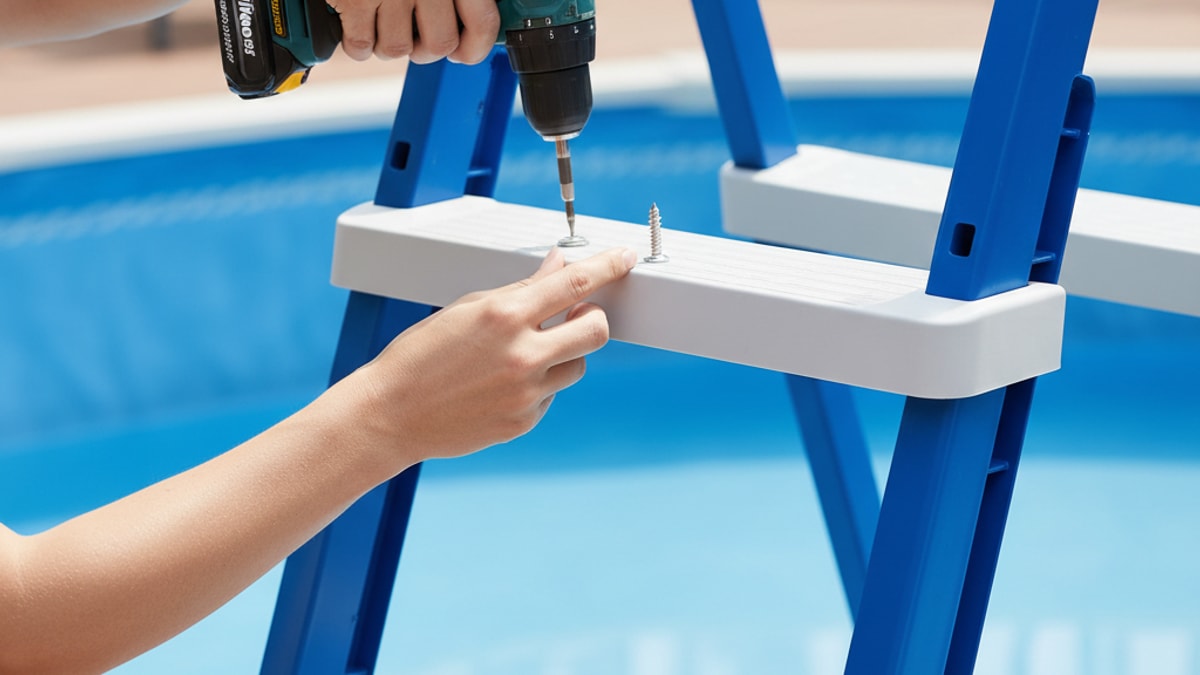
- Cordless Drill with Phillips Head Bit: This is a total game-changer. Driving dozens of screws by hand is grueling. A drill makes it effortless, but be sure to set it to a low torque setting to avoid stripping the plastic or overtightening.
- Rubber Mallet: Some parts are designed for a snug friction fit. A rubber mallet lets you gently tap them into place without cracking the plastic. Don't use a metal hammer. Ever.
- Level: A small torpedo level is perfect. You'll use this on the ground outside the pool and on the steps themselves to ensure everything is perfectly horizontal and vertical.
- Bucket(s) and Funnel: For filling the steps with sand or water as ballast. A funnel makes the process much cleaner.
- Utility Knife: For cutting open bags and trimming any plastic flashing left over from the manufacturing process.
- Safety Gloves: Protect your hands from sharp plastic edges and pinch points.
Having these items ready before you start transforms the experience from a struggle into a smooth, methodical process. It's all about working smarter, not harder.
Choosing Your Champion: A-Frame vs. Drop-In Steps
Not all pool steps are created equal. The type you have will dictate the installation process. Generally, they fall into two main categories: the classic A-Frame ladder that straddles the pool wall, and the more luxurious drop-in or deck-mounted steps.
An A-Frame ladder is the most common type included with above-ground pool kits. It’s a simple, effective solution for pools without a surrounding deck. A drop-in system, on the other hand, requires a deck for mounting and provides a more seamless, in-ground pool feel. Our work on Pools AND Spas often involves designing a deck that can accommodate these more elegant entry systems. They offer wider treads, gentler slopes, and are often easier for children and those with mobility challenges to use.
Here’s a quick breakdown of what you're dealing with:
| Feature |
A-Frame Ladder |
Drop-In / Deck-Mounted Steps |
| Best For |
Pools without a deck |
Pools with a full or partial deck |
| Installation |
Freestanding; straddles the pool wall |
Mounts directly to the deck surface |
| Stability |
Relies on a level base and ballast |
Extremely stable when properly secured to the deck |
| Footprint |
Takes up space both inside and outside the pool |
Primarily inside the pool; minimal deck footprint |
| Aesthetics |
Utilitarian and functional |
More integrated and elegant appearance |
| Common Feature |
Often includes a lockable security gate |
Wider treads, handrails, and a more gradual slope |
Understanding which type you have is the first step to a successful installation. The assembly logic is fundamentally different for each.
The Main Event: A Step-by-Step Installation Guide
Alright, you’ve done your prep work, you’ve gathered your tools, and you know what type of steps you’re working with. It's go time. Remember to read your specific manufacturer's manual, as models vary, but the core principles we outline here are universal.
For A-Frame Ladders:
This is typically an assembly of two halves—an inside-the-pool section and an outside-the-pool section—that you'll connect at the top.
Assemble the Sides Separately: Lay the pieces for one side (e.g., the exterior ladder) on your tarp. Attach the treads to the risers. Here’s a pro tip: Don’t fully tighten the screws yet. Leave them just a little loose. This gives you some wiggle room to get everything aligned perfectly. Once all the treads for one side are in place, go back and tighten all the screws snugly. Repeat the entire process for the other half of the ladder.
Attach the Top Platform: Now you'll connect the two ladder halves with the top platform or bridge. This is often the trickiest part for alignment. Having a second person to help hold the sides steady while you insert the bolts can be a massive help. Once it's connected, the A-frame structure will start to feel much more rigid.
Add the Ballast (The Critical Step!): This is the step people most often get wrong. Your ladder has hollow legs for a reason. They need to be filled with a weight—either water or sand—to counteract buoyancy. If you don't do this, your ladder will float the second you put it in the pool. We strongly recommend using sand. It’s denser than water and provides more weight. Use your funnel to fill the designated legs or compartments completely. It takes more sand than you think, so have a full bag ready. Seal the fill holes securely.
Place it in the Pool: Carefully lift the assembled ladder and place it over the pool wall. Gently lower the interior side until it rests on the pool floor. Make sure the exterior side is sitting flat and stable on your prepared ground or pad. Check for levelness. Adjust as needed. It should feel solid, with no rocking or wobbling.
For Drop-In / Deck-Mounted Steps:
These systems feel more substantial and their installation is all about creating a secure connection to your deck.
Assemble the Main Step Unit: Much like the A-frame, you'll start by assembling the core staircase. Attach the treads to the risers, again leaving the screws slightly loose until everything is aligned, then tightening them all at once. This unit will be a single, large piece.
Attach Handrails: Most drop-in systems come with one or two handrails. These usually slide into designated sockets on the top step and are secured with bolts. Ensure they are fully seated and the hardware is tight. They are a primary safety feature, so give them a good shake to test their stability.
Position and Secure the Deck Flanges: This is the most important part. Place the assembled step unit in the pool, pressed up against the inside of your deck. The top of the steps should have mounting flanges or brackets that will sit on top of the deck surface. Position them where you want the steps to be permanently. Use a pencil to mark the drill holes on your deck.
Drill and Mount: Move the steps out of the way and drill pilot holes where you made your marks. Then, move the steps back into position, align the flanges with your pilot holes, and secure them firmly with the provided screws or lag bolts. The connection to the deck should be rock-solid.
Add Weights: Just like the A-frame, these steps need ballast. Some have compartments to be filled with sand. Others use weighted bags that you place discreetly underneath or behind the unit. Whatever the system, make sure you add the recommended amount of weight to keep it firmly planted on the pool floor.
Safety First, Always: The Non-Negotiable Checks
An installed ladder isn’t a finished ladder. Now comes the final inspection, the part where you double-check your work to ensure it’s not just functional, but unequivocally safe.
First, test the stability. Hold onto the handrails and gently try to rock the steps side-to-side and front-to-back. There should be minimal give. If it wobbles, you need to revisit your work. Is the base level? Are all the screws tight? Are the deck mounts secure? Don't ignore a wobble. It will only get worse with use.
Next, check all surfaces. Run your hand over the treads and handrails. Are there any sharp edges from the plastic molding? If so, you can carefully trim them with a utility knife. Make sure any non-slip tread pads are firmly attached.
Consider the area around the steps. Is it clear of tripping hazards? Proper illumination is also a key part of poolside safety, especially for evening swims. Thoughtfully placed Landscape Lighting SAN Diego can illuminate entry points, pathways, and the pool's edge, drastically reducing the risk of accidents after dark.
Finally, if your ladder has a security feature, like a lockable gate or a roll-guard, test it thoroughly. These are designed to prevent unsupervised access to the pool by small children and are a crucial layer of protection. Make sure it operates smoothly and locks securely every single time.
Common Pitfalls and How to Sidestep Them
Over the years, our team has seen a few common mistakes pop up time and time again. Knowing what they are in advance can help you avoid them entirely.
The Floating Steps: This is almost always a ballast issue. The user either forgot to add weight or, more commonly, didn't add enough. Plastic is incredibly buoyant. You need to completely fill the ballast compartments with sand or water until they can’t take any more.
The Wobbly Ladder: This points to an uneven base. If the ground outside the pool isn't perfectly level, the whole structure will be unstable. Take the time to dig down and level the ground or, better yet, install a small paver pad. It’s worth the effort.
Stripped Screws or Cracked Plastic: This is a classic case of over-tightening with a power drill. Keep your drill on a low torque setting. You want the screws snug, not torqued down with the force of a professional impact driver. You're working with plastic and aluminum, not steel I-beams.
Liner Damage: Be incredibly careful when placing the steps inside the pool. Don't drag them. Lift and lower them into place. Many step systems require a protective liner pad to be placed underneath them to prevent chafing and eventual tearing of the pool liner. If your kit came with one, use it. If not, it's a wise investment.
Beyond the Basics: Integrating Steps into Your Backyard Design
Your pool steps don't have to be a purely functional afterthought. They are the gateway to your aquatic oasis, and they can be integrated beautifully into your overall backyard design. This is where a little bit of planning can elevate the entire space from a simple pool to a luxurious retreat.
Think about creating a dedicated 'entry zone.' This could be a deck that wraps around one section of the pool, providing a perfect platform for drop-in steps and a place to lounge. Imagine stepping out of your home onto a beautiful patio, walking over to your custom-built Outdoor Kitchens SAN Diego, and then heading over to the pool area. The flow is everything. The steps become part of a larger, cohesive experience.
We often design low Seat Retaining Walls near the pool entrance to define the space and provide extra seating. The materials used for the pool deck can be coordinated with walkways and patios throughout the yard, creating a unified and polished look. It’s this kind of holistic thinking that turns a simple backyard into a stunning personal resort.
This is the philosophy behind our approach. It’s not just about installing individual elements; it's about understanding how they all work together. A well-placed set of pool steps is just one piece of a much larger, more beautiful puzzle.
Putting in your pool steps is a satisfying final step in your DIY pool journey. It’s a project that is absolutely achievable with a bit of patience and attention to detail. By following these guidelines and thinking like a pro, you can ensure your pool entrance is safe, stable, and ready for a summer full of memories. But if you’re looking at your yard and thinking bigger—imagining a fully integrated space where the pool, deck, patio, and landscaping all work in perfect harmony—that’s where we come in. Don't hesitate to BOOK MY FREE CONSULTATION, and our design team can help you map out the backyard of your dreams.



.webp)
.webp)