Your Top Question: How Much Does a Pool Fence Cost to Install?
It’s the first question on every homeowner’s mind once they've committed to a new pool or decided to secure an existing one. And let's be honest, it’s a critical one. You’re trying to budget for a project that’s not just an aesthetic upgrade but a non-negotiable safety feature. You search online for "how much does a pool fence cost to install" and get a dizzying array of numbers that seem to contradict each other. Why? Because anyone giving you a flat price per foot without seeing your property is simply guessing.
The truth is, the cost is a moving target influenced by a dozen different variables. Our team has installed hundreds of pool fences as part of comprehensive backyard transformations, and we’ve seen it all. The final price tag isn't just about the fence itself; it’s about the unique landscape of your yard, the materials you choose, and the specific safety codes you need to meet. It's a puzzle, and every piece affects the final picture. So, let’s put the vague online calculators aside and talk about the real factors that drive the cost up or down.
The Big Three: Material, Labor, and Linear Feet
At its core, your pool fence cost boils down to three primary components. Understanding how they interact is the first step toward building a realistic budget. It’s not complicated, but overlooking one can lead to some serious sticker shock down the line. We can't stress this enough: getting these fundamentals right from the start will save you headaches and money.
First, there’s the total length of the fence, measured in linear feet. This is the most straightforward part of the equation. A small, simple perimeter around a plunge pool will naturally cost less than a sprawling fence enclosing a large pool and patio area. The more feet, the more material and labor required. Simple, right?
Second is the material itself. This is where the biggest price variations occur. You could choose a budget-friendly mesh fence or opt for a show-stopping frameless glass enclosure. The difference isn't just a few dollars per foot; it can be an order of magnitude. We’ll dive deep into specific materials in a moment, but for now, know that your choice here has the single greatest impact on your total investment. It’s a balance between aesthetics, durability, and your wallet.
Finally, there's labor. Installation isn't just about sticking posts in the ground. It involves site preparation, navigating tricky terrain like slopes or rock beds, working around existing hardscaping like concrete or pavers, and ensuring every single post is perfectly secure and level. A flat, grassy yard is a much simpler (and therefore cheaper) installation than a multi-level yard with complex angles and tough soil. This is where the expertise of a professional crew truly shows its value. A poorly installed fence isn't just an eyesore; it's a safety hazard.
A Deep Dive into Pool Fence Materials
Alright, let's get into the specifics. The material you choose defines not only the look of your pool area but also its long-term maintenance needs and, of course, its cost. Our experience shows that homeowners often underestimate how dramatically different the pricing can be between materials that seem similar on the surface. Here's what our team has learned over the years about the most common options.
Removable Mesh Fencing
This is often the most affordable option and a popular choice for families with young children who need a temporary or flexible barrier. Mesh fences are made from a durable, UV-resistant mesh fabric stretched between aluminum poles. The poles are inserted into sleeves drilled into your pool deck or surrounding surface.
- Cost: Typically the lowest price point, often ranging from $15 to $30 per linear foot installed.
- Pros: It’s removable, which is a huge plus for homeowners who want an unobstructed view when entertaining adults. It’s also very difficult for small children to climb, as there are no handholds or footholds. Installation is relatively quick.
- Cons: Aesthetically, it's not for everyone. It has a more functional, utilitarian look compared to other options. While strong, it doesn’t provide the same sense of permanence or security as a fixed fence. Some homeowners find the process of taking it down and putting it back up to be a bit of a chore.
Aluminum Fencing
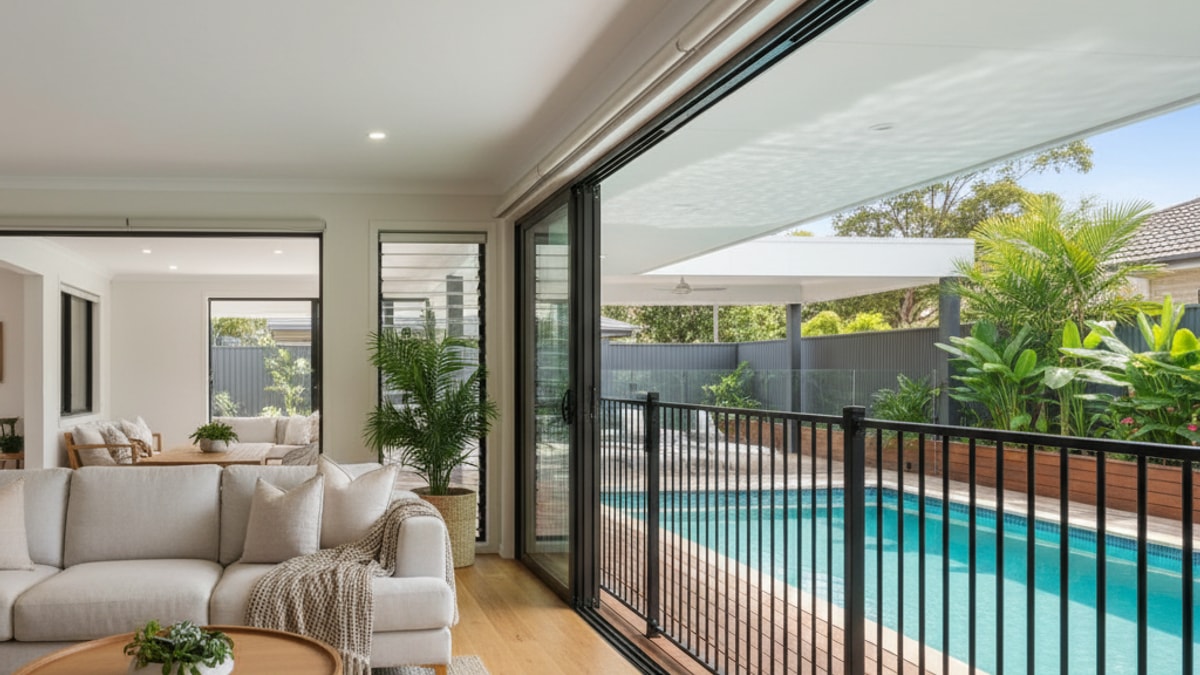
This is one of the most popular choices we see, and for good reason. It offers a classic, elegant look that mimics traditional wrought iron without the high cost or relentless maintenance. It's lightweight, durable, and comes in a variety of styles and colors.
- Cost: A significant step up from mesh, generally falling between $35 and $60 per linear foot installed. Taller fences or more ornate designs will be at the higher end of that range.
- Pros: It’s incredibly low-maintenance. Aluminum doesn't rust, making it perfect for the humid environment around a pool. It provides a clean, open look that doesn’t completely block the view of your beautiful pool. It's a strong, permanent barrier that meets most safety codes with ease.
- Cons: While it offers a good view, it’s not as transparent as glass. Installation is more involved than mesh, as it requires setting posts in concrete for a secure, permanent fit.
Steel Fencing
For those seeking maximum strength and a formidable security barrier, steel is an excellent choice. It looks very similar to aluminum but offers a higher level of durability and impact resistance. It’s heavier and more robust, providing a feeling of ultimate security.
- Cost: Slightly more expensive than aluminum, usually in the $45 to $75 per linear foot range. The price depends heavily on the grade of steel and the protective coating applied.
- Pros: Unmatched strength and durability. If security is your absolute top priority, steel is hard to beat. It provides the same classic, open look as aluminum.
- Cons: It can be susceptible to rust if the protective coating (usually a powder coat or galvanized layer) is scratched or compromised. This makes it a bit more high-maintenance than aluminum in the long run, requiring occasional touch-ups to prevent corrosion. It’s also heavier, which can sometimes add a bit to the labor cost.
Wood Fencing
Wood offers a natural, traditional look that can be beautiful and provide excellent privacy. However, our team generally advises clients to think carefully before choosing wood for a poolside application. It requires a lot of upkeep in a wet environment.
- Cost: The cost can vary wildly depending on the type of wood, from about $25 per foot for pressure-treated pine to over $60 for cedar or redwood.
- Pros: It can be designed to offer complete privacy, unlike metal or glass fences. The aesthetic can be customized with different stains and paints to perfectly match your home and landscape design.
- Cons: Maintenance is the big one. Wood is prone to warping, rotting, and insect damage, especially when constantly exposed to pool water and moisture. It requires regular sealing, staining, or painting to keep it looking good and structurally sound. From a safety perspective, a privacy-style wood fence completely blocks the view of the pool, which can be a concern for some parents.
Vinyl (PVC) Fencing
Vinyl is a fantastic low-maintenance alternative to wood. It provides a similar look, often in a classic picket or privacy style, but without the risk of rot or insect damage. It’s a durable, practical choice that has become increasingly popular.
- Cost: Generally runs from $30 to $55 per linear foot. The cost increases for taller panels, decorative tops, or textured finishes that mimic wood grain.
- Pros: Extremely low-maintenance. A simple wash with soap and water is usually all it needs. It won't rot, warp, or splinter. It comes in a variety of colors (though white is the most common) and styles, including full privacy panels.
- Cons: It can be more susceptible to impact damage in very cold weather and may stain from mold or algae in shady, damp areas (though it’s usually easy to clean). The aesthetic is clean and modern, but some people feel it lacks the natural character of wood.
Glass Fencing
This is the undisputed king of high-end pool fencing. For homeowners who want maximum safety with a completely unobstructed view, nothing beats a glass fence. It creates a seamless, luxurious transition from your patio to your pool, making the entire space feel larger and more integrated. Our team often incorporates glass fencing into our high-end Pools AND Spas projects for that 'wow' factor.
- Cost: This is a premium product with a premium price tag. Framed or semi-frameless systems can start around $100 per linear foot, while fully frameless systems with stainless steel spigots can easily exceed $200-$300 per linear foot installed.
- Pros: The aesthetic is simply stunning. It offers a million-dollar view and an unparalleled sense of open space. It’s also an incredibly effective windbreak and is extremely difficult to climb. The tempered safety glass is exceptionally strong and durable.
- Cons: The cost is the primary barrier for most people. It also requires regular cleaning to look its best, as water spots and fingerprints are highly visible. Installation is a highly specialized job that must be done perfectly to ensure both safety and aesthetics. This is not a DIY project.
Pool Fence Material Comparison
To make it easier, here’s a quick breakdown of the options. We've found that seeing the trade-offs side-by-side really helps clarify the decision-making process.
| Feature |
Mesh Fence |
Aluminum Fence |
Steel Fence |
Glass Fence |
| Avg. Cost/Foot |
$15 - $30 |
$35 - $60 |
$45 - $75 |
$100 - $300+ |
| Aesthetics |
Functional, Utilitarian |
Classic, Elegant |
Strong, Traditional |
Modern, Luxurious |
| View |
Partially Obscured |
Open |
Open |
Unobstructed |
| Maintenance |
Low |
Very Low |
Low (check for rust) |
High (cleaning) |
| Durability |
Good (flexible) |
Excellent (rust-proof) |
Superior Strength |
Excellent (tempered) |
| DIY-Friendly? |
Possible |
Challenging |
Very Challenging |
Not Recommended |
Beyond the Fence: Other Costs to Factor In
A fence isn’t just a line of panels. Several other critical components and factors contribute to the final cost. These are the details that often get overlooked in initial estimates, so paying attention here is key.
Gates are a Must
Every pool fence needs at least one gate, and this is an area where you absolutely cannot cut corners. Pool safety codes are incredibly strict about gates. They must be self-closing and self-latching, with the latch positioned high enough to be out of a small child's reach. These specialized hardware systems add to the cost.
A standard self-closing gate for an aluminum or mesh fence might add $300 to $600 to your project total. A high-end, custom gate for a glass fence with hydraulic hinges and a magnetic latch could easily cost over $1,500. If you need multiple gates for different access points, these costs will multiply.
The Lay of the Land: Terrain and Site Prep
As we mentioned, your yard's topography plays a huge role. If we're installing on a perfectly flat concrete deck, the job is straightforward. But what if your yard has:
- Slopes or Hills: Fencing on a slope requires special 'racked' or 'stair-stepped' panels that are more expensive and take longer to install correctly.
- Rocky Soil: Drilling post holes through rock or dense clay is a formidable task that requires specialized equipment and significantly more labor.
- Existing Landscaping: We may need to carefully remove and transplant shrubs, work around trees, or navigate complex garden beds. Sometimes, a project like this is the perfect opportunity to rethink the entire area, which is where a comprehensive Landscape Design SAN Diego plan comes into play.
- Core Drilling: If the fence needs to be installed on an existing concrete patio or stone paver area, each post hole must be 'core drilled'—a precise, time-consuming process that costs more than digging in soil.
Permits, Codes, and Inspections
Nearly every municipality requires a permit for a new pool fence. The cost of the permit itself is usually modest, maybe $50 to $200. However, the real 'cost' is meeting the specific requirements of the local building code. These codes dictate the minimum height of the fence (usually 48 to 60 inches), the maximum spacing between pickets, the direction the gate must swing, and the specific hardware required.
Failing an inspection means having to redo work, which is a costly and frustrating delay. Working with an experienced company like Modern Yardz ensures the design and installation plan meets all local codes from the very beginning, avoiding any unwelcome surprises. We handle the entire permitting process, so you don't have to navigate that bureaucratic maze.
Can You DIY a Pool Fence Installation?
It’s a tempting thought, especially for the more affordable mesh or vinyl kits you can buy online. For a very simple, short run on flat, soft ground, a handy homeowner might be able to tackle it. Maybe.
But here's our honest, professional opinion: for most situations, it's a bad idea. Pool fence installation is a safety-critical job where precision is everything. An improperly set post, a gate that doesn't latch perfectly every time, or a gap that's a quarter-inch too wide can have catastrophic consequences. The potential savings are simply not worth the risk. Furthermore, a professional installation ensures your fence not only meets safety codes but also enhances your property's value. A poorly installed fence can actually detract from it. The best way to understand the full scope and get a precise quote is to have an expert assess your specific site. That’s why we always suggest you BOOK MY FREE CONSULTATION with our team first.
Integrating Your Fence with the Overall Design
Your pool fence isn't an isolated element. It's a major visual component of your backyard. The best results happen when the fence is considered as part of a holistic design. The style should complement your home's architecture, the material should work with your patio and decking, and the layout should enhance the flow of your outdoor living space. Does it frame the view or block it? Does it connect the pool area to your Outdoor Kitchens SAN Diego or does it create an awkward barrier? These are the questions a professional designer asks.
Thinking about the bigger picture can also lead to smarter investments. For instance, incorporating a low Seat Retaining Walls into one side of the pool area might reduce the amount of fencing you need while adding functional seating. Strategic Landscape Lighting SAN Diego can turn your new fence from a simple barrier at night into a beautifully illuminated architectural feature. It’s all connected.
Ultimately, the cost to install a pool fence is an investment in safety, peace of mind, and your property's overall aesthetic. While it's tempting to focus solely on the price per foot, the real value comes from a durable, beautiful, and professionally installed barrier that perfectly suits your family's needs and your home's unique character for years to come.



.webp)
.webp)