Building an Outdoor Kitchen with Wood: Our Unflinching Guide
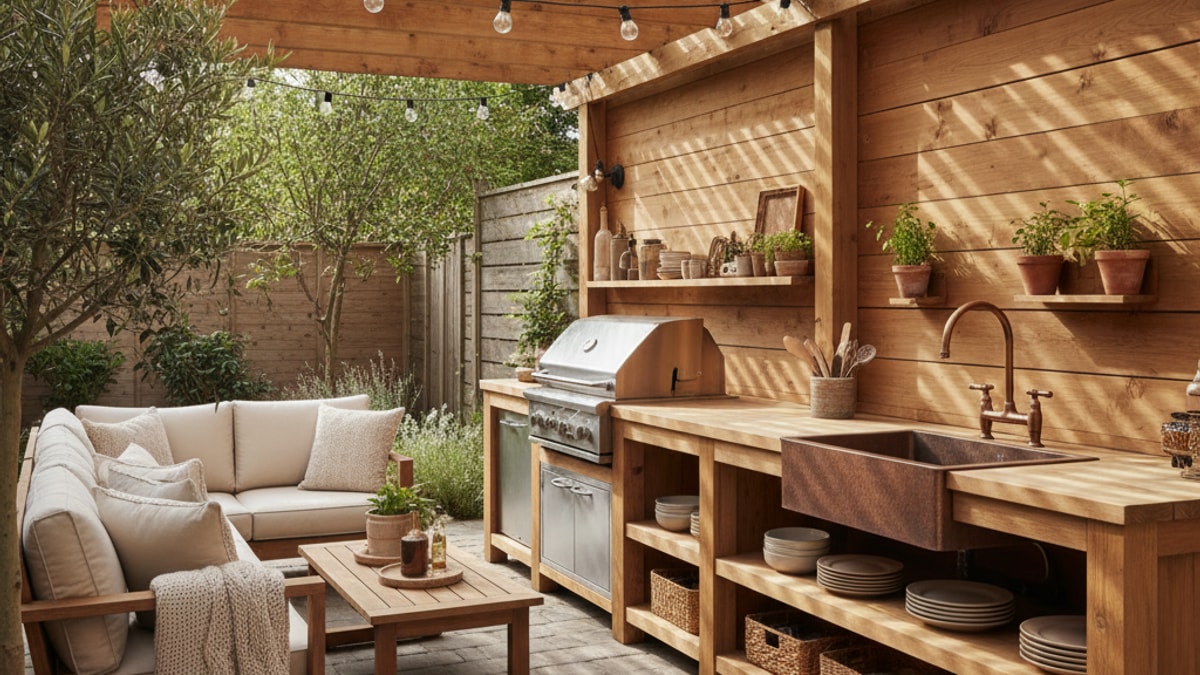
The question comes up a lot. More than you might think. Homeowners see these stunning, rustic outdoor kitchens in magazines and online, with rich cedar or warm teak framing a gleaming grill, and they ask us, “Can you build an outdoor kitchen with wood?” The short answer is yes. Of course, you can.
But the long answer—the one that really matters—is far more nuanced. It’s a “yes, but…” filled with critical considerations, non-negotiable safety protocols, and a deep understanding of materials science. A wood outdoor kitchen isn't just a project; it's a commitment. Our team has seen gorgeous wooden installations thrive for decades, and we've also been called in to assess catastrophic failures that could have been easily avoided. The difference is always in the details, the planning, and an unflinching respect for the elements: fire, water, and time.
The Allure of Wood: Why We Even Ask the Question
Let’s be honest, the appeal is undeniable. Stone and stainless steel are sleek, modern, and incredibly durable, but they can sometimes feel cold or clinical. Wood is different. It’s organic. It has warmth, texture, and character that no manufactured material can replicate. It connects your culinary space to the natural landscape around it, creating a seamless transition from your home to your yard.
A well-designed wood kitchen feels less like an appliance station and more like a piece of custom furniture for your backyard. It evokes a sense of permanence and craftsmanship. Whether you’re envisioning a sprawling entertainment hub or a cozy corner for family barbecues, wood offers a design versatility that can feel both timeless and deeply personal. It’s this emotional connection, this aesthetic pull, that keeps the dream of a wood outdoor kitchen alive. It’s beautiful. It’s inviting. And when done right, it’s absolutely spectacular.
Let's Be Honest: The Challenges Are Real
Before we get into the how-to, we need to talk about the why-not. Or, more accurately, the “why you need to be extremely careful.” Ignoring these realities is where projects go wrong. Wood, for all its beauty, has three formidable adversaries in an outdoor setting, especially when you introduce high-heat cooking appliances into the mix.
First, there’s fire. This is the big one, the most immediate and dangerous threat. Wood is combustible. Placing a 700-degree grill inside a wooden structure without impeccable planning and the right safety components is a recipe for disaster. We can’t stress this enough.
Second, there’s water. Rain, humidity, splashes from a nearby sink or pool, even morning dew—they all want to seep into the wood. Once moisture gets in, it invites rot, mildew, and decay, compromising the structural integrity and the beauty of your kitchen from the inside out.
Finally, you have pests. Termites, carpenter ants, and other wood-boring insects see a wooden outdoor structure as an open invitation for a feast. An untreated or poorly maintained kitchen can become a home for critters you definitely don’t want near your food prep areas.
Facing these challenges doesn’t mean you have to give up on the idea. Not at all. It just means you have to be smarter, more deliberate, and more invested in the process from the very beginning. It means the foundation of your project must be built on safety and durability, not just looks.
Fire Safety Isn't a Suggestion—It's a Mandate
This is the part of the conversation where we get serious. There is zero room for error when combining fire and wood. Zero. Building a safe, compliant wooden outdoor kitchen revolves around one core concept: isolation. You must isolate the intense heat of your grill from every single piece of combustible material.
How do we accomplish this? Through a multi-layered defense system.
The Insulated Grill Jacket: This is the single most critical component. An insulated jacket (or grill liner) is a stainless steel box that your built-in grill head sits inside. It’s engineered with a double wall, creating an air gap that prevents the tremendous heat generated by the grill from transferring to the surrounding structure. Most grill manufacturers specify that their products must be installed with an insulated jacket when placed in a combustible enclosure like wood. Skipping this is not an option. It’s a fire code violation in many areas and just plain reckless.
Non-Combustible Framing Around the Grill: Even with a jacket, our team always builds the immediate cavity around the grill with steel studs. While the rest of the kitchen frame might be wood, the bay that holds the grill and jacket should be metal. This provides a crucial extra layer of protection right where the heat is most concentrated.
Proper Ventilation: Heat needs to escape. A buildup of heat and gas within a combustible enclosure is incredibly dangerous. The grill jacket and the cabinet cavity itself must be properly ventilated according to the manufacturer's specifications. This usually involves installing stainless steel vent panels—typically two, placed on opposite sides of the cabinet to create cross-flow—that allow cool air to enter and hot air to escape.
Strategic Clearances: Pay close attention to the required clearances. Your grill manufacturer will provide a detailed manual specifying the minimum distance the grill must be from any combustible vertical surfaces (like the wall of your house) or overhead structures (like a pergola). These numbers are not suggestions. A comprehensive plan, often part of a professional Landscape Design SAN Diego service, will account for these clearances from the very start, ensuring the kitchen is placed in a safe and functional location within your yard.
Following these steps turns a high-risk concept into a manageable, safe installation. It’s a technical process, and one where professional guidance is invaluable.
Naples Outdoor Kitchen FL
This video provides valuable insights into can you build an outdoor kitchen with wood, covering key concepts and practical tips that complement the information in this guide. The visual demonstration helps clarify complex topics and gives you a real-world perspective on implementation.
Choosing the Right Wood: Not All Lumber is Created Equal
Once you’ve addressed the fire safety equation, your next major decision is the wood itself. The type of wood you choose will have a colossal impact on your kitchen's lifespan, its maintenance requirements, and its overall cost. You can’t just grab standard pine from a big-box store and expect it to survive.
Our experience shows that success hinges on selecting wood with natural resistance to the outdoors. Here are the primary categories we work with:
Naturally Resistant Hardwoods: These are the top-tier choices. Woods like Ipe, Teak, and Cumaru are incredibly dense, oily, and naturally resistant to rot, moisture, and insects. They are the gold standard for outdoor construction. They are, however, also the most expensive and can be more difficult to work with due to their density. An Ipe kitchen, properly maintained, can last for 50 years or more. It’s a true long-term investment.
Naturally Resistant Softwoods: Woods like Cedar and Redwood are excellent options that offer a great balance of durability and workability. They contain natural oils (tannins) that make them resistant to decay and insects. They’re not as dense or long-lasting as Ipe, but they are significantly more affordable and still provide decades of reliable service when cared for. Their rich color is a huge part of their appeal.
Pressure-Treated (PT) Wood: This is typically Southern Yellow Pine that has been chemically treated to resist rot and insects. It's the most budget-friendly option and is perfectly suitable for the internal framing of the kitchen, especially if it's protected from direct weather. We are very selective about using it for visible surfaces like doors or cladding, as it can be prone to warping and cracking over time if not properly sealed and maintained.
Thermally Modified Wood: This is a newer technology where wood is heated in a controlled, oxygen-free environment. The process changes the cell structure of the wood, making it far more stable and resistant to rot and moisture. It’s a fantastic, eco-friendly option that offers durability comparable to tropical hardwoods without the same environmental impact. It's a choice we're increasingly recommending to clients.
Here’s a quick comparison of the most common choices:
Wood Type
Durability & Lifespan
Maintenance Level
Cost Factor
Key Feature
Ipe / Teak
Exceptional (40+ years)
Low to Medium
$$$$
Extreme density, natural rot/insect resistance. The ultimate choice.
Cedar / Redwood
Very Good (20-30 years)
Medium
$$$
Natural beauty, good rot/insect resistance, easier to work with.
Thermally Modified
Excellent (25+ years)
Low
$$$
High stability, eco-friendly, rot resistant. A modern alternative.
Pressure-Treated Pine
Good (15-20 years)
High
$
Most affordable. Best for internal framing, requires diligent sealing.
The Unseen Enemy: Moisture, Rot, and Pesky Critters
Fire might be the fast and flashy threat, but water is the slow, silent killer of wood outdoor kitchens. A relentless campaign against moisture is essential for the longevity of your investment. This battle is fought on two fronts: construction and maintenance.
During construction, every detail matters. The entire wooden structure should be built on a solid, non-porous base. Building directly on soil is out of the question. A proper foundation of Concrete SAN Diego or high-quality Pavers SAN Diego is the first line of defense, preventing ground moisture from wicking up into the frame. We also design our structures with small air gaps at the bottom to promote drainage and airflow, ensuring the base of the frame can dry out completely.
Every single cut end of every single board must be sealed. This is a step amateurs often skip, but it’s critical. The end grain of wood is like a bundle of straws, ready to suck up any available moisture. Sealing these ends prevents water from getting into the heart of the lumber.
The countertop you choose also plays a massive role in water management. A solid, non-porous surface like granite, quartzite, or concrete is ideal. It should be installed with a slight overhang (a drip edge) to direct water away from the wooden cabinet faces below. The seam between the countertop and any backsplash must be impeccably sealed with a high-quality outdoor-grade silicone caulk.
Finally, the finish is your kitchen’s raincoat. A high-quality penetrating oil or sealant needs to be applied to every square inch of the wood—inside and out—before the appliances are even installed. This finish will need to be reapplied periodically as part of a regular maintenance routine.
Smart Design Strategies for a Wood Outdoor Kitchen
Great design can mitigate many of wood’s inherent risks while maximizing its beauty. One of the most effective strategies our team employs is a hybrid approach. Instead of an all-wood structure, we might design a kitchen with a durable masonry block or steel frame base and then clad it with beautiful wood panels or doors. This gives you the best of both worlds: the stunning look and feel of wood on the exterior, with a non-combustible and rot-proof core that houses the grill and provides structural integrity.
This approach opens up a world of possibilities. You could have a base built from decorative concrete block, clad in gorgeous cedar planks, and topped with a polished concrete countertop. It’s a sophisticated look that is also incredibly robust. It’s this kind of thoughtful integration that defines our Outdoor Kitchens SAN Diego projects.
Another key design element is protection from above. Placing your wood kitchen under a solid roof or one of our custom Patio Covers Pergolas SAN Diego can dramatically extend its life. It shields the wood from the harshest sun and the heaviest rains, significantly reducing the maintenance burden and slowing the natural aging process of the wood.
The complexity of blending these materials, ensuring proper drainage, and creating a functional layout that is also safe and beautiful is significant. It’s why many homeowners find that starting with a professional design process is the most valuable first step. If you're feeling overwhelmed by the variables, don't hesitate to BOOK MY FREE CONSULTATION. We can walk you through the options and help you visualize a solution that fits your space and lifestyle perfectly.
The Frame Game: Building a Structure That Lasts
Let’s look deeper at the skeleton of your kitchen. The framing provides all the support for your heavy countertops, appliances, and cladding. You essentially have two primary choices for the frame: pressure-treated wood or galvanized steel studs.
Pressure-treated wood is the more traditional choice. It’s strong, relatively inexpensive, and familiar to any experienced carpenter. When building a wood frame, we use exterior-grade fasteners and hardware (stainless steel or hot-dipped galvanized) to prevent rust and corrosion, which can compromise the joints over time. The key, as mentioned before, is to keep it dry. A well-designed, well-sealed wood frame can last for many, many years.
Light-gauge steel framing, however, is becoming an increasingly popular choice, and for good reason. Steel studs are perfectly straight, they don’t warp or twist, and they are completely impervious to rot, moisture, and insects. They are also non-combustible, which makes them the undisputed champion for framing the area around the grill. While the material cost is slightly higher and it requires different construction techniques, the peace of mind and longevity it provides are often worth the investment. A hybrid frame—steel for the hot zone and wood for the remaining sections—is often a fantastic compromise between cost and ultimate durability.
Maintenance: The Long-Term Commitment to Your Wood Kitchen
There is no such thing as a maintenance-free wood outdoor kitchen. That’s the reality. Embracing a simple, consistent maintenance schedule is the secret to keeping your kitchen looking beautiful and functioning safely for years to come.
What does that look like? At least once a year, you should give your kitchen a thorough inspection. Check all the joints, look for any signs of water damage or pests, and ensure all hardware is tight. Give it a gentle cleaning with a pH-neutral wood cleaner to remove any dirt, pollen, or mildew that may have accumulated.
The most important task is refinishing. Depending on your climate and the wood’s exposure to the sun, you’ll likely need to reapply a coat of sealant or oil every 1-3 years. This is what feeds the wood and renews its protective barrier against UV rays and moisture. It’s a bit of work, but it’s also incredibly rewarding to see the wood’s rich color and grain spring back to life after a fresh coat.
Think of it like owning a classic car. It requires a bit more love and attention than a basic sedan, but the pride of ownership and the sheer joy it brings are unparalleled.
So, can you build an outdoor kitchen with wood? Absolutely. It’s a project that marries natural beauty with sophisticated engineering. It requires a healthy respect for the materials and an uncompromising approach to safety. It’s not the simplest path, but for those who value the warmth, character, and timeless appeal of real wood, the result can be the undisputed heart of the home—a stunning, functional space where memories are grilled to perfection for years to come.
Frequently Asked Questions. Here are some common questions. Find the answers you're looking for below.
What is the best type of wood for an outdoor kitchen?
Tropical hardwoods like Ipe and Teak are the gold standard for their incredible density and natural resistance to rot and insects. For a balance of durability and cost, Cedar and Redwood are also excellent, popular choices.
Is an insulated grill jacket really necessary for a wood kitchen?
Yes, it is absolutely non-negotiable. An insulated jacket creates a protective air barrier, preventing the grill's intense heat from transferring to the combustible wood structure. Most grill manufacturers mandate its use for safety and warranty purposes.
Can I use composite decking material to build my outdoor kitchen?
We strongly advise against using composite decking for the primary structure. While it's great for decks, it lacks the structural integrity needed for a kitchen frame and can melt or warp under the high heat generated by a built-in grill.
How often do I need to seal a wood outdoor kitchen?
This depends on your climate and sun exposure, but a good rule of thumb is every 1 to 3 years. You'll know it's time when water stops beading on the surface and starts to soak in. Regular sealing is critical for longevity.
What's a better countertop for a wood kitchen: granite or concrete?
Both are excellent choices. Granite and other natural stones like quartzite are extremely durable and non-porous. Poured concrete offers a modern aesthetic and can be customized, but it must be impeccably sealed to prevent staining and water absorption.
Should the framing for my wood kitchen be wood or metal studs?
A hybrid approach is often best. We recommend using galvanized steel studs for the bay that houses the grill due to their non-combustibility. Pressure-treated wood framing is perfectly suitable for the remaining cabinet structure.
How do I prevent pests like termites from damaging my wood kitchen?
Start by using naturally resistant or pressure-treated wood. Ensure the kitchen is built on a concrete or paver base, not directly on soil. Finally, regular sealing and inspections will help deter any pests from taking up residence.
Can I place a wood outdoor kitchen directly against my house?
This requires extreme caution and adherence to local fire codes and grill manufacturer specifications for clearance. Generally, a significant air gap is required, and the wall siding in the immediate area should be non-combustible.
What is the biggest mistake people make when building a wood outdoor kitchen?
The most common and dangerous mistake is failing to properly isolate the grill's heat. This includes skipping the insulated jacket, ignoring ventilation requirements, or not using non-combustible materials around the grill opening.
Does a pergola or patio cover help protect a wood kitchen?
Absolutely. A roof structure provides significant protection from direct sun and rain, which dramatically slows the wood's aging process and reduces your maintenance workload. It's one of the best ways to protect your investment.
Is a wood outdoor kitchen more expensive than a stone or stucco one?
It can be, especially if you opt for premium hardwoods like Ipe or Teak. The material costs for these woods can exceed that of many stone veneers. However, using a more common wood like Cedar can result in a comparable price point.
How do I clean my wood outdoor kitchen?
Use a soft brush and a gentle, pH-neutral wood cleaner. Avoid pressure washers, as they can be too aggressive and damage the wood fibers. A simple annual cleaning before re-sealing is usually all that's needed.



.webp)
.webp)