How to Install Outdoor Kitchen Doors The Right Way
An outdoor kitchen is more than just a grill on a patio. It's the heart of your backyard, the central hub for gatherings, and a testament to your love for good food and great company. We've designed and built countless Outdoor Kitchens, and our team knows that the final details are what separate a good project from a truly spectacular one. And one of the most crucial finishing touches—one that homeowners often underestimate—is the installation of the access doors and drawers.
It might seem like a simple task, but how you install outdoor kitchen doors can make or break the entire look and functionality of your island. A crooked door, a poorly sealed frame, or a wobbly handle screams amateur work. It detracts from the beautiful stonework, the gleaming countertop, and the high-end appliances. Getting it right ensures a clean, professional aesthetic and protects the internal components of your island from weather and pests for years to come. It’s a detail we never compromise on, and you shouldn’t either.
First Things First: Planning and Preparation
Let’s be honest, the temptation to jump right in and start drilling is strong. We get it. But our years of experience have taught us one unflinching truth: meticulous preparation is the bedrock of a flawless installation. Rushing this stage is the number one cause of headaches, frustration, and costly mistakes down the line. Before you even think about picking up a power tool, you need to get these fundamentals absolutely right.
First, measure your rough openings. Then measure them again. Seriously. We can't stress this enough. Use a quality tape measure and check the height, width, and depth of the opening where your door unit will sit. Record these numbers, and then measure a third time just to be certain. An outdoor kitchen island is an unforgiving structure; unlike drywall, you can't just patch a misplaced hole. You're looking for consistency. Is the opening square? Use a framing square to check the corners. If they aren't perfect 90-degree angles, you'll need to account for that during the installation, which we'll cover later. This initial data is critical, non-negotiable.
Next, you need to deeply understand the material you're working with. Is your island framed with steel studs and covered in cement board and veneer? Is it constructed from concrete masonry units (CMU blocks) with a stucco finish? The composition of your island dictates the type of fasteners you'll need and the drilling technique you'll employ. Using a standard wood screw on a masonry block is a recipe for failure. It simply won't hold. You need the right tool for the job, and that starts with knowing what the 'job' actually is. This is a core principle in our comprehensive Landscape Design process—we plan for every material and every connection from the very beginning, ensuring there are no surprises during the build.
Finally, unbox your new doors and inspect them carefully. Don't wait until the moment of installation to discover a dent, a scratch, or a missing part. Check that the frame is square and that the doors themselves open and close smoothly. Place the unit on a flat surface to make sure it doesn't rock. This pre-flight check saves an immense amount of time and prevents you from installing a faulty product. It’s a simple quality control step that professionals never skip.
Choosing Your Tools and Materials
You wouldn't build a house with just a hammer, and you shouldn't approach this task with a flimsy toolkit. Having the right equipment not only makes the job easier but also drastically improves the quality of the final result. You don't need a sprawling workshop, but a few key items are essential.
Here’s what our installation crews at Modern Yardz carry for this specific task:
A High-Quality Level: Don't skimp here. A 24-inch level is a good all-around size for this project. You'll be using it constantly to ensure the door frame is perfectly plumb (vertically level) and level (horizontally). A cheap level can give you false readings, leading to a crooked installation that’s maddeningly difficult to fix.
Power Drill/Impact Driver: An impact driver is our team's preference for driving screws, as it provides more torque and reduces the chance of stripping the screw head. A standard power drill will work just fine, especially for drilling pilot holes.
Appropriate Drill Bits: This is critical. You'll need a bit for drilling pilot holes into the door flange (if they aren't pre-drilled) and a bit specifically designed for the island material. For steel frames, you'll need a cobalt bit. For masonry or concrete, a hammer drill and a masonry bit are non-negotiable.
Tape Measure & Pencil/Marker: For obvious reasons. A fine-tip permanent marker works well for marking on metal frames.
Caulking Gun and Outdoor-Rated Silicone Sealant: This is the professional secret weapon. A quality 100% silicone sealant creates a waterproof barrier between the door frame and the island, preventing moisture intrusion. Choose a color that matches your island finish or the door's stainless steel.
Shims: We prefer composite or plastic shims over wood, as they are waterproof and won't rot over time. These small wedges are invaluable for making tiny adjustments to get the door perfectly aligned in the opening.
The Correct Fasteners: The screws or anchors you use are just as important as the door itself. Using the wrong type will lead to rust, corrosion, and eventual failure. This is so important that it deserves its own breakdown.
Fastener Type
Best Use Case
Why We Recommend It
Potential Pitfalls
304/316 Stainless Steel Screws
Metal-framed islands with cement board or backer board.
Excellent corrosion resistance, making them ideal for outdoor exposure. 316 offers superior protection in coastal or saltwater environments.
Can be more brittle than standard steel; always drill a pilot hole to prevent snapping. Not suitable for masonry.
Tapcon® Style Masonry Screws
Concrete block (CMU), poured concrete, or brick islands.
Designed to cut their own threads into masonry. They offer a secure hold without the need for a separate plastic anchor.
Requires a hammer drill and specific masonry bit size. Over-tightening can strip the threads in the block.
Sleeve or Wedge Anchors
Heavy-duty applications or when securing to solid stone.
Provide immense holding power by expanding within the drilled hole. Ideal for very large or heavy door units.
Can be overkill for standard access doors. The hole size must be precise, and they are a permanent installation.
Exterior-Grade Construction Adhesive
Supplemental holding power in combination with mechanical fasteners.
Adds an extra layer of security and helps seal small gaps. Reduces vibration.
Should not be used as the sole method of attachment. Messy to clean up if over-applied.
Choosing the right fastener isn't just a suggestion; it's a requirement for a durable, long-lasting installation. We've seen beautiful Pavers patios stained with rust streaks running down from an outdoor kitchen island, all because the installer used cheap, zinc-plated screws instead of stainless steel. It’s a small detail with catastrophic visual consequences.
The Installation: A Step-by-Step Professional Process
Alright, you’ve done your prep work, you’ve gathered your tools, and you understand your materials. Now it's time for the main event. We're going to walk through this just like our team would on a job site. Follow these steps methodically, and don't rush.
Step 1: The Dry Fit
This is a non-negotiable first step. Carefully place the door unit into the rough opening. Don't try to force it. It should slide in with a small, consistent gap (ideally 1/8" to 1/4") around the entire perimeter. This gap will allow for adjustments and sealant. Check the face of the door frame against the island finish. Does it sit flush? Are there any large, unsightly gaps? If the opening is too tight, you may need to grind it slightly (if masonry) or trim it (if a framed structure). If it's too loose, you'll rely on your shims in the next steps. This dry fit tells you everything you need to know before you make a permanent commitment with a drill.
Step 2: Level, Plumb, and Shim
With the door unit still sitting in the opening, place your level on top of the frame. Is it perfectly level? If not, use your composite shims to lift the low side until the bubble is dead center. Now, place the level against the side of the frame. Is it perfectly plumb? You may need to insert shims behind the side flanges to push the frame forward or backward until it’s perfectly vertical. Check both sides. A door that isn't plumb will swing open or closed on its own, which is incredibly annoying. A door that isn't level will look crooked and create uneven gaps. Take your time here. This alignment is what separates a DIY job from a professional one.
Step 3: Mark Your Holes
Once you're satisfied that the door is perfectly positioned, level, and plumb, it's time to mark your screw locations. Most outdoor kitchen doors have pre-drilled holes in the frame flange. Use your fine-tip marker or pencil to mark the center of each hole directly onto the face of your island. If your unit doesn't have pre-drilled holes, you'll need to create them. We recommend drilling them now, while the unit is out of the opening. A good rule of thumb is to place a hole in each corner and then every 12-16 inches in between.
After marking, carefully remove the door unit and set it aside. Your marks should be clear and precise. This is your point of no return.
Step 4: Drill the Pilot Holes
Select the correct drill bit for your island material and fastener type. If you're using Tapcon screws, the packaging will tell you the exact size masonry bit to use. This is crucial—too small and the screw won't go in, too large and it won't grab. When drilling into masonry or stone veneer, start slow to prevent the bit from 'walking' away from your mark. For steel studs, a small pilot hole will prevent the self-tapping screw from wandering and ensure it bites securely. Only drill to the depth required for your fastener. No need to go deeper.
Step 5: Apply the Sealant
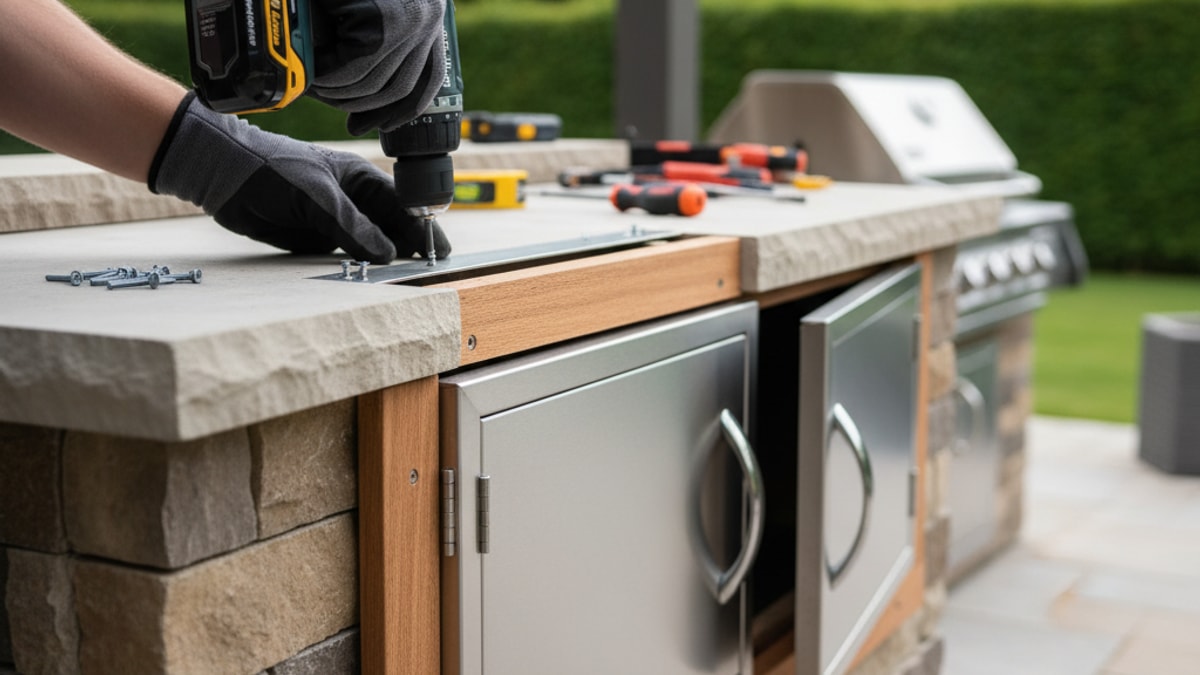
Here's the pro move that many DIY guides skip. Grab your caulking gun and apply a continuous, thin bead of 100% silicone sealant on the back of the door frame's flange—the part that will make contact with the island. This bead doesn't need to be huge; a 1/4-inch bead is plenty. This creates a gasket that will compress when you tighten the door, forming a watertight and pest-proof seal. It's an indispensable step for protecting the interior of your island, especially the gas lines and electrical wiring that might be housed inside.
Step 6: Set and Secure the Door
Time for the final placement. Carefully press the door unit, with its bead of wet silicone, back into the opening. The silicone will help hold it in place temporarily. Insert your first screw, but don't tighten it all the way. We recommend starting with a top corner. Get a second screw in the opposite bottom corner, again, just snug. Now, do one final check with your level. Make any last-millimeter adjustments before proceeding. Once you're certain it's perfect, drive the remaining screws. Tighten them until they are snug, but do not over-tighten. Over-tightening can warp the frame, causing the doors to bind. You should see a tiny bit of silicone squeeze out around the edge of the frame. That's a good sign.
Step 7: Clean Up and Admire
Before the silicone cures, use a damp cloth or a paper towel with a bit of denatured alcohol to wipe away any excess that has squeezed out. This creates a clean, sharp line. Peel off any protective plastic film from the stainless steel. Open and close the doors several times to ensure they operate smoothly without rubbing or binding. Then, step back and admire your work. You've just completed a critical step in creating a truly functional and beautiful outdoor kitchen.
Naples Outdoor Kitchen FL
This video provides valuable insights into how to install outdoor kitchen doors, covering key concepts and practical tips that complement the information in this guide. The visual demonstration helps clarify complex topics and gives you a real-world perspective on implementation.
When Things Go Wrong: Common Mistakes to Avoid
Even with the best instructions, things can go awry. Our team has been called in to fix plenty of installations, and we see the same mistakes over and over again.
The Crooked Door: This almost always stems from not using a level properly or rushing the shimming process. The fix is frustrating: you have to remove the unit, clean off the old silicone, and start over. Take the extra five minutes during Step 2. It's worth it.
The Rusty Weep: As mentioned, this is a direct result of using the wrong fasteners. Cheap plated screws will rust within months, leaving ugly orange streaks down your beautiful island finish. There's no easy fix for the stains. The only solution is to prevent it by using high-quality stainless steel from the start.
The Drafty Gap: This happens when you forget the silicone sealant. It might look fine, but you're leaving a direct path for water, insects, and rodents to enter your island. This can lead to chewed wires, nests, and water damage. It's a simple step that provides massive protection.
The Warped Frame: This is a classic case of over-enthusiasm with the impact driver. Cranking down on the screws with too much force can bend the thin metal frame of the door unit, causing the doors to misalign and not close properly. The feel should be 'snug,' not 'cranked.'
Avoiding these pitfalls is about patience and attention to detail. It's the same philosophy we apply to all our projects, whether it's laying intricate Concrete work or installing complex Landscape Lighting. The details aren't just details; they're everything.
And sometimes, the best decision is knowing when to call for help. If your island has a complex stone veneer, if the opening is significantly out of square, or if you simply don't feel confident, there's no shame in bringing in a professional. A project like this is an investment, and ensuring it's done right protects that investment. If you're in the planning stages of a larger project, you can always BOOK MY FREE CONSULTATION with our design team to see how we integrate these elements seamlessly from the start.
An outdoor kitchen is a significant, sometimes dramatic, upgrade to your home and lifestyle. It becomes the stage for countless memories. The doors are a small but vital part of that stage. Installing them correctly ensures the performance is flawless, the look is impeccable, and the entire structure is built to last. It’s the kind of finishing touch that brings the whole vision together, turning a collection of materials into a cherished part of your home.
Frequently Asked Questions. Here are some common questions. Find the answers you're looking for below.
What is the best material for outdoor kitchen doors?
We almost exclusively recommend 304-grade stainless steel for its excellent balance of durability, corrosion resistance, and aesthetic appeal. For coastal areas with salt in the air, upgrading to 316-grade stainless steel provides superior protection against rust and pitting.
Can I install outdoor kitchen doors myself?
Yes, it's a manageable DIY project for someone with basic tool skills and patience. The key is meticulous measurement and preparation. However, if you're dealing with a difficult island material like natural stone or you're not confident, a professional can ensure a perfect, weatherproof fit.
How do I ensure my doors are perfectly level and plumb?
Don't trust your eyes. Use a quality 24-inch or longer level for accuracy. Place it on the top frame to check for level and against the side frames to check for plumb. Use composite shims to make micro-adjustments until the bubble is perfectly centered in both directions before you drill.
What's the most common mistake people make when installing these doors?
The most frequent mistake we see is using the wrong fasteners. Using interior-grade or zinc-plated screws will lead to rust and ugly stains on your island. Always invest in high-quality stainless steel screws or the appropriate masonry anchors for your island's construction.
Do I really need to use silicone sealant?
Absolutely. This is a critical step that professionals never skip. Applying a bead of 100% outdoor-rated silicone behind the door flange creates a waterproof and pest-proof seal, protecting the internal components and structure of your outdoor kitchen from the elements.
My rough opening isn't perfectly square. What should I do?
This is quite common. Your goal is to make the door unit itself level and plumb, even if the opening is off. You'll use shims to align the door correctly, and the door's flange will cover most minor imperfections in the opening. The final silicone bead will seal any remaining small, uneven gaps.
How much of a gap should I leave around the door unit in the rough opening?
Ideally, the rough opening should be about 1/4 inch to 1/2 inch larger than the door unit's insert dimensions (height and width). This provides enough wiggle room to shim the unit perfectly level and plumb and allows space for the sealant.
Can I install doors into an island finished with stone or brick veneer?
Yes, but it requires more care. You'll need a hammer drill and a quality masonry drill bit. It's crucial to drill into the solid structure behind the veneer (like the CMU block) and use appropriate masonry fasteners, not just into the veneer itself, which may not provide enough holding power.
How do I clean and maintain my new stainless steel doors?
For routine cleaning, use a soft cloth with warm water and a mild detergent. For a deeper clean or to remove fingerprints, use a dedicated stainless steel cleaner, always wiping with the grain of the metal. Avoid abrasive pads or harsh chemicals, which can scratch the finish.
What is the difference between an access door and a sealed pantry unit?
An access door is typically a simple frame and door providing access to the cavity for plumbing or gas lines. A sealed pantry or cabinet unit is a fully enclosed box with a gasketed door, designed to keep contents dry and protected from pests. The installation process is similar, but sealed units are often heavier.
Should I install the doors before or after the countertop is installed?
Our team prefers to install doors after the countertop is in place. This prevents any accidental damage to the doors during the heavy and messy process of setting the countertop. It also ensures you can get a perfect fit under the countertop overhang.



.webp)
.webp)