Getting Outdoor Counter Height Right: Your Definitive Answer
You're picturing it already, aren't you? The sizzle of the grill, the clink of glasses, friends and family gathered around the heart of your new backyard. An outdoor kitchen isn't just an addition; it's a lifestyle transformation. But in the midst of dreaming about smokers and sinks, there's a seemingly tiny detail that our team has seen make or break the entire experience: the counter height. It sounds simple. It sounds trivial. We're here to tell you it's one of the most critical, non-negotiable elements of a truly functional outdoor space.
Getting it wrong means a summer of aching backs from stooping over a prep surface that’s too low, or the awkward feeling of a bar top that’s just a bit too high for comfortable conversation. Getting it right, however, is magic. It’s the invisible thread of good design that makes your space feel intuitive, comfortable, and effortlessly usable. As a team that lives and breathes landscape architecture, we've spent years perfecting the science and art behind building exceptional Outdoor Kitchens SAN Diego, and this single measurement is something we obsess over. Let's dig into what we've learned.
The "Standard" Height: Why 36 Inches is the Starting Point
If you ask a dozen contractors 'how tall should an outdoor kitchen counter be,' most will give you a single number: 36 inches. And they're not wrong, exactly. It's the accepted industry standard. But we think of it as a starting point, not a final answer.
This 36-inch (or 3-foot) standard is borrowed directly from indoor kitchen design. For decades, it has been the established height for base cabinets, providing a comfortable working surface for a person of average height to chop vegetables, knead dough, and wash dishes. It's a proven, ergonomically sound dimension that translates quite well to the outdoors. Most drop-in appliances like grills, side burners, and outdoor sinks are manufactured with this standard height in mind, allowing for a seamless, built-in look. A 36-inch counter allows these components to sit flush, creating a clean, professional aesthetic.
So, if you're looking for a straightforward, no-fuss answer, 36 inches is a safe bet. It’s familiar, it's functional for most tasks, and it accommodates the widest range of off-the-shelf equipment. Easy, right?
Well, not always. The outdoors presents a different set of variables and opportunities that an indoor space just doesn't have. Sticking rigidly to the 36-inch rule without considering the bigger picture can be a missed opportunity for creating something truly special and personalized.
Thinking Beyond the Standard: Bar Height vs. Counter Height
This is where a thoughtful design process really begins to shine. One of the most popular and effective ways to elevate an outdoor kitchen is by introducing multiple levels. Specifically, by adding a raised bar-height section. It’s a significant, sometimes dramatic shift in functionality.
Let’s be honest, this is crucial. A standard 36-inch counter is a workspace. A 42-inch bar top is a social space.
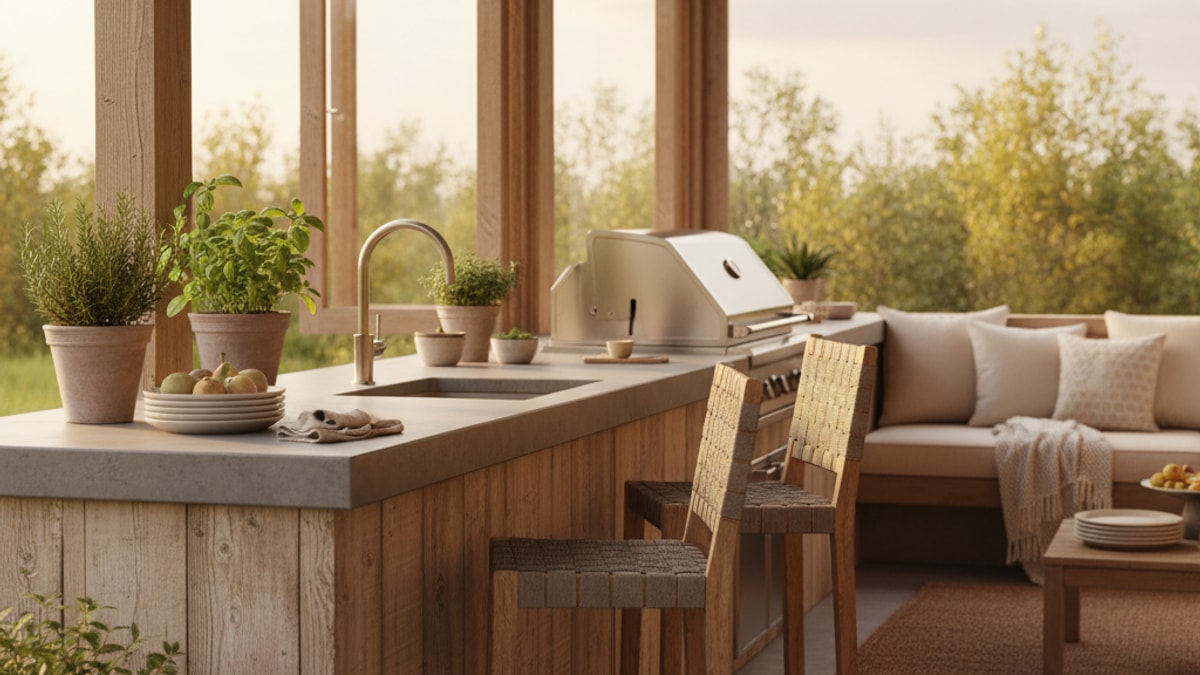
By building a bi-level island, you create a clear and intuitive separation between the 'chef’s zone' and the 'guest zone.' The working side remains at an ergonomic 36 inches for all your prep and cooking. The guest-facing side is raised to a more social height of around 42 inches. This raised ledge accomplishes several things at once. First, it subtly hides any mess on the prep counter from the view of those seated. Second, it creates a natural gathering spot. People can lean against it with a drink or pull up a bar stool without feeling like they are hovering over the person who is cooking. It’s more comfortable, more defined, and infinitely more social.
When planning for a 42-inch bar top, you need to pair it with the right seating. You’ll be looking for stools with a seat height of around 28 to 30 inches. This provides the perfect amount of legroom without making your guests feel like they're climbing into their seats. It’s this kind of integrated thinking, considering the furniture and flow from the very start, that separates a good outdoor kitchen from a truly phenomenal one.
Customization is King: Tailoring Height to Your Needs
Here’s what our experience shows: the 'perfect' height is ultimately the one that is perfect for you. Standards are fantastic guidelines, but your outdoor kitchen should be tailored to the people who will be using it most.
Are you or your partner particularly tall? A 36-inch counter might lead to uncomfortable stooping. We've designed stunning kitchens with 38-inch work surfaces that made a world of difference for our taller clients. Conversely, for a shorter individual, a 34-inch counter can feel far more natural and reduce shoulder strain. Don't be afraid to deviate from the standard. We can't stress this enough: mock it up. Stack some boxes or books on an existing table to find the height that feels best for your body while mimicking chopping or plating motions.
The primary function of a specific counter area also plays a formidable role. A dedicated pizza oven station, for instance, might need to be lower. Why? Because you need leverage to slide a heavy peel in and out of the oven. A lower surface, maybe around 30-32 inches, can provide better ergonomics for that specific task. On the other hand, a simple serving buffet or drink station with no appliances might be perfectly fine at the standard 36 inches or even slightly higher.
Thinking about long-term use and accessibility is also part of a comprehensive design. If you envision aging in place or have family members with mobility challenges, incorporating a section of counter at a lower, ADA-accessible height (typically 28-34 inches with proper knee clearance) can make the space inclusive and usable for everyone for years to come. This is the kind of forward-thinking that a professional Landscape Design SAN Diego process brings to the table.
Polishing Of Granite Counter Top(kitchen)
This video provides valuable insights into how tall should an outdoor kitchen counter be, covering key concepts and practical tips that complement the information in this guide. The visual demonstration helps clarify complex topics and gives you a real-world perspective on implementation.
How Appliances Dictate Your Counter Dimensions
We’ve seen this happen. A client buys a beautiful, high-end, kamado-style grill—think Big Green Egg or Kamado Joe—and wants to build it into their new kitchen island. The problem? These grills are deep. Setting one into a standard 36-inch counter would place the cooking grate far too low, forcing the user to hunch over uncomfortably. It's a catastrophic design flaw that could have been easily avoided.
This is why we always say the appliances come first. Before we even think about pouring concrete or laying a single block, we need the exact specifications for every single piece of equipment you plan to install. A drop-in grill has a specific cutout dimension and height requirement. An outdoor refrigerator needs proper ventilation space. A kegerator has a tap that needs to clear any upper structures. The appliance specs are not suggestions; they are rules that dictate the foundational structure of your kitchen.
Our process involves designing the entire kitchen around your chosen appliances, not trying to shoehorn them in later. For that kamado grill, the solution is often a dedicated, lower counter section. By dropping that portion of the island to around 24-28 inches, the grill's cooking surface ends up at a perfect, ergonomic height. It creates a multi-level, dynamic look that is also supremely functional. It all comes down to planning.
The Material Question: How Thickness Impacts Final Height
Now, this is where it gets interesting and where professional expertise becomes invaluable. You've decided on a 36-inch finished height. But what is that counter being made of? The thickness of your chosen countertop material directly impacts the height of the underlying support structure.
A sleek, modern countertop made from a 2-inch thick slab of poured Concrete SAN Diego requires a base structure built to 34 inches. A more traditional design using a thinner granite or quartzite slab (typically 1.25 inches thick) on top of a cement board underlayment might need a base built to 34.25 inches. If you're opting for tile, you have to account for the thickness of the tile itself plus the mortar bed.
Does a quarter-inch really matter? Absolutely. It's the difference between an appliance fitting perfectly flush or sitting awkwardly proud of the surface. It’s the difference between a clean, waterproof seal and a gap that allows moisture to penetrate the base structure, leading to long-term damage. Our team calculates these tolerances with precision, ensuring that the finished height is exactly what was planned, regardless of the materials being used. It's a nuanced detail, but it's the details that ensure longevity and a flawless look.
The Seating Equation: Getting Leg Room and Clearance Just Right
So you've decided on a beautiful bi-level island with a 42-inch bar top for seating. The job isn't done. Now you have to engineer the space for people to actually sit there comfortably. The most important measurement here is the countertop overhang, which creates the knee space for anyone sitting at the bar.
We recommend a minimum overhang of 12 to 15 inches for a standard 36-inch counter where you might want to tuck stools. For a 42-inch bar top, a minimum of 10 to 12 inches is sufficient. This gives guests enough room to sit without knocking their knees against the cabinet base. Trying to skimp on this overhang is a common mistake that renders the seating area almost useless.
But wait, there's more to understand. You also need to plan for clearance behind the seats. How much space do you need to pull out a stool and comfortably sit down? And how much space do you need for someone to walk behind a person who is already seated? Our rule of thumb is to allow at least 36 inches of open space behind the spot where the stools will be. If it's a major walkway or thoroughfare in your backyard, we push that to 48 inches or more. This prevents bottlenecks and ensures your beautiful new kitchen enhances the flow of your yard instead of obstructing it.
Here’s a simple breakdown to help visualize the differences:
Feature
Standard Counter Seating
Bar Height Seating
Finished Height
34" - 36"
40" - 42"
Primary Use
Casual seating, food prep
Socializing, serving drinks, dining
Required Stool Height
24" - 26" stools
28" - 30" stools
Minimum Knee Overhang
12" - 15"
10" - 12"
Pros
Creates a large, single-level work surface
Creates a distinct social hub, hides prep mess
Cons
Guests may feel like they are in the work zone
Not ideal for food prep or as a work surface
Don't Forget the Ground Beneath Your Feet
An outdoor kitchen doesn't exist in a vacuum. It's built upon a foundation, and that foundation has its own set of rules. Whether your kitchen sits on a deck, a concrete slab, or an intricate layout of Pavers SAN Diego, the surface itself is a critical factor.
Every patio we build has a slight, almost imperceptible slope—typically about a quarter-inch drop per foot. This is essential for proper drainage, preventing water from pooling around your home's foundation or your new kitchen island. But this slope means that one end of a 10-foot-long island might be technically 2.5 inches lower than the other relative to a level line. A professional design and build team accounts for this from the start. We ensure the countertop itself is perfectly level, while the base is scribed to the slope of the patio. This is a complex step that DIY projects often miss, resulting in a visibly slanted counter.
The final grade of the entire yard plays into this. We consider the whole environment, ensuring the kitchen feels integrated and that its height makes sense relative to other elements like adjacent Seat Retaining Walls or the threshold of the door leading into the house. It's a holistic approach that guarantees the final product feels intentional and impeccably executed.
Our Process: How We Guarantee the Perfect Height Every Time
We don't guess. We don't assume. We have a meticulous process to ensure every dimension is perfect for you and your space. It starts the moment you BOOK MY FREE CONSULTATION.
First, we listen. We talk about how you plan to use the space, who will be using it, and what your dream setup looks like. We'll discuss your height, your preferred cooking style, and your entertainment habits. Then, we move to the design phase. We'll help you select appliances and materials, getting the exact specifications for every component. Using this information, our designers create detailed 3D renderings of your new kitchen. You'll be able to see exactly how the different heights look and feel, and we can make adjustments with a few clicks of a mouse—long before it costs time and money to change on-site.
Once the design is approved, our build team takes over. But we don't just hand them a blueprint. We're on-site, measuring and confirming every single step. We use laser levels to account for patio slope and ensure a perfectly horizontal work surface. We build the base structure to the precise height needed to accommodate your specific countertops and appliances. It's this relentless attention to detail that ensures the final reveal is everything you dreamed of and more. It’s comprehensive.
Ultimately, the right counter height is the one that feels right for you. It’s a subtle detail that makes a world of difference, turning a beautiful structure into a space you’ll genuinely love to use for years to come. It's about blending impeccable design with the rhythm of your daily life, and that's the kind of detail our team obsesses over, ensuring every project is not just built, but masterfully crafted.
Frequently Asked Questions. Here are some common questions. Find the answers you're looking for below.
What is the best height for an outdoor pizza oven counter?
We generally recommend a lower counter height for pizza ovens, typically between 30 and 34 inches. This provides better leverage and ergonomics for sliding the heavy pizza peel in and out of the oven safely and comfortably.
Should my grill counter be lower than my prep counter?
It can be, especially for certain types of grills. For kamado-style cookers, a lower counter is almost essential for comfortable use. For standard drop-in grills, keeping them at the same 36-inch height as your prep space creates a seamless, unified work surface.
How much overhang do I really need for seating at my outdoor bar?
We can't stress this enough: don't skimp here. For a 42-inch bar, we recommend a minimum of 10-12 inches of clear knee space. For counter-height seating at 36 inches, you'll want a bit more, around 12-15 inches, for maximum comfort.
Is 38 inches too tall for a standard outdoor counter?
Not at all, especially if you or your family members are taller. A 38-inch counter can be significantly more comfortable and prevent back strain for taller individuals. The key is to customize the height to fit the primary users.
How does ADA compliance affect outdoor counter height?
ADA guidelines recommend a counter height between 28 and 34 inches, with adequate knee clearance underneath. Incorporating a section at this height can make your outdoor kitchen more accessible and inclusive for everyone.
What's the ideal height difference between a prep counter and a raised bar top?
The most common and visually pleasing difference is 6 inches. A 36-inch work counter paired with a 42-inch bar top creates a clear separation between the cooking and social zones without feeling disconnected.
Does my patio's slope affect how the counter height is measured?
Yes, absolutely. A professional installer will build the counter's base to match the patio's drainage slope but will ensure the final countertop surface is perfectly level. This is a critical step for both function and aesthetics.
How do I choose the right stool height for my counter?
The rule is to have about 10-12 inches of space between the seat and the bottom of the countertop. For a 36-inch counter, look for 24-26 inch stools. For a 42-inch bar, you'll need 28-30 inch stools.
Can I have three different counter heights in one kitchen?
Certainly. A multi-level design can be extremely functional. You might have a low section for a kamado grill, a standard prep area, and a raised bar for seating. This approach adds visual interest and customizes each zone for its specific task.
What is the most common mistake people make with outdoor kitchen counter height?
The biggest mistake we see is not planning for the specific appliances. People assume a standard height will work for everything, only to find their specialty grill is too low or their refrigerator doesn't fit correctly. Always design around your equipment.
Should the outdoor counter be the exact same height as my indoor kitchen counter?
It's a great starting point for consistency, especially if the spaces are visually connected. However, the outdoors offers more flexibility. Don't be afraid to adjust the height based on specific outdoor appliances or a desire for features like a raised bar.



.webp)
.webp)