How Long to Build an Outdoor Kitchen? An Expert Timeline
So, you're dreaming of an outdoor kitchen. We get it.
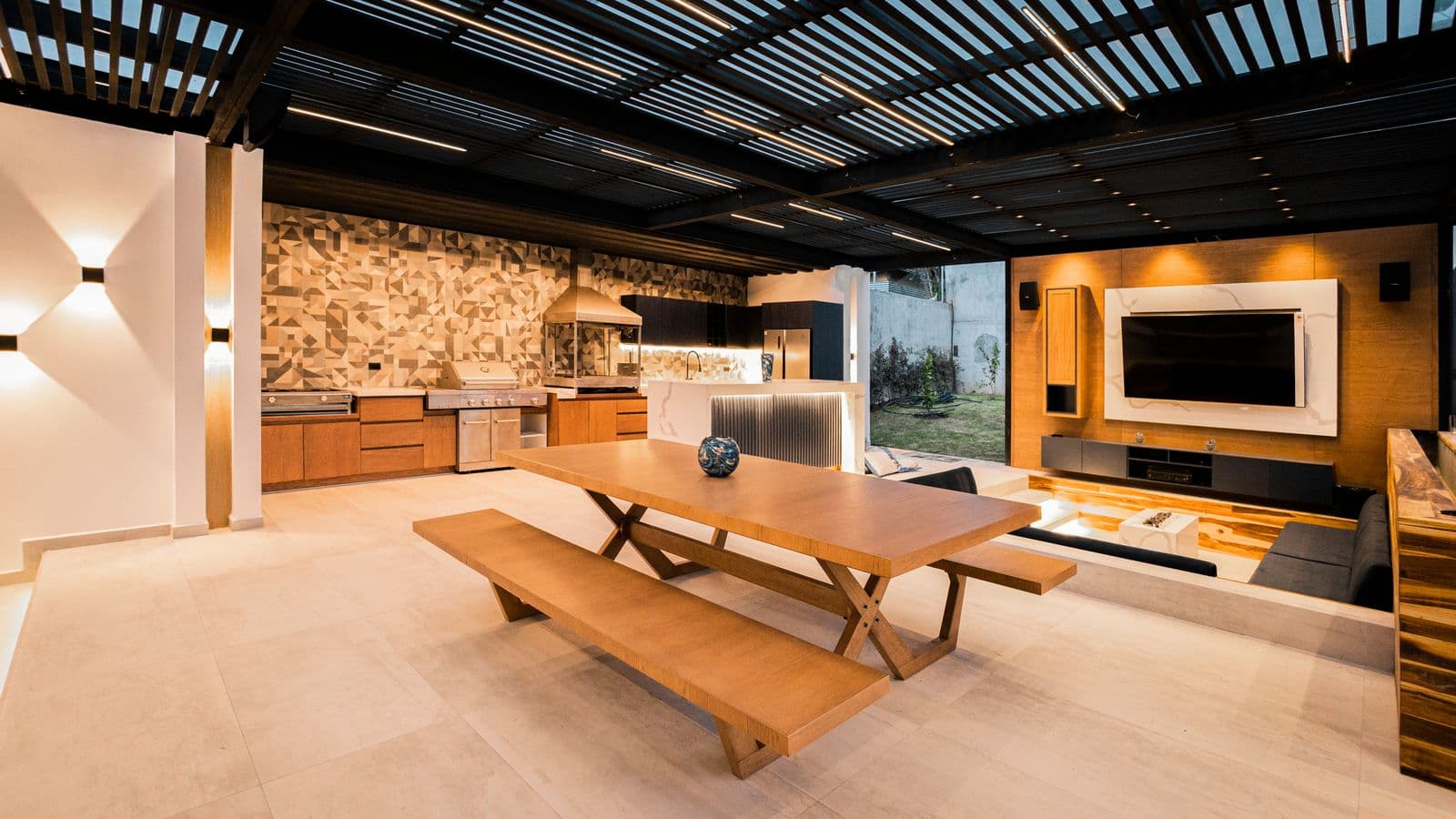
So, you're dreaming of an outdoor kitchen. We get it. You're picturing summer evenings with friends, the sizzle of a grill, and the perfect space to entertain without being stuck inside. It's a fantastic vision. But then, the practical questions start creeping in, and the biggest one we hear is always: how long does it take to build an outdoor kitchen? It's the million-dollar question, and the honest answer is... it depends. Frustrating, we know, but it's the truth.
The timeline for creating your backyard oasis isn't a simple, one-size-fits-all number. It's a nuanced journey influenced by design complexity, material choices, permitting, and a dozen other factors. At Modern Yardz, we've guided countless homeowners through this exact process, and our team has learned that transparency about the timeline is just as important as the quality of the final build. We're here to pull back the curtain and give you a realistic, phase-by-phase look at what the journey from a patch of grass to a gourmet outdoor kitchen really entails.
The First Step: Vision, Design, and Planning
This is where it all begins. It's arguably the most exciting phase, but it's also a critical, non-negotiable element that sets the stage for everything to come. Rushing here is a recipe for regret. Our experience shows that a well-thought-out design phase can actually _save_ time down the road by preventing costly changes and delays. The timeline for this phase can range from 1 to 4 weeks, sometimes longer for exceptionally intricate designs.
What's happening during this time? It's a whirlwind of creativity and logistics. You're not just picking a grill; you're crafting an experience. We work with clients to answer key questions: What's the primary use? Casual family barbecues or large-scale entertaining? Do you need a simple grill island or a sprawling L-shaped layout with a sink, refrigerator, pizza oven, and bar seating? The scope dictates everything. Our Landscape Design SAN Diego process is built around this collaborative discovery.
During these weeks, our team is translating your vision into tangible plans. This involves:
- Initial Consultation: We talk about your lifestyle, your budget, and your must-haves.
- Site Analysis: We measure the space, assess sunlight, drainage, and proximity to the main house. This is crucial for functionality.
- Concept Sketches & 3D Renderings: This is where you see your ideas come to life. We'll iterate on layouts, materials, and appliance placement until it's perfect. Seeing a 3D model eliminates guesswork.
- Material and Appliance Selection: Choosing between granite, concrete, or quartzite countertops isn't just an aesthetic decision; it impacts fabrication time. Selecting appliances requires checking for stock and lead times. We can't stress this enough: supply chain issues are real, and ordering appliances early is a pro move that can prevent massive delays later.
Honestly, the speed of this phase often depends on you, the homeowner. How quickly can you make decisions? How clear is your vision? Taking the time here ensures the final product is exactly what you dreamed of. Feeling overwhelmed by the choices is normal. It's precisely why a structured design process is so valuable, and it's a great time to BOOK MY FREE CONSULTATION so our experts can guide you through it.
Navigating the Labyrinth: Permits and Approvals
Ah, permits. No one's favorite topic, but an absolutely essential one. Forgetting or skipping this step is a catastrophic mistake. Depending on your project's scope and your local municipality's efficiency, the permitting process can take anywhere from 2 weeks to 3+ months. Yes, you read that right.
This is the part of the timeline that is most out of anyone's direct control. A simple grill island on a patio might not require a permit at all — the City of San Diego's Information Bulletin 201 confirms some gas-burning barbecues, fire pits and fireplaces need no Building/Combination permit. But the moment you start talking about running new gas lines, electrical wiring, or plumbing for a sink, you're entering permit territory — San Diego Municipal Code §129.0203 is explicit that a building-permit exemption is not an exemption from electrical, plumbing or mechanical permits. These regulations are in place for your safety, ensuring that all utility work is done to code by licensed professionals.
Our team handles this entire process, from submitting the detailed plans drafted in the design phase to communicating with the local building department. The CSLB's Building Official Information Guide confirms a C-27 landscape contractor may obtain those permits and contract for gas and electrical work when it is part of or incidental to an overall landscaping project. The timeline is influenced by the department's current workload, the complexity of your project, and whether they request revisions to the plans. We've seen straightforward approvals happen in a couple of weeks, while more complex projects involving extensive utility work or structural elements have sat in review for months. It's a waiting game, and it's important to factor this potential delay into your overall project schedule from day one. There is absolutely no construction that can begin until those approved permits are in hand.
It's a significant, sometimes dramatic, variable.
Laying the Foundation: Site Prep and Footings
Once the permits are approved, things finally start moving on-site. The site preparation and foundation phase typically takes about 1 to 2 weeks. This is where the physical transformation of your backyard begins. It's messy, but it's progress.
First, we define the exact footprint of your new kitchen. The area is excavated to the required depth. This might involve removing sod, relocating sprinklers, or dealing with existing landscaping. If your kitchen is being built on an existing concrete patio, we have to verify that the slab is thick enough and properly reinforced to handle the immense weight of the kitchen structure and countertops. You can't just build a heavy masonry kitchen on a standard 4-inch patio slab; it will crack. Our experience with Concrete SAN Diego projects gives us deep insight into these structural requirements.
If a new foundation is needed, we'll pour a reinforced concrete footing. This is the solid base upon which everything else rests. This step also includes trenching for the utility lines—gas, water, electrical, and drainage. Proper planning here is paramount. We need to know the exact location of every appliance to ensure the utility lines are placed with precision. Moving them later is a costly and time-consuming headache. This foundational work has to be impeccable. It's the unseen hero of your entire outdoor kitchen.
Naples Outdoor Kitchen FL
This video provides valuable insights into how long does it take to build an outdoor kitchen, covering key concepts and practical tips that complement the information in this guide. The visual demonstration helps clarify complex topics and gives you a real-world perspective on implementation.
The Hidden Network: Utility Rough-Ins
With the trenches dug and the foundation set, the next step is the utility rough-in. This phase usually takes 3 to 7 days and often happens in conjunction with the foundation work. It involves licensed plumbers and electricians running the necessary lines to their designated spots within the kitchen's footprint.
This includes:
- Gas Lines: For your grill, side burners, or fire features.
- Electrical Conduit: For outlets, refrigerators, rotisseries, and essential Landscape Lighting SAN Diego.
- Water Supply & Drain Lines: For your sink, ice maker, and dishwasher.
This work is meticulous. Once these lines are encased in concrete or buried, they are not easy to access. Everything has to be perfect. After the rough-ins are complete, they must be inspected by the city before any further construction can continue. This inspection is another potential point of delay, entirely dependent on the inspector's schedule. A passed inspection gives us the green light to move forward. A failed one means corrections and another waiting period for re-inspection.
Taking Shape: Framing and Structure
Now for the really exciting part. You finally get to see the three-dimensional form of your kitchen emerge. The framing stage typically takes 1 to 2 weeks. The structure rises from the foundation, and you can begin to visualize yourself cooking in the space.
There are two primary methods for framing:
- CMU (Concrete Masonry Unit) Blocks: This is a traditional, incredibly durable method. Masons build the walls of the kitchen island with cinder blocks, which are then covered with a veneer.
- Steel Framing: This involves building a frame with galvanized steel studs. It's lighter than block and offers more flexibility for custom shapes and cavities for appliances.
Our team at Modern Yardz is proficient in both methods, and the choice often comes down to the design, budget, and desired finish. During this phase, we're also creating the precise openings for your grill, access doors, refrigerator, and any other built-in components. Measurements must be exact, cross-referencing the specification sheets for every single appliance. A quarter-inch mistake here can cause major installation headaches later. It's all about precision.
| Feature | Prefab/Modular Kitchens | Custom-Built Kitchens |
|---|---|---|
| Design Flexibility | Limited to manufacturer's configurations and sizes. | Nearly infinite. Designed to fit your space and needs perfectly. |
| Installation Time | Faster: 1-3 days for placement and hookup once on site. | Slower: 4-8+ weeks for on-site construction. |
| Initial Lead Time | 2-8 weeks for manufacturing and delivery. | 1-4 weeks for design and material sourcing. |
| Total Timeline | 3-10 Weeks (Manufacturing + Install) | 8-16+ Weeks (Design + Permit + Build) |
| Site Disruption | Minimal. The unit arrives mostly assembled. | Significant. A full construction zone for several weeks. |
| Best For | Homeowners prioritizing speed and simplicity with a standard layout. | Homeowners wanting a unique, fully integrated design. |
Adding Personality: Veneer, Cladding, and Countertops
This is where your kitchen's aesthetic truly comes to life. Applying the exterior finish (veneer or cladding) and installing the countertops can take 1 to 3 weeks. The duration heavily depends on the materials chosen.
For the kitchen's vertical surfaces, you might choose from options like stacked stone, brick veneer, stucco, or tile. Each has its own installation process. Stucco requires multiple coats and curing time. Intricate stone patterns require a skilled mason and can be a painstaking, artistic process. This is the skin of your kitchen; it's what everyone will see first.
Countertop installation is a milestone. Once the base structure is complete, a fabricator will come to the site to create a precise template. They then take this template back to their shop to cut your chosen slab of granite, quartzite, or other material. This fabrication process can take 1-2 weeks alone. Once the countertop is ready, the installation itself is usually completed in a single day. But it's a delicate, heavy job that requires a skilled crew. This is a huge part of the investment in high-quality Outdoor Kitchens SAN Diego, and we ensure it's done perfectly.
The Heartbeat: Appliance Installation
With the structure and countertops in place, it's time to install the heart of the kitchen—the appliances. This phase typically takes 2 to 5 days. It's more than just sliding a grill into a hole. It's about careful, secure, and safe connections.
Our crews will install the grill, side burners, access doors, drawers, refrigerator, and any other components you've selected. The plumber and electrician return to perform the final hookups, connecting the appliances to the utility lines we roughed-in earlier. Every connection is tested thoroughly—we check for gas leaks, ensure water flows correctly, and test every electrical outlet and feature. Safety is non-negotiable. This step transforms the structure from a beautiful piece of masonry into a functional, high-performance kitchen.
The Final Flourish: Finishing Touches and Site Cleanup
We're in the home stretch. The final details can take another 1 to 2 weeks, and they are what elevate a good project to a great one. This phase is about integration with the rest of your backyard.
This can include:
- Finishing the surrounding patio: Whether it's laying the last of the beautiful Pavers SAN Diego or sealing the concrete.
- Installing a backsplash: If it's part of your design.
- Adding structures: A project might include Patio Covers Pergolas SAN Diego to provide shade and define the space.
- Landscaping: Planting new garden beds, installing fresh Artificial Turf SAN Diego around the area, or adding pottery.
- Final walkthrough and cleanup: We conduct a meticulous cleanup of the entire site. We then walk you through your new kitchen, showing you how to operate every appliance and care for the new surfaces. We don't consider a job finished until you are 100% satisfied and confident.
So, What's the Grand Total?
Let's add it up. If you're looking for a ballpark range, a custom outdoor kitchen project, from the very first design meeting to your first cookout, typically takes somewhere between 8 and 16 weeks.
Could it be faster? Possibly. For a very simple, prefabricated island with no complex utilities on an existing patio, you might be on the lower end of that spectrum. Could it be longer? Absolutely. A highly complex, large-scale kitchen with custom features, top-of-the-line appliances with long lead times, and a slow permitting office could easily stretch beyond 20 weeks. Our goal is always to set realistic expectations from the start.
The journey to building an outdoor kitchen is a significant undertaking, but it's also an incredibly rewarding one. It's an investment in your home and your lifestyle, creating a hub for memories that will last for years. Understanding the timeline and the process is the first step toward making that dream a reality.
Start Your Free Design Consultation
Tell us about your project and we'll be in touch within 24 hours. No pressure, no obligation.
Common questions
- How much time should I budget for a custom outdoor kitchen build?
- A custom outdoor kitchen typically takes between 8 and 16 weeks, from the first design meeting to your first cookout. A very simple prefabricated island with no complex utilities on an existing patio can land at the lower end, while a large, complex kitchen with long-lead appliances and a slow permitting office can stretch beyond 20 weeks.
- Do I need a permit to build an outdoor kitchen?
- It depends on scope: a simple grill island on a patio might not require a permit at all. But the moment you add new gas lines, electrical wiring, or plumbing for a sink, you're in permit territory. The team handles the whole process, and permitting can take anywhere from 2 weeks to 3+ months.
- Is a prefab outdoor kitchen faster than a custom-built one?
- Yes. A prefab or modular kitchen has a total timeline of about 3-10 weeks, with placement and hookup taking just 1-3 days once on site. A custom-built kitchen runs 8-16+ weeks because it's constructed on-site over 4-8+ weeks. Prefab suits speed and standard layouts; custom suits unique, fully integrated designs.
- How long does the design phase take before construction starts?
- The vision, design, and planning phase ranges from 1 to 4 weeks, sometimes longer for exceptionally intricate designs. It covers the initial consultation, site analysis, concept sketches and 3D renderings, and material and appliance selection. Its speed largely depends on how quickly you make decisions, and ordering appliances early prevents supply-chain delays later.
- Can I build an outdoor kitchen on my existing concrete patio?
- Sometimes, but the slab must be verified first. You can't build a heavy masonry kitchen on a standard 4-inch patio slab; it will crack. The team confirms the slab is thick enough and properly reinforced to handle the weight of the structure and countertops. Otherwise, a new reinforced concrete footing is poured.
Ready to design your dream yard?
Tell us about your project. We'll send back a real plan, not a templated quote.
Book My Free Consultation→