It’s a question we hear all the time from homeowners across San Diego County, from the coast in La Jolla to the inland hills of Poway. “How wide is a patio door?” And on the surface, it seems like a simple question looking for a simple number. But our team has learned—after designing and building hundreds of custom outdoor spaces—that it’s one of the most pivotal questions you can ask. It's not just about a measurement; it's about defining the entire relationship between your home and your yard.
The answer dictates more than just how you’ll get outside. It shapes the light in your living room, the flow of your parties, and that seamless indoor-outdoor lifestyle that makes living in Southern California so incredible. Get it right, and your home feels boundless. Get it wrong, and you’re left with a frustrating bottleneck. Here at Modern Yardz, we’ve made it our mission to help homeowners navigate these crucial decisions, ensuring every element, right down to the doorway, serves a greater vision. You can learn more about our philosophy on our About page.
It's More Than Just a Number
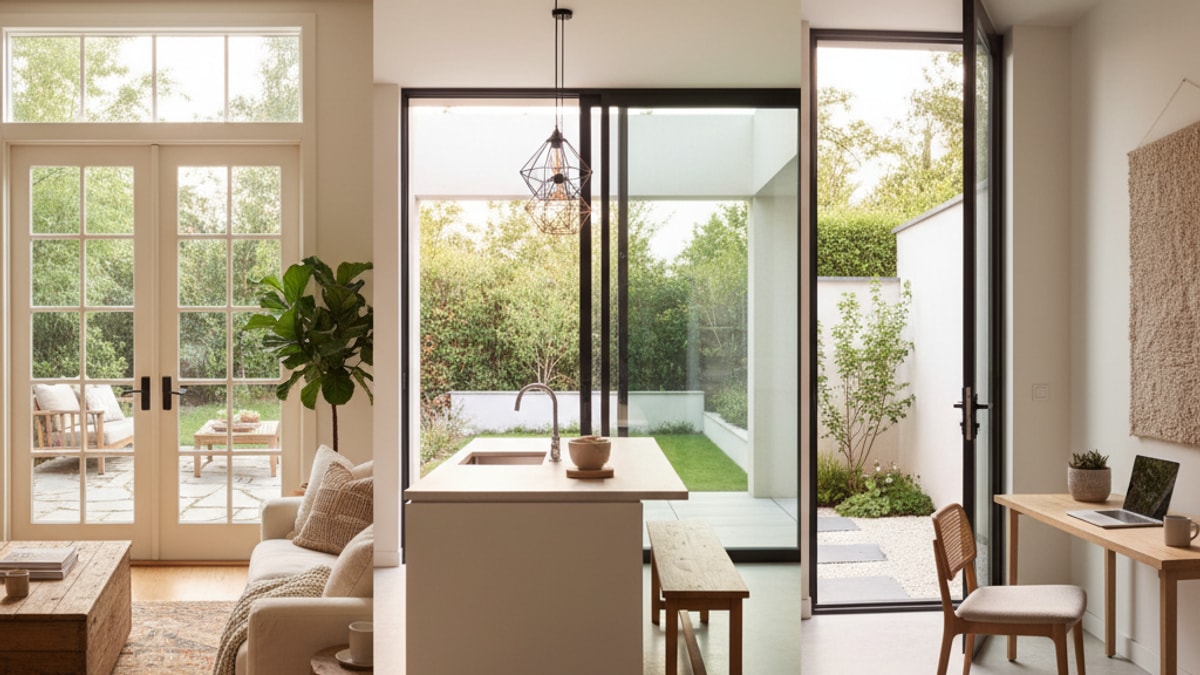
Before we dive into inches and feet, let’s reframe the conversation. The width of your patio door is a foundational architectural choice. It's the literal gateway to the outdoor oasis you’re creating, whether that’s a modern patio with an outdoor kitchen or a tranquil space with a custom fire feature. Think of it as the aperture of a camera lens—the wider it opens, the more light, life, and scenery you let in. A narrow door can make even the most stunning backyard feel distant and disconnected, an afterthought you view through a small window.
We’ve seen it happen. A homeowner invests in a breathtaking landscape, complete with intricate pavers and landscape lighting, only to be funneled through a standard, cramped 30-inch single door. It’s a design tragedy. The psychological barrier remains, and the two spaces—inside and out—never truly merge. Conversely, we've seen modest backyards transformed into sprawling extensions of the home simply by installing a wider, more inviting patio door. The effect is dramatic, sometimes startlingly so. It changes how you live in your space every single day.
So, when you ask, “how wide is a patio door,” what you’re really asking is, “how connected do I want to be to my outdoor space?” Are you looking for a simple point of entry, or are you looking to erase the boundary between your living room and your new patio? The answer to that question will guide you to the right dimensions far better than any standard chart. And—let’s be honest—in a place like San Diego, maximizing that connection is everything.
Standard Patio Door Widths: The Common Ground
Okay, with the philosophy out of the way, let’s get into the practical numbers. While the possibilities with custom work are nearly endless, the construction industry does rely on a set of standard sizes. These are the off-the-shelf options you’ll find at major retailers. They’re designed to fit common rough openings in homes built over the last several decades, which makes them a cost-effective choice for many remodels and new builds.
Our team often starts here to establish a baseline. Knowing the standards helps you understand the point at which you’re entering “custom” territory, which has implications for budget and timeline. The most common types are sliding doors and hinged (or French) doors, and their standard widths are quite consistent across manufacturers. We've put together a quick reference table to make it easier to visualize the common options.
| Door Type |
Common Configurations |
Standard Widths (Door Only) |
Typical Rough Opening Width |
Notes |
| Sliding Glass Door |
2-Panel (One fixed, one slides) |
5' (60"), 6' (72"), 8' (96") |
Add ~2.5" to door width |
The most common patio door style in modern homes. |
| Sliding Glass Door |
3-Panel (Center or end panel slides) |
9' (108"), 12' (144") |
Add ~2.5" to door width |
Offers a wider opening than a standard 2-panel. |
| Sliding Glass Door |
4-Panel (Two center panels slide apart) |
10' (120"), 12' (144"), 16' (192") |
Add ~2.5" to door width |
Creates a grand, symmetrical opening. |
| French Door (Hinged) |
Single In-swing/Out-swing |
2'6" (30"), 2'8" (32"), 3' (36") |
Add ~2" to door width |
Less common as a primary patio door but used for smaller access points. |
| French Doors (Hinged) |
Double In-swing/Out-swing |
5' (60"), 6' (72") |
Add ~2" to door width |
A classic, elegant option. Requires clear swing space. |
These are the workhorses of the patio door world. They're reliable, widely available, and get the job done. But as you can see, even within “standard” sizes, there's a significant range. A 5-foot slider offers a completely different experience than a 12-foot, four-panel system. Understanding the nuances of each type is the next critical step.
Sliding Glass Doors: The Classic Choice
When most people picture a patio door, they’re thinking of a sliding glass door. It’s been a staple of American homes since the mid-20th century for good reason. Its design is brilliantly simple and space-efficient. Because the panels slide parallel to the wall on a track, they don’t require any interior or exterior floor space to swing open. This makes them absolutely ideal for rooms where furniture might be placed near the door or for patios where a swinging door would be an obstruction.
The most common configuration is a two-panel door, usually 5 or 6 feet wide (60 or 72 inches). In this setup, one panel is fixed, and the other slides, giving you an opening of about 2.5 to 3 feet. It’s functional, for sure. But we're seeing a massive trend toward wider openings. An 8-foot, two-panel slider is becoming the new standard for many of our projects, offering a much more generous view and entryway.
From there, you can expand. Three-panel sliders, often 9 or 12 feet wide, offer more flexibility. You can have the center panel operate or have two fixed panels with one at the end that slides. This gives you a wider opening—a full third of the total width. Then you have the four-panel systems, which are genuinely impressive. Typically 12 or 16 feet wide, the two center panels slide outward over the two fixed end panels, creating a massive, unobstructed central opening. It’s a fantastic way to get a huge view and a ton of airflow without committing to a more complex (and expensive) bi-fold system. We’ve found that for many San Diego homes, a high-quality 4-panel slider strikes the perfect balance between cost, performance, and that coveted “wow” factor.
French Doors: Timeless Elegance and Its Demands
There’s an undeniable romance to French doors. Their classic, double-hinged design adds a touch of traditional elegance and architectural character that a simple slider can’t match. Instead of one large pane of glass, they typically feature multiple smaller panes (lites), which can complement certain home styles, like Craftsman or Colonial, beautifully. They feel more substantial, more like a grand entrance than a simple doorway.
The standard width for a double French door set is the same as for a small slider: 5 or 6 feet (60 or 72 inches). This gives you two doors, each 2.5 or 3 feet wide. When both are open, you get a completely clear opening of the full 5 or 6 feet, with no center post in the way. This is their major functional advantage over a standard two-panel slider, which always leaves one panel of glass in the opening.
But—and this is a big but—they demand space. You have to account for the swing. An out-swing configuration is usually preferred for patios, as it doesn't eat into your interior living space. However, this means you need to keep a clear radius on your patio, free of furniture, planters, or grills. An in-swing configuration saves your patio space but can create a major headache indoors, potentially conflicting with sofas, tables, or general foot traffic. Our team always maps out the swing radius during the design phase. It's a non-negotiable step. We've seen homeowners fall in love with the idea of French doors only to realize they would render half their patio unusable. It’s a crucial detail that can make or break their functionality.
Bi-Fold & Multi-Slide Doors: The Wall Removers
Now, this is where it gets really exciting. For homeowners who want to completely obliterate the line between indoors and out, bi-fold and multi-slide doors are the ultimate solution. These are less like doors and more like operable glass walls. They represent a significant investment, but the lifestyle payoff is unparalleled, especially for a home designed around entertaining.
Bi-fold doors, sometimes called folding glass walls, consist of multiple panels that are hinged together and run along a track. When you open them, they fold up accordion-style and stack neatly to one or both sides, leaving the entire opening completely clear. We’re talking about clear spans of 10, 15, even 20 feet or more. The effect is transformative. Your living room and patio become one continuous, sprawling space. It’s the pinnacle of the Southern California lifestyle.
Multi-slide doors achieve a similar outcome through a different mechanism. Instead of folding, multiple large panels slide on parallel tracks and stack behind each other at one end, or disappear entirely into a wall pocket. A pocketing multi-slide door is the cleanest look imaginable—when it’s open, the doors are literally gone, hidden within the wall. This requires significant structural planning (and a thicker wall), but the result is pure magic. Our experience shows that these systems are almost always a custom order. You’re not picking a size off a chart; you’re working with us and the manufacturer to engineer a system specifically for your home's structure and your design vision.
How to Measure for Your New Patio Door
Feeling inspired to upgrade? Great. But before you get too far, it’s essential to understand how doors are measured. A sloppy measurement can lead to a world of frustration, from costly order mistakes to drafty, ill-fitting installations. While we always recommend having a professional from our team take the final field measurements, it’s helpful for you to know how to take a preliminary measurement to guide your research.
You’re primarily interested in the “rough opening.” This is the structural frame of the house that the door unit will be installed into. It's always slightly larger than the door itself to allow for shimming and insulation.
Measure the Width: Using a tape measure, measure the horizontal distance between the studs of the rough opening. Take three measurements: one near the top, one in the middle, and one near the bottom. If the numbers differ slightly (which is common), use the smallest of the three. This is your rough opening width.
Measure the Height: Measure the vertical distance from the header (the top beam of the frame) down to the subfloor (the surface the door sill will rest on). Again, take three measurements—left, middle, and right—and use the smallest one.
Check for Square: This is a pro tip. Measure diagonally from the top-left corner to the bottom-right corner, and then from the top-right to the bottom-left. If the two measurements are the same, your opening is perfectly square. If they’re off by more than a quarter-inch, it tells us the opening is racked, which requires some skill to correct during installation.
Don't measure the old door itself! You need to measure the opening it sits in. This basic measurement will tell you if a standard 5-foot, 6-foot, or 8-foot door is a potential fit. If your numbers don’t line up with the standard rough opening requirements, you're likely looking at a custom-sized door or some reframing work.
Factors That Influence Your Decision (Beyond the Tape Measure)
Choosing the right width isn't just a numbers game. It's a balancing act between your dreams, your home's reality, and your budget. Our design process involves walking clients through a series of crucial considerations that go far beyond a simple measurement.
First, there’s the architectural style of your home. A sleek, modern home in Encinitas might scream for a massive, minimalist multi-slide system, while a Spanish-style home in Rancho Santa Fe might be better complemented by the classic charm of arched French doors. The door should feel like an organic part of the home's design, not a jarring addition. We can't stress this enough—context is king.
Then there's the intended use and traffic flow. How will you use this space? If you’re planning large gatherings that spill from the family room onto your new paver patio, you’ll want the widest possible opening to avoid a human traffic jam. If it's a more private access point from a bedroom to a small balcony, a standard slider or even a single French door might be perfectly adequate. Think about carrying trays of food, moving furniture, and how many people will be passing through at once.
And, of course, there’s the budget. It’s a simple reality: bigger and more complex means more expensive. Standard-sized sliding doors are the most budget-friendly option. French doors are a step up. Custom-sized bi-fold and multi-slide systems represent the top tier. It's not just the cost of the door unit itself; a wider door may require a larger header and significant structural work to carry the load of the roof and floors above, adding to the overall project cost. This is where professional guidance is critical, not optional. If you’re considering a major change, we urge you to BOOK MY FREE CONSULTATION so our team can assess the structural implications before you go too far down the road.
The Custom Route: When Standard Just Won't Do
For many of our most transformative projects, standard sizes simply aren’t an option. The vision demands something more. This is the world of custom patio doors, where the only real limits are engineering and imagination. If you want a 30-foot glass wall that disappears into a pocket, it can be done. If you need a door that follows the curve of a wall, that's possible too.
Going custom means the door is manufactured to the exact specifications of your home. This is the ideal solution for older homes with non-standard openings or for new designs where you want to make a bold architectural statement. Our Services extend beyond just landscaping; we are a full-service design and build firm, which means we manage this entire process. We work with architects, structural engineers, and premium door manufacturers to design, order, and install these complex systems flawlessly.
The process begins during the initial design phase. We analyze the home’s structure, discuss your aesthetic and functional goals, and then create a design that integrates the perfect door system. This isn't something you can do on a whim. It requires meticulous planning from the very beginning. But the reward is a home that feels completely unique and perfectly tailored to your lifestyle—a space where the boundary between inside and out truly dissolves. It’s a game-changer.
Integrating Your Door with a Complete Landscape Design
Finally, remember that your patio door is not an isolated element. It’s a critical component of a larger, cohesive system: your home and landscape. The width, style, and placement of your door should directly inform the design of your patio, outdoor kitchen, pool deck, and even your planting scheme. Our whole-picture approach at Modern Yardz is built on this principle of integration.
A wide, central door might lead to a grand, symmetrical patio with a focal point like a fire pit or fountain directly ahead. A corner bi-fold system could open up to an L-shaped outdoor kitchen and dining area, creating a seamless entertainment zone. The door directs the flow of traffic, so we design the “landing zone” on the other side to be both beautiful and functional. We consider things like sun exposure at different times of day, prevailing breezes, and key sightlines from inside the house.
It's a conversation between the interior and the exterior. The door is the mediator. By thinking about your project holistically, you ensure that your investment in a new patio door pays dividends across your entire property, enhancing its value, beauty, and usability. For more ideas and to see how we’ve integrated stunning doors into our projects, feel free to browse our Blog for inspiration.
Ultimately, the right width for your patio door is the one that best serves your home, your family, and your vision for a life lived both indoors and out. It’s a decision that bridges architecture and landscape design. It's about more than just a measurement—it’s about creating a feeling, an experience, and a connection to the beautiful San Diego environment right outside your walls. If you’re ready to explore the possibilities for your home, our team is here to help. You can reach out through our Contact page to get the conversation started.



.webp)
.webp)