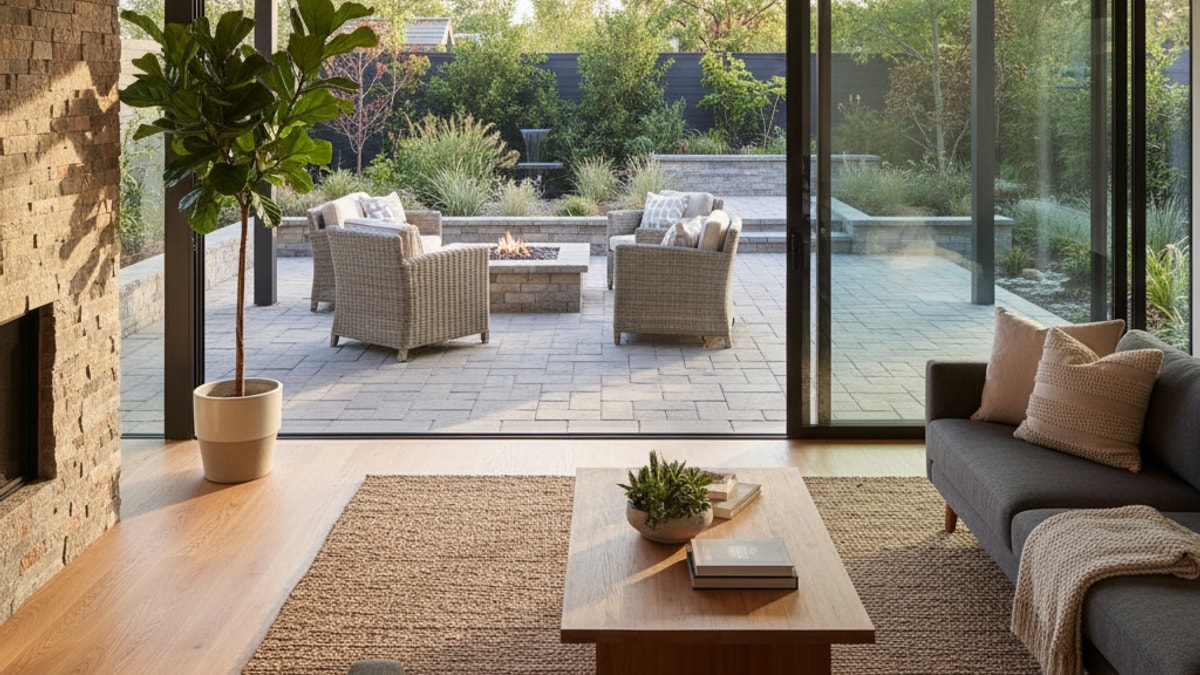
A sprawling, beautiful paver patio. It’s the centerpiece of countless San Diego backyards, the stage for family barbecues, quiet morning coffees, and sunset cocktails. It’s a dream we at Modern Yardz help bring to life every single week. But we've also seen the other side of that dream—the one that turns into a maintenance nightmare. We’re talking about the sunken spots that collect water, the wobbly stones that create tripping hazards, and the relentless weeds that transform a beautiful pattern into a green-and-grey mess.
And let's be honest—the difference between a patio that lasts for decades and one that fails in a few years almost always comes down to one thing: the foundation. Knowing how to set pavers for a patio isn't just about laying pretty stones in a pattern. It's an exercise in engineering, patience, and an unflinching respect for the ground beneath your feet. Our team has repaired enough failed DIY patios from Chula Vista to Oceanside to know exactly where things go wrong. So, we're pulling back the curtain to show you how it’s done right.
Why Proper Paver Installation is Non-Negotiable
We get it. You see the paver stones stacked at the home improvement store, you watch a few online videos, and you think, "I can do that this weekend." The enthusiasm is fantastic, but the reality can be brutal. A poorly installed patio isn't just an eyesore; it's a structural failure waiting to happen. The ground shifts, water erodes, and gravity is a relentless force. Without a proper base, your beautiful investment will quickly become a lumpy, uneven liability.
Our experience shows that the biggest failures stem from underestimating the prep work. It's the invisible part of the project, the grueling work that happens before a single paver is laid. A proper foundation does three critical things: it provides a stable, unmoving base for the pavers; it facilitates proper drainage to prevent water from pooling and causing heaving; and it creates a uniform surface that ensures the final patio is perfectly level and smooth. Skip or rush this, and you're practically guaranteeing future problems. It’s a lesson we’ve learned over decades of dedicated work, which you can read more about on our About page. The integrity of the entire project—and your long-term satisfaction—depends on it. It’s that simple.
Gathering Your Arsenal: Tools and Materials
Before you break ground, you need to assemble the right gear. Showing up to a gunfight with a knife is a bad idea, and showing up to a paver installation without a plate compactor is a similarly flawed strategy. This isn't a complete list for every conceivable situation, but it covers the absolute essentials our crews use on nearly every job.
Essential Tools:
- Shovels: Both pointed for digging and square for moving material.
- Wheelbarrow: You'll be moving tons—literally—of rock, sand, and soil. Don’t skimp here.
- Tape Measure & Level: A long 4-foot or 6-foot level is crucial for checking slope and surface evenness.
- String Line & Stakes: For creating your layout and keeping your lines perfectly straight.
- Hand Tamper: Good for compacting small areas and edges.
- Plate Compactor: This is a non-negotiable rental. A hand tamper simply cannot achieve the level of compaction needed for a stable base.
- Rubber Mallet: For tapping pavers into place without damaging them.
- Screed Rails & a Screed Board: Two pieces of 1-inch outer diameter metal conduit and a very straight 2x4 work perfectly.
- Paver Saw (Wet Saw) or Splitter: For making precise cuts around edges and obstacles. A wet saw provides cleaner cuts and is what our pros use.
- Push Broom, Safety Glasses, and Gloves.
Essential Materials:
- Pavers: The star of the show! Choose a style and color that complements your home.
- Class II Road Base (or equivalent): This is crushed aggregate that will form the structural foundation of your patio.
- Bedding Sand: Coarse, washed concrete sand—not play sand.
- Edge Restraints: Plastic or metal edging that holds the entire system together.
- Polymeric Sand: A special sand with a polymer additive that hardens when wet, locking pavers in place and preventing weed growth.
- Landscape Fabric (Optional but Recommended): To place between the native soil and the aggregate base to prevent mixing.
Here’s a quick breakdown of your base options. It’s a decision that has a significant impact on the project's longevity.
| Base Material |
Pros |
Cons |
Our Recommendation |
| Crushed Stone (Class II Base) |
Excellent compaction, fantastic drainage, industry standard for a reason. |
Can be heavy and difficult to move and grade without experience. |
This is our go-to for nearly all paver applications. Its stability and drainage properties are unmatched for creating a lasting foundation. |
| Recycled Concrete |
Often more affordable, eco-friendly. Can compact well. |
Quality can be inconsistent. May contain rebar fragments or other debris if not sourced from a reputable supplier. |
A viable alternative if you can verify the source and quality. Ensure it's properly screened to avoid issues. |
| Decomposed Granite (DG) |
Creates a very hard, stable surface. Good for certain applications. |
Drainage is significantly poorer than crushed stone. Can turn to mush in very wet conditions if not properly installed. |
We generally avoid DG as a primary paver base in San Diego, especially in areas with poor soil drainage. It's better suited for pathways. |
The Foundation is Everything: Excavation and Base Prep
This is it. The most important, labor-intensive, and absolutely critical stage of setting pavers. We can't stress this enough—get this part wrong, and nothing else matters.
First, you need to calculate your excavation depth. Work backward from your desired final patio height. Let's say you're using a 2 3/8-inch paver. Your calculation would look like this:
- Paver Height: 2 3/8 inches
- Sand Bed: 1 inch
- Compacted Base: A minimum of 4 inches for pedestrian patios, but our team recommends 6 inches for superior stability and to combat San Diego's expansive clay soils.
So, your total excavation depth is 2 3/8" + 1" + 6" = 9 3/8 inches below your final desired grade. That's a lot of digging. Don't eyeball this. Measure it carefully from your string lines.
Next, you need to establish the slope. Your patio must slope away from your house foundation to ensure water drains away. A catastrophic mistake we often see is a flat or negatively sloped patio that directs water right back toward the home. The standard slope is a 1/4-inch drop for every 1 foot of run. So, for a 12-foot patio, the far edge should be 3 inches lower than the edge against the house. Use your string lines and a line level to set this grade perfectly before you start digging.
Once excavated, compact the native soil (the subgrade) with the plate compactor. If you have soft spots, you may need to dig them out and fill them with base material. This is your one chance to create a solid bottom layer. After compacting the subgrade, lay down your landscape fabric if you're using it.
Now comes the base. Add your Class II base material in lifts—or layers—of no more than 2-3 inches at a time. Do not just dump all 6 inches in at once. It will not compact properly. Spread a 2-inch layer, rake it out evenly, and then run the plate compactor over it in overlapping passes until it's solid. Then add the next 2-inch lift and repeat. And again. It's tedious. It's loud. But this process is what creates a monolithic, interlocking base that will resist movement for years.
This is where projects live or die.
The Sand Bed: Your Pavers' Immediate Support System
After your base is compacted to what feels like the hardness of concrete, it's time for the sand bed. The purpose of this 1-inch layer of coarse sand is not structural support—that's the base's job. The sand is purely a leveling medium that allows you to set each paver perfectly and accommodate for tiny variations in paver thickness.
This is where your screed rails and board come in. Lay your two 1-inch metal pipes on top of the compacted base, parallel to each other and about 6-8 feet apart. Dump sand between them. Now, pull the straight 2x4 (your screed board) across the top of the pipes in a sawing motion. This will remove the excess sand, leaving a perfectly smooth, 1-inch-thick bed. Remove the pipes and carefully fill in the indentations with sand, smoothing them with a trowel.
Here's what's important—once you've screeded a section, do not walk on it or disturb it. You'll work your way backward, laying pavers on the prepared sand bed as you go. This meticulous process ensures a perfectly flat surface for your pavers to rest on.
Laying the Pattern: Where Art Meets Engineering
Finally, the fun part. This is where you start to see your vision come to life. Start laying your pavers from a hard edge, like the wall of your house, or from a 90-degree corner. Use string lines stretched taut along the edges of your planned field to keep your paver courses laser-straight. A slight wobble in the first row will become a glaring, dramatic curve by the tenth row.
Place the pavers gently onto the sand bed. Don't slide them or twist them into place, as this will disrupt the sand. Just set them down and tap them snugly against their neighbors. Use a rubber mallet to make minor adjustments and to level them with adjacent pavers. We frequently check our work with a long level as we go. It's much easier to fix a high or low paver right away than to try and correct it later.
When you reach the edge of the patio or an obstacle, you'll need to make cuts. A wet saw is the best tool for this, providing a clean, factory-like edge. Always wear safety glasses when cutting. The complexity of your cuts will depend on the pattern you choose and the shape of your patio. This is one area where professional expertise and equipment can make a significant difference, especially when creating intricate designs, a core part of our landscape design Services.
Locking It All In: Edging, Compaction, and Sanding
Your pavers are all laid. It looks like a finished patio, but it's not. Right now, it's just a collection of loose stones sitting on sand. The final steps are what lock it all together into a durable, unified surface.
First, install your edge restraints. These are absolutely mandatory. Without them, the outer pavers will slowly creep outward under pressure, creating gaps and causing the entire system to fail. Secure the plastic or metal edging against the outside border of your pavers, driving long metal spikes through the edging and deep into the compacted base material every 12-18 inches.
Next comes the final compaction. Run your plate compactor over the entire surface of the pavers. This is a critical step that many DIYers skip. It vibrates the pavers, settling them firmly into the sand bed and creating an interlocking, unified surface. It's the step that makes the patio feel solid, not like a collection of individual blocks. Do a few passes in different directions.
Now for the magic—polymeric sand. Sweep the sand across the dry paver surface, working it into every joint until they are completely full. Don't leave piles on the surface. Use a leaf blower on a low setting to blow all the excess sand and dust off the paver faces. This is crucial—any sand left on the surface will harden into a permanent, hazy film. Once the surface is perfectly clean, it's time to activate the sand. Set your hose nozzle to a fine mist or shower setting. Gently wet a 10x10 foot section at a time, letting the water soak in. Don't blast it with a jet of water, as this will wash the sand out of the joints. Follow the manufacturer's specific instructions, but generally, you'll mist it a couple of times and then let it cure for 24-48 hours.
When to DIY vs. When to Call the Pros
Honestly, though. Can you do this yourself? For a small, perfectly square 10x10 foot patio on flat ground with no drainage issues, a determined and physically capable person probably can. It's a formidable amount of work, but it's achievable.
But what if your yard has a slope? What if you need a small retaining wall? What if you want a circular pattern with complex cuts or integrated landscape lighting? What if you simply don't have several long, back-breaking weekends to dedicate to moving tons of rock? That's when it's time to call in a team like Modern Yardz. Our experience allows us to anticipate and solve problems before they arise—from dealing with tricky soil conditions to ensuring perfect drainage and flawless execution. We handle everything from the initial design to the final grain of sand, ensuring the result is not just beautiful but structurally impeccable.
If you're considering a project and want to understand the difference professional installation can make, we'd love to talk. You can Contact our San Diego team directly. We're happy to provide a no-obligation assessment of your space and show you what's possible. Feel free to BOOK MY FREE CONSULTATION to get started.
Maintaining Your San Diego Paver Patio
Congratulations, you have a beautiful, durable paver patio. Now, let's keep it that way. Maintenance is surprisingly simple. Keep it clean by sweeping it regularly and rinsing it with a hose. For tougher stains, a pressure washer on a low setting with a wide-angle tip can be effective, but be careful not to blast the sand out of the joints.
Every few years, you may notice some of the joints are a little low on sand. You can simply sweep more polymeric sand into the joints and re-activate it to top them off. For San Diego homeowners, especially near the coast, we also recommend sealing your pavers every 3-5 years. A good quality sealer will protect them from the intense sun, prevent staining, and can even enhance their color. It's a simple step that preserves the beauty of your investment for the long haul.
Creating amazing outdoor spaces is what we do here at Modern Yardz. We believe a great patio can fundamentally change how you experience your Home. For more ideas and inspiration on transforming your entire yard, feel free to browse our other articles on our Blog.
Building a paver patio is a serious undertaking, but the reward is a beautiful, functional outdoor living area that adds immense value and enjoyment to your home. Whether you tackle it yourself or entrust it to professionals, the key is to never, ever compromise on the foundation. It’s the unseen hero of a project that will bring you joy for years to come.



.webp)
.webp)