A sliding patio door is more than just an entryway. It’s a frame for your landscape, a source of natural light, and the critical link between your indoor comfort and your outdoor oasis. Here in San Diego, where the line between inside and outside living is beautifully blurred, getting this feature right is absolutely essential. It transforms a simple wall into a dynamic, functional part of your home’s design. We’ve seen it time and again—a well-installed sliding door can completely redefine a living space.
But let's be honest. The process of learning how to install a sliding patio door can feel formidable. It’s a project that demands precision, patience, and a healthy respect for the forces of nature (especially water). A sloppy installation doesn't just look bad; it can lead to catastrophic water damage, energy loss, and security issues. Our team at Modern Yardz has spent years not just designing stunning outdoor spaces but also ensuring every component, right down to the doors that lead to them, is installed with impeccable craftsmanship. We're here to pull back the curtain and share the process we've refined, giving you the insights you need to tackle this project confidently or to know exactly what to look for when hiring a pro.
First Things First: Planning and Preparation
Before a single screw is turned, the most critical work happens. Planning. This is the non-negotiable foundation of the entire project. Rushing this stage is a recipe for expensive mistakes and a whole lot of frustration. We've seen homeowners buy a beautiful door only to find their rough opening is completely out of whack, turning a weekend project into a month-long headache.
Your first job is to measure. And then measure again. You need three measurements for both the width and the height of your rough opening (the unfinished, framed hole in the wall). Measure the width at the top, middle, and bottom. Then measure the height on the left, middle, and right. Your final rough opening dimensions will be the smallest of these respective measurements. Why? Because you can always add shims to fill a small gap, but you can’t easily shrink a door that’s too big. The door manufacturer will specify the required rough opening size for their product—it's usually about a half-inch to a full inch larger than the door frame itself to allow for adjustments. Check these specs religiously.
Next, assess the condition of the opening itself. Is the sill (the bottom of the frame) level? Use a long level to check. Are the jambs (the sides) plumb (perfectly vertical)? Is the header (the top) level? And—this is the one people often forget—is the opening square? You can check for square by measuring diagonally from corner to corner. If the two diagonal measurements are the same, your opening is square. If they aren't, you've got some work to do. We’ve found that older homes, in particular, have a tendency to settle, throwing these measurements off. Ignoring an out-of-square opening means your door will never operate smoothly. It will bind, stick, and wear out prematurely.
Finally, let's talk about the door itself. You're not just buying a piece of glass and vinyl; you're investing in your home's security, energy efficiency, and aesthetic. Here’s a quick rundown of common materials our team works with:
| Material |
Pros |
Cons |
Best For (San Diego Climate) |
| Vinyl |
Low maintenance, excellent insulation, cost-effective, won't rot or corrode. |
Limited color options (though improving), can feel less premium than other materials. |
Excellent choice. Its resistance to salt air and moisture makes it a durable, energy-efficient option for our coastal environment. |
| Aluminum |
Strong, lightweight, slim frames for a modern look, durable finish. |
Poor insulator (thermal breaks are a must), can be prone to corrosion in salty air without a proper finish. |
Good for a modern aesthetic, but only if it’s a high-quality, thermally broken frame with a robust, marine-grade finish. |
| Wood |
Classic, high-end look, can be painted or stained, good natural insulator. |
High maintenance (requires regular sealing/painting), susceptible to rot and termites if not maintained. |
A beautiful but demanding option. Best for covered patios or homes set back from the immediate coast where moisture and sun exposure are less relentless. |
| Fiberglass |
Extremely durable, resists swelling and warping, can mimic the look of wood, highly energy efficient. |
Higher upfront cost, can be more difficult to find in a wide range of styles. |
A top-tier choice. It combines the low maintenance of vinyl with the strength and look of wood, making it almost perfect for the San Diego climate. |
Take your time here. Consider how the door will complement the rest of your Home and the outdoor living spaces we help create. A sleek aluminum door might be perfect for a modern concrete patio, while a fiberglass door with a wood grain finish could beautifully frame a rustic outdoor kitchen.
Prepping the Rough Opening: The Unseen Hero
Alright, you've got your door, and you've confirmed your measurements. Now comes the work that separates a professional installation from an amateur one: preparing the rough opening. If you discovered any issues during your initial assessment—an unlevel sill, out-of-plumb jambs, or significant rot—you must address them now. We can't stress this enough. Putting a brand-new, perfectly square door into a crooked, rotting hole is like putting a new engine in a car with a broken frame. It’s just not going to work.
Start by removing the old door and all the old trim, inside and out. Carefully inspect the wood of the subfloor, sill, and studs. Poke at it with a screwdriver. Is it soft? Spongy? Discolored? That's rot. And where there's rot, there's been water intrusion. You have to find the source of the leak and fix it before you even think about proceeding. This often means replacing sections of the sill plate, jack studs, or even the subfloor. This can be a significant, sometimes dramatic, undertaking. If you find extensive damage, this is a very clear sign to pause the DIY project and get a professional opinion. Our Services extend beyond just the aesthetic elements; we understand the structural integrity required to support these beautiful features.
Once any repairs are made, ensure the opening is clean and free of debris. Sweep it out, vacuum it, and make sure you have a smooth, solid surface to work with. The sill, in particular, must be perfectly level. If it's not, you can use a self-leveling compound or plane down high spots to get it just right. A door installed on an unlevel sill will rock, causing the seals to fail and the latch to misalign. It's a tiny detail with massive consequences.
The Waterproofing Masterclass: Flashing and Sill Pans
Water is relentless. It will find any gap, any pinhole, any weakness in your installation and exploit it. This is why the next step—creating a bomb-proof water barrier—is arguably the most important part of learning how to install a sliding patio door. Our experience shows that 90% of door-related failures are due to improper flashing.
It all starts at the bottom with a sill pan. You can buy pre-fabricated sill pans or make your own from flexible, self-adhering flashing membrane. A sill pan is essentially a three-sided tray that sits on the subfloor at the bottom of the rough opening. Its job is to catch any water that might get past the door's weatherstripping and direct it back outside, away from your wall cavity. The back edge of the pan should have a tall dam, and the sides should be turned up. All corners must be meticulously sealed. Don't skip this. We mean it. A high-quality sill pan is your last line of defense against rot and mold.
With the sill pan in place, it’s time for the flashing tape. This is a self-adhering, waterproof membrane that you'll apply around the entire opening. The sequence is critical, non-negotiable, and designed to work like shingles on a roof—layering from bottom to top so water always sheds down and out.
- Sill First: Start by applying a strip of flashing tape over the front edge of your sill pan and down onto the building's weather-resistive barrier (WRB), like Tyvek or tar paper.
- Jambs Next: Run flashing tape up the sides (jambs) of the opening. This tape must overlap the sill flashing at the bottom. Start from the bottom and work your way up, overlapping each piece by a few inches.
- Header Last: Finally, apply the flashing tape across the top (header) of the opening, making sure it overlaps the jamb flashing on both sides.
When you're done, you should have a continuous, overlapping seal of flashing around the entire perimeter. This detailed work is what our About page talks about when we mention our team's commitment to precision. It's the stuff that's hidden behind the trim, but it’s what ensures your investment lasts for decades.
Setting the Frame: Precision and Power
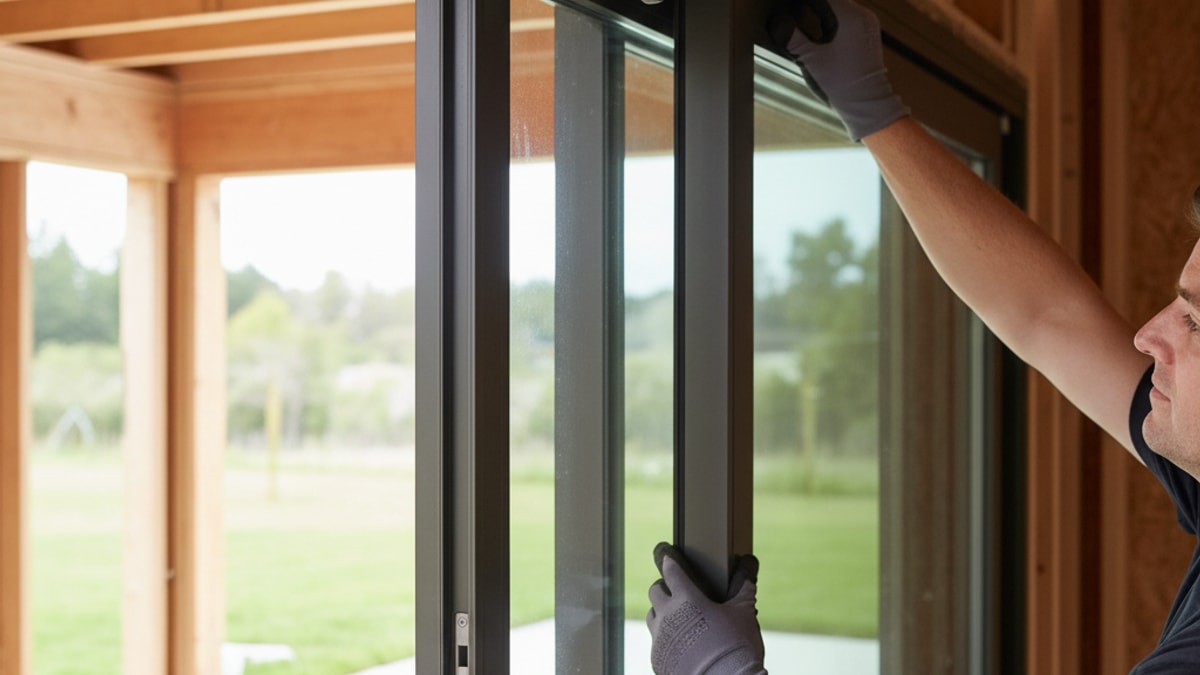
This is the moment of truth, and you'll definitely need a helper—patio door frames are heavy and awkward. Before you even lift the frame, run three thick, continuous beads of high-quality polyurethane sealant along the subfloor where the door sill will sit. Run one bead near the back, one in the middle, and one near the front. This sealant will create a waterproof gasket between the door and the sill pan.
Now, carefully tilt the door frame into the opening from the outside. Center it left to right, and then push the bottom in first, pressing it firmly into the beads of sealant. Tilt the top of the frame into place. The goal now is to get the door perfectly plumb, level, and square within the opening using shims.
Shims are small, tapered wedges (usually wood or composite) that you insert into the gaps between the door frame and the rough opening. Here's the professional way to do it:
- Start at the Sill: Place shims under the sill at the anchor points, typically under each side jamb and at the center. Use your level to ensure the sill is perfectly level across its entire length. Add or remove shims as needed.
- Move to the Jambs: Start on the hinge side (or the fixed panel side). Place shims behind the pre-drilled fastener holes—top, middle, and bottom. Use your level to get this jamb perfectly plumb. Don't secure it yet.
- Tack it in Place: Once the sill is level and the first jamb is plumb, drive one screw through the top shim location to temporarily hold the frame. Don't drive it all the way in.
- Plumb the Other Jamb: Now move to the other side jamb and repeat the shimming process, making sure it's plumb. Check the top of the frame (the header) to ensure it's level. You might need to add shims there, too.
Throughout this process, you need to be constantly checking for squareness inside the door frame itself. Measure the diagonals of the frame. They must be equal. Adjust the shims as needed to rack the frame one way or another until it's perfectly square. Only when the frame is level, plumb, and square should you drive the mounting screws through the shims to secure it to the rough opening. Be careful not to overtighten the screws, as this can bow the frame and cause the door to bind.
Installing Panels, Hardware, and Making Adjustments
With the frame securely in place, it’s time to install the door panels. This process varies by manufacturer, so your instruction manual is your best friend here. Generally, the fixed (non-moving) panel goes in first. It's often lifted into the top channel and then settled into the bottom track. It’s then secured to the frame with brackets or screws.
Next, install the operating (sliding) panel. This usually involves setting the top rollers onto the track in the header and then swinging the bottom of the panel into the bottom track. Now, test the door. Slide it back and forth. Does it glide smoothly and quietly? Or does it scrape, bump, or stick? Most sliding doors have adjustment screws on the bottom rollers that allow you to raise or lower each side of the panel. Use these to get the panel perfectly aligned within the frame, ensuring an even gap all the way around. This takes patience. Small adjustments make a big difference.
Once the door is rolling like a dream, you can install the handle, the lockset, and the keeper or strike plate on the jamb. Test the lock mechanism thoroughly. It should engage smoothly without needing to force the door. If you have to lift or push the door to get it to lock, your panel isn't adjusted correctly. Go back and tweak the rollers until it's perfect. For more tips on maintaining outdoor features, check out our Blog.
The Final Seal: Insulation, Trim, and Caulk
The door is in and working. You're almost there. The final steps are all about weatherproofing and aesthetics. You’ll have a gap between the new door frame and your rough opening. You need to fill this void with insulation. Use a low-expansion foam sealant designed specifically for windows and doors. Regular expanding foam can actually bow the frame, so be sure to get the right stuff. Apply it carefully from the inside, filling the gap about halfway—it will expand to fill the rest.
Once the foam has cured, you can install your interior and exterior trim. The trim, or casing, bridges the gap between the door frame and your wall finish (like drywall or siding). It gives the installation a clean, finished look. Measure carefully and make precise cuts for a professional appearance.
Finally, apply a continuous bead of high-quality exterior-grade caulk around the entire outside perimeter of the door, between the exterior trim and your siding. This is your primary defense against air and water infiltration. Use a good polyurethane or siliconized acrylic caulk that will remain flexible. Tool the bead with a wet finger or a caulking tool for a smooth, clean line. Do the same on the inside with an interior-grade, paintable caulk.
Knowing When to Call Us
We've laid out the comprehensive process for how to install a sliding patio door. It's a rewarding project. But it's also a demanding one. There are moments where a DIY project can quickly spiral out of control.
Here’s when we strongly recommend putting the tools down and reaching out to a professional:
- Discovering Significant Rot or Structural Damage: This requires carpentry skills beyond a simple door swap.
- The Opening is Drastically Out of Square: Reframing an opening is a major structural job.
- You're Installing a Door in a New Location: This involves cutting through a load-bearing wall, which requires engineering, permits, and deep structural knowledge.
- You're Dealing with a Large, Complex Multi-Panel System: These oversized doors have zero tolerance for error.
- You Simply Don't Have the Time or Confidence: Your peace of mind is worth a lot. A professional installation is guaranteed to be done right.
At Modern Yardz, we see your patio door as the gateway to the beautiful outdoor environments we build. A flawed installation can compromise the entire experience. If you’re feeling overwhelmed or just want the assurance of a perfect, weatherproof fit, we’re here to help. Contact our team today. We'd be happy to discuss your project and help you BOOK MY FREE CONSULTATION to explore how a new door can integrate seamlessly with your dream landscape design.



.webp)
.webp)