That San Diego sun is glorious, isn't it? It’s the reason we live here. It’s also relentless. Having an outdoor space you can actually use year-round means creating shade—not just any shade, but a functional, beautiful extension of your home. That's where a well-built patio cover comes in. It’s more than a roof; it’s an outdoor living room, a dining area, a sanctuary. But the path from a sun-scorched patch of concrete to that idyllic retreat is paved with details. And—let's be honest—those details can be formidable.
Our team at Modern Yardz has spent years designing and constructing these essential structures all over San Diego County, from the coastal breezes of Oceanside to the inland heat of Chula Vista. We've seen the triumphant DIY successes and the... well, the not-so-successful attempts that required a professional rescue. We’re here to share what we've learned, to pull back the curtain on what it truly takes to build a patio cover that’s not just standing, but is safe, stylish, and seamlessly integrated into your home's architecture. This isn't just a weekend project. It's an investment in your home and your lifestyle.
First Things First: The Planning You Can't Afford to Skip
Before a single post hole is dug, the real work begins. This is the phase that separates a lasting structure from a future headache. We can't stress this enough: meticulous planning is everything. It’s the foundation—both literally and figuratively—of your entire project. Rushing this stage is a catastrophic mistake that we see people make far too often.
So, where do you start? With the rules. Every city in San Diego County, and likely your HOA, has something to say about structures like patio covers. You’ll need to investigate local building codes for requirements on height, setbacks from property lines, and footing specifications. Ignoring this can lead to fines or—even worse—a tear-down order. It’s a bureaucratic maze, but a necessary one. Our experience shows that a quick call to your local planning department can save you a world of pain later. They'll tell you exactly what kind of permits are required for your specific project.
Next up is the design. This is the fun part, but it’s also full of critical decisions. Are you envisioning an attached cover that feels like a natural extension of your house, or a freestanding pavilion creating a destination spot in your yard? An attached structure needs a ledger board—a beam bolted directly to your house—and this connection has to be absolutely impeccable. It must be flashed properly to prevent water intrusion into your walls, a problem that can cause thousands in hidden damage. Freestanding covers offer more placement flexibility but require four or more support posts, each needing a substantial concrete footing. The choice really depends on your property layout and how you plan to use the space.
And then there's the roof. Do you want full shade with a solid, waterproof roof? Or do you prefer the architectural look of a lattice or pergola-style cover that lets dappled light filter through? There are even adjustable louvered systems that give you the best of both worlds. The roof style dramatically impacts the feel of the space, so think about your primary goal. Is it rain protection for an outdoor kitchen, or simply taming the afternoon sun? Our Services team specializes in helping homeowners navigate these choices to create a truly custom solution.
A Professional Breakdown of Patio Cover Materials
Choosing the right material is a balancing act between aesthetics, budget, maintenance, and the local climate. Here in San Diego, with our coastal salt air and intense sun, material durability is a critical, non-negotiable element. What works in a different climate might not be the best choice here.
Here’s a straightforward comparison our team often shares with clients:
| Feature |
Wood (e.g., Cedar, Redwood) |
Aluminum |
Vinyl (PVC) |
| Aesthetics |
Classic, natural, customizable with stain/paint |
Modern, clean lines, available in various finishes |
Clean, traditional look, limited color palette |
| Maintenance |
High (requires regular sealing, staining, or painting) |
Very Low (rinse with a hose, resistant to rust/corrosion) |
Very Low (won't rot, peel, or fade; may need cleaning) |
| Durability |
Prone to rot, termites, and warping without upkeep |
Excellent (resists weather, pests, and fire) |
Excellent (resists moisture, pests, and weathering) |
| Cost |
Moderate to High (depending on wood type) |
Moderate |
Moderate to High |
| Lifespan |
10-20 years (highly dependent on maintenance) |
30+ years |
30+ years |
| Coastal Fitness |
Poor to Fair (salt air accelerates deterioration) |
Excellent (powder coating provides great protection) |
Excellent (impervious to salt and moisture) |
Our team has found that while the timeless beauty of a heavy timber wood cover is undeniable, the maintenance can be a grueling commitment for busy homeowners. For a low-maintenance solution that stands up to the coastal environment, aluminum is often a superior choice. Modern aluminum isn't the flimsy material you might be picturing; it's robust, can be embossed with a realistic wood grain texture, and the factory-applied finishes are incredibly durable. Vinyl is another fantastic, worry-free option, though it typically offers fewer color and style choices. The right material is the one that fits your lifestyle, not just your initial vision.
The Build Process: From Dirt to Done
Alright, you've got your plan, your permit, and your materials. Now it's time to build. This process demands precision. We mean this sincerely—measurements need to be exact, cuts need to be clean, and everything must be level, plumb, and square. There is very little room for error.
Step 1: The Footings
This is where it all begins. You absolutely cannot skimp here. The footings are the concrete anchors that hold your entire structure down. Local codes will dictate the required depth and diameter, which are based on the size and weight of your cover and your soil type. Typically, you'll be digging holes 18-24 inches deep or more. You’ll place a cardboard form tube into the hole and set your metal post anchor in the wet concrete, ensuring it's perfectly positioned and level. Let the concrete cure completely. This takes days. Don't rush it.
Step 2: Setting the Posts
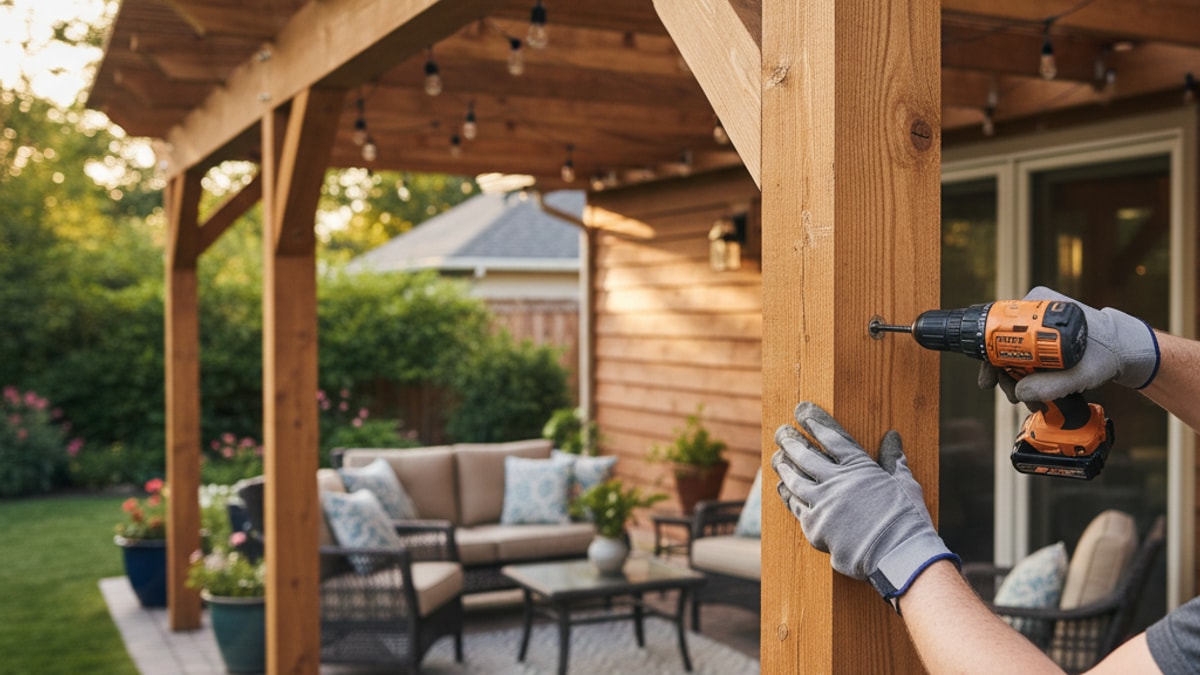
Once the footings are rock solid, you can attach your support posts. Whether they're 4x4, 6x6, or larger, the posts must be perfectly plumb (vertically straight) in both directions. Use a level on two adjacent sides to check. Brace them temporarily so they don't move while you work on the next steps. The height of your posts determines the slope of your roof, which is critical for drainage on a solid cover. A slope of at least 1/4 inch per foot is standard.
Step 3: Installing Beams and Ledger Board
This is where the skeleton of your patio cover takes shape. The main support beams run parallel to the house and sit directly on top of your posts, secured with heavy-duty structural hardware. If you're building an attached cover, this is also when you'll install the ledger board against the house. This is arguably the most critical connection in the entire structure. It must be bolted—not nailed—into the house's framing (the rim joist), and it must be properly flashed to prevent water from getting behind it. A failed ledger board is a catastrophic failure. We’ve seen it happen, and it’s not pretty. If you are even slightly unsure about this step, it's time to call a professional. Seriously.
Step 4: Placing the Rafters
The rafters are the smaller boards that run perpendicular to the main beams, creating the main framework for the roof. Their spacing depends on the type of roofing you're using and the load it needs to support. They are typically attached to the beams and ledger board with metal joist hangers for strength. Every rafter needs to be cut to the exact same length and installed perfectly parallel to its neighbors. This is what gives the structure its clean, professional look. It's tedious work that requires unwavering attention to detail.
Step 5: Attaching the Roof
Now for the crowning element. If you're installing a lattice roof, you'll be adding smaller strips of wood or aluminum across the top of the rafters. If it's a solid roof, you'll first lay down plywood or OSB sheathing, followed by roofing paper and your final roofing material—whether that's shingles to match your house or insulated aluminum panels designed specifically for patio covers. Ensuring every seam is sealed and every edge is flashed is crucial for a leak-proof result.
Step 6: The Finishing Touches
The structure is built. Now it's time to make it beautiful. This means painting or staining the wood, caulking any gaps, and wrapping posts or beams for a more finished look. It’s also the perfect time to think about integrating features like outdoor lighting, a ceiling fan, or even infrared heaters. Planning for the electrical wiring during the construction phase is much easier than trying to add it later. These final details are what elevate a basic structure into a true outdoor room. If you're unsure of what's possible, our Blog has tons of inspirational projects to spark ideas.
The Mistakes We See All The Time
Building a patio cover seems straightforward on paper, but our team has been called in to fix a lot of projects gone wrong. The DIY spirit is admirable, but optimism isn't a substitute for experience.
One of the most common—and dangerous—mistakes is under-building. This includes using undersized lumber, not enough fasteners, or improperly sized footings. A patio cover has to withstand high winds and, in some areas, even snow loads. An under-built structure is a safety hazard, plain and simple.
Another huge issue is water management. We've talked about the ledger board flashing, but it doesn't stop there. The roof needs to have an adequate slope to shed water away from the house, and you may need to install gutters and downspouts to manage the runoff and protect your foundation. We’ve seen beautiful new covers cause basement flooding because nobody thought about where all the rainwater would go. It's a system, and every part matters.
Finally, people often underestimate the sheer labor involved. This is a two- or three-person job, at a minimum. Lifting heavy beams into place, holding posts steady while they're secured—it's physically demanding work. It’s also time-consuming. A project that you think will take a weekend can easily stretch into weeks, leaving your backyard a construction zone. It’s important to be brutally honest with yourself about the time, skills, and tools you have at your disposal. Our About page talks more about the seasoned professionals on our team who do this every single day. There's a reason for that—experience makes the process smoother, safer, and yields a far superior result.
More Than a Cover, It's a Cohesive Outdoor Space
A patio cover shouldn't exist in a vacuum. It's the anchor of your outdoor living area. The best designs consider the entire yard as one cohesive space. How does the patio cover flow with your existing patio pavers or concrete slab? Does it create a natural hub for an outdoor kitchen or a seating area around a fire feature? How will landscape lighting enhance the structure at night, making it usable and beautiful 24/7?
This is where a holistic design approach makes a significant, sometimes dramatic shift in the outcome. At Modern Yardz, we don't just build structures; we design environments. We think about how the lines of the cover complement the architecture of your home, how the materials harmonize with your landscape, and how the entire space will be used by your family. It's about creating a destination. A place for morning coffee, family dinners, and quiet evenings. If you’re ready to think beyond just a cover and envision a complete outdoor transformation, we’d love to help. You can see the scope of what we do on our main Home page.
Building a patio cover is a substantial undertaking. It requires careful planning, the right materials, and a healthy dose of skill and precision. Whether you decide to take on the challenge yourself or bring in a professional team, understanding the process is key to a successful outcome. The reward is an incredible expansion of your living space—a comfortable, sheltered spot where you can enjoy the San Diego lifestyle to its fullest.
If you're feeling that this project might be more than you want to handle, that's perfectly okay. That’s why we’re here. Our team can manage every single detail, from initial design and permitting to the final construction and cleanup, ensuring you get a beautiful, durable patio cover without the stress and guesswork. Ready to start the conversation? BOOK MY FREE CONSULTATION today and let's talk about what's possible for your backyard. We're here to help you create the outdoor space you've always dreamed of. Just Contact us to get started.



.webp)
.webp)