What Are the Black Pellets in Artificial Turf? (Infill)
Research from the Synthetic Turf Council found that infill accounts for up to 70% of a turf system's performance and durability. Yet most homeowners don't even know it's there until they see black specks stuck to shoes or scattered across their patio. What looks like random debris is actually the most critical component of the entire installation.
We've installed hundreds of artificial turf projects across residential and commercial properties. The single most common question we hear after the first month: "What are these black pellets, and why are they everywhere?" Here's what most installation guides never explain.
What are the black pellets in artificial turf?
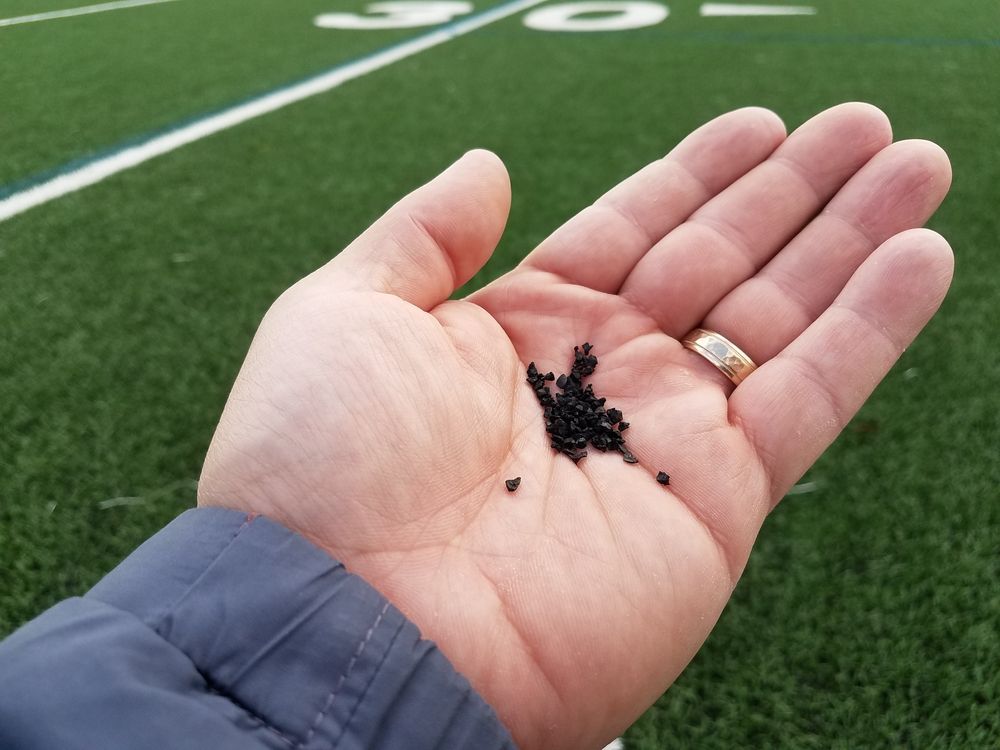
The black pellets in artificial turf are crumb rubber infill — recycled tire rubber ground into granules 0.5–2.5mm in diameter. This infill is spread between and beneath synthetic grass blades to provide ballast, stabilization, shock absorption, and drainage. Without infill, artificial turf fibers collapse flat, lose resilience, and degrade within 2–3 years instead of the typical 15–20 year lifespan.
What Crumb Rubber Infill Actually Does
Crumb rubber infill isn't filler — it's structural. Think of artificial turf as a layered system: backing fabric, drainage holes, grass fibers, and infill. The infill locks the fibers upright through friction and weight. Each square foot of turf contains 2–5 pounds of rubber granules depending on pile height and density.
The infill performs five functions simultaneously. It weighs down the turf backing to prevent wrinkling and shifting. It supports grass blades vertically so they return to position after foot traffic. It absorbs impact energy during falls or athletic activity — reducing ground force by 30–50% compared to compacted soil. It dissipates heat by creating air pockets that allow convective cooling. And it facilitates drainage by maintaining open channels between the backing and the surface.
Crumb rubber is made from recycled vehicle tires processed through ambient grinding or cryogenic freezing. Tires are shredded, steel belts and fiber are removed, and the remaining rubber is ground to specification. The final product is screened to consistent particle size, washed to remove residual dust, and tested for heavy metal content. Quality manufacturers provide certificates showing lead, cadmium, and other contaminant levels below EPA residential soil standards.
The pellets themselves are irregular chunks — not perfect spheres. This angular shape creates mechanical interlock between particles and prevents excessive migration. Smooth spherical infill would roll off slopes and consolidate into low spots within weeks.
Why You See Black Pellets on Shoes and Patios
Infill migration is normal during the first 30–60 days after installation. New turf sheds excess granules as fibers settle and the infill compacts under traffic. You'll see pellets tracked onto hard surfaces, stuck in shoe treads, and scattered near high-traffic transitions like doorways and gates.
This initial shedding doesn't mean the installation is failing. Installers deliberately overfill by 10–15% because some loss is inevitable during the break-in period. Once the infill layer compacts and fibers lock into their final position, migration drops to minimal levels — typically less than 5% per year after the first season.
Ongoing migration happens at transition edges, on slopes steeper than 3:1, and in areas with aggressive pet activity. Dogs dig and run in repetitive patterns that displace infill faster than human foot traffic. Leaf blowers set to high velocity also push rubber granules out of the turf matrix.
Here's the honest answer: if you're still seeing significant infill loss six months after installation, something's wrong. Either the infill quantity was insufficient from the start, the particle size was too small, or the turf backing lacks adequate perforation density to retain granules. Quality installations using 2–2.5mm crumb rubber lose less than one pound per 100 square feet annually after the first year.
Crumb Rubber vs. Alternative Infill Materials
Crumb rubber dominates the market because it's inexpensive and performs well across all five functional requirements. But it's not the only option. Homeowners concerned about heat retention, environmental impact, or aesthetics increasingly specify alternative materials.
| Infill Material |
Cost per Sq Ft |
Heat Retention |
Lifespan |
Best Use Case |
| Crumb Rubber |
$0.50–$0.75 |
Moderate (140–160°F surface temps) |
15+ years |
Athletic fields, play areas, budget installations |
| Coated Rubber |
$0.75–$1.00 |
Low (120–140°F with acrylic or polyurethane coating) |
12–15 years |
Residential lawns, pet areas where heat is a concern |
| Silica Sand |
$0.30–$0.50 |
Very Low (110–130°F) |
20+ years |
Low-traffic decorative turf, putting greens |
| TPE (Thermoplastic Elastomer) |
$1.50–$2.00 |
Very Low (110–130°F) |
15–20 years |
High-end residential, areas with strict environmental standards |
| Zeolite |
$2.00–$3.00 |
Very Low + odor control |
15–20 years |
Pet turf where ammonia neutralization is priority |
| Cork |
$2.50–$3.50 |
Very Low (105–125°F) |
10–12 years |
Premium residential, eco-focused clients |
Coated crumb rubber offers the performance of standard rubber with 20–30°F cooler surface temperatures. The coating is typically acrylic or polyurethane applied during manufacturing. It costs about 50% more than uncoated rubber but solves the primary complaint about traditional infill.
Silica sand is the oldest infill type — it's still used on golf putting greens and low-traffic decorative turf. Sand doesn't provide shock absorption, so it's unsuitable for play areas or athletic surfaces. But it stays cooler than rubber and never degrades.
TPE (thermoplastic elastomer) is engineered polymer infill designed to mimic rubber's performance without using recycled tires. It's manufactured from virgin plastic resins, which appeals to clients concerned about tire-derived contaminants. TPE costs 2–3 times more than crumb rubber but tests show comparable shock absorption and better color stability.
Zeolite is a volcanic mineral with a porous crystalline structure. It absorbs ammonia from pet urine and releases it slowly during irrigation, which reduces odor by up to 80% compared to rubber infill. We specify zeolite blends for clients with multiple large dogs.
Cork infill is ground cork oak bark — a renewable material harvested without killing trees. It's the coolest infill available, often running 30–40°F below rubber in direct sun. The tradeoff: cork compacts faster than rubber and typically needs top-dressing every 5–7 years.
Key Takeaways
- Crumb rubber infill weighs 2–5 pounds per square foot and accounts for 70% of artificial turf's structural performance and longevity.
- Without infill, synthetic grass fibers collapse flat within 2–3 years instead of lasting the typical 15–20 year lifespan.
- Initial infill migration during the first 30–60 days is normal — installers overfill by 10–15% to account for break-in shedding.
- Coated crumb rubber reduces surface temperatures by 20–30°F compared to standard rubber while maintaining shock absorption performance.
- Alternative infills like TPE, zeolite, and cork cost 2–4 times more than crumb rubber but solve specific concerns about heat, odor, or environmental impact.
What If: Artificial Turf Infill Scenarios
What If You Remove All the Black Pellets?
Don't. The turf will flatten irreversibly within weeks and lose structural integrity within months. Grass blades stay upright because infill locks them in position through friction and weight. Remove that support and fibers bend, mat together, and develop permanent crush patterns. The backing wrinkles without ballast weight. Drainage channels close. Surface temperatures rise 15–20°F as air circulation stops.
If you've already removed infill or purchased turf advertised as "no-infill," understand that these products use shorter, stiffer fibers with different backing configurations. They don't perform like traditional infilled turf — expect a harder surface, faster wear patterns, and reduced aesthetic quality.
What If Your Turf Sheds Pellets Constantly for Six Months?
Call the installer. Persistent migration beyond the 60-day break-in period indicates either insufficient initial infill quantity, incorrect particle size specification, or poor backing perforation design. A reputable installer will inspect the system, measure infill depth, and add material if needed.
Normal infill depth for residential turf with 1.5–1.75-inch pile height is 1–1.25 inches. You can check this yourself by gently spreading grass blades apart and measuring from the backing to where infill ends. If you're seeing more than 0.5 inches of exposed fiber above the infill line, the system is underfilled.
What If You Have Small Children or Pets and Worry About Crumb Rubber?
Request lab test results showing heavy metal content below EPA residential soil screening levels. Quality crumb rubber infill meets these standards — the testing costs manufacturers about $800 per batch, so only serious suppliers bother.
If you prefer to avoid tire-derived materials entirely, specify coated rubber, TPE, or zeolite. These alternatives eliminate the tire component while maintaining performance. The cost premium is real but manageable — about $1,500–$2,000 more for a typical 1,000-square-foot residential installation.
What If Your Turf Surface Gets Too Hot in Summer?
Surface temperature is the most common complaint about artificial turf in warm climates. Standard crumb rubber infill reaches 140–160°F in direct sun when ambient air temperature hits 85–95°F. That's too hot for bare feet or pets.
You have three options. Install coated crumb rubber or an alternative cool infill like TPE or cork — this solves the problem at the material level but requires replacing existing infill. Apply a turf cooling product like HydroChill, a moisture-retaining additive that reduces surface temps through evaporative cooling. Or modify your landscape design by adding shade structures, incorporating hardscape breaks, or positioning turf areas where they receive afternoon shade.
We integrate patio covers and pergolas into many turf projects specifically to create shaded play areas. A 12×16-foot pergola with 50% shade cloth drops turf surface temperature by 25–35°F in the covered zone.
What If You Want to Replace Crumb Rubber with a Different Infill?
It's possible but labor-intensive. The existing infill must be vacuumed out using specialized equipment — you can't effectively remove rubber granules with standard shop vacuums. Professional infill extraction costs $0.50–$1.00 per square foot. Then the new infill is installed and power-broomed into the turf matrix.
Total cost including material and labor runs $2.00–$4.00 per square foot depending on the replacement infill type. For a 500-square-foot yard, expect $1,000–$2,000. Most clients who pursue this path do it to switch from standard rubber to coated rubber or TPE.
The better approach: specify your preferred infill during initial installation. Changing infill later costs 3–4 times more than choosing the right material from the start.
The Infill Maintenance Reality No One Mentions
Artificial turf isn't maintenance-free — it's low-maintenance. And infill management is the primary ongoing task. Every installation loses 5–10% of its infill annually through normal use. High-traffic areas, slopes, and pet zones lose more.
You'll need to add infill every 3–5 years to maintain performance. This process involves purchasing bagged infill material (50-pound bags cost $20–$35 for crumb rubber, $60–$120 for alternatives), spreading it evenly across the surface, and power-brooming it into the grass matrix. Most homeowners hire this out — professional top-dressing costs $0.75–$1.50 per square foot including material and labor.
The biggest mistake people make: assuming all black pellets are the same. Particle size matters enormously. If you top-dress with 0.5mm fine rubber when your system was originally filled with 2.0mm coarse rubber, the fine material sinks to the backing layer and the coarse layer stays on top. You end up with stratification that reduces drainage and creates uneven firmness.
Always match the original infill specification. Your installer should provide this information at project completion — particle size, material type, and recommended top-dressing schedule. If they didn't, remove a sample, measure particle diameter with calipers, and take it to a turf supply yard for matching.
When Crumb Rubber Infill Genuinely Becomes a Problem
Let's be direct about this: crumb rubber infill can fail. It doesn't happen often, but when it does, the consequences are expensive.
Infill failure occurs when rubber granules break down into progressively smaller particles through UV exposure, temperature cycling, and mechanical abrasion. As particle size decreases, the infill loses its ability to stay locked in the turf matrix. It starts migrating in larger quantities, creating bare patches and exposing backing.
This process takes 15–20 years under normal conditions. But accelerated failure happens in three scenarios: when low-quality recycled rubber with high contaminant content is used, when the turf system experiences poor drainage that keeps infill constantly wet, and when the installation receives extreme UV exposure without adequate fiber UV stabilization.
You'll know you're facing infill failure when you see significant bald patches in the turf, rubber dust accumulating on the surface, or dramatic increases in infill migration despite stable use patterns. At this point, the entire infill layer needs replacement — vacuuming out degraded material and installing fresh infill. That costs $2.00–$3.00 per square foot.
This is one reason we emphasize proper material selection during the initial installation phase. Saving $500 on cheaper infill can cost $3,000 to fix later. When we design outdoor spaces that incorporate artificial turf, we specify infill materials based on site-specific factors: sun exposure, expected use intensity, client priorities around heat and environmental impact, and budget.
How Infill Choice Shapes Long-Term Turf Performance
The infill you choose determines your turf's performance envelope for its entire lifespan. You can't easily change your mind later without significant cost. Here's what matters most.
Shock absorption: Crumb rubber, coated rubber, and TPE all provide 30–50% impact reduction compared to compacted soil. Silica sand offers almost no shock absorption. Cork and zeolite fall in between at 15–25% reduction.
Heat retention: Standard crumb rubber hits 140–160°F in full sun. Coated rubber drops to 120–140°F. TPE, cork, and zeolite run 105–125°F. Silica sand stays coolest at 100–120°F but lacks cushioning.
Drainage: Coarse infill (2.0–2.5mm particles) drains faster than fine infill (0.5–1.0mm). Oversized infill creates voids that improve drainage but reduces fiber support. The sweet spot for most residential applications is 1.5–2.0mm.
Odor control: Only zeolite provides active ammonia absorption. Other infills are odor-neutral — they don't create smell but don't eliminate it either. For pet areas without zeolite, odor management depends on regular rinsing and enzyme treatments.
Environmental factors: Cork is the only renewable infill option. TPE is made from virgin plastic (recyclable but not recycled content). Crumb rubber and coated rubber are recycled but derived from tires. Silica sand is mined. Zeolite is mined volcanic mineral. No option is perfectly clean from an environmental perspective.
We work with clients during the landscape design phase to match infill choice to priorities. A family with young children playing barefoot in summer gets coated rubber or TPE. A multi-dog household gets zeolite blend. A decorative turf area with minimal foot traffic gets silica sand to minimize cost.
The Bottom Line on Black Pellets
Those black pellets scattered across your patio aren't debris — they're the reason your artificial turf works. The infill does more structural and functional work than the grass fibers themselves. It provides weight, support, cushioning, cooling, and drainage simultaneously.
Initial shedding is normal. Ongoing migration should be minimal after the first 60 days. If it's not, address it immediately — underfilled turf degrades rapidly. Choose infill material based on your specific priorities: budget, heat sensitivity, environmental concerns, pet needs. And plan for top-dressing every 3–5 years to maintain performance.
If the pellets concern you, raise it before installation. Specifying a different infill costs nothing extra upfront and matters across a 15-year turf lifespan. Changing it later costs three times more and requires tearing apart a functioning system.



.webp)
.webp)