Imagine a landscape that not only flows beautifully but also tackles challenging slopes with an almost primal elegance. That's the undeniable power of a well-constructed boulder retaining wall. It's not just about holding back earth; it's about sculpting the land, creating visual interest, and adding a formidable, natural aesthetic that few other hardscape elements can match. Many homeowners gaze upon a sloped yard and wonder, 'how to build boulder retaining wall' without it looking haphazard or, worse, failing structurally. It's a valid concern, and honestly, a project that demands precision, planning, and a deep understanding of both aesthetics and engineering principles.
At Modern Yardz, we've spent years refining the art and science of outdoor transformations. We understand that every project, especially one as foundational as a retaining wall, needs to be more than just functional; it needs to be an integral part of your home's overall outdoor narrative. When you're looking to truly elevate your property, knowing how to build boulder retaining wall becomes a critical skill—or, more realistically, a critical partnership with seasoned professionals like us. We're here to demystify the process, sharing our collective expertise on what it truly takes to construct a boulder retaining wall that stands the test of time, weather, and admiring glances. This isn't just a guide; it's a deep dive into the 'why' and 'how' from a company that's built countless breathtaking landscapes since our inception.
Why Boulder Retaining Walls? Unpacking Their Enduring Appeal
Before we delve into the intricate details of how to build boulder retaining wall, let's talk about their inherent advantages. Why do they continue to be a top choice for discerning homeowners and designers in 2026? First, it's their sheer aesthetic. Boulders bring an organic, timeless quality to any yard. They blend seamlessly with natural surroundings, offering a rugged beauty that manufactured blocks often struggle to replicate. You're not just installing a wall; you're integrating a piece of the earth itself into your design.
Then there's the durability factor. We're talking about massive stones, often weighing hundreds or even thousands of pounds. When properly installed, they offer unparalleled strength against soil erosion, water runoff, and seismic shifts. Our team has found that boulder walls, especially those built with careful attention to foundation and drainage, require minimal maintenance compared to other wall types over their extended lifespan. This longevity is a significant, sometimes dramatic shift, in value for many homeowners who are tired of annual repairs. Understanding how to build boulder retaining wall means recognizing these foundational benefits.
Furthermore, boulder walls can create striking topographical changes. They allow for the creation of tiered gardens, leveled seating areas, or even define distinct zones within a sprawling landscape. We've seen them transform previously unusable sloped areas into vibrant, functional outdoor rooms. It's an investment that pays dividends in both curb appeal and practical usability. Honestly, though, the visual impact is often the most compelling reason. The monumental scale of boulders makes an immediate, powerful statement.
Site Assessment and Planning: The Unflinching First Steps
Every successful boulder retaining wall project begins long before the first stone is moved. The planning phase is, in our experience, the most critical, non-negotiable element. Trying to figure out how to build boulder retaining wall without a meticulous site assessment is like trying to build a house without blueprints—it's destined for complications. We're talking about understanding your property's unique geology, hydrology, and existing topography.
First, soil analysis is paramount. What kind of soil are you dealing with? Is it sandy, clay-heavy, or a loamy mix? The soil's composition dictates crucial aspects of the foundation and drainage. Our team always recommends professional geotechnical surveys for larger or higher walls. This isn't just a suggestion; it's a requirement for structural integrity. You need to know the soil's bearing capacity before you even think about how to build boulder retaining wall.
Next, drainage. This might be the single most overlooked aspect by those attempting DIY retaining walls. Water is the nemesis of any retaining structure. Improper drainage leads to hydrostatic pressure buildup, which can cause walls to bulge, crack, or even collapse. We always plan for comprehensive drainage systems, often involving gravel backfill, perforated pipes, and weep holes. This proactive approach ensures that water is effectively managed and diverted away from the wall's base. It's a critical component when considering how to build boulder retaining wall safely.
Finally, the design itself. This is where our Landscape Design SAN Diego expertise truly shines. We work closely with clients to visualize the wall's height, length, curvature, and the specific type and size of boulders that will best suit the overall aesthetic. The goal isn't just functionality; it's harmonious integration with your existing home and garden features. We'll also assess local regulations and permits, as retaining walls above a certain height almost always require professional engineering and municipal approval. This ensures that when we implement how to build boulder retaining wall, it's not only beautiful but also compliant and safe.
Tools, Materials, and the Right Crew: What You'll Need
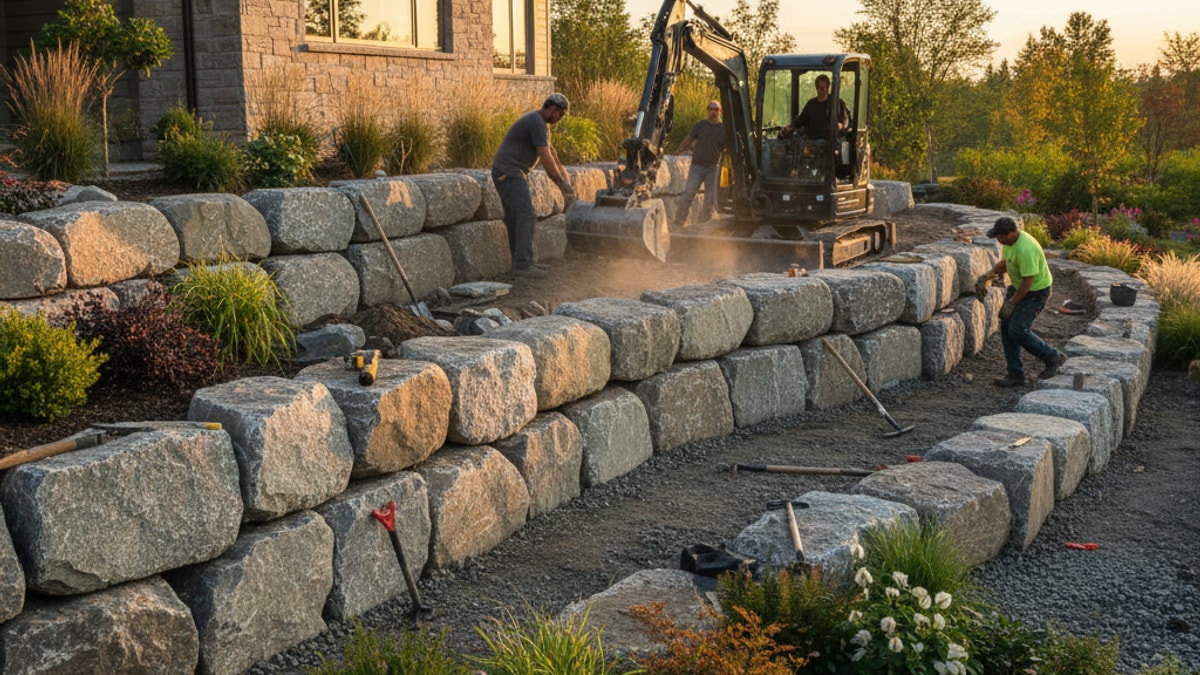
Successfully tackling how to build boulder retaining wall requires more than just enthusiasm; it demands the right equipment, quality materials, and a skilled crew. This isn't a project for a simple shovel and wheelbarrow, especially when dealing with boulders that can weigh hundreds or even thousands of pounds. We've seen firsthand the catastrophic results of underestimating the physical demands and specialized tools required.
Key Equipment:
- Excavator or Skid Steer: Absolutely essential for digging the trench, moving large boulders, and backfilling. Trying to manually excavate a proper foundation for a significant wall is grueling and inefficient.
- Heavy-Duty Chains and Slings: For safely lifting and positioning boulders with the machinery.
- Plate Compactor: Crucial for achieving proper compaction of the base material and backfill.
- Levels and Measuring Tools: Large spirit levels, string lines, and measuring tapes are vital for maintaining grade and alignment.
- Sledgehammers and Pry Bars: For minor adjustments and seating boulders.
- Safety Gear: Hard hats, steel-toed boots, heavy-duty gloves, and eye protection are non-negotiable. Safety first, always.
Materials:
- Selected Boulders: These are the stars of the show. We carefully source boulders for their aesthetic appeal, structural integrity, and consistency in type. They should be angular rather than perfectly round for better interlocking. We've found that a mix of sizes often creates the most natural and robust wall.
- Crushed Gravel or Road Base: For the foundation and drainage layer. This provides a stable, free-draining base.
- Geotextile Fabric: Used to separate the drainage layer from the native soil, preventing clogging and ensuring long-term drainage efficiency.
- Backfill Material: Typically a well-draining granular material to relieve pressure on the wall.
When considering how to build boulder retaining wall, the experience of the crew can't be overstated. Our team brings years of hands-on knowledge to every project. We've learned the nuances of boulder placement, the delicate balance of creating a natural look while ensuring structural soundness. It's a craft, truly, that combines brute strength with an artist's eye. We understand the importance of having the right expertise for projects like Seat Retaining Walls which demand both structural integrity and aesthetic appeal.
The Construction Process: A Step-by-Step Breakdown
Knowing how to build boulder retaining wall means understanding the sequence, the critical steps that ensure a lasting structure. Let's break down the actual construction, detailing each phase our team undertakes.
1. Site Preparation and Excavation:
First, we precisely mark out the wall's footprint according to the approved design. Then, the excavation begins. We dig a trench that's wider than the base of your largest boulders and deep enough to accommodate a substantial gravel base and ensure the first course of boulders is partially buried. This partial burial is crucial for anchoring the wall against soil movement. The depth will vary based on wall height and soil conditions; for taller walls, we're talking about a significant trench, sometimes several feet deep. We can't stress this enough: proper excavation sets the stage for everything else.
2. Creating the Foundation:
Once the trench is excavated, we lay down a layer of geotextile fabric. This prevents the base material from migrating into the native soil. On top of this, we place a generous layer (typically 6-12 inches) of compacted crushed gravel or road base. This granular material provides a stable, free-draining footing for the wall. Using a plate compactor, we compact this base in lifts, ensuring it's incredibly dense and level. An uneven or poorly compacted base is a recipe for future wall failure. Honestly, though, this step is often rushed by less experienced builders.
3. Laying the First Course of Boulders:
This is where the heavy lifting, literally, begins. We carefully select the largest, flattest boulders for the base course. Using the excavator or skid steer, we position each boulder, ensuring it's level front-to-back and side-to-side, and that it's firmly seated into the compacted gravel. We aim for a slight backward lean (batter) into the slope, typically 1-2 inches per foot of height, to help the wall resist soil pressure. The boulders should interlock as much as possible, minimizing gaps. This initial layer is the anchor; get it right, and the rest follows. This is a crucial moment for how to build boulder retaining wall correctly.
4. Installing Drainage Behind the Wall:
As we lay the first course, we simultaneously begin installing the drainage system. Behind the boulders, we place a perforated drain pipe, typically 4-inch corrugated pipe, ensuring it slopes gently towards an outlet. This pipe is then surrounded by clean, coarse gravel, which extends up the back of the wall. Another layer of geotextile fabric is often placed between this gravel backfill and the native soil to prevent soil particles from clogging the drainage system. This meticulous drainage work is a hallmark of our approach to how to build boulder retaining wall.
5. Stacking Subsequent Courses:
With the foundation and initial drainage in place, we continue stacking boulders. Each subsequent course should be set back slightly from the one below it, maintaining that crucial batter. We meticulously select boulders that fit snugly, minimizing voids. It's like a giant, rugged jigsaw puzzle, where each piece needs to contribute to the overall stability. We use smaller stones or shims (spalls) to fill minor gaps and ensure each boulder is stable and doesn't rock. The goal is maximum contact between stones, creating a monolithic structure. We also ensure that vertical joints are staggered, much like brickwork, to distribute weight evenly and prevent continuous weak points. This ensures the structural integrity of your Seat Retaining Walls or any other boulder wall we construct.
6. Backfilling and Compaction:
As each course is laid, we backfill behind the wall with suitable granular material, compacting it in lifts (6-12 inch layers). This compaction is vital for stability, reducing the likelihood of future settlement or wall movement. The drainage gravel and geotextile fabric continue to rise with the wall. Proper backfilling relieves hydrostatic pressure and helps anchor the wall against the slope. It's a relentless, methodical process that directly impacts the wall's longevity.
7. Finishing Touches and Capstones:
Once the wall reaches its desired height, the final course, or capstones, are carefully selected and placed. These often provide a flat, finished top surface, though sometimes we opt for a more natural, uneven look depending on the design. We then ensure all exposed areas are clean, and the surrounding landscape is graded to encourage proper surface drainage away from the wall. This might involve integrating Artificial Turf SAN Diego right up to the wall's edge for a neat, low-maintenance finish, or careful planting to soften the wall's appearance. Knowing how to build boulder retaining wall isn't just about the structure; it's about the entire integrated landscape.
Common Pitfalls and How We Avoid Them
Even with the best intentions, building a boulder retaining wall can go awry. Our experience has taught us invaluable lessons about what not to do, ensuring our projects stand strong. Here's what we've learned and how we proactively address these common pitfalls when considering how to build boulder retaining wall.
One major issue is inadequate foundation preparation. Many DIYers skimp on trench depth or fail to properly compact the base material. The result? Settlement, shifting, and ultimately, wall failure. We can't emphasize enough the importance of a deep, wide, and thoroughly compacted base. It's the bedrock of the entire structure.
Another frequent problem is poor drainage. As discussed, water is a formidable foe. Without proper drainage behind the wall, hydrostatic pressure will build, pushing the wall outwards. We've seen walls buckle, crack, and even collapse because of neglected drainage. Our team always implements robust drainage systems, often incorporating multiple layers of gravel, geotextile fabric, and perforated pipes to manage water effectively. This isn't an optional extra; it's a critical, non-negotiable element for any wall built in 2026.
Lack of proper batter or setback is also common. A vertical retaining wall is inherently unstable. The slight backward lean (batter) into the slope is essential for the wall to resist the immense lateral pressure from the soil. We meticulously check and adjust the batter with each course to ensure optimal stability. It's a small detail with huge consequences.
Finally, selecting the wrong boulders. Perfectly round river rocks, while beautiful, don't interlock well and can create unstable walls. We prioritize angular, irregularly shaped boulders that can be fitted together like puzzle pieces, maximizing contact and friction. This creates a much stronger, more cohesive structure that won't shift under pressure. When you consider how to build boulder retaining wall, these are the nuanced details that make all the difference.
Boulder Retaining Walls vs. Other Options: A Comparison
It's helpful to understand how boulder retaining walls stack up against other popular choices. While each has its merits, they serve different aesthetic and functional purposes. Here's a brief comparison:
| Feature |
Boulder Retaining Wall |
Segmental Block Wall |
Poured Concrete Wall |
| Aesthetic |
Natural, rugged, organic, monumental |
Uniform, modern, clean lines, sometimes repetitive |
Smooth, minimalist, can be stained/stamped |
| Durability |
Extremely high, long lifespan, natural erosion resist. |
High, but can be susceptible to freeze-thaw cycles |
Very high, engineered strength |
| Installation |
Specialized heavy equipment, skilled labor required |
Modular, easier for DIY, less heavy equipment |
Complex formwork, rebar, specialized concrete work |
| Cost |
Moderate to high (due to material & labor) |
Low to moderate (materials are mass-produced) |
Moderate to high (labor-intensive, material cost) |
| Environmental Impact |
Low (natural stone, minimal processing) |
Moderate (manufactured concrete) |
Moderate (concrete production, formwork materials) |
| Drainage Needs |
Critical, requires robust systems |
Critical, often integrated drainage features |
Critical, requires weep holes/drainage behind |
As you can see, while Pavers SAN Diego offer a different kind of hardscape solution, and Concrete SAN Diego provides a versatile, modern look, boulder walls stand distinct in their natural beauty and formidable strength. We've found that for clients seeking an organic, long-lasting solution with significant visual impact, knowing how to build boulder retaining wall effectively makes them an unparalleled choice.
Integrating Your Boulder Wall into a Cohesive Landscape
A boulder retaining wall, while impressive on its own, truly shines when it's part of a larger, thoughtfully designed outdoor space. We don't just build walls; we craft environments. When you embark on a project like this, it's an opportunity to rethink your entire outdoor living area. So, once you've considered how to build boulder retaining wall, what's next?
Consider how the wall will interact with other elements. Perhaps it forms the backdrop for a new Outdoor Kitchens SAN Diego, creating a cozy, defined culinary zone. Or maybe it provides the perfect elevation for a cascading water feature that drains into a stunning new pool. We've designed projects where a series of boulder walls create dramatic, multi-level terraces, each featuring unique plantings, seating areas, and even Fire Features for evening ambiance.
Lighting is another often-underestimated aspect. Strategically placed Landscape Lighting SAN Diego can dramatically enhance the wall's texture and form, especially after dark. Uplighting can highlight the rugged beauty of the boulders, transforming a daytime functional element into a nighttime artistic statement. It's about creating depth and drama, extending the usability and beauty of your yard well into the evening hours.
And let's not forget the planting. The right plants can soften the wall's edges, introduce color and life, and further integrate it into the natural landscape. Drought-tolerant succulents, creeping groundcovers, or even small trees can thrive in the microclimates created by the wall. Our team can help you select species that complement the rustic aesthetic of the boulders and thrive in your local environment. This holistic approach ensures that when you choose how to build boulder retaining wall, it becomes a true asset to your property.
We understand that undertaking a significant hardscape project like this can feel daunting. That's precisely why Modern Yardz exists. We specialize in transforming complex visions into tangible, breathtaking realities. From the initial concept and Landscape Design SAN Diego to the meticulous construction of every element, including sophisticated Pools AND Spas or elegant Patio Covers Pergolas SAN Diego, we handle it all with an unwavering commitment to quality and craftsmanship. We're not just builders; we're partners in creating the outdoor space you've been dreaming of. When you're ready to embark on such a transformative project, whether it's figuring out how to build boulder retaining wall or designing an entirely new outdoor sanctuary, we're here to guide you every step of the way.
The intricacies of how to build boulder retaining wall demand a blend of artistry and engineering. It's a project that, when executed flawlessly, can dramatically enhance your property's beauty, functionality, and value for decades to come. Don't underestimate the power of these natural giants. They offer a unique opportunity to shape your landscape with enduring strength and timeless appeal.
Ready to Upgrade Your Backyard? Let's Design the Outdoor Space You've Been Dreaming Of.
FAQ: Your Questions About Boulder Retaining Walls Answered
Q: How much does it cost to build a boulder retaining wall?
A: The cost varies significantly based on factors like wall height and length, boulder type and size, site accessibility, and drainage requirements. Smaller, simpler walls will naturally be less expensive than large, complex installations. We recommend getting a detailed quote for your specific project.
Q: How long does it take to build a boulder retaining wall?
A: Construction time depends heavily on the wall's scale and complexity. A smaller wall might take a few days, while a large, multi-tiered structure could take several weeks. Site preparation, including excavation and material delivery, also adds to the overall timeline.
Q: Do I need a permit to build a boulder retaining wall?
A: For most retaining walls above a certain height (often 3-4 feet, but local regulations vary), yes, you'll need a permit and often an engineered design. It's crucial to check local building codes before starting any construction. Our team handles the permitting process as part of our comprehensive service.
Q: What kind of boulders are best for a retaining wall?
A: Angular, irregularly shaped boulders are generally preferred over smooth, rounded ones. Their natural facets allow them to interlock better, creating a more stable and robust wall. We always select boulders that are structurally sound and aesthetically pleasing for your design.
Q: How do you ensure the wall won't collapse?
A: We ensure stability through meticulous planning, including soil analysis and engineering designs, a properly compacted gravel foundation, a slight backward lean (batter), interlocking boulder placement, and a comprehensive drainage system to prevent hydrostatic pressure buildup. These steps are critical.
Q: Can I build a boulder retaining wall myself?
A: While it's technically possible for very small, low walls, building a significant boulder retaining wall is a complex and physically demanding project. It requires heavy machinery, specialized skills, and a deep understanding of engineering principles. For most projects, we strongly recommend professional installation to ensure safety and longevity.
Q: What is the purpose of the drainage system behind the wall?
A: The drainage system's primary purpose is to relieve hydrostatic pressure. Water accumulating behind the wall can exert immense force, leading to bulging, cracking, or collapse. A well-designed drainage system channels this water away, protecting the wall's structural integrity.
Q: How deep should the foundation trench be for a boulder wall?
A: The depth varies, but generally, the trench should be deep enough to accommodate a substantial gravel base (6-12 inches) plus ensure the first course of boulders is partially buried. For taller walls, this could mean an excavation several feet deep to ensure proper anchoring.
Q: How do you choose the right size and type of boulders?
A: We select boulders based on the wall's height, desired aesthetic, and structural requirements. Larger, heavier boulders are typically used for the base, with a mix of sizes for subsequent courses to create a natural, interlocking pattern. We also consider the local availability and geological suitability.
Q: Can a boulder retaining wall be curved?
A: Absolutely! Boulder retaining walls can be designed with gentle curves, adding a fluid, organic feel to your landscape. Achieving smooth curves requires careful boulder selection and precise placement, but the aesthetic results are truly stunning and unique. It's a great way to soften the landscape.
Q: What maintenance does a boulder retaining wall require?
A: Once properly installed, boulder retaining walls require minimal maintenance. We recommend periodic checks for any shifting or erosion, especially after heavy rains. Ensuring the drainage outlets remain clear is also important. Unlike some other wall types, they typically don't need sealing or repainting.
Q: How does a boulder retaining wall affect property value?
A: A professionally designed and installed boulder retaining wall significantly enhances curb appeal and functionality, especially on sloped properties. It can transform unusable land into valuable outdoor living space, which often leads to a positive increase in property value and market attractiveness.
Q: What if my soil conditions are challenging (e.g., clay, very wet)?
A: Challenging soil conditions necessitate even more rigorous planning and potentially specialized engineering solutions. For clay soils, enhanced drainage and specific foundation designs are critical. For very wet areas, extensive sub-surface drainage might be required. Our experts are well-versed in addressing diverse soil challenges. We adapt our approach to ensure stability and longevity, regardless of the underlying geology.



.webp)
.webp)