How Much Does Retaining Wall Cost? (2026 Pricing)
A 30-foot retaining wall installed in 2026 costs anywhere from $4,500 to $18,000 — and both quotes might be perfectly fair for the same length of wall. The difference isn't contractor greed. It's site conditions. A wall holding back 2 feet of level soil on stable ground is structurally simple. A wall holding back 5 feet of saturated clay on a slope requires engineered footings, drainage solutions, and permits. The material you see is only part of what you're paying for.
We've designed and installed hundreds of retaining walls across varying terrain, and the gap between an accurate estimate and a budget-blowing surprise comes down to three factors most online calculators completely ignore: site assessment requirements, drainage solutions, and load-bearing capacity needs.
How much does retaining wall cost in 2026?
Retaining wall costs range from $20 to $150+ per square foot in 2026, with the national average sitting around $45 per square foot for a standard installation. Material choice, wall height, and site complexity drive the variance. Timber walls start at $20–$30 per square foot, while engineered concrete or natural stone installations with drainage and permits can exceed $100 per square foot. Your final cost depends more on what's beneath the wall than what's visible above it.
Understanding Retaining Wall Pricing by Material
The material you choose sets the baseline, but it doesn't cap your final cost. Timber is the least expensive upfront but requires replacement every 10–15 years. Concrete block offers the best balance of cost and longevity. Natural stone delivers curb appeal and a 50+ year lifespan but demands skilled labor and premium pricing.
Timber retaining walls cost $20–$30 per square foot installed. They're ideal for walls under 3 feet tall on stable, well-drained soil. Expect rot and warping within a decade if the site stays wet. Pressure-treated 6×6 timbers are standard, but even treated wood degrades faster than masonry alternatives.
Concrete block retaining walls cost $35–$60 per square foot. These modular systems — like Allan Block or Belgard — stack without mortar, integrate drainage easily, and handle walls up to 6 feet without engineering in most jurisdictions. They're the workhorse of residential retaining walls. Color and texture options have improved dramatically, and a well-installed block wall can last 40+ years with minimal maintenance.
Poured concrete retaining walls cost $50–$100 per square foot. Engineers spec these for high-load applications: walls over 6 feet, commercial sites, or locations with poor soil. They require formwork, rebar, and concrete delivery, which adds labor hours. The result is a monolithic structure with superior load-bearing capacity and a clean, modern appearance.
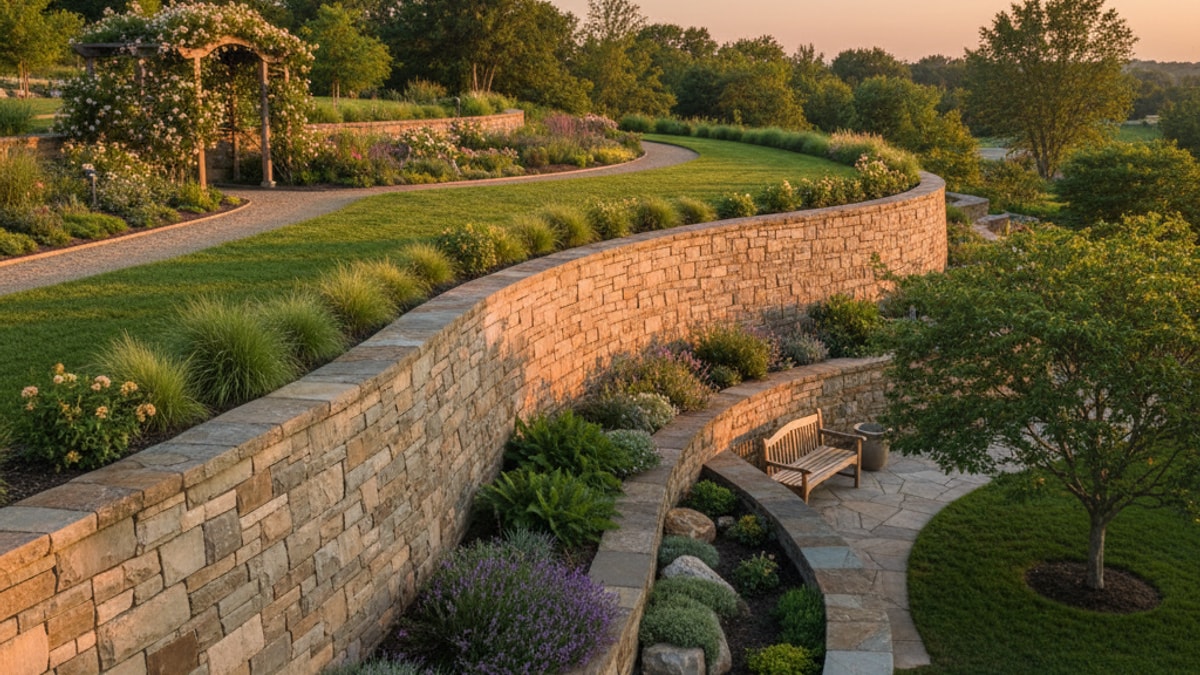
Natural stone retaining walls cost $80–$150+ per square foot. Dry-stacked stone (no mortar) offers drainage advantages and timeless aesthetics but requires a mason experienced in gravity wall construction. Mortared stone is more stable but needs weep holes and gravel backfill to prevent hydrostatic pressure from cracking the joints. Stone walls are premium investments — both in installation and ROI on home improvement.
Boulder retaining walls cost $100–$200+ per square foot when large boulders are placed individually by excavator. These are functional and sculptural, often used on properties where natural integration with the landscape is the priority. Delivery and placement equipment drive costs up quickly.
What Drives Retaining Wall Cost Beyond Material
Wall height is the single biggest cost multiplier. A 2-foot wall is a DIY-friendly project in many cases. A 4-foot wall requires proper footings, compacted base material, and drainage. A 6-foot wall often triggers engineering requirements, permit fees, and inspections. As the wall gets taller, the footing gets deeper, the drainage system gets more complex, and the material specification gets stricter.
Site conditions determine whether your project is straightforward or a problem-solving exercise. Sloped sites require stepped footings and more excavation. Poor soil — clay, loose fill, or high groundwater — demands soil stabilization or deeper footings to reach load-bearing strata. Access matters too. If equipment can't reach the site, labor costs double because everything moves by hand.
Drainage solutions are non-negotiable for any retaining wall over 2 feet tall. Water is the enemy. Hydrostatic pressure from saturated soil behind the wall will crack, bow, or topple even a well-built structure. Standard practice includes a gravel backfill zone, perforated drain pipe at the base, and weep holes or drainage gaps in the face. On high-water sites, you may need a French drain system running parallel to the wall. Skipping drainage to save $800 upfront often means rebuilding a failed wall for $12,000 within five years.
Engineered walls add $1,500–$5,000+ to the project. Local building codes vary, but most jurisdictions require a licensed engineer's stamp for walls over 4 feet tall, walls supporting structures (like a patio or driveway), or walls on slopes exceeding a certain grade. The engineer reviews soil reports, specifies footing depth and rebar placement, and signs off on the design. It's not optional red tape — it's liability protection and structural assurance.
Permits and inspections cost $200–$1,000 depending on your municipality. Some areas require permits for any wall over 30 inches. Others only regulate walls over 6 feet. Inspectors check footing depth, base compaction, and drainage installation at key stages. Working without a permit when one is required can result in fines and a tear-out order. Always confirm HOA compliance and local building code requirements during the planning phase.
Retaining Wall Cost Breakdown by Project Size
Small retaining walls (under 50 square feet) cost $1,500–$4,000 installed. These are typically garden beds, terraced planting areas, or low border walls. Material choice and access drive the range. A timber wall on flat ground sits at the low end. A mortared stone wall on a slope with hand-carry access hits the high end.
Medium retaining walls (50–200 square feet) cost $4,000–$15,000 installed. This range covers most residential projects: patio step-downs, driveway support, or single-tier slope retention. Concrete block is the most common material here, and drainage is almost always part of the scope. Expect a project timeline of 3–7 days depending on site prep and curing time.
Large retaining walls (200+ square feet) cost $15,000–$50,000+ installed. These are multi-tier systems, commercial walls, or high (6+ foot) residential walls requiring engineering. Mobilization costs, equipment rental, and engineering fees all contribute. Large projects often include grading, backfill material delivery, and coordination with other trades (like irrigation or landscape lighting).
Here's how material, height, and site conditions interact to shape final pricing:
| Wall Material |
Low End ($/sq ft) |
High End ($/sq ft) |
Best Use Case |
Typical Lifespan |
Drainage Requirement |
| Timber |
$20 |
$30 |
Walls under 3 feet, temporary applications |
10–15 years |
Minimal (weep holes) |
| Concrete Block |
$35 |
$60 |
Standard residential walls, 2–6 feet tall |
40+ years |
Gravel backfill + drain pipe |
| Poured Concrete |
$50 |
$100 |
Engineered walls, high-load applications |
50+ years |
Integrated weep system |
| Natural Stone |
$80 |
$150+ |
Premium aesthetics, long-term investment |
50+ years |
Dry-stack gaps or weep holes |
| Large Boulders |
$100 |
$200+ |
Natural integration, sculptural design |
Permanent |
Natural gaps between boulders |
Key Takeaways
- Retaining wall costs range from $20 to $150+ per square foot depending on material, height, and site complexity, with concrete block averaging $35–$60 per square foot for most residential projects.
- Walls over 4 feet tall or supporting structures typically require engineered plans, adding $1,500–$5,000 to the project but ensuring load-bearing capacity and code compliance.
- Drainage solutions — gravel backfill, perforated pipe, and weep holes — are mandatory for walls over 2 feet tall to prevent hydrostatic pressure from causing structural failure.
- Site conditions like slope, soil type, and equipment access often contribute more to final cost than material selection, with difficult sites doubling labor hours.
- Natural stone and boulder walls deliver the highest ROI on home improvement and longest lifespan (50+ years) but require skilled masons and premium budgets starting at $80 per square foot.
What If: Retaining Wall Scenarios
What If My Retaining Wall Needs to Be Taller Than 4 Feet?
Hire a licensed structural or geotechnical engineer before you proceed. Walls over 4 feet are governed by stricter building codes in most jurisdictions, and they require calculations for soil pressure, footing depth, and reinforcement. Skipping engineering might save $2,500 upfront, but it voids your workmanship warranty, exposes you to liability if the wall fails, and risks a tear-out order if an inspector flags it during a property transaction.
What If I Have Poor Drainage or Clay Soil?
Install a full French drain system behind the wall in addition to standard gravel backfill. Clay holds water, and hydrostatic pressure will bow or crack even a well-built wall. A French drain — perforated pipe in gravel leading to a daylight outlet or drywell — relieves that pressure before it becomes structural load. This adds $1,200–$3,000 to the project but prevents a $15,000 rebuild five years later.
What If My HOA Requires Approval Before I Build?
Submit your material specification, wall height, and site plan to your HOA architectural review committee at least 30 days before breaking ground. Many HOAs restrict certain materials (like timber or colored block) or require natural stone to match neighborhood aesthetics. Starting construction without approval can result in fines and a mandated tear-out. Ask your contractor if they've worked in your community before — experienced pros know the local approval process and can streamline it.
What If I Want to Add Lighting or Seating to the Wall?
Build those features into the design phase, not after installation. Landscape lighting integrated into a retaining wall requires conduit runs placed during base prep. Bench seating built into the wall cap requires reinforced sections and specific cap stone cuts. Retrofitting lighting or seating into a finished wall triples the cost and often looks bolted-on rather than intentional. Plan the full scope upfront.
What If the Wall Is on a Shared Property Line?
Get written agreement from your neighbor before construction starts, and confirm the survey line with a licensed surveyor if there's any ambiguity. Retaining walls on property lines often become shared structures legally, which complicates maintenance responsibilities and liability. If the wall primarily benefits your property (holding back your soil), you're typically responsible for construction and upkeep, but state laws vary. Document everything.
How Installation Method Affects Final Cost
Dry-stacked systems (modular concrete block or stone) are faster to install and more forgiving of minor settling because the units aren't bonded. Labor costs run lower, and material waste is minimal. Most residential projects under 6 feet use dry-stack methods with pinned or interlocking units for lateral stability.
Mortared systems (natural stone or brick) require skilled masons, longer curing times, and precise drainage planning. Mortar joints create a monolithic structure, which is stronger against lateral forces but less tolerant of soil movement. If the ground settles unevenly, mortared walls crack. Budget 20–30% more labor cost for mortared installations compared to dry-stack.
Poured-in-place concrete walls are the most labor-intensive. Formwork must be built, rebar tied, concrete poured, and forms stripped after curing. The result is a seamless, high-strength wall ideal for commercial applications or walls supporting heavy loads like driveways. Expect a minimum 5-day project timeline and costs at the top of the range.
Maintenance Costs Over the Wall's Lifespan
Timber walls require sealing every 2–3 years and eventual board replacement as rot progresses. Budget $500–$1,200 every 3 years for maintenance, with full replacement likely by year 15.
Concrete block walls are essentially maintenance-free if properly installed. Occasional joint sand replenishment (for permeable cap systems) and annual cleaning are the extent of upkeep. Total maintenance cost over 40 years: under $500.
Natural stone walls need repointing (mortar joint repair) every 20–30 years if mortared, or occasional stone resetting if dry-stacked and subjected to freeze-thaw cycles. Budget $2,000–$5,000 for a full repointing on a 100-square-foot mortared wall.
Drainage system maintenance is often overlooked. Perforated drain pipes can clog with silt over decades, especially if filter fabric wasn't installed or has degraded. Flushing or replacing drain lines costs $800–$2,000 depending on access. A clogged drain pipe turns your maintenance-free block wall into a bowed, failing structure within two wet seasons.
Why Some Quotes Are Higher Than Others
Licensed and insured contractors charge more than unlicensed laborers, but the difference isn't profit padding — it's protection. A licensed contractor carries general liability and workers' compensation insurance, pulls permits, and provides a workmanship warranty. If an uninsured crew member is injured on your property, you're liable. If an unlicensed builder's wall fails and damages your neighbor's foundation, you have no recourse. The $8,000 quote from a licensed contractor isn't overpriced compared to the $4,500 cash quote from a guy with a truck — it's appropriately priced for the risk transfer and accountability you're buying.
Some contractors include drainage, base prep, and compaction in their per-square-foot rate. Others quote the wall only and add drainage, excavation, and backfill as separate line items. Always compare scopes, not just totals. A $50/sq ft all-inclusive quote is often a better deal than a $35/sq ft quote that excludes $4,000 in necessary site prep.
Engineered designs cost more upfront but prevent change orders. When a contractor encounters unexpected soil conditions or water issues mid-project without an engineer's plan, the fix is often improvised and billed as extra. An engineer anticipates those conditions during the design phase, specifies solutions in advance, and locks in the scope. You pay more for the plan, but you avoid mid-project surprises that balloon costs by 40%.
What Most Contractors Won't Tell You About Retaining Walls
Here's the honest answer: the cheapest contractor is almost never the best value on a retaining wall project. Retaining walls are structural elements, not decorative features. A poorly built wall doesn't just look bad — it fails catastrophically, often taking your patio, your driveway, or your neighbor's fence with it. The $3,000 you save by hiring the low bidder evaporates the moment the wall bows, cracks, or collapses, and you're facing a $15,000 tear-out and rebuild.
The ROI on a retaining wall isn't in resale value — it's in preventing erosion damage and unlocking unusable space. A well-designed retaining wall can turn a sloped, unusable backyard into a tiered patio and garden, adding 500+ square feet of functional outdoor living space. That's not a 10% return when you sell. That's a quality-of-life improvement you use daily for decades.
If your wall will be visible from the street or a primary outdoor living area, treat it as a design feature, not an afterthought. Stepped walls, integrated planters, and cap lighting transform a utilitarian structure into a focal point. Budget 10–15% extra for design features if curb appeal or backyard aesthetics matter to you.
How Modern Yardz Approaches Retaining Wall Projects
At Modern Yardz, we don't quote retaining walls over the phone. Every project starts with a site assessment, because the material you want and the wall your site needs aren't always the same. We evaluate soil type, drainage patterns, slope, and access before recommending a solution. That assessment is where we catch the hidden problems — high groundwater, expansive clay, or undersized footings from a previous DIY attempt — that turn a $6,000 wall into a $12,000 project if discovered mid-installation.
Our Seat/Retaining Walls service integrates function and design. We build walls that do more than hold back soil — they create seating for fire pits, frame outdoor kitchens, or terrace gardens into multi-level landscapes. Every wall includes engineered drainage solutions, compacted base material, and a workmanship warranty backed by decades of local installation experience. We're licensed, insured, and familiar with local building codes and HOA requirements, which means fewer delays and no mid-project surprises.
When a project requires engineering, we coordinate with licensed structural engineers we've worked with for years. They know our installation methods, and we know their specifications. That relationship eliminates the miscommunication that often plagues engineered projects when the designer and builder have never collaborated before.
If your retaining wall is part of a larger outdoor transformation — a patio, pool, or outdoor kitchen — we design those elements together so the wall integrates seamlessly rather than looking like an afterthought. A retaining wall that doubles as a planter bed beside a patio installation or frames a pool deck elevates the entire space.
Related Services
Retaining walls often pair with complementary outdoor features. If you're investing in site grading and excavation for a wall, consider integrating other elements during the same project timeline to maximize value and minimize mobilization costs.
Landscape Design helps you visualize how a retaining wall fits into your broader outdoor space, ensuring the wall enhances function and aesthetics rather than solving one problem while creating another.
Patio Covers & Pergolas can transform the flat space a retaining wall creates into a shaded outdoor living area, extending usability and ROI.
Fire Features integrate naturally into retaining wall projects, with the wall providing built-in seating and a visual anchor for the fire pit or fireplace.
A well-planned retaining wall isn't an expense — it's an investment in usable space, erosion control, and long-term property value. The difference between a wall that lasts 15 years and one that lasts 50 comes down to three things: proper drainage, adequate base preparation, and a contractor who treats it as a structural element, not a landscaping accessory. If you're ready to move forward with a retaining wall project, start with a site assessment from a licensed professional who'll tell you what your site actually needs, not just what you want to hear. The honest answer upfront costs nothing. The dishonest answer mid-project costs everything.



.webp)
.webp)