A sloped yard presents a formidable challenge. It can feel like a puzzle with no easy solution—a beautiful view, maybe, but a functional nightmare. We've seen it countless times. Homeowners feel stuck with unusable space, fighting erosion and struggling to create level areas for patios, gardens, or even just a safe place for kids to play. It's a common frustration.
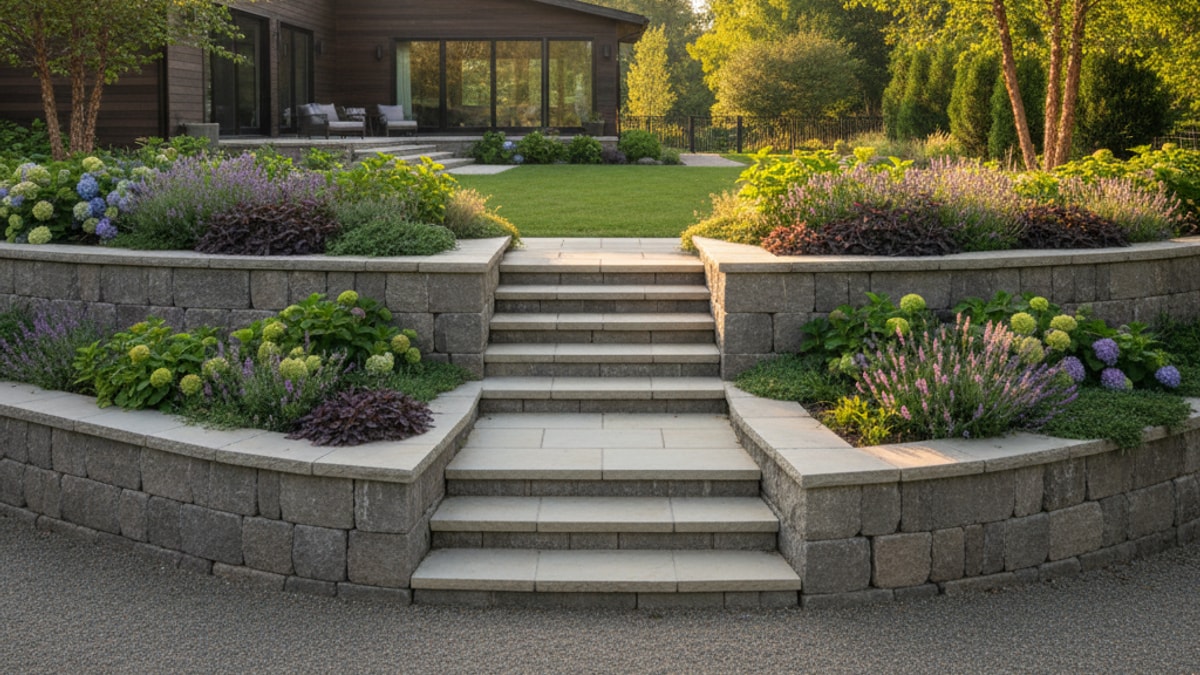
But what if that slope wasn't a problem? What if it was an opportunity? At Modern Yardz, we see these challenging topographies as blank canvases. The solution, and the one that unlocks the most potential, is often a thoughtfully designed retaining wall with integrated stairs. This isn't just about holding back dirt; it's about reclaiming your property and creating a dynamic, multi-level outdoor experience. It's about turning a difficult, often moving-target objective into a stunning feature. And we're here to walk you through exactly how to build a retaining wall with stairs, sharing the insights our team has gathered over years of transforming landscapes.
Why Bother? The Real Value of an Integrated Wall and Stairs
Let's be honest, this is a significant project. It's more than a weekend DIY. So, is it worth it? Absolutely. The decision to learn how to build a retaining wall with stairs is an investment in your property's function, beauty, and value. First, there's the obvious functional benefit: you create flat, usable land where there was none. This opens up possibilities for everything from a sprawling Outdoor Kitchens SAN Diego area to a serene garden nook or a level space for some high-quality Artificial Turf SAN Diego. The stairs provide elegant, safe access between these new levels, connecting your outdoor spaces seamlessly. We've seen it work. A well-executed project completely changes how a family interacts with their yard.
Beyond pure function, the aesthetic transformation is dramatic. A retaining wall adds structure, texture, and a strong architectural element to the landscape. It can define different 'rooms' in your yard, creating a more organized and intentional design. When you're considering how to build a retaining wall with stairs, you're not just thinking about utility; you're thinking about creating a visual journey through your property. The materials you choose, from rugged natural stone to sleek modular blocks, set the entire tone. This is where a proper Landscape Design SAN Diego plan becomes a critical, non-negotiable element. Finally, there's the undeniable boost to your property value. This isn't just a curb appeal upgrade; it's a fundamental improvement to the land itself, and that's something potential buyers in 2026 recognize and reward.
Before You Break Ground: The Non-Negotiable Planning Phase
Jumping into excavation without a rock-solid plan is a recipe for catastrophic failure. We can't stress this enough: the success of this entire project hinges on what you do before a single shovel hits the dirt. The complex process of how to build a retaining wall with stairs demands meticulous preparation. First things first: check with your local building department about permits. Generally, walls over a certain height (often three or four feet, including the buried portion) require a permit and, in some cases, an engineer's stamp. Don't skip this. It's a safety and liability issue you don't want to face later.
Next is a thorough site assessment. Where is the water going? Understanding drainage is paramount. A retaining wall is essentially a dam, and if you don't give water a planned escape route, hydrostatic pressure will build up and push your beautiful wall over. It happens. We’ve been called in to fix these exact problems. Your plan for how to build a retaining wall with stairs must include provisions for a perforated drain pipe, gravel backfill, and 'weep holes' if necessary. You also need to analyze your soil. Is it sandy? Clay-heavy? This affects the foundation requirements and the overall design. Finally, lay out the entire structure with stakes and string. Walk the path of the stairs. Visualize the finished height. Make adjustments now, because it's a whole lot harder to change things once you start digging. This is where professional guidance can save you from costly mistakes down the line, ensuring your vision for how to build a retaining wall with stairs is both beautiful and structurally sound.
Choosing Your Weapon: Materials Matter (A Lot)
The material you choose dictates not only the look of your wall but also the construction method, the cost, and the long-term durability. It's a huge decision in the process of how to build a retaining wall with stairs. You want something that complements your home's architecture and any existing hardscaping, like Pavers SAN Diego on a nearby patio. Let's break down the most common options our team works with.
| Material |
Pros |
Cons |
Best For |
| Modular Concrete Blocks |
Interlocking design, uniform size, DIY-friendly, wide range of colors/textures. |
Can look manufactured, may require specific engineering for taller walls. |
Homeowners looking for a straightforward, predictable, and cost-effective solution. Excellent for learning how to build a retaining wall with stairs. |
| Natural Stone |
Unmatched natural beauty, extremely durable, timeless appeal. Each wall is unique. |
Irregular shapes make it challenging to stack, labor-intensive, higher material cost. |
Achieving a high-end, rustic, or classic look. Best left to experienced masons or very patient DIYers. A true art form. |
| Poured Concrete |
Incredibly strong and durable, can be formed into any shape (curves!), modern aesthetic. |
Requires extensive formwork, professional installation is a must, can be stark-looking without a veneer. |
Modern or minimalist designs and for very large, engineered walls where strength is the top priority. Think of it as the foundation for our Seat Retaining Walls service. |
| Pressure-Treated Timber |
Relatively inexpensive, easy to cut and work with, good for a rustic or natural look. |
Limited lifespan (15-20 years), susceptible to rot and insects, not as strong as masonry. |
Lower-height walls, terraced gardens, and projects with a tighter budget. A good starting point, but not a forever solution. |
Our experience shows that modular concrete blocks offer the best balance of aesthetics, durability, and ease of installation for most residential projects. They've been engineered specifically for this purpose, and the system is designed to be forgiving. But no matter what you choose, understanding the material is a core component of how to build a retaining wall with stairs that lasts for decades.
The Step-by-Step Build: From Dirt to Done Deal
Alright, you've planned, you've permitted, and you've picked your materials. Now the real work begins. This is the heart of how to build a retaining wall with stairs. We're going to break it down into manageable stages. Remember, precision at every step is key. Don't rush it.
Step 1: Excavation and Trenching
This is more than just digging. You need to excavate the area for the wall's base and also remove the soil from the slope you're retaining. Your trench for the base should be deep enough to bury at least half of your first course of blocks (or about 10% of the total wall height) plus 6-8 inches for the gravel footing. It also needs to be wide enough for the block and some working room. Use a line level and stakes to ensure the bottom of your trench is perfectly level. Perfectly. We mean it. A wonky base guarantees a wonky wall. This initial phase sets the stage for the entire process of how to build a retaining wall with stairs.
Step 2: Building a Solid Base (Gravel Footing)
Never, ever set your first course of blocks directly on dirt. You need a compacted gravel base. Fill the trench with 6-8 inches of paver base or crushed stone. Spread it evenly and then use a hand tamper (or a plate compactor for larger projects) to compact it until it's solid and level. This base provides a stable footing and, just as importantly, allows water to drain away from the bottom of the wall. This step is a non-negotiable part of how to build a retaining wall with stairs correctly.
Step 3: Laying the First Course
This is the most critical step in the entire build. The first course must be perfect. Flawless. Impeccable. Every single block needs to be perfectly level, both front-to-back and side-to-side. Use a 4-foot level and a rubber mallet to tap each block into place. Take your time. If this course isn't right, every subsequent course will be off, and the structural integrity is compromised. Our team spends more time on the first course than almost any other. It’s that important for anyone wondering how to build a retaining wall with stairs that will endure.
Step 4: Building Up and Backfilling
Once the first course is set, the rest is a matter of stacking. Most modular blocks have an interlocking lip on the back that creates a slight 'batter' or setback with each course, which adds strength. As you add each new course, you'll also backfill behind the wall. Shovel in about 12 inches of gravel directly behind the blocks for drainage, and then add your native soil behind that, compacting every 6-8 inches. This is also when you'll lay your perforated drain pipe at the bottom, just behind the first course, ensuring it has a slight slope to drain to daylight. This continuous process of stacking and backfilling is the rhythm of how to build a retaining wall with stairs.
Step 5: Finishing Touches
With the wall at its final height, it's time for the finishing touches that elevate the project from functional to beautiful. Secure the top course of blocks with a high-strength construction adhesive, then place your capstones on top. This provides a clean, finished look. Consider integrating some subtle Landscape Lighting SAN Diego into the wall or stairs. It not only adds safety for nighttime navigation but also creates a stunning visual effect, highlighting the texture of your wall. This final step completes the journey of how to build a retaining wall with stairs.
The Staircase Conundrum: Integrating Steps Seamlessly
The stairs aren't an afterthought; they are an integral part of the structure. The secret to how to build a retaining wall with stairs that looks professional is to build the stairs at the same time as the wall. Don't build the wall and then try to tack the stairs on later. It won't work. The wall blocks and the stair blocks should interlock and be built up together, course by course.
First, you need to do some math. Sorry, it's unavoidable. A comfortable stair has a consistent rise (height) and run (depth). A good rule of thumb is a 6-7 inch rise and a 12-14 inch run. You'll need to calculate how many steps you need to cover the total elevation change. The foundation for the stairs needs to be just as robust as the wall itself—a deep, compacted gravel base is essential. Each stair tread should be built like a mini-retaining wall, filled and compacted before the next one is added on top. Every tread must be perfectly level and pitched ever so slightly forward (about 1/8 inch per foot) to shed water. The complexity here is why so many guides on how to build a retaining wall with stairs fall short. They treat the stairs as a separate project. They aren't. They are one cohesive system. Ready to Upgrade Your Backyard? This is one area where professional expertise really shines through, ensuring the final result is both safe and beautiful.
Common Pitfalls and How to Sidestep Them Like a Pro
Over the years, our team at Modern Yardz has seen every possible mistake. Here's what we've learned and what you need to avoid when tackling how to build a retaining wall with stairs.
Ignoring Drainage: We mentioned it before, but it bears repeating. This is the #1 killer of retaining walls. Hydrostatic pressure is a relentless force. Without a clear path for water to escape (gravel backfill, drain pipe), your wall is on borrowed time. It's not a question of if it will fail, but when.
Skimping on the Base: A weak, unlevel, or non-existent base is the second most common failure point. The entire weight of the wall and the soil it's holding back rests on this foundation. Compacting that 6-8 inches of gravel is not optional. It’s the key to a long-lasting structure.
Forgetting the 'Batter': Most retaining wall block systems are designed with a built-in setback. This slight backward lean is critical for fighting the pressure of the soil. Building a perfectly vertical wall might look good for a year, but it's fighting physics in a way it's not designed to. It's a subtle but crucial detail in how to build a retaining wall with stairs.
Underestimating the Labor: This is heavy, back-breaking work. The blocks are heavy. The gravel is heavy. The dirt is heavy. Be realistic about the physical toll and the time commitment. A project that looks simple on paper can quickly become an overwhelming, months-long ordeal. Sometimes, the best DIY decision is knowing when to call in the pros.
Knowing how to build a retaining wall with stairs is about more than just stacking blocks; it's about understanding the forces of nature you're working against and building a structure that can stand up to them for years to come. It’s about precision, patience, and a whole lot of planning.
This project is a journey. It's a formidable undertaking that promises an equally formidable reward: a transformed landscape that is more beautiful, more functional, and more valuable. By following these steps and respecting the forces of gravity and water, you can create a feature that you'll be proud of for years. But it requires an unflinching commitment to getting the details right, from the first survey line to the final capstone. Let’s Design the Outdoor Space You’ve Been Dreaming Of, one that masterfully combines form and function.



.webp)
.webp)