A sprawling, sloped yard can feel like a curse. It’s a beautiful canvas, sure, but it's often an unusable one where furniture slides, gardens wash away, and kids can’t quite play. Our team has seen this countless times. Homeowners feel stuck with a challenging space, unsure how to reclaim it. The solution? It’s often a beautifully crafted, structurally sound rock retaining wall. It’s more than just a stack of stones; it's an architectural feature that tames the terrain and unlocks your property's true potential.
But let's be honest, the process of how to build a rock retaining wall on a slope is a formidable undertaking. It’s a project that marries artistry with unflinching physics. Get it right, and you have a timeless feature that adds immense value and utility. Get it wrong, and you’re looking at a catastrophic failure that’s both dangerous and costly. We’re here to pull back the curtain, sharing the insights we’ve gained over years of designing and building these structures. This isn’t just a checklist; it's a deep dive into the methodology behind a wall that lasts a lifetime.
Why a Rock Retaining Wall is Your Slope's Best Friend
Before we get into the grit and gravel, let’s talk about the 'why.' Why go through all this effort? Because the benefits are transformative. The most obvious win is creating level, usable land. That once-unusable hill can become the perfect spot for a patio, an Outdoor Kitchens SAN Diego, or a safe play area for your family. It’s about creating function where there was none. This is the core reason most people first research how to build a rock retaining wall on a slope.
Beyond that, it’s about control. A properly constructed wall is your number one defense against soil erosion. It holds back the earth, preventing precious topsoil from washing away during heavy rains, protecting your home's foundation and the rest of your landscape. Then there’s the sheer aesthetic appeal. Natural stone adds texture, character, and a sense of permanence that few other materials can match. It feels integrated with the environment, not imposed upon it. For many, a guide on how to build a rock retaining wall on a slope is the first step toward a more beautiful and practical yard.
It’s a significant investment of time and energy, but the payoff is a feature that serves multiple critical functions. It solves a problem while simultaneously adding beauty. That's a rare win-win in landscaping.
Before You Break Ground: The Non-Negotiable Planning Phase
We can't stress this enough: failure to plan is planning to fail. The real work on how to build a rock retaining wall on a slope begins long before you pick up a shovel. Your first move should always be to check with your local building authority. Walls over a certain height (often three or four feet, including the buried portion) typically require a permit and an engineer's stamp of approval. Don't guess. Make the call. Ignoring this can lead to fines and a mandated tear-down. It's a nightmare scenario our team has seen others face, and it's entirely avoidable.
Next, call 811 to have public utility lines marked. You absolutely do not want to discover a buried gas or water line with the tip of a shovel. It's a free, simple service that prevents disaster. With those safety checks done, it’s time to design. Think about the height, length, and exact placement. Use stakes and string to outline the wall's footprint. How will it integrate with the rest of your yard? Will it incorporate steps or curves? Proper planning is the most important component of how to build a rock retaining wall on a slope. This is where professional guidance can be a game-changer. Our Landscape Design SAN Diego service helps homeowners visualize the final product and ensure the plan is structurally sound from the outset. A detailed plan is your roadmap; without it, you're just guessing.
Choosing Your Weapon: The Right Rocks for the Job
Not all rocks are created equal, especially when you're learning how to build a rock retaining wall on a slope. The stone you choose will dictate the wall's appearance, stability, and the difficulty of the build itself. You're looking for a balance of form and function. The stones need to be heavy and substantial enough to hold back tons of soil, but they also need to fit your home's aesthetic. We've found that success in how to build a rock retaining wall on a slope often comes down to this initial material selection.
Here's a breakdown of common choices our team works with:
| Rock Type |
Pros |
Cons |
Best For |
| Fieldstone |
Natural, weathered look; often locally sourced; varied shapes create a rustic feel. |
Irregular shapes make stacking more challenging; can be heavy and dense. |
Informal, cottage-style gardens; walls under 3 feet. |
| Quarried Stone |
Uniform shapes (angular or rounded); easier to stack tightly; available in various colors. |
Can be more expensive; less natural look than fieldstone. |
Formal, modern landscapes; taller, engineered walls. |
| River Rock |
Smooth, rounded appearance; excellent for drainage-focused areas. |
Very difficult to stack securely without mortar due to round shape. |
Decorative elements, creek beds, not recommended for structural retaining walls. |
| Limestone |
Consistent color and texture; easy to shape and cut; strong and durable. |
Can be susceptible to acidic rain over many decades; may be costly. |
Sleek, contemporary walls; integrated seating. |
Our professional advice? For a DIY project, angular, flat-ish stones are your best friend. They are far easier to stack securely than rounded boulders. When you're figuring out how to build a rock retaining wall on a slope, making the stacking process as straightforward as possible will save you endless frustration. Order about 15-20% more stone than you calculate you'll need. You'll want plenty of options to choose from as you fit the pieces together like a massive, heavy puzzle.
Tools of the Trade: What You'll Absolutely Need
Having the right equipment is non-negotiable. This is a labor-intensive job, and the right tools make the difference between a successful project and a trip to the chiropractor. You don’t need a massive commercial setup, but a few key items are essential for anyone serious about how to build a rock retaining wall on a slope.
Here’s a list of the must-haves:
- Safety Gear: This is number one. Steel-toed boots, heavy-duty work gloves, and safety glasses are not optional.
- Excavation Tools: A sturdy round-point shovel for digging, a square-bladed spade for creating clean trench edges, and a mattock or pickaxe for breaking up compacted soil or rocks.
- Leveling & Measuring: A 4-foot level, a torpedo level, a tape measure, and stakes with string line.
- Moving & Setting: A heavy-duty wheelbarrow is critical for moving stone and gravel. A hand truck or dolly can also be a back-saver for larger stones. For positioning heavy rocks, a long steel pry bar (digging bar) is your best friend.
- Compaction: A hand tamper is essential for compacting the gravel base and the backfill. You can’t skip this. For larger projects, renting a plate compactor for a day is a wise investment.
- Cutting & Shaping: A 4-pound sledgehammer and a stone chisel (or a brick-set chisel) will be needed to knock off edges and make stubborn stones fit.
This list might seem daunting, but each tool plays a critical role. Understanding how to build a rock retaining wall on a slope means respecting the physical demands of the job and equipping yourself properly.
Step 1: Laying a Formidable Foundation
Everything—and we mean everything—depends on the foundation. A weak base guarantees a failed wall. This is the most physically demanding part of learning how to build a rock retaining wall on a slope, but it's where you must be the most meticulous. Start by excavating a trench along your string line. The trench should be at least 12 inches deep and about 24 inches wide (or twice the width of your average base stone).
Here’s a crucial pro tip: the trench floor must be perfectly level from end to end. On a slope, this means you'll be 'stepping' the foundation down. You dig a level section, then step down and dig the next level section. You can't just dig a trench that follows the slope of the hill. Once excavated, you need to add your foundation base. This consists of 6-8 inches of compactible gravel (like crushed stone or road base). Add the gravel in 3-inch layers, thoroughly compacting each layer with your hand tamper. It needs to be rock-solid. This compacted base provides a stable platform for your first course of stones and, critically, allows water to drain away from the base of the wall. This is a fundamental principle of how to build a rock retaining wall on a slope that many DIY guides gloss over.
Step 2: The Art of the First Course
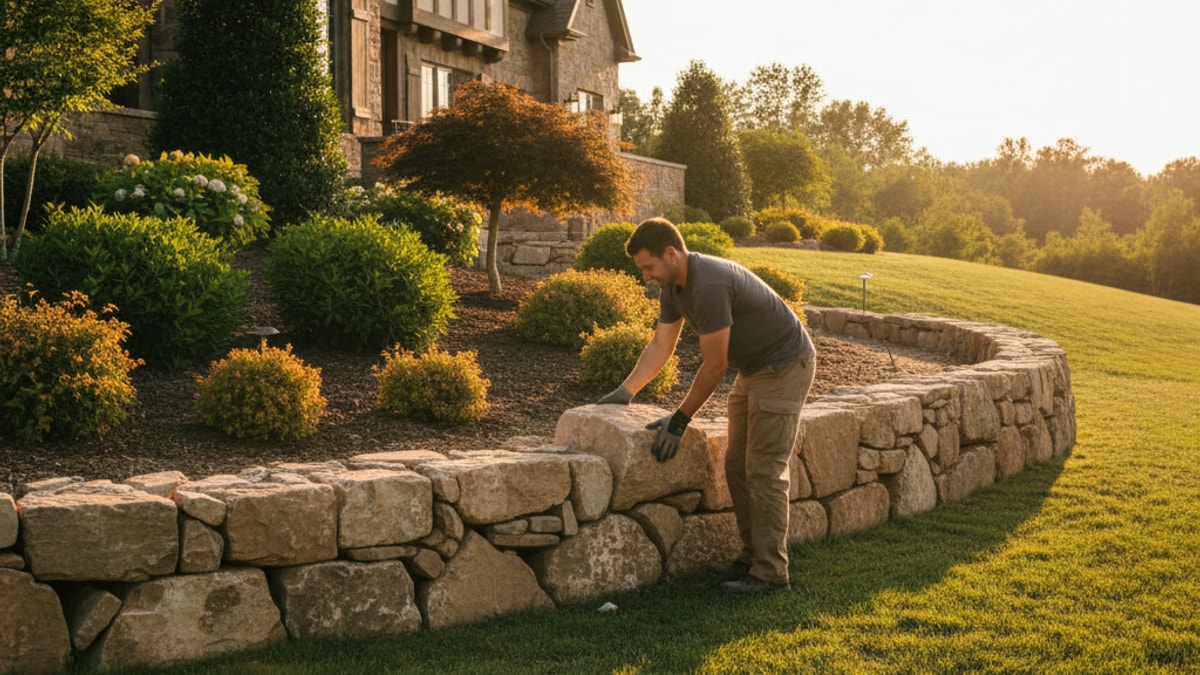
The first row of stones, known as the base course, is the most important one you'll lay. It sets the stage for the entire wall. You'll want to use your largest, flattest, most stable stones for this course. Our team's process for how to build a rock retaining wall on a slope always prioritizes a flawless first course. Each stone must be partially buried in the trench—at least half of its height should be below the final grade level. This anchors the entire structure into the earth.
Set each stone firmly into the compacted gravel base, wiggling and tamping it until it's completely stable and doesn't rock. Use your level to check it from front to back and side to side. Then, check it against the neighboring stones. The tops of this entire first course must be perfectly level. Perfect. We mean this sincerely: it needs to be absolutely, unequivocally level. Use your sledgehammer and chisel to knock off high points if necessary. Take your time here. Rushing the first course is a mistake you'll pay for with every subsequent layer.
Step 3: Stacking, Staggering, and Backfilling Like a Pro
With the base course set, you can begin building upwards. The key principle here is to stagger the joints, just like in a brick wall. A joint on one course should never line up directly with a joint on the course below it. This interlocking pattern is what gives the wall its strength. The core technique of how to build a rock retaining wall on a slope is about creating a stable, interconnected mass.
As you place each stone, ensure it sits firmly on the stones below it. It should have at least three points of contact to prevent wobbling. Use smaller stones (shims) to fill any small gaps and lock the larger stones in place. Another critical element is 'batter.' Your wall shouldn't be perfectly vertical. It needs to lean back into the hillside slightly. A good rule of thumb is a setback of 1-2 inches for every foot of height. You can use your string line as a guide to maintain a consistent batter. This backward lean uses gravity to its advantage, making the wall significantly stronger. Following this advice is vital for anyone asking how to build a rock retaining wall on a slope.
Here's another pro tip we've learned over the years: backfill as you go. After you complete each course, add a layer of 3/4-inch clean drainage gravel behind the wall, about 12 inches deep. Don't wait until the wall is finished to backfill. Doing it course by course allows you to properly fill all the voids and ensure good compaction. This integrated process is a hallmark of professional technique when it comes to how to build a rock retaining wall on a slope.
Step 4: Mastering Drainage (Or Risk Catastrophic Failure)
If the foundation is the heart of your wall, drainage is its circulatory system. This is the part that so many DIYers get wrong, and the consequences are dire. The soil behind your wall will become saturated with water during rain. This water creates immense hydrostatic pressure, which pushes relentlessly against the wall. Without a way to relieve that pressure, it will eventually push your wall over. It's not a matter of 'if,' but 'when.' Understanding this is the most important lesson in how to build a rock retaining wall on a slope.
To manage this, you need to create a drainage column directly behind your wall. The 12 inches of clean gravel you've been backfilling is the start. Within this gravel column, about 6-8 inches above the base, you need to lay a 4-inch perforated drain pipe. The pipe should have the holes facing down and be wrapped in a geotextile filter fabric 'sleeve' to prevent silt from clogging it. This pipe should run the length of the wall and 'daylight' at one or both ends, allowing water to escape freely away from the structure. Your entire gravel backfill column should then be separated from the rest of the soil by a layer of landscape filter fabric. This prevents soil from migrating into your gravel and ruining its drainage capacity. Proper drainage is the secret to longevity, and it’s the defining factor in how to build a rock retaining wall on a slope that will last for generations.
Step 5: Capping It Off and Finishing Touches
You've done the heavy lifting, and now it's time for the final, satisfying steps. The top course of your wall is the cap. You'll want to use wide, flat, and relatively uniform stones for a stable and attractive finish. Set them carefully, ensuring they are level and secure. You can even use a construction adhesive designed for stone to lock the capstones in place for extra security, especially if the wall will be used for informal seating—a popular feature in many of our Seat Retaining Walls projects.
Once the wall is capped, you can complete the backfilling process. The final 6-8 inches of backfill behind the wall should be native topsoil, not gravel. This allows you to plant grass or other vegetation right up to the edge of your wall. Grade the soil at the top and bottom of the wall to ensure water flows away from the structure, not toward it. Now, you can step back and admire your work. The newly created level space is a blank canvas. Will it be a lush lawn of Artificial Turf SAN Diego? A beautiful patio made with Pavers SAN Diego? The possibilities are endless. Consider adding some subtle Landscape Lighting SAN Diego to uplight the wall's texture at night, turning a functional structure into a stunning nighttime feature.
When is DIY a Bad Idea? Knowing When to Call Us
We love empowering homeowners with the knowledge of how to build a rock retaining wall on a slope. It's a rewarding project. However, we also believe in being realistic. This is a brutally physical and technically demanding job. There are situations where a DIY approach is simply not advisable.
If your planned wall is over four feet tall, you're dealing with very steep or unstable slopes, or you see signs of significant water drainage issues (like springs or constant sogginess), it's time to call in the professionals. These factors dramatically increase the complexity and risk. The engineering required for taller walls is significant, and the consequences of failure are severe. Our team has the heavy equipment to move massive stones with ease, the experience to read a landscape's unique challenges, and the engineering knowledge to design a wall that is guaranteed to last. The detailed process of how to build a rock retaining wall on a slope can be overwhelming, and there is no shame in seeking expert help.
Ready to Upgrade Your Backyard? Sometimes the best DIY decision is knowing when not to DIY. If you’re looking at a challenging slope and want a guaranteed, beautiful, and permanent solution, our team is here to help. We specialize in turning landscape problems into stunning features.
Building a wall is just one piece of the puzzle. It’s about creating a cohesive, beautiful outdoor living space. The knowledge of how to build a rock retaining wall on a slope is powerful, but it's the execution that matters. Whether you tackle it yourself or work with a team like ours, the goal is the same: to create a safe, functional, and beautiful landscape that you can enjoy for many years to come. Let’s Design the Outdoor Space You’ve Been Dreaming Of and transform that difficult slope into the highlight of your property.



.webp)
.webp)