How to Build a Short Retaining Wall? (Step-by-Step)
A properly built three-foot retaining wall will outlast your mortgage. An improperly built one can fail before you've finished the backyard barbecue season. The difference isn't the block you choose — it's three techniques most homeowners skip because they don't look important until the wall starts leaning six months later.
We've guided hundreds of residential projects through this exact process. The gap between a retaining wall that lasts fifteen years and one that needs rebuilding in three comes down to what happens behind the blocks, not in front of them.
How do you build a short retaining wall that won't fail?
Building a short retaining wall requires a compacted gravel base at least 6 inches deep, interlocking blocks set with construction adhesive, and a drainage layer of crushed stone behind the wall with a perforated drain pipe at the base. Proper backfill compaction in 4-inch lifts and a backward lean (batter) of 1 inch per foot of height ensure the wall resists soil pressure for decades without bowing or cracking.
The real work happens in site preparation and drainage — not stacking blocks. This guide covers material specification for load-bearing capacity, the installation method professionals use to prevent hydrostatic pressure failure, and what to check during your site assessment before you buy a single block.
What You Need Before You Start
Every retaining wall project begins with understanding what you're holding back. Soil type, slope angle, and drainage patterns determine whether your wall succeeds or becomes a costly redo.
Start with a site assessment. Walk your property after a heavy rain and note where water pools or runs. A retaining wall built in a natural drainage path without proper accommodation will fail — not from structural weakness, but from hydrostatic pressure pushing outward as water accumulates behind the blocks. If your wall location sits downslope from roof runoff or a yard that channels water, you'll need to address drainage before the first block goes down.
Measure your slope. For walls under 3 feet in height, most local building codes don't require a permit, but some municipalities set the threshold at 2 feet or require permits for any structure that changes grade. Check with your jurisdiction before ordering materials. HOA compliance matters too — some communities restrict retaining wall height, setback from property lines, or approved materials. We've seen homeowners forced to dismantle finished walls because they assumed approval.
Soil composition affects your foundation depth and backfill choice. Clay soils retain water and exert tremendous pressure when saturated. Sandy soils drain naturally but offer less stability. If you're working with heavy clay, you'll need deeper gravel drainage and possibly geotextile fabric to separate the clay from your drainage stone. Rocky soil complicates excavation but provides excellent drainage once you've cleared the trench.
Here's what you'll need:
- Retaining wall blocks: Calculate based on block dimensions and wall length. A standard 12-inch deep block covers 0.83 square feet of face. Add 10% for cuts and waste.
- Crushed gravel base: Three-quarter-inch angular gravel compacts tighter than round river rock. Calculate 6 inches deep by wall length by 18 inches wide.
- Drainage gravel: Three-quarter-inch clean crushed stone (no fines) goes behind the wall. Calculate 12 inches wide by wall height by wall length.
- Perforated drain pipe: 4-inch diameter, one length per wall run.
- Construction adhesive: One tube per 10 linear feet for cap blocks and top course.
- Geotextile fabric: Separates soil from drainage gravel. Calculate wall height by wall length.
- Hand tamper or plate compactor: Rental plate compactors cost $50–75 per day and compact faster than hand tampers.
- 4-foot level: Longer levels catch grade errors shorter levels miss.
- Rubber mallet: For adjusting block position without damage.
- Mason's line and stakes: For keeping courses straight.
- Safety glasses and work gloves: Non-negotiable.
Material specification matters more than most homeowners realize. Not all retaining wall blocks carry the same load-bearing capacity. Concrete blocks rated for structural use weigh more and cost slightly more than decorative landscape blocks, but they won't crack under the compaction force of proper backfill. If you're building a wall to support a walkway, patio, or any traffic-bearing surface above, specify structural-rated blocks and mention your use case to the supplier.
Project timeline depends on wall length and your experience level. A first-time builder can expect one full day for a 20-foot wall under 3 feet tall — longer if you're renting a compactor and learning proper technique. Experienced builders move faster, but even professionals allocate time for compaction and checking level after every course. Rushing compaction is the single most common cause of wall failure we see.
Step 1: Excavate and Prepare the Base Trench
Your wall's longevity is determined in the first six inches — before the first block goes down. A retaining wall without a proper base will settle unevenly, causing courses to shift and blocks to crack.
Mark your wall line with stakes and mason's line pulled taut. For a straight wall, this is straightforward. For curves, use a garden hose to establish the line, then mark it with spray paint. Your trench should extend 6 inches behind the back of your blocks to accommodate drainage gravel.
Dig your base trench 6 inches deep and 18 inches wide (for standard 12-inch deep blocks). If you're in an area with freeze-thaw cycles, dig below the frost line — typically 12–18 inches depending on your region. Walls built above the frost line can heave during winter, breaking the interlock between blocks and creating dangerous lean.
The trench bottom must be level side-to-side but can slope slightly along its length if your wall follows a grade. Check level every 3 feet with a 4-foot level. Remove high spots and fill low spots — don't just add more gravel to compensate for an uneven trench. Compacted gravel on top of loose soil creates a false base that will settle unpredictably.
Fill the trench with 6 inches of three-quarter-inch angular crushed gravel. Angular gravel locks together under compaction; round gravel shifts. Pour in 2-inch layers and compact each layer thoroughly before adding the next. If you're using a plate compactor, make three passes over each layer. If you're using a hand tamper, expect to spend 20–30 minutes compacting a 20-foot trench properly. The gravel should feel rock-solid underfoot — if it shifts when you walk on it, compact more.
Here's the honest answer: most DIY failures trace back to under-compacted base gravel. You cannot over-compact at this stage. We've seen walls built on minimally compacted bases begin settling within six months, creating a lean that only worsens with each rain.
Once compacted, check level again along the trench length. Your base course of blocks will only be as level as this gravel. A 1/4-inch variation over 10 feet compounds with each course and becomes visually obvious by the third row.
Step 2: Set the Base Course
The base course establishes your wall's alignment, height, and backward lean. Get this course wrong and every block above inherits the error.
Most retaining wall blocks feature a built-in setback lip that creates a backward lean (called "batter") automatically when stacked. This lean — typically 1 inch per foot of height — is essential. It directs the wall's weight into the retained soil rather than allowing it to tip forward. If you're using blocks without a setback lip, you'll need to manually create this lean by adjusting each course slightly back as you stack.
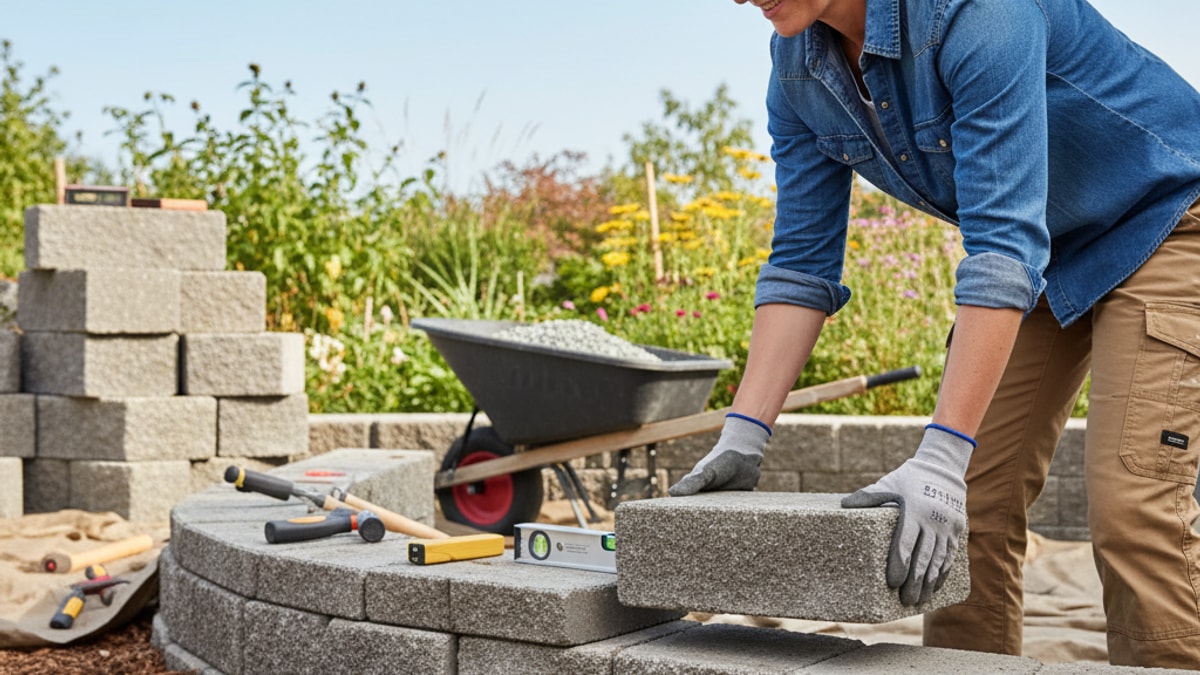
Place your first block at one end of the wall line. Set a 4-foot level on top and adjust the block until it's level side-to-side and front-to-back. Use the rubber mallet to tap blocks into position — hitting them directly with a hammer can chip corners. Check level after every adjustment.
Place the second block tight against the first. Most interlocking wall systems use a tongue-and-groove edge or simply butt tightly together. Set your level across both blocks and adjust the second block to match the first. Continue along the base course, checking level after each block placement.
At corners, you'll need to cut blocks or use corner units if your block system provides them. A masonry saw or circular saw with a diamond blade cuts cleanly through concrete blocks. Wear safety glasses and a dust mask — concrete dust is a respiratory hazard. Alternatively, score the block deeply with a brick chisel and break it along the score line. Cut blocks leave rough edges that won't affect structural integrity but may be visible, so orient cut ends away from the wall face where possible.
Once your base course is complete, step back and sight down the wall line. It should appear perfectly straight (or follow your planned curve smoothly). Any wobble or deviation will worsen with height. If you spot a problem, pull the offending blocks and reset them now. Correcting base course errors after stacking additional courses means dismantling everything above — a frustrating and time-consuming redo.
Bury the base course halfway. Some builders prefer burying the entire base course for shorter walls (under 2 feet), which lowers the finished height slightly but increases stability. For taller walls, burying half the base course provides sufficient anchorage without excessive excavation. Backfill soil against the front of the base course and tamp it firmly.
Step 3: Install Drainage Behind the Wall
Hydrostatic pressure — water accumulating behind your wall — is the most common cause of retaining wall failure. A drainage layer behind the wall and a perforated pipe at the base eliminate this pressure by giving water an escape route.
Before stacking your second course, lay perforated drain pipe along the back edge of the base course. The pipe should rest on the compacted gravel base, directly behind the blocks. Orient the perforations downward — counterintuitive, but correct. Water enters through the bottom perforations and flows along the pipe to an outlet at the wall's end. If you orient perforations upward, the pipe can fill with gravel and clog.
Run the pipe the full length of your wall. At the end, direct the pipe outlet away from the wall — either to daylight (if your wall is on a slope) or into a drainage bed. If you have no natural outlet, consider a dry well filled with gravel where water can percolate into the soil. Never cap the pipe end — it must drain freely.
Cut geotextile fabric to the height of your wall plus 12 inches. Lay the fabric vertically behind the wall blocks, with the bottom edge resting on the gravel base and covering the drain pipe. The fabric prevents soil from migrating into your drainage gravel and clogging the system. As you stack courses, the fabric will stand vertically against the back of each block.
As you build each course, backfill with 12 inches of three-quarter-inch clean crushed stone (no fines) directly behind the blocks, between the blocks and the geotextile fabric. Clean stone contains no small particles that can clog drainage pathways. Pour the stone as you go — don't wait until the wall is fully stacked. Each course of blocks contains the stone layer below it.
The biggest mistake people make when building retaining walls isn't skipping drainage entirely — it's using the wrong backfill material. We've seen walls backfilled with native clay soil that became saturated, exerted immense lateral pressure, and pushed the wall outward within a single season. The stone drainage layer behind your wall is as critical as the blocks themselves.
After placing drainage stone behind each course, tamp it lightly. Don't compact drainage stone as aggressively as your base — you want it firm but permeable. Over-compaction crushes the angular edges and reduces drainage effectiveness.
Step 4: Stack Remaining Courses
With your base course level and drainage system started, stacking subsequent courses becomes repetitive — but precision at each level remains critical.
Clean the top of each block before placing the next course. Dust, dirt, or loose gravel prevents blocks from seating flush and can create weak spots. Most interlocking systems rely on tight contact and friction between courses, not mortar.
Stagger vertical joints like brickwork. The joint between two blocks in one course should fall at the center of the block in the course below. This overlapping pattern distributes load and prevents vertical crack lines from forming. If your block length doesn't naturally create a half-block offset, cut blocks to size for the corners and ends of alternating courses.
Place each block onto the course below, aligning the setback lip if your system uses one. The lip should seat firmly into the recess or against the back edge of the block below. Press down firmly — the block should feel locked in place, not tippy or loose. If a block rocks, check for debris underneath or an uneven surface on the block below.
Check level after every course — both along the wall's length and side-to-side on individual blocks. Small deviations compound with height. A course that's 1/4 inch high on one end becomes 1 inch high by the fourth course. Correct problems immediately by shimming low blocks with compacted stone dust (never sand or soil, which compress over time) or grinding down high spots.
As you stack, continue backfilling with drainage stone behind each course and native soil behind the drainage stone. The soil backfill must be compacted in 4-inch lifts — thin layers compacted thoroughly before adding the next layer. Dumping 2 feet of loose soil behind a finished wall and compacting it all at once is ineffective. The top compacts, but the bottom remains loose and will settle over time, creating voids and allowing the wall to shift.
Rent a plate compactor if your wall exceeds 2 feet in height. Hand tampers work for low walls and small areas, but compacting several feet of soil backfill by hand is exhausting and rarely achieves the density needed to prevent settling. Make three passes with the compactor over each 4-inch lift.
The geotextile fabric should extend up the back of the wall as you build. Once you reach your final course, fold the excess fabric over the top of the drainage stone, then cap it with native soil. This creates a complete separation between your drainage layer and the retained soil.
Step 5: Install Cap Blocks and Final Details
Your top course determines both appearance and long-term durability. Cap blocks — flat-topped units that sit on the final structural course — protect the wall from water infiltration and provide a finished look.
Cap blocks typically aren't interlocking. They're held in place with construction adhesive. Apply a continuous bead of adhesive along the top of your final structural course, then press cap blocks firmly into place. Wipe away excess adhesive immediately — it's nearly impossible to remove once cured.
Cap blocks overhang the wall face slightly, creating a drip edge that sheds water away from the wall surface. This small detail prevents water from running down the block face and into joints, where freeze-thaw cycles can cause damage.
If your wall includes steps, lights, or Seat Retaining Walls with integrated seating, this is the stage where those elements get finalized. Built-in seating transforms a retaining wall from functional to focal — a feature we incorporate often in custom outdoor space designs.
Backfill the area behind your wall with topsoil suitable for planting. Grade the soil to slope gently away from the wall, directing surface water away from the drainage system. While the drainage layer handles subsurface water, proper surface grading prevents unnecessary runoff from overwhelming the system.
Plant the area above the wall within a few weeks. Exposed soil erodes, and erosion behind a retaining wall undermines stability. Groundcovers, shrubs, and perennials with established root systems hold soil in place. Avoid planting large trees directly above retaining walls — roots can eventually exert pressure against the wall back and compromise stability.
Comparison: Block Types and Load-Bearing Capacity
Retaining wall blocks aren't interchangeable. The wrong choice for your project can mean premature failure even with perfect installation.
| Block Type |
Weight per Unit |
Load-Bearing Capacity |
Best Use |
Cost per Square Foot |
Professional Assessment |
| Standard Concrete Block |
30–50 lbs |
Moderate (walls under 3 feet) |
Residential landscaping, garden beds, basic grade changes |
$3–6 |
Adequate for most DIY projects when properly installed with drainage |
| Structural Interlocking Block |
50–80 lbs |
High (walls under 6 feet without engineering) |
Traffic-bearing areas, heavy soil, clay backfill conditions |
$8–12 |
Worth the premium if your wall supports a driveway, patio, or walkway |
| Natural Stone Veneer Block |
40–60 lbs |
Moderate to high |
Curb appeal projects, upscale landscaping, visible locations |
$10–18 |
Aesthetically superior but requires adhesive on every course for stability |
| Modular Concrete (Stackable) |
25–40 lbs |
Low to moderate (walls under 2 feet) |
Quick landscaping projects, raised beds, non-load-bearing applications |
$2–5 |
Not suitable for true retaining walls with significant soil load |
Block weight directly affects stability. Heavier blocks resist lateral soil pressure better and are less likely to shift during backfill compaction. However, they're harder to handle — expect physical strain placing sixty 70-pound blocks by hand.
Some block systems use pins, clips, or integrated channels for reinforcement. These features add cost but dramatically improve performance in challenging conditions. If you're retaining clay soil, building on a slope exceeding 2:1, or your wall will support structures above, the added workmanship warranty and engineering support from pin-based systems is worth considering.
Key Takeaways
- A 6-inch compacted gravel base is mandatory for any retaining wall regardless of height — under-compaction is the single most common cause of premature failure.
- Hydrostatic pressure from trapped water causes more wall failures than structural inadequacy — a perforated drain pipe and 12-inch drainage stone layer behind the wall eliminate this risk.
- Backfill soil must be compacted in 4-inch lifts as you build, not dumped loosely behind a finished wall — loose backfill settles over time and creates voids that allow the wall to lean.
- The built-in setback on interlocking blocks creates approximately 1 inch of backward lean per foot of height, directing wall weight into the retained soil rather than allowing forward tipping.
- Burying at least half the base course anchors the wall and prevents frost heave in climates with freeze-thaw cycles.
What If: Retaining Wall Scenarios
What If the Wall Starts Leaning Forward After the First Winter?
This indicates either inadequate drainage, insufficient base compaction, or frost heave. If the lean is minor (under 1 inch at the top of a 3-foot wall), monitor it through another season — some settling is normal in the first year. If the lean exceeds 1 inch or worsens noticeably, you'll need to dismantle and rebuild the wall with improved drainage and deeper base excavation below the frost line. Leaning walls don't self-correct — they fail progressively.
What If You Hit Rock or Hardpan While Digging the Trench?
Shallow bedrock or hardpan (compacted clay layer) can actually work in your favor. If the rock is level, you can pour a 2-inch sand leveling bed directly on the rock and set blocks on that. Rock provides excellent drainage and won't settle. If the rock is uneven, you'll need to level it with a grinder or build up low spots with compacted gravel. Never set blocks directly on uneven rock — they'll tip.
What If Local Building Code Requires a Permit for Your Wall Height?
Apply for the permit before starting work. Most jurisdictions require engineered drawings for walls over 3 feet, which means hiring a structural engineer — typically $500–1,500 depending on wall complexity. Skipping permits risks fines and, worse, being forced to dismantle a finished wall that doesn't meet code. If your wall is close to the height threshold, consider reducing the height slightly or terracing two shorter walls instead of one tall wall.
What If You Need a Curved Retaining Wall Instead of Straight?
Curved walls follow the same principles with minor adaptations. Mark your curve with a garden hose, then dig the trench following that curve. Trapezoidal blocks designed for curves maintain proper alignment — standard rectangular blocks can work for gentle curves, but you'll need to leave slight gaps on the inside radius and fill them with construction adhesive. Sharp curves may require cutting blocks to fit. Curved walls often look more natural in residential landscaping and can follow existing grade contours better than straight walls.
The Bottom Line on DIY Retaining Walls
Let's be direct about this: most homeowners can successfully build a short retaining wall if they respect the site assessment, invest time in base preparation, and don't skip drainage. The walls that fail aren't built with the wrong blocks — they're built without drainage, proper compaction, or adequate base depth. Materials matter less than method.
The hardest part isn't stacking blocks. It's resisting the urge to rush. Compacting base gravel thoroughly feels tedious when you're eager to see blocks going up. Backfilling in thin lifts and compacting each one feels like unnecessary repetition. But these are exactly the steps that determine whether your wall lasts three years or thirty.
Walls under 2 feet with good drainage rarely fail even when built by first-timers. Walls between 2–4 feet demand attention to detail but remain well within DIY capability for someone comfortable with physical labor and precision work. Walls over 4 feet, walls retaining clay soil, or walls supporting traffic-bearing surfaces above should trigger a conversation with professionals — not because DIY isn't possible, but because the consequences of failure escalate dramatically. At that height and load, a failing wall isn't just ugly — it's dangerous.
If you're looking at a complex grade change, unstable soil, or a wall that integrates with other hardscape like Pavers or Pools and Spas, we'd recommend a site assessment before you commit to a DIY approach. Some projects genuinely benefit from professional installation methods, engineering oversight, and the workmanship warranty that comes with licensed and insured contractors.
Maintenance Schedule and Long-Term Durability
A properly built retaining wall requires minimal maintenance but shouldn't be ignored entirely. Inspecting your wall twice yearly — spring and fall — catches small issues before they escalate.
Check for leaning or bowing. Stand at each end of the wall and sight down its length. Any visible outward curve indicates soil pressure, drainage failure, or settling. Minor lean (under 1/2 inch over 10 feet) may be cosmetic, but progressive lean requires investigation. Look behind the wall if possible — erosion, exposed drainage pipe, or settling soil suggests drainage problems.
Inspect joints between blocks. Cracks in individual blocks or widening gaps between blocks suggest movement or freeze-thaw damage. Isolated cracks in a single block are usually cosmetic unless they span the full width of the block. Multiple cracked blocks or cracks aligning vertically through several courses indicate structural stress and should be evaluated by a professional.
Clear weeds growing in joints. Roots can exert surprising pressure as they grow, gradually forcing blocks apart. Pull weeds when small, or apply polymeric sand in the joints to inhibit growth. Never use a pressure washer on retaining wall joints — the high-pressure water erodes joint sand and can dislodge blocks.
Check the drainage outlet. After heavy rain, water should flow from your drain pipe outlet. If it doesn't, the pipe may be clogged or crushed. Flush the pipe with a garden hose from the outlet end to clear minor blockages. If water doesn't flow through, the pipe may need excavation and replacement — a significant repair best handled by professionals.
Monitor erosion above the wall. If the soil above the wall is eroding and creating ruts or gullies, surface water is concentrating in specific areas and may overwhelm your drainage system. Improve grading or add erosion control measures like landscape fabric, mulch, or additional plantings.
Enhancing Retaining Walls With Integrated Features
Retaining walls don't have to be purely functional. Thoughtful integration of lighting, seating, or planters transforms a retaining wall into a focal feature that enhances your entire outdoor space.
Landscape Lighting installed at the base or cap level adds safety and visual interest after dark. Low-voltage LED fixtures mounted on the wall face or at ground level cast upward or downward washes that highlight texture and create depth. Lights on timers or photocell sensors provide automatic illumination without manual intervention. Plan electrical conduit runs during wall construction — retrofitting lighting after the wall is complete requires surface-mounted wiring that's less attractive and more vulnerable to damage.
Integrated seating converts the cap of a retaining wall into functional space. Walls built to 18–24 inches in height double as bench seating when capped with smooth, wide cap blocks or natural stone. This works particularly well around Fire Features or conversation areas where informal seating adds capacity without furniture.
Pocket planters — recessed sections built into the wall face — introduce color and texture. Leave out blocks in a regular pattern, backfill the recesses with planting soil, and install drought-tolerant perennials or succulents. The wall itself provides excellent drainage for plants that thrive in well-drained conditions. Water requirements remain low because planting pockets don't retain moisture the way ground-level beds do.
Steps integrated into the wall provide access between levels without requiring a separate stairway. Retaining walls that change elevation by 2–3 feet can incorporate three to four steps directly into the wall structure during construction. This approach is particularly useful in terraced yards where multiple shorter walls create planting beds or lawn areas at different levels.
If your project involves a retaining wall as part of broader landscape transformation — terracing a sloped yard for Artificial Turf installation, creating a level pad for an Outdoor Kitchen, or defining planting beds around a Patio Cover or Pergola — coordinating the entire design upfront produces far better results than building in stages. We handle full design-to-construction outdoor projects regularly, and the ROI on home improvement when hardscape elements work together as a cohesive system consistently outperforms piecemeal additions.
Visit Modern Yardz to explore how retaining walls fit into comprehensive landscape design. Whether you're tackling a DIY project or ready to discuss professional design and build services, understanding how your wall integrates with the rest of your outdoor space ensures you're building something functional, durable, and worth the effort.



.webp)
.webp)