Have you ever looked at a sloped section of your property and envisioned something more? Something functional, beautiful, and structurally sound? For many homeowners, understanding how to build a block retaining wall is the key to transforming these challenging areas into usable, aesthetic additions to their outdoor living space. It's a project that demands precision, planning, and a deep understanding of landscape dynamics, but the rewards are truly extraordinary when you know how to build a block retaining wall correctly.
At Modern Yardz, we've spent years helping clients realize the full potential of their outdoor environments. We've seen firsthand the dramatic impact a well-constructed retaining wall can have, from preventing erosion to creating multi-tiered gardens or defining elegant patio spaces. This isn't just about stacking blocks; it's about engineering a lasting feature that enhances both the beauty and utility of your property. We're here to share our collective expertise, guiding you through every critical step involved in understanding how to build a block retaining wall and ultimately creating a formidable structure.
Why a Retaining Wall is a Game-Changer
Before we dive into the nitty-gritty of how to build a block retaining wall, let's consider the 'why.' Why are these structures so indispensable in modern landscape design? Primarily, retaining walls serve a crucial engineering function: they hold back soil, a critical task if you're serious about long-term landscape stability. If you have any significant grade changes on your property, a retaining wall prevents erosion, manages water runoff, and creates flat, usable land where none existed before. Think about it: a sloped yard can be a wasted opportunity, a constant battle against gravity. A robust wall fundamentally changes that equation. It's a foundational element for many stunning outdoor transformations, allowing for features like leveled Pavers patios or serene Pools AND Spas to be built on previously unusable terrain. Our team often incorporates them as part of a larger Landscape Design vision, and knowing how to build a block retaining wall is central to that process.
But it's not just about practicality. A well-designed block retaining wall adds immense aesthetic value. It provides visual interest, defines distinct areas within your yard, and can even become a design focal point. We've seen them used to craft raised garden beds, delineate outdoor 'rooms,' or even form the base for elegant Fire Features or Outdoor Kitchens. The versatility is astounding. In 2026, homeowners are increasingly looking for multi-functional outdoor spaces, and a retaining wall is often the cornerstone of such designs. It's truly a critical, non-negotiable element for maximizing outdoor living, and understanding how to build a block retaining wall properly ensures these benefits are fully realized.
Essential Planning: Before You Dig
This is where many DIY projects falter, honestly. Proper planning is, without question, the most critical step when you're considering how to build a block retaining wall. Don't skip this. First, you'll need to assess the site. What's the height of the wall? What's the soil type? Is there existing drainage? Our team always emphasizes thorough site analysis because it directly impacts the wall's stability and longevity. We recommend consulting with local authorities regarding permits; for walls over a certain height (often 3-4 feet), engineering plans and permits are almost always required. Ignoring these regulations can lead to costly rework or, worse, structural failure. We've seen it happen, and it's devastating. You need to know how to build a block retaining wall within all legal parameters.
Next, consider drainage. Water is the enemy of any retaining wall. Without proper drainage, hydrostatic pressure can build up behind the wall, leading to bowing, cracking, or even collapse. We typically recommend a gravel backfill and a perforated drainpipe (French drain) behind the wall, routed to daylight or a suitable drainage system. This isn't optional; it's a fundamental requirement for a successful, long-lasting structure. Planning how to build a block retaining wall without a solid drainage strategy is like building a house without a roof. It just won't work.
Choosing the Right Block and Materials
When you're figuring out how to build a block retaining wall, the type of block you select profoundly impacts both the aesthetics and the structural integrity. Segmental retaining wall (SRW) blocks are the most common choice for homeowners and professionals alike. They're designed with a lip or pin system that locks them together, providing inherent stability. We've worked with countless varieties, and the quality can really vary. Look for blocks with good compressive strength and weather resistance.
Here's a quick comparison of common block types:
| Feature |
Standard Concrete Block |
Architectural Block (Split-Face) |
Tumbled Block (Aged Look) |
Large Format Block (Engineered) |
| Appearance |
Uniform, utilitarian |
Rough, stone-like texture |
Softer edges, rustic |
Modern, substantial |
| Cost |
Lower |
Moderate |
Moderate to Higher |
Higher |
| Ease of Install |
Generally easy |
Easy |
Easy |
Requires more labor/equipment |
| Best Use |
Utility walls, hidden areas |
Feature walls, gardens |
Traditional, informal landscapes |
Tall walls, commercial, modern |
Beyond the blocks themselves, you'll need crushed gravel for the base and backfill, geotextile fabric (to prevent soil migration into the gravel), and potentially capstones for a finished look. We can't stress this enough: don't skimp on material quality. It's a critical, non-negotiable element for a wall that stands the test of time. Understanding how to build a block retaining wall also means understanding material specifications.
The Foundation: Building a Stable Base
Every great structure begins with a great foundation, and that's especially true when learning how to build a block retaining wall. This isn't just about leveling; it's about creating an unyielding platform that will support tons of soil and block for decades. First, mark out your wall's footprint, making it slightly wider than your blocks. Then, excavate a trench. For most residential walls, we recommend a trench depth of at least 6-8 inches below grade, plus the height of your first course of blocks, ensuring at least half of the first block is buried. This critical 'bury' provides toe stability, preventing the wall from kicking out.
Next, lay down a 4-6 inch layer of compacted crushed gravel (road base is ideal). This gravel base provides excellent drainage and a stable, level surface. You'll need a plate compactor for this step – renting one is usually quite affordable. Compaction is paramount. We're talking about achieving maximum density here, creating a rock-solid platform. If the base isn't perfectly level and perfectly compacted, your entire wall will be compromised. Our experience shows that rushing this stage leads to catastrophic failures down the line. It's the absolute core of how to build a block retaining wall correctly. Use a long level and string line obsessively. Seriously, obsessively.
Laying the First Course: Precision is Key
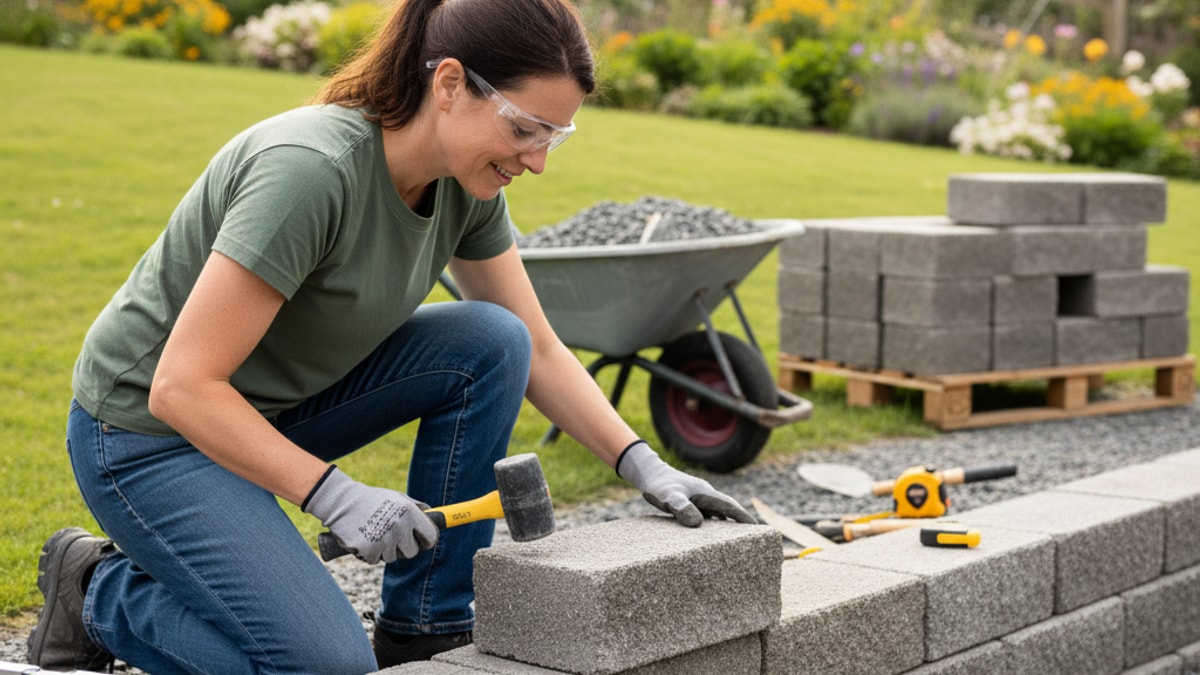
With your base established, it's time to lay the first course, often called the 'footer course.' This is arguably the most important step in how to build a block retaining wall, as every subsequent course depends on its accuracy. Begin at the lowest point of your wall. Place your first block directly on the compacted gravel base. Using a level, ensure it's perfectly level from front to back and side to side. Tamp it firmly into place with a rubber mallet. Now, here's what we've learned: success depends on meticulously leveling each subsequent block in that first course relative to the one before it, and across the entire run.
Use a string line pulled taut between stakes at either end of your wall to maintain a straight line. Adjust blocks by adding or removing small amounts of gravel beneath them until they are all perfectly aligned and level. This takes time. It demands patience. But it's non-negotiable. An uneven first course will propagate errors up the entire wall, resulting in a crooked, unstable structure. We've seen projects where enthusiastic DIYers had to tear down their entire wall because they rushed this stage. Don't be that person. This is the moment to really focus on how to build a block retaining wall with unwavering precision.
Stacking the Courses and Incorporating Drainage
Once the first course is flawlessly laid, stacking the subsequent courses becomes a bit more straightforward, but precision remains vital. Stagger the blocks so that vertical joints don't align (like brickwork) – this creates a stronger, more stable wall. Each block should be set back slightly from the one below it, creating a natural batter (slope) into the hillside. This batter is crucial for stability, leaning the wall into the earth it's retaining. Most SRW blocks are designed with a lip or pin system that automatically creates this setback.
As you stack each course, backfill the area behind the wall with coarse gravel. This gravel serves two purposes: it adds weight behind the wall, increasing its stability, and it creates a permeable layer for drainage. After every 1-2 courses, install a layer of geotextile fabric. This fabric separates the gravel backfill from the native soil, preventing fine soil particles from migrating into the gravel and clogging your drainage system over time. We can't stress this enough: this fabric is a critical component of a durable wall. When you're learning how to build a block retaining wall, remember that proper drainage is paramount.
For taller walls (over 3-4 feet), you'll also need to incorporate a perforated drainpipe (a French drain) behind the first course of blocks, laid in the gravel backfill. The pipe should have a slight slope, directing water to an outlet point where it can safely exit the wall system. This pipe, along with the gravel and fabric, forms the complete drainage system that protects your wall from hydrostatic pressure. It's a complex dance of materials, but when executed correctly, it ensures your wall stands firm, even during heavy rains, which are an increasing concern in 2026 climate patterns.
The Role of Geogrid: Reinforcement for Taller Walls
For walls exceeding 3-4 feet in height, or those supporting significant loads (like a driveway or structure above), geogrid reinforcement becomes absolutely essential. Geogrid is a high-strength polymer mesh that's laid horizontally within the block courses and extended back into the retained soil. It essentially ties the wall into the earth, distributing the load and preventing the wall from pushing outward. It's like adding rebar to Concrete – it dramatically increases tensile strength.
When figuring out how to build a block retaining wall that's tall or load-bearing, geogrid placement is critical. It's typically laid after every 2-3 courses of blocks, extended back a distance equal to roughly 60-70% of the wall's height. The geogrid is rolled out, stretched taut, and then anchored by the next course of blocks. Then, you backfill and compact the soil over the geogrid. This creates a reinforced soil mass that acts as a single, incredibly strong unit. Our team always emphasizes proper geogrid installation, as it's a make-or-break element for tall wall stability. Consulting an engineer for taller walls is almost always a wise, sometimes dramatic shift, in strategy. This approach (which we've refined over years) delivers real results, giving you peace of mind.
Finishing Touches and Aesthetics
Once the main courses are laid and reinforced, it’s time for the finishing touches. This is where the structural marvel becomes an aesthetic masterpiece. Capstones, which are solid blocks designed to sit on the top course, provide a clean, finished look and protect the internal structure from water infiltration. These are typically adhered with a high-strength construction adhesive, preventing them from shifting or being dislodged. We've found that well-chosen capstones truly elevate the entire project.
Consider integrating elements like Seat Retaining Walls into your design. These dual-purpose walls offer structural support while also providing comfortable, built-in seating for your outdoor gathering spaces. It’s a smart way to maximize functionality and design cohesion. Another beautiful addition is thoughtful Landscape Lighting. Strategically placed lights can highlight the texture of the blocks, illuminate steps, and create a warm, inviting ambiance in the evenings. It's amazing how lighting can transform a functional wall into a striking architectural feature. This is part of our holistic approach to Landscape Design, ensuring every element works together.
Finally, backfill the remaining area with topsoil, ensuring proper grading away from the wall to prevent standing water. You can then plant appropriate vegetation. We often recommend drought-tolerant plants that won't have aggressive root systems that could potentially compromise the wall over time. This careful planting completes the integration of your new wall into the existing landscape, making it look like it's always been there. It's all part of the process of understanding how to build a block retaining wall that's both durable and beautiful.
When to Call the Experts: Modern Yardz's Perspective
While understanding how to build a block retaining wall can empower you with knowledge, there are definite instances when professional intervention isn't just recommended, it's essential. If your wall is going to be over 4 feet tall, if it's supporting a structure (like a deck or foundation), or if you're dealing with complex soil conditions or significant water issues, that's when you really need to bring in the pros. Engineering expertise becomes paramount to ensure safety, compliance, and long-term stability. Our team specializes in these formidable projects, transforming challenging terrains into stunning, functional outdoor spaces. We handle everything from the initial Landscape Design to the final construction, ensuring every detail is meticulously managed.
We understand the allure of a DIY project, but certain undertakings carry too much risk to go it alone. The structural integrity of a retaining wall is not something to compromise on. A failing wall isn't just an eyesore; it can be a dangerous hazard, leading to property damage or even injury. Our expertise ensures your wall is built to code, engineered for its specific site conditions, and designed to integrate seamlessly with your overall outdoor vision. We're not just building walls; we're building peace of mind. Let’s be honest, this is crucial. We can't stress this enough: for complex projects, professional guidance is indispensable. Ready to Upgrade Your Backyard? We're here to help.
From the initial consultation to the final inspection, we pride ourselves on delivering impeccable craftsmanship and enduring results. We're passionate about creating outdoor spaces that are as functional as they are beautiful, and a properly built retaining wall is often a critical element in achieving that balance. Our comprehensive services mean you don't have to juggle multiple contractors; we manage the entire process, ensuring a cohesive and stress-free experience. We've seen it work, time and time again. Transform Your Outdoor Space Into Something Extraordinary with our dedicated team.
Maintaining Your Block Retaining Wall
Building a robust retaining wall is a significant accomplishment, but proper maintenance ensures its longevity. Even after you've mastered how to build a block retaining wall, vigilance is key. Regularly inspect your wall for any signs of distress: cracks, bowing, bulging, or shifting blocks. Minor issues caught early are far easier and less costly to address than major structural problems. Pay particular attention after heavy rainfall or significant seismic activity, if applicable. We always advise homeowners to walk their property line and check these critical structures.
Ensure that your drainage system remains clear. Leaves, soil, or debris can clog drainpipes or saturate the gravel backfill, leading to hydrostatic pressure build-up. Keep the area around the wall free of excessive vegetation, especially trees or shrubs with aggressive root systems that could penetrate and destabilize the wall over time. While the blocks themselves are durable, constant monitoring is a small price to pay for the protection and beauty your wall provides. It's a testament to knowing how to build a block retaining wall not just for today, but for decades to come. Our commitment to creating lasting outdoor spaces extends to helping you care for them, too. Let’s Design the Outdoor Space You’ve Been Dreaming Of, and we’ll help you keep it pristine.
Innovations and Trends in 2026
The landscape (pun intended!) of outdoor design is constantly evolving, and retaining walls are no exception. In 2026, we're seeing a significant, sometimes dramatic shift towards integrating retaining walls with smart home technology and sustainable practices. For instance, permeable Pavers are increasingly being used in conjunction with retaining walls to create comprehensive stormwater management systems, reducing runoff and replenishing groundwater. We're also seeing more sophisticated Landscape Lighting systems embedded directly into walls, offering adaptive illumination that can be controlled via smartphone apps, adjusting to time of day or even weather conditions.
Another major trend is the use of recycled and locally sourced materials. Homeowners are more environmentally conscious than ever, and we're responding by offering options like blocks made from recycled concrete aggregates or locally quarried stone. This not only reduces the carbon footprint but also supports local economies. Furthermore, the integration of Artificial Turf on top of or adjacent to retaining wall terraces is gaining traction for its low maintenance and water-saving benefits, especially in areas with demanding schedules and high expectations for pristine outdoor aesthetics. These innovations show that even a classic structural element like a retaining wall can be modern and forward-thinking, demonstrating our deep expertise in understanding how to build a block retaining wall with an eye to the future.
Building a block retaining wall is a significant undertaking, but it’s an investment that pays dividends in functionality, aesthetics, and property value. Whether you're tackling a small garden wall or a major terracing project, the principles of planning, proper base preparation, precise block laying, and effective drainage remain paramount. Our team at Modern Yardz is always here to provide expert guidance, exceptional design, and flawless execution for your outdoor projects. We're dedicated to helping you create an outdoor space that’s not just beautiful, but also built to last, a true testament to knowing how to build a block retaining wall with enduring quality. We believe your outdoor space should be an extension of your home, a place of beauty, relaxation, and lasting memories. That's our promise.



.webp)
.webp)