So, you're standing at the edge of your driveway, planning your next big outdoor project. Maybe you're dreaming of a gorgeous new walkway, a sleek modern patio, or even trenching for the utilities to an outdoor kitchen. There's just one problem: a formidable sheet of black asphalt is in the way. It's a common scenario our team at Modern Yardz encounters all the time. The solution often begins with a single, critical task that sounds intimidating but is entirely achievable with the right knowledge. That task is learning exactly how to cut an asphalt driveway. It's the first step in transforming your existing space into something truly special.
Don't let the material fool you. While asphalt is tough, it's not invincible. Knowing how to cut an asphalt driveway cleanly and safely is the difference between a professional-looking result and a jagged, crumbling mess that compromises your entire project. It's a foundational skill for any serious landscape modification. We've spent years perfecting this process as part of larger installations, and we're here to share what we've learned. This isn't just about raw power; it's about technique, precision, and understanding the material you're working with. Let's get into the specifics of how to cut an asphalt driveway like a seasoned pro.
Why Bother Cutting Asphalt? The Project Foundation
Let's be honest, taking a power saw to your perfectly good driveway might seem counterintuitive. But in the world of landscape design and construction, it's often a necessary—and transformative—first step. The reasons for needing to understand how to cut an asphalt driveway are as varied as the projects themselves. Our experience shows it almost always boils down to making way for something better. You're not just destroying; you're creating a path for improvement. It’s a critical part of the process.
One of the most common reasons we see is for installing new hardscaping. Imagine a beautiful, winding path made from high-quality Pavers SAN Diego leading from your driveway to your front door. You can't just lay those on top of the asphalt. You need a clean, defined edge. This is where mastering how to cut an asphalt driveway becomes essential. A precise cut creates a stable boundary, preventing the asphalt from crumbling and ensuring your new pavers have a solid base to rest against. The same principle applies when you're integrating a new section of poured Concrete SAN Diego for a modern patio or a utility pad. The transition between the old asphalt and the new concrete has to be impeccable.
Another huge driver is utility installation. Planning one of our custom Outdoor Kitchens SAN Diego? You'll need to run water, gas, and electrical lines. Those lines have to go somewhere, and that's usually underground. Knowing how to cut an asphalt driveway allows you to create a narrow, controlled trench for these utilities without demolishing the entire surface. After the lines are laid, the trench can be backfilled and patched, a far more efficient and cost-effective solution than a full replacement. This surgical approach is central to understanding the practical application of how to cut an asphalt driveway. It’s about minimal disruption for maximum impact.
Drainage solutions are another major reason. Poor water management can be catastrophic for a landscape, leading to erosion, foundation issues, and unusable spaces. Often, the best solution involves installing channel drains or French drains across a driveway to redirect water flow. This absolutely requires a clean, straight cut. The process of how to cut an asphalt driveway for drainage has to be precise to ensure the drain fits snugly and functions correctly. We've seen projects delayed and budgets blown simply because this initial step was handled poorly. That's why we believe a deep understanding of how to cut an asphalt driveway is not just for contractors, but for any homeowner embarking on a serious outdoor upgrade in 2026.
Safety: The Unskippable First Step
Before you even think about which blade to use or how to snap a chalk line, we need to talk about safety. We can't stress this enough: cutting asphalt is a serious task with real risks. It involves powerful machinery, flying debris, and potentially hazardous materials. A casual approach is a recipe for disaster. For our team, safety isn't just a box to check; it's the entire framework for how we approach every job. The most important lesson in how to cut an asphalt driveway has nothing to do with the saw itself—it's about protecting yourself.
First, let's talk Personal Protective Equipment, or PPE. This is non-negotiable. Your kit should include:
- Safety Glasses or Goggles: Asphalt and aggregate chips will fly. A full-face shield over safety glasses is even better. Your eyesight is irreplaceable.
- Hearing Protection: A gas-powered walk-behind saw is incredibly loud. We're talking well over 100 decibels. Prolonged exposure without protection can cause permanent hearing damage. Use high-quality earplugs or over-ear muffs.
- Respiratory Mask: Cutting asphalt creates fine dust containing silica and other particulates. Inhaling this is seriously bad for your lungs. A NIOSH-approved respirator (N95 at a minimum) is a must-have piece of gear for anyone learning how to cut an asphalt driveway.
- Steel-Toed Boots: These protect your feet from the heavy saw and any chunks of asphalt that might fall. They also provide better grip and stability.
- Heavy-Duty Gloves: To protect your hands from blisters, cuts, and abrasions while handling the equipment and debris.
Once you're geared up, you need to prepare the site. Before you begin the process of how to cut an asphalt driveway, you must call 811 or your local utility locating service. This is a critical, often legally required step. You need to know what's buried beneath your driveway—gas lines, water pipes, electrical conduits. Hitting one of these isn't just expensive; it can be deadly. The service is typically free and will mark the location of all underground utilities. Never, ever skip this call. Knowing how to cut an asphalt driveway safely means knowing where not to cut.
Finally, clear the area. Remove any vehicles, potted plants, furniture, and toys. Cordon off the work zone to keep pets and children safely away. Ensure you have a clear, stable path to move along your cut line without tripping hazards. If you're using a wet saw, be mindful of where the water runoff is going. You don't want to create a treacherous, muddy slip-and-fall hazard. A prepared site is a safe site. It’s the professional way to approach the task of how to cut an asphalt driveway.
The Right Tool for the Job: Saws and Blades
Alright, with safety covered, let's get to the fun part: the tools. The success of your project hinges on using the right equipment. The question of how to cut an asphalt driveway is really a question of what you're cutting it with. You have two primary options, each with its own set of pros and cons. The choice depends on the scale of your project, your budget, and your comfort level with heavy machinery.
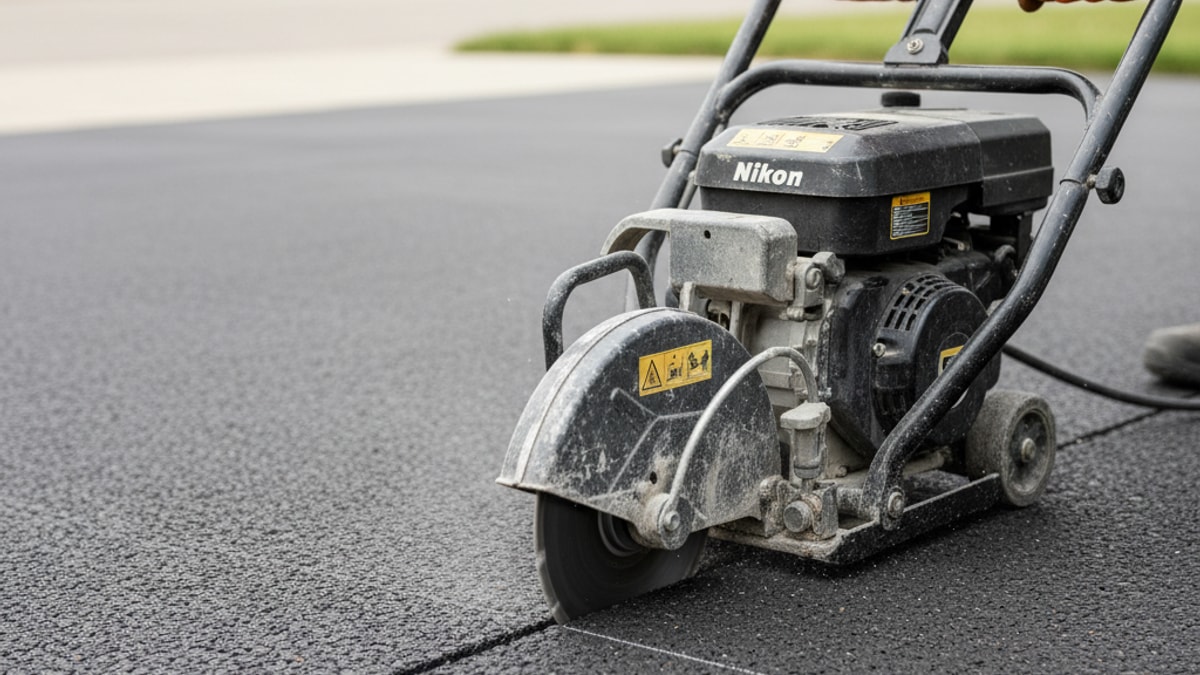
Your main contenders are the walk-behind concrete saw (often called a cut-off saw or road saw) and a high-powered handheld circular saw fitted with a diamond blade. A standard wood-cutting circular saw won't even make a dent and is incredibly dangerous to try. Don't do it. You need a tool specifically designed for masonry and asphalt. Our teams almost exclusively use professional-grade walk-behind saws for their power, precision, and efficiency, but a handheld saw can work for very small, shallow jobs. Understanding the difference is key to figuring out how to cut an asphalt driveway effectively.
Let’s compare them directly.
| Feature |
Walk-Behind Saw (Wet Saw) |
Handheld Saw w/ Diamond Blade |
| Power & Speed |
High. Gas-powered engines make quick work of thick asphalt. |
Moderate. Limited by electric motor size. Much slower. |
| Cut Quality |
Excellent. Provides a very straight, clean, and deep cut. |
Fair to Good. Harder to keep the line perfectly straight. |
| Ease of Use |
Physically demanding to push, but easy to guide straight. |
Lighter, but requires significant strength to control. |
| Dust Control |
Excellent. Integrated water system suppresses nearly all dust. |
Poor. Creates immense amounts of hazardous dust. |
| Cost |
Expensive to buy, but widely available for rent. |
Cheaper to buy, but may not be powerful enough. |
| Best For |
Long, straight cuts, deep trenches, any project over a few feet. |
Very short cuts, small patch removal, tight spaces. |
For any significant project, we strongly recommend renting a walk-behind wet saw. The water hookup is a game-changer. It cools the diamond blade, which is essential. An overheating blade will warp, dull quickly, and cut inefficiently. More importantly, the water turns the hazardous dust cloud into a manageable slurry that can be washed away. This makes the entire process of how to cut an asphalt driveway safer and cleaner. The power and stability of a walk-behind model also mean you'll get a much straighter, more professional-looking cut with far less physical strain than trying to wrestle a handheld saw. The rental cost is a small price to pay for a better, safer result. The core of learning how to cut an asphalt driveway in 2026 is using the right modern equipment.
The blade is just as important as the saw. You need a diamond blade specifically designed for abrasive materials like asphalt. These are often labeled as "asphalt blades" or "green concrete blades." They have softer bonds that allow dull diamonds to fall away and expose new, sharp ones, which is necessary for cutting through the gummy, abrasive nature of asphalt. Using a hard-bond blade meant for cured concrete will just glaze over and stop cutting. This is a nuanced but critical detail in mastering how to cut an asphalt driveway.
The Modern Yardz Method: A Step-by-Step Breakdown
Now we get to the heart of the matter. You've got your safety gear, you've chosen your saw, and you've prepped your site. It's time to make the cut. Following a systematic process is what separates a clean job from a chaotic one. Here's how our pros approach the task of how to cut an asphalt driveway, broken down into manageable steps.
Step 1: Mark Your Lines with Precision
Your cut will only be as straight as your guide. A fuzzy, uncertain line will lead to a wavy, amateurish cut. We recommend using a chalk line reel for perfectly straight lines. Snap it once, then go over the line with a can of high-visibility spray paint (white or yellow works best). The paint provides a durable, clear line that won't get washed away by the water from a wet saw. For curves, a garden hose can be laid out to create a smooth arc, then carefully traced with spray paint. Take your time here. A few extra minutes of careful marking makes the entire process of how to cut an asphalt driveway go more smoothly.
Step 2: Set Up Your Saw Correctly
If you're using a walk-behind wet saw, connect it to a reliable water source. Ensure the flow is consistent and directed right at the blade's point of contact with the asphalt. Next, adjust the cutting depth. The golden rule is to cut in shallow passes, or what we call "step-cutting." Your first pass should only be about 1 to 1.5 inches deep. This creates a clean pilot groove and is much easier on both the blade and the saw's engine. Trying to cut through 4 inches of asphalt in one go is a common mistake that leads to blade binding and a stalled engine. This is a crucial technique for anyone learning how to cut an asphalt driveway.
Step 3: The Initial Cut (The First Pass)
Start the saw and let it come up to full RPM before you engage the blade with the asphalt. Line the blade up with your painted line, about an inch before your starting point. Slowly and smoothly, lower the spinning blade into the asphalt. Once it reaches your set depth, begin pushing the saw forward. Don't force it. Let the weight of the machine and the speed of the blade do the work. Your job is to guide it. Pushing too hard is the number one cause of blade binding. Maintain a slow, steady walking pace. This first pass is the most important part of how to cut an asphalt driveway, as it sets the path for all subsequent cuts.
Step 4: Subsequent Passes and Finishing
Once you've completed your first shallow pass along the entire line, bring the saw back to the starting point. Lower the blade another inch or so and repeat the process, following the groove you've already created. The saw will track in this groove beautifully, making the subsequent passes much easier. Continue this step-cutting process until you've cut all the way through the asphalt layer. You'll know you're through when you see a change in the color of the slurry or feel a distinct lack of resistance. You have now successfully executed the core mechanics of how to cut an asphalt driveway.
Step 5: Cleanup and Removal
With the cutting complete, it's time for cleanup. Use a shovel and a pry bar to remove the section of asphalt you've cut out. It may take some effort to break it free from the aggregate base below. Once the large pieces are gone, sweep the area thoroughly to remove any remaining debris. A clean worksite is a professional worksite. This final step completes the job and leaves you with a clean edge, ready for the next phase of your landscape project, whether that's installing a stunning set of Fire Features or laying the groundwork for a new pool deck.
Rookie Mistakes Our Pros Always See
Over the years, we've been called in to rescue more than a few DIY projects gone wrong. Learning from others' mistakes is a lot less painful (and less expensive) than making them yourself. When it comes to the task of how to cut an asphalt driveway, a few common errors pop up again and again. Here's what we see and how you can sidestep these pitfalls.
Mistake #1: Forcing the Saw
This is the big one. People get impatient. They think that by pushing harder, they'll get the job done faster. It's the exact opposite. Forcing the saw puts immense strain on the engine, causes the blade to overheat and wear out prematurely, and is the leading cause of the blade binding or pinching in the cut. This can cause the saw to kick back violently, which is incredibly dangerous. The correct method of how to cut an asphalt driveway involves finesse, not brute force. Let the saw work at its own pace. If it feels like you're fighting it, you're doing it wrong.
Mistake #2: Cutting Dry
Some people, especially those using a handheld saw, try to skip the water to avoid the mess. This is a catastrophic error. As we mentioned, the water serves two critical functions: cooling the blade and suppressing dust. A dry-cutting blade will overheat in seconds, potentially warping or losing its diamond segments. And the dust… it's not just messy; it's a serious health hazard. We can't say it enough: a wet cut is the only safe and effective way to approach how to cut an asphalt driveway. If your saw doesn't have a water hookup, have a helper gently run a continuous stream of water from a garden hose directly onto the cut line ahead of the blade.
Mistake #3: Setting the Blade Too Deep
This goes hand-in-hand with forcing the saw. The allure of getting the job done in a single pass is strong, but it's a trap. A full-depth cut puts too much surface area of the blade in contact with the asphalt at once, creating massive friction and resistance. This bogs down the engine and can easily cause the saw to stall or bind. The step-cutting method (making multiple shallow passes) is the professional standard for a reason. It's faster in the long run, better for the equipment, and a much safer way to manage the process of how to cut an asphalt driveway.
Mistake #4: Ignoring the Weather
Asphalt is a temperature-sensitive material. On a scorching hot day, it becomes softer and gummier. This can make the blade bind more easily as the asphalt grabs onto it. Conversely, on a very cold day, asphalt is more brittle and prone to chipping or cracking along the cut line. The ideal temperature for this work is moderate—think a pleasant spring or fall day, maybe between 50-75°F (10-24°C). Understanding how the material behaves is a subtle but important part of mastering how to cut an asphalt driveway.
Knowing When to Call for Backup
There's a tremendous sense of satisfaction that comes from a successful DIY project. But there's also a point where ambition can outstrip experience and equipment. Knowing your limits is just as important as knowing the steps. While a short, straight cut for a small project might be well within reach for a capable homeowner, larger and more complex jobs are often best left to a professional team like ours.
So, when should you put down the rental saw and pick up the phone? If your project involves long, sprawling cuts, intricate curves, or is part of a major installation, it's time to call for backup. For example, preparing the site for one of our custom Pools AND Spas involves far more than just cutting. It requires excavation, grading, and ensuring the integrity of the surrounding surfaces. A mistake in the initial cutting phase can have a domino effect on the entire project. This is where a comprehensive Landscape Design SAN Diego plan becomes invaluable. We don't just see a line on the ground; we see how that cut integrates with the entire vision for your outdoor space.
If the asphalt is particularly thick (6 inches or more) or is reinforced with rebar or mesh (which is uncommon but possible), the difficulty level skyrockets. These situations require more powerful equipment and specialized blades. Furthermore, if the area you need to cut is on a steep slope or has poor access, managing the heavy equipment safely becomes a significant challenge. Our crews are equipped and trained to handle these formidable scenarios efficiently. We have the experience to know exactly how to cut an asphalt driveway in even the most challenging conditions.
Ultimately, it comes down to a cost-benefit analysis of your time, your safety, and the quality of the final result. A professional crew can often complete in a few hours what might take a homeowner an entire weekend. The cut will be perfectly straight, the cleanup will be immaculate, and you'll have the peace of mind that it was done right. If you're feeling overwhelmed by the prospect or your project demands a level of precision you're not confident you can deliver, that's the perfect time to reach out. You can even BOOK MY FREE CONSULTATION with our design team to discuss your project. We can help you understand all the steps involved, from the first cut to the final installation.
Executing a clean cut in your driveway is often just the first step in a much larger, more exciting journey of transforming your property. It’s about creating a solid foundation for the beautiful, functional outdoor living spaces you've been dreaming of. Whether it's a simple path or a complex multi-level patio, getting that first cut right sets the tone for the quality of the entire project. It's a testament to the idea that great things are built one precise step at a time.



.webp)
.webp)