Every homeowner eventually faces a challenge with uneven terrain, soil erosion, or simply the desire to add structure and beauty to their outdoor living areas. It's a common scenario, honestly, one we see all the time at Modern Yardz. Building a retaining wall often emerges as the ideal solution, and timber walls, specifically, offer a classic, robust aesthetic that blends seamlessly with many landscape designs. But how do you approach such a project? More importantly, how to build a retaining wall timber that's not just functional, but also beautiful and long-lasting? That's precisely what we're going to unpack today.
Here at Modern Yardz, we've spent years transforming outdoor spaces, understanding the intricacies of everything from Landscape Design SAN Diego to complex installations. Our collective experience has taught us that while the idea of a DIY project like this can be appealing, understanding the nuances of how to build a retaining wall timber correctly is absolutely critical. It’s not just about stacking wood; it’s about engineering, drainage, and ensuring structural integrity for years to come. In 2026, with evolving material options and best practices, getting this right from the start has never been more important.
Understanding the 'Why' Before the 'How'
Before we dive into the nuts and bolts of how to build a retaining wall timber, let's talk about the purpose. Why do you need one? Is it to prevent soil erosion on a sloped yard? To create level planting beds? To define distinct outdoor zones, perhaps alongside a new Outdoor Kitchens SAN Diego or a serene Pools AND Spas area? Knowing your objective is paramount, as it dictates the wall's height, length, and ultimately, the structural demands. A small garden bed wall is a very different beast from a multi-tiered structural wall holding back significant earth.
Our team always starts with a comprehensive assessment of the site. We’re looking at soil type, water runoff patterns, existing landscape features, and of course, any utility lines. This preliminary due diligence is a critical, non-negotiable element of any successful project. You don't want to start digging only to discover a major irrigation line or, worse, a gas pipe. Honestly, though, this step saves so much headache down the line. It's truly foundational to understanding how to build a retaining wall timber that won't cause future headaches.
Planning Your Timber Retaining Wall: The Blueprint for Success
Careful planning is the bedrock upon which a robust timber retaining wall is built. We can't stress this enough. Rushing the design phase is a common misstep we've observed over the years, leading to costly corrections. So, how to build a retaining wall timber with impeccable planning? It begins with a detailed sketch, complete with measurements. This sketch needs to account for the wall's length, height, and any curves or corners. Remember, gravity is a formidable opponent, especially with soil and water pressure.
Considerations for Your Plan:
- Height Matters: Walls over four feet high typically require professional engineering and permits. This isn't a suggestion; it's a code requirement in most places. Ignoring this can lead to catastrophic failure and significant legal trouble. For walls over this height, we strongly advise consulting with experts who specialize in Seat Retaining Walls and other structural landscape elements.
- Drainage, Drainage, Drainage: This is perhaps the single most important factor for a timber retaining wall's longevity. Without proper drainage, water will build up behind the wall, creating immense hydrostatic pressure that will eventually cause the wall to bow, crack, or collapse. We're talking about a significant, sometimes dramatic shift in the earth. You simply must plan for a robust drainage system.
- Material Selection: Pressure-treated timber is the standard for retaining walls, and for good reason. It resists rot, decay, and insect infestation. But even within pressure-treated options, there are different ratings. Ground contact rated timber is what you'll need. We've found that using anything less is a recipe for premature failure. When considering how to build a retaining wall timber, the quality of your wood choice is paramount.
- Tooling Up: You'll need more than a shovel. Think about a level, tape measure, string line, post-hole digger, circular saw, drill, impact driver, and a tamper or plate compactor. Our team always recommends having the right tools for the job; it makes the work safer, more efficient, and the results far superior.
Materials and Tools: What You'll Need
Building a timber retaining wall is a demanding task, requiring specific materials and tools to ensure durability and safety. We've compiled a list based on our extensive experience:
- Pressure-Treated Lumber: As mentioned, ground-contact rated. Typically 6x6 or 4x6 dimensions. The thicker, the stronger.
- Gravel/Crushed Stone: For the base and the drainage layer behind the wall.
- Geotextile Fabric: Essential for preventing soil from mixing with your drainage gravel, maintaining drainage efficacy.
- Rebar or Large Timber Spikes: For securing courses of timber and anchoring the wall into the ground.
- Drainage Pipe (Perforated): A 4-inch corrugated or PVC pipe is usually sufficient.
- Construction Adhesive: An exterior-grade adhesive for added stability between timber courses.
- Safety Gear: Gloves, safety glasses, hearing protection, sturdy boots. We can't stress safety enough.
- Measuring & Marking Tools: Tape measure, carpenter's level, string line, stakes, spray paint.
- Cutting & Fastening Tools: Circular saw, drill, impact driver, appropriate drill bits.
- Digging & Compacting Tools: Shovel, pickaxe, post-hole digger, hand tamper or plate compactor.
Now, let's be honest, acquiring all these items and understanding their proper use can feel overwhelming. It's why many homeowners opt for professional assistance, and it's certainly a service our team at Modern Yardz provides. But if you're determined to learn how to build a retaining wall timber yourself, having this comprehensive list is your first solid step.
Step-by-Step: How to Build a Retaining Wall Timber
This is where the rubber meets the road. Building a retaining wall is a multi-stage process, and each step is interdependent. Skipping or rushing one can compromise the entire structure. Our experience shows that attention to detail here delivers real results.
Step 1: Site Preparation and Layout
Clear the area of any vegetation, rocks, or debris. This is your blank canvas. Use stakes and a string line to mark the exact path of your retaining wall. Remember to account for the width of your timber; if you're using 6x6s, your trench needs to be at least 6 inches wide. Use spray paint to clearly mark the excavation area. This precision is vital for how to build a retaining wall timber correctly.
Step 2: Digging the Trench and Preparing the Base
Excavate a trench that is at least 6-8 inches deeper than the first course of timber and wide enough to comfortably fit your timber. The depth ensures that the first course (the 'footer' or 'deadman') is partially buried, providing crucial stability against lateral soil pressure. Our team consistently emphasizes digging below the frost line if you're in a region with significant freezes, though this varies greatly depending on your location's climate (always verify local building codes for frost line depths).
Once the trench is dug, compact the soil thoroughly. This is where a hand tamper or plate compactor comes into play. Loose soil under your wall's foundation is a recipe for future settling and instability. Next, add a 2-3 inch layer of crushed stone or gravel and compact it again. This gravel base provides excellent drainage and a stable, level surface for your first timber course. It's a critical component for how to build a retaining wall timber that lasts.
Step 3: Laying the First Course
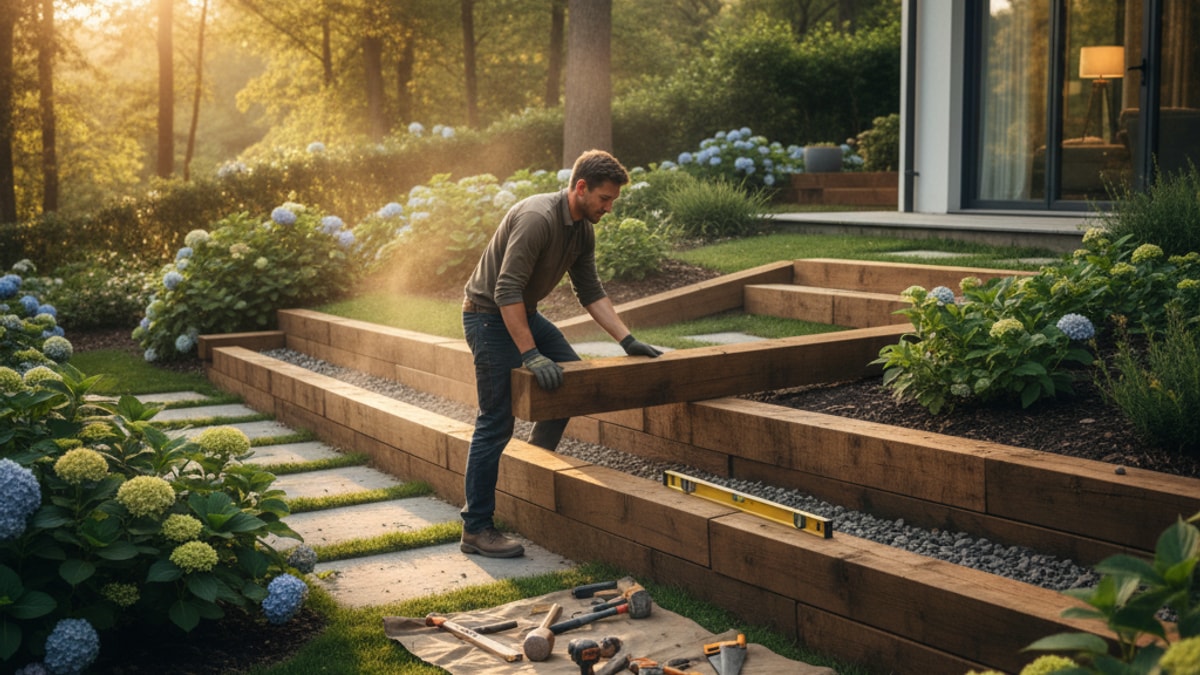
Lay your first course of pressure-treated timber directly on the compacted gravel base. Use your level religiously. This initial course must be perfectly level, both front-to-back and side-to-side. Any deviation here will compound with each subsequent course, leading to a visibly uneven and structurally weak wall. Adjust the gravel as needed to achieve perfect leveling. Our team often uses a long level (4-foot minimum) for this stage.
Once level, anchor the first course into the ground. For this, we recommend driving rebar (1/2-inch or 5/8-inch diameter, 2-3 feet long) through pre-drilled holes in the timber and into the compacted soil below. Space rebar every 4-6 feet along the length of the wall. This anchoring is what truly keeps your wall from shifting laterally over time; it's central to how to build a retaining wall timber that resists the relentless pressure of the earth.
Step 4: Installing Drainage
Before laying the second course, install your geotextile fabric. Line the back of the trench and extend it up the slope, leaving enough excess to fold over the top of your drainage material later. Place your perforated drainage pipe directly behind the first timber course, ensuring the perforations face downwards. Cover the pipe and the area directly behind the first course with 6-12 inches of gravel. This is your primary drainage system; it's essential. This entire assembly, which we’ve refined over years, delivers real results in preventing hydrostatic pressure.
Step 5: Stacking Subsequent Courses
Lay the second course of timber on top of the first, staggering the joints like brickwork for increased strength. Apply a generous bead of construction adhesive between each course of timber before placing the next. This adhesive provides additional stability and helps seal out moisture. Drive timber spikes (10-12 inches long) or shorter rebar sections through the upper timber into the lower one, spacing them every 4-6 feet and ensuring they don't align directly with the rebar from the first course. This crisscross pattern significantly enhances the wall's integrity. As you build up, backfill the area behind the wall with gravel, covering the drainage pipe and continuing to layer geotextile fabric up the slope. This is crucial for how to build a retaining wall timber that truly performs.
Step 6: Deadmen (For Taller Walls)
For walls over 2-3 feet high, incorporating 'deadmen' timbers is a critical structural enhancement. Deadmen are timbers laid perpendicular to the wall, extending back into the slope, and anchored into the retained soil. They act as anchors, counteracting the forward pressure on the wall. Typically, you'd integrate deadmen into every second or third course, extending them 4-6 feet back into the hillside. You'll attach them to the wall timbers with timber spikes or heavy-duty lag screws. This is an advanced technique, but one we strongly recommend for significant walls when considering how to build a retaining wall timber that offers long-term stability.
Step 7: Finishing and Backfilling
Once all courses are laid and secured, fold the excess geotextile fabric over the top layer of drainage gravel behind the wall. Then, backfill the remaining area behind the wall with compacted soil, grading it away from the wall to encourage surface water runoff. You'll want to finish the top of your wall, perhaps with a cap timber or by simply leaving the top course exposed. For an integrated look, consider how your new retaining wall ties into other elements like new Pavers SAN Diego or Artificial Turf SAN Diego for a truly cohesive outdoor space. This attention to detail is part of our holistic approach to Landscape Design SAN Diego.
Comparison of Timber Types for Retaining Walls
When you're trying to figure out how to build a retaining wall timber, choosing the right wood is a big deal. Here's a quick look at common options:
| Timber Type |
Pros |
Cons |
Best Use Case |
| Pressure-Treated Pine |
Readily available, affordable, rot-resistant. |
Can warp/twist, less aesthetic, not suitable for high-visibility. |
Budget-conscious projects, hidden walls, structural support. |
| Railroad Ties |
Extremely durable, heavy, rustic look. |
Contain creosote (toxic), inconsistent sizing, very heavy. |
Industrial aesthetics, heavy-duty structural walls (with care). |
| Cedar/Redwood |
Naturally rot-resistant, beautiful appearance. |
Very expensive, softer wood (less structural strength), less common. |
Decorative, lower height walls where aesthetics are paramount. |
| Laminated Veneer Lumber (LVL) |
Engineered for strength, consistent dimensions. |
Higher cost, often requires additional sealing/treatment. |
High-strength, engineered walls, where precision is key. |
Our team generally leans towards high-quality, ground-contact rated pressure-treated pine for most structural retaining walls due to its balance of cost-effectiveness and durability. For purely aesthetic purposes, or smaller, non-load-bearing walls, options like cedar can be stunning. This is just one of the many considerations we walk clients through when they're planning their outdoor transformations, from new Patio Covers Pergolas SAN Diego to integrated Fire Features.
Long-Term Maintenance for Your Timber Wall
Even after you've mastered how to build a retaining wall timber, the work isn't entirely done. Like any outdoor structure, timber retaining walls benefit from occasional maintenance. We're not talking about a grueling road warrior hustle, but rather periodic checks.
- Inspect Annually: Look for signs of rot, insect damage, or movement. Small cracks or shifts are easier to address early. Check for pooling water behind the wall after heavy rains, which could indicate drainage issues.
- Clear Debris: Keep the area around the wall free of leaves, soil buildup, and other organic matter that can trap moisture against the timber.
- Re-seal (Optional but Recommended): Every few years, applying a quality timber sealant can extend the life of your wall, especially if it's exposed to harsh weather. This adds an extra layer of protection against the elements, something we've seen make a real difference in the longevity of structures, even those built with robust Concrete SAN Diego elements.
When to Call the Experts
While understanding how to build a retaining wall timber yourself is empowering, there are definitely times when bringing in professionals makes the most sense. If your project involves:
- Walls over 3-4 feet high.
- Steep slopes or challenging terrain.
- Proximity to existing structures (your home, a neighbor's, utility lines).
- Significant water drainage issues.
- Complex designs or integrated features.
That's when our team at Modern Yardz really shines. We specialize in custom outdoor spaces, tackling these demanding schedules and high expectations with precision. We handle every step, from initial Landscape Design SAN Diego to construction, ensuring your vision comes to life seamlessly. We’ve built countless Seat Retaining Walls and integrated them into stunning outdoor environments, often alongside beautiful Landscape Lighting SAN Diego schemes. It's why we're trusted to create outdoor spaces that are as functional as they are beautiful. We're here to help you create an outdoor space you'll love for years.
Learning how to build a retaining wall timber is a rewarding endeavor, offering a tangible sense of accomplishment and a significant upgrade to your property. But it’s also a project that demands respect for proper technique, safety, and a deep understanding of the forces at play. Whether you tackle it yourself or opt for professional help, remember that a well-built timber retaining wall is an investment in the beauty and stability of your outdoor environment. Ready to upgrade your backyard? Let’s design the outdoor space you’ve been dreaming of. Explore our full range of services on our website today and see how we can transform your vision into reality.



.webp)
.webp)