A sloped yard can feel like a formidable challenge. It limits usable space, creates drainage headaches, and can make landscaping feel like an uphill battle—literally. The solution? A retaining wall. But let's be honest, the process of how to install a retaining wall is one of the most misunderstood and underestimated projects in landscaping. We've seen it all: leaning walls, catastrophic failures, and projects that cost twice as much to fix as they did to build incorrectly in the first place.
That's why we're here. At Modern Yardz, we don't just build walls; we engineer solutions that integrate seamlessly into a property's overall design and function. This isn't just about stacking blocks. It's about understanding soil pressure, water management, and the unflinching laws of physics. Our team has spent years mastering the nuances of how to install a retaining wall that is not only beautiful but structurally impeccable. This guide distills our collective experience into a comprehensive, no-nonsense roadmap for 2026. Simple, right?
First Things First: Planning Your Retaining Wall
Before a single shovel hits the dirt, you need a plan. A solid one. Rushing this stage is the number one cause of failure we see in DIY projects. The entire success of how to install a retaining wall hinges on what you do right now. Think of it as the foundation for your foundation. You need to consider the wall's purpose, height, and location. Is it a small, decorative garden wall under two feet, or are you terracing a significant slope? The answer dramatically changes the scope and engineering required.
First, call 811 to have underground utility lines marked. It’s free, it’s the law, and it can prevent a disastrous and costly accident. We can't stress this enough. Once you know the coast is clear, you can start mapping out the wall's location with stakes and string. For anything over three to four feet in height (check your local codes, as this varies), you're almost certainly going to need a building permit and an engineer's stamp of approval. This isn't bureaucratic red tape; it's a critical safety measure. The forces at play behind a tall wall are immense, and a collapse can be catastrophic. Our comprehensive Landscape Design SAN Diego services always incorporate these structural and regulatory necessities from the very beginning, ensuring a smooth process. Knowing the right way for how to install a retaining wall means knowing the rules.
Now, think about water. Where does it come from? Where will it go after the wall is built? Poor drainage is the silent killer of retaining walls. Hydrostatic pressure—the force of water-saturated soil—can push over even the most well-built wall. Your plan must include a robust drainage system, which we'll cover in detail later. This is a non-negotiable element. The planning process for how to install a retaining wall must account for every drop of water.
Choosing Your Materials: Blocks, Stone, or Timber?
Material choice is about more than just aesthetics; it dictates the construction method, longevity, and cost of your project. Each option has distinct advantages and challenges. Our experience shows that matching the material to the site and the home's architecture creates the most cohesive look. Let’s break down the most common choices for anyone learning how to install a retaining wall.
| Material |
Pros |
Cons |
Best For |
Our Team's Insight |
| Segmental Concrete Blocks |
Interlocking design, uniform size, relatively easy for DIY, wide variety of colors and textures. |
Can look manufactured, may require specific engineering for taller walls. |
Straight or curved walls up to 4-6 feet, DIY-friendly projects, modern aesthetics. |
These are the workhorses of the industry for a reason. Their consistency makes the process of how to install a retaining wall much more predictable. We recommend brands with robust pin or lip locking systems. |
| Natural Stone |
Unmatched natural beauty, extremely durable, timeless appeal, each wall is unique. |
Irregular shapes make it very difficult to stack, requires skilled labor, can be very expensive. |
High-end landscape designs, rustic or traditional styles, creating a truly one-of-a-kind feature. |
This is true artistry. It's less about a simple step-by-step and more about fitting a complex puzzle together. It's not a beginner project. |
| Pressure-Treated Timber |
Lower upfront cost, good for straight lines and rustic look, relatively easy to cut and install. |
Shorter lifespan (15-20 years), susceptible to rot and insects, limited in height and design flexibility. |
Terraced gardens, rustic settings, budget-conscious projects under 3 feet. |
We use timber sparingly. While the cost is tempting, its longevity is a major concern. If you go this route, ensure the wood is rated for ground contact and use a robust waterproofing membrane. |
| Poured Concrete |
Extremely strong and durable, highly customizable with forms and finishes (stamped, stained). |
Requires extensive formwork, professional installation is a must, can be stark without a veneer. |
Tall engineered walls, modern or industrial designs, integrated features like planters or benches. |
When you need sheer strength, this is the answer. Our Concrete SAN Diego work often involves engineering these formidable structures for challenging slopes. |
Selecting the right material is a pivotal moment in understanding how to install a retaining wall. For most homeowners, segmental concrete blocks offer the best balance of performance, aesthetics, and accessibility.
The Dig: Excavation and Building the Foundation
Here's where the hard work begins. The stability of your entire wall depends on the trench you dig and the base you prepare. Skimp here, and you're guaranteeing failure. Gravity always wins.
The trench needs to be wide enough for the block itself plus at least 6-12 inches behind it for backfill and drainage. The depth is absolutely critical. You need to dig deep enough to bury at least half of your first course of blocks, plus 6-8 inches for the gravel base. In colder climates, you'd need to go below the frost line, but even in milder areas, a deep, solid base is paramount. This is a core principle for how to install a retaining wall that lasts.
Once the trench is dug, the next step is compaction. You must compact the native soil at the bottom of the trench with a hand tamper or, for larger projects, a plate compactor. We’ve seen countless walls fail because they were built on loose, uncompacted soil. It's a grueling step, but it’s essential. After compacting the soil, you'll add your base material. We recommend a 6- to 8-inch layer of compactible gravel or crushed rock. This layer needs to be spread evenly and then compacted in lifts (2-3 inch layers at a time) until it's perfectly level and rock-solid. Use a long level to check it from front to back and side to side. The entire wall is built upon this single surface; it has to be impeccable. This meticulous base preparation is the most important part of learning how to install a retaining wall.
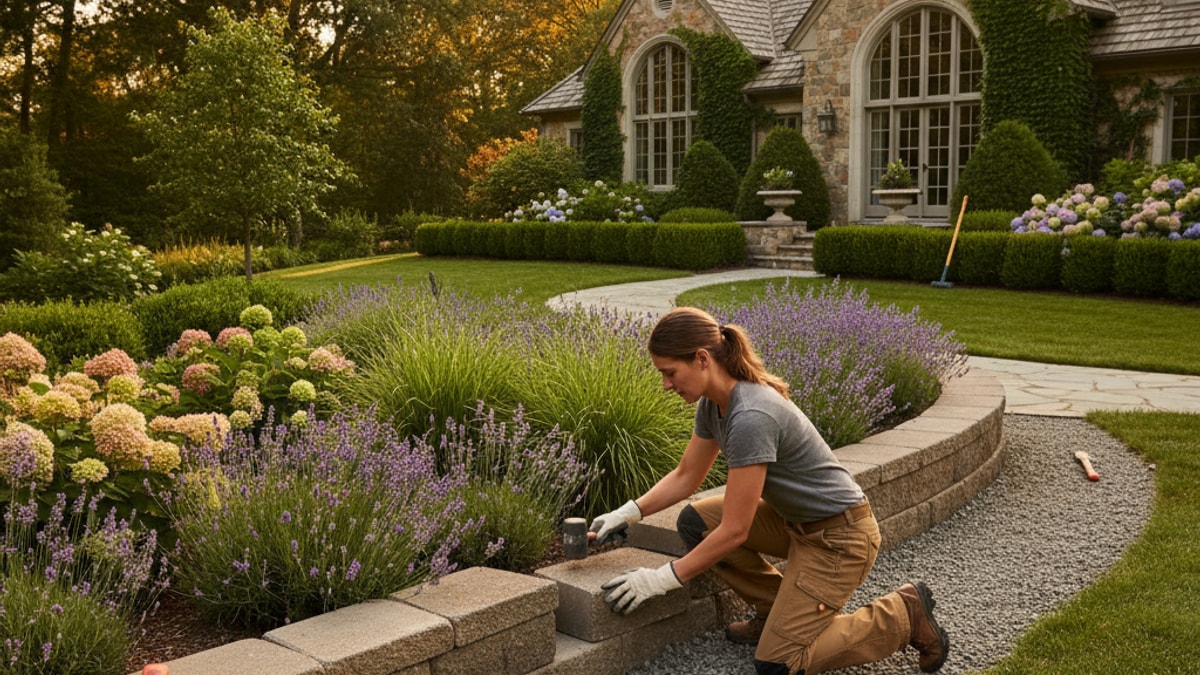
That first course of blocks is the most important one you will lay. It must be perfectly level. Take your time. Use a rubber mallet to tap blocks into place, checking for level constantly. If the first course is off by even a fraction of an inch, that error will be magnified with every subsequent course, resulting in a wobbly, unprofessional-looking wall. This is a tedious, painstaking process, but it's the only way to get it right. Our crews spend more time on the base and first course than on almost any other part of the build when they're tasked with how to install a retaining wall.
Stacking, Backfilling, and Managing Drainage
Once your first course is perfectly level, the rest of the process starts to move more quickly. For segmental blocks, you'll sweep the tops of the previous course clean before adding the next. Stagger the joints, just like in brickwork, for strength and stability. Many systems use fiberglass pins or a locking lip to secure the courses together. Follow the manufacturer's specific instructions for your chosen block. This is the stage where you really see the visual progress of how to install a retaining wall.
Now, let's talk about the most crucial component for longevity: drainage. As you build, you need to backfill behind the wall. But you can't just shovel the dirt back in. Immediately behind the wall, you must place a column of clean, ¾-inch drainage gravel, at least 12 inches wide, extending from the base all the way to just below the top course. This creates a path for water to flow down freely instead of pushing against your wall. At the bottom of this gravel column, you'll lay a perforated drain pipe (holes facing down) that runs the length of the wall. This pipe should be wrapped in a fabric sock to prevent clogging and must be sloped to an outlet, daylighting away from the wall's foundation. This whole assembly is then separated from the rest of the soil backfill by a layer of professional-grade landscape fabric. This fabric prevents soil from migrating into your drainage stone and clogging the system. We can't overstate this: a proper drainage system is the key to mastering how to install a retaining wall.
With each course you add, you should pull some of the drainage gravel and soil backfill in behind it, compacting it thoroughly. This process of lifting, stacking, and backfilling continues until you reach your desired height. For taller walls, you may also need to install geogrid reinforcement. This is a strong, flexible mesh that gets laid horizontally between courses and extends back into the slope, effectively anchoring the wall to the soil behind it. It's another engineering requirement that is absolutely essential for wall stability over a certain height. A wall isn't just a facade; it's part of an integrated system, sometimes functioning as beautiful Seat Retaining Walls that combine form and function.
The Finishing Touches That Make a Difference
You're almost there. The final steps are what transform your structure from a pile of blocks into a finished landscape feature. The last course is topped with capstones, which are secured with a high-strength construction adhesive. This not only provides a clean, polished look but also helps lock the top course together and prevent water from infiltrating the wall core from above. A well-chosen cap can tie the wall into other hardscape elements, like a nearby patio built with our quality Pavers SAN Diego.
Finally, you'll complete the backfilling process, adding topsoil behind the wall and grading it to create a gentle slope away from the structure. This is your chance to fully integrate the wall into your landscape. You can plant shrubs, install mulch, or even lay new Artificial Turf SAN Diego for a low-maintenance solution. The details matter. Consider adding some elegant Landscape Lighting SAN Diego to uplight the wall's texture at night, turning a functional structure into a stunning nighttime feature. A well-executed project focused on how to install a retaining wall should look like it was always meant to be there.
Ready to Upgrade Your Backyard? This is the point where a simple structural project can become the cornerstone of a complete outdoor transformation. A retaining wall creates new, usable space—a perfect spot for an outdoor kitchen, a cozy fire pit, or a level play area for the kids.
Learning how to install a retaining wall is a significant undertaking. It requires meticulous planning, immense physical effort, and an unflinching respect for the forces of nature you're trying to control. It's a project with zero margin for error. For small, decorative walls, a determined DIYer can achieve great results by following these steps precisely. But for larger, more complex walls, the expertise of a professional team is invaluable. We ensure the wall is not just built, but engineered to last a lifetime.
Let’s Design the Outdoor Space You’ve Been Dreaming Of. A retaining wall is often the first step in unlocking your property's true potential. By creating level tiers, you open up a world of possibilities for patios, gardens, and outdoor living areas. It’s about more than just holding back dirt; it’s about creating space for life to happen. That’s the real art behind knowing how to install a retaining wall.



.webp)
.webp)