A sloped yard can feel like a formidable challenge. It creates drainage problems, limits usable space, and can make your outdoor area feel more like a hill than a haven. At Modern Yardz, we've seen this countless times. The solution? A properly constructed retaining wall. It’s not just a barrier; it's an architectural element that reclaims your yard. But the question we hear most often is how to build a concrete block retaining wall that actually lasts. It's a significant undertaking, and honestly, there's a huge difference between a wall that looks good for a year and one that stands strong for decades.
That's what we're here to talk about. We're going to pull back the curtain on the professional process, sharing the insights our team has gained over years of building these structures. This isn't just a list of steps. It's a deep dive into the why behind the what—the critical details that prevent catastrophic failure and ensure your hard work pays off. Understanding how to build a concrete block retaining wall is about mastering gravity, water, and soil. Let's get into it.
First Things First: The Non-Negotiable Planning Phase
Let’s be honest, the temptation to just start digging is strong. We get it. But jumping the gun is the single biggest mistake you can make. The success of this entire project hinges on what you do before a single shovel of dirt is moved. This is the cornerstone of how to build a concrete block retaining wall correctly. First, you need a plan. A real one. Sketch out your wall's location, length, and height. How will it integrate with the rest of your landscape? This is where professional Landscape Design can be invaluable, ensuring the wall feels like a deliberate, integrated part of your outdoor space, not an afterthought.
Now for the serious stuff. Any wall over three or four feet tall (check your local codes, as this varies) will almost certainly require a building permit and an engineered design. This isn't just bureaucratic red tape; it's a safety measure. The forces at play behind a retaining wall are immense and unforgiving. Our experience shows that trying to skirt these rules often leads to costly, and dangerous, failures down the road. Another critical, non-negotiable step: call 811. Before you dig anywhere, you must have underground utility lines marked. Hitting a gas or electrical line is a catastrophic error. Seriously, don't skip this. A comprehensive plan is the foundation for anyone asking how to build a concrete block retaining wall that stands the test of time.
Your Toolkit: Assembling the Right Gear and Materials
Showing up to a job without the right tools is a recipe for frustration and poor results. For a project of this scale, you need to be properly equipped. We're not just talking a shovel and a wheelbarrow. The process of how to build a concrete block retaining wall demands precision, and that requires the right equipment. You'll need a heavy-duty tamper for compacting the base, a 4-foot level, a string line and stakes for keeping things straight, a circular saw with a masonry blade for cuts, and plenty of high-quality safety gear—gloves, safety glasses, and steel-toed boots are a must.
When it comes to materials, the choices you make are just as critical. The blocks themselves, the gravel for your base and drainage column, the perforated drain pipe, and the landscape fabric are all part of a system. They have to work together. Skimping on the quality of your base material or choosing the wrong type of drain pipe can undermine the entire structure. The secret to how to build a concrete block retaining wall that endures is recognizing that every single component matters. This is a system, not just a stack of blocks.
| Tool/Material Category |
Essential Items |
Pro-Level Upgrades |
Our Team's Take |
| Excavation & Prep |
Shovel, Pickaxe, Wheelbarrow, Tape Measure |
Mini-Excavator, Laser Level |
For any wall over 20 feet, renting a mini-excavator will save your back and days of labor. A laser level ensures impeccable accuracy. |
| Compaction |
Hand Tamper |
Plate Compactor |
A hand tamper works for very small walls, but a gas-powered plate compactor provides the consistent, powerful compaction needed for a truly stable base. |
| Layout & Leveling |
4-Foot Level, String Line, Stakes, Rubber Mallet |
Builder's Level, Torpedo Level |
The 4-foot level is your best friend. The string line is your unflinching guide. Don't eyeball anything. Ever. |
| Cutting & Setting |
Masonry Chisel, Hammer, Caulk Gun |
Circular Saw with Diamond Blade, Dead Blow Hammer |
A chisel works for rough splits, but a saw gives you the clean, precise cuts needed for corners and end caps. It's a game-changer. |
| Materials |
Concrete Blocks, Crushed Stone/Gravel, 4" Perforated Drain Pipe, Landscape Fabric, Construction Adhesive |
Engineered Blocks, Geogrid Reinforcement |
For taller walls, geogrid is not an upgrade; it's a necessity. It anchors the wall into the soil behind it, providing immense strength. |
The Foundation: Where Walls Are Made or Broken
We can't stress this enough: your retaining wall is only as good as its foundation. A weak, improperly prepared base is a guarantee of future failure. It will sink, shift, and heave, and your beautiful wall will come tumbling down. This is the most physically demanding part of learning how to build a concrete block retaining wall, but it’s also the most important. You need to excavate a trench that is wide enough for the block plus at least 6-12 inches of space behind it for drainage, and deep enough to bury at least half of the first course plus a 6-inch compacted gravel base.
Once the trench is dug, the real work begins. You'll add your crushed stone or gravel in 2-3 inch layers (we call these 'lifts'). After adding each lift, you must compact it thoroughly with a tamper. You want it to be rock-solid. Absolutely unyielding. This process is repeated until you have a dense, level base that is at least 6 inches deep. This base does two things: it creates a stable platform for the blocks and it helps with drainage, allowing water to escape from under the wall. Getting this step perfect is a crucial element of how to build a concrete block retaining wall that won't sag or lean over time. You need to check for level constantly—both front-to-back and side-to-side. It has to be perfect. No exceptions.
Laying the First Course: The Moment of Truth
This is it. The most critical course you will lay. Every other block will reference this first one, so any imperfections here will be magnified as you build higher. The key to how to build a concrete block retaining wall is starting with an impeccable first course. Place your first block at one end of the trench on top of the compacted gravel base. Use your level to check it front-to-back and side-to-side. Use a rubber mallet to make fine adjustments, tapping it down until it's perfectly level.
Now, place the next block right beside it, ensuring the edges are snug. Level this block relative to the first one. Continue this process for the entire length of the wall, using your string line as a guide for alignment and your level for, well, leveling. This is a slow, painstaking process. Don't rush it. Our crews spend more time on the first course than almost any other. We've found that this meticulous approach prevents massive headaches later. If your base is level and your first course is perfect, the rest of the process of how to build a concrete block retaining wall becomes dramatically easier. You're setting yourself up for success.
Building Up: Stacking, Drainage, and Reinforcement
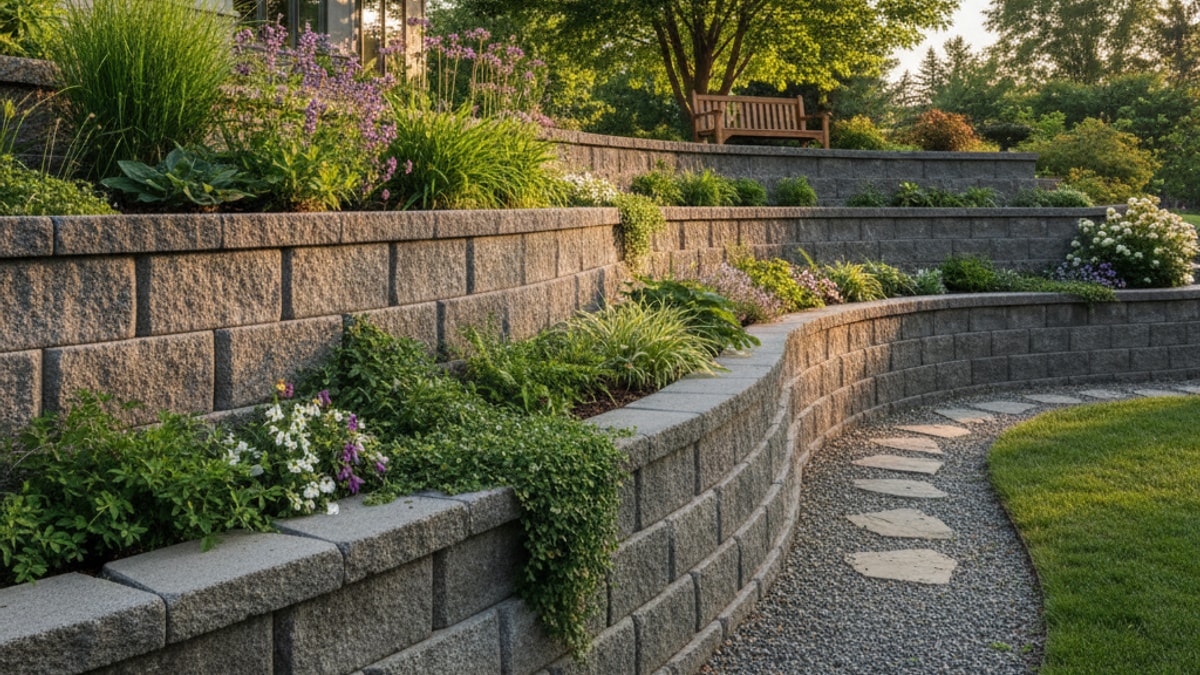
With the first course perfectly in place, the wall starts to take shape quickly. For the second course, you'll start with a half-block to create a staggered, or running bond, pattern. This is the same pattern you see in brickwork, and it's essential for the wall's structural integrity. It locks all the blocks together, distributing the load across the entire structure. Most modern retaining wall blocks have a locking lip on the back that helps set the block back slightly from the one below it, creating the necessary 'batter' or backward lean that helps the wall resist soil pressure. This design is a key feature in modern approaches to how to build a concrete block retaining wall.
Now, let's talk about the real enemy of every retaining wall: water. Hydrostatic pressure—the force of water-saturated soil—can push over even the strongest walls. The secret to defeating it is drainage. As you stack each course, you need to backfill the space behind the wall with more crushed stone or gravel. This creates a drainage column. At the bottom of this column, directly behind your first course, you'll lay a 4-inch perforated drain pipe. This pipe, wrapped in landscape fabric to prevent clogging, will collect water and channel it away to a safe location. The knowledge of how to build a concrete block retaining wall that lasts is fundamentally about managing water effectively.
For walls taller than 3-4 feet, you'll also need to incorporate geogrid reinforcement. This is a high-strength polymer mesh that gets laid between courses of blocks and extends back into the hillside. You then bury it with compacted soil. It acts like rebar, locking the wall mass to the soil mass behind it, creating a single, incredibly strong, unified structure. This is an advanced technique, but it's a critical part of how to build a concrete block retaining wall of any significant height.
The Finishing Touches: Caps, Backfill, and Final Grading
You're almost there. The wall is built, the drainage is in, and it's looking solid. Now it's time to put the finishing touches on it. The final step in how to build a concrete block retaining wall is securing the capstones. These are the flat, smooth blocks that give the wall a clean, finished look. Apply two generous beads of high-strength construction adhesive to the top course of blocks and carefully set the capstones in place, making sure they are aligned and level.
With the caps on, you can complete the backfilling process. The top 6-8 inches behind the wall should be filled with topsoil, not gravel. This allows you to plant grass or other vegetation right up to the wall's edge. Fold the landscape fabric over the top of the gravel drainage column before adding the topsoil to keep the two layers separate. Finally, grade the soil around the wall to ensure that surface water flows away from it, not towards it. This final step is often overlooked but is a crucial detail in the overall strategy of how to build a concrete block retaining wall.
Common Pitfalls Our Team Sees (And How to Avoid Them)
Over the years, we've been called in to fix or replace countless failing retaining walls. And almost every single failure comes down to one of a few common, avoidable mistakes. The number one culprit? You guessed it: poor drainage. People either skip the gravel backfill and drain pipe entirely or use the wrong materials. This is the fatal flaw in so many attempts at how to build a concrete block retaining wall.
Another huge issue is an inadequate foundation. A few inches of uncompacted sand is not a foundation. It's a suggestion. The base needs to be deep, wide, and compacted to the point of refusal. We also see walls built without the proper 'batter' or step-back. Vertical walls are much weaker and more susceptible to soil pressure. Using the correct interlocking blocks automates this, but it's something to be aware of. Understanding how to build a concrete block retaining wall is as much about knowing what not to do. It’s why our professional Seat Retaining Walls projects are planned with such meticulous attention to these foundational principles. It’s not just about stacking blocks; it’s about engineering a system that works with nature, not against it. Our approach to Concrete work in general is built on this philosophy of durability and design.
Building a wall yourself can be a deeply rewarding project. It physically reshapes your landscape, adding beauty, function, and value to your home. But it requires unflinching attention to detail and a respect for the powerful forces you're trying to contain. Taking on the challenge of how to build a concrete block retaining wall is a serious commitment. Ready to Upgrade Your Backyard? Whether you decide to tackle it yourself or bring in a team of experts, the result is a permanent improvement to your outdoor world. By following these steps, you're not just building a wall; you're creating a lasting feature and reclaiming your space. Let’s Design the Outdoor Space You’ve Been Dreaming Of, one that is both beautiful and built to last.



.webp)
.webp)