A beautifully constructed retaining wall transforms a landscape, creating usable space, preventing erosion, and adding architectural interest. It's a formidable structure, really. But here's the stark truth: even the most robust wall is utterly vulnerable without a meticulously planned, flawlessly executed drainage system. We've seen countless walls fail prematurely because homeowners or less experienced contractors overlooked this critical, non-negotiable element. It's not just about aesthetics; it's about structural integrity and the longevity of your entire outdoor investment.
At Modern Yardz, we've spent years honing our craft, understanding that the hidden details often make the most dramatic difference. We specialize in creating custom outdoor spaces, and that unwavering commitment to quality extends to every aspect, particularly when it comes to crucial foundational elements like proper drainage. Today, in 2026, with shifting weather patterns becoming more unpredictable, understanding how to build a retaining wall drainage system isn't just good practice; it's absolutely paramount. Let's delve into what it takes to get it right.
Why Drainage is Non-Negotiable for Retaining Walls
Think about it: a retaining wall's primary job is to hold back soil. That soil, especially after a heavy rain, becomes saturated and incredibly heavy. Water, you see, exerts immense hydrostatic pressure. If that pressure isn't relieved, it relentlessly pushes against the wall. Our team has found that this relentless, often unseen force is the single biggest enemy of a retaining wall. It's a common misconception that a strong wall alone can resist this. It can't. The wall isn't designed to be a dam; it's designed to hold soil while allowing water to pass through or around it in a controlled manner.
Without an effective strategy for how to build a retaining wall drainage, you're essentially setting up your wall for a slow, agonizing demise. This isn't an exaggeration; it's a professional observation we've made time and again. The consequences range from minor annoyances to catastrophic failures, impacting not just the wall itself but potentially adjacent structures, landscapes, and even your property's foundation. It's a big deal, honestly.
The Catastrophic Consequences of Poor Drainage
Let's be unflinching about what happens when you skimp on proper drainage. We've witnessed the full spectrum of disasters, and none of them are pretty. First, you'll likely see efflorescence – those unsightly white mineral deposits on the wall's face. While primarily an aesthetic issue, it's a clear signal of water movement where it shouldn't be. Then comes cracking. Small fissures appear, often near the base, slowly expanding as water continually freezes, thaws, and exerts pressure from behind. That's a structural warning sign you absolutely can't ignore.
Beyond cracking, you might observe bowing or bulging. The wall starts to lean, visibly deforming under the relentless hydrostatic assault. This is often the point of no return; repair becomes incredibly complex, if not impossible, often requiring a complete rebuild. And don't forget the impact on the landscape itself. Saturated soil can lead to erosion at the wall's base or top, damaging your carefully cultivated garden beds or Artificial Turf. In extreme cases, a wall can outright collapse, creating a hazardous situation, expensive property damage, and a monumental headache. Our experience shows that investing in correct drainage from the start is infinitely cheaper and safer than dealing with the aftermath of failure. It really is.
Understanding the Core Principles of Retaining Wall Drainage
Before we dive into the nuts and bolts of how to build a retaining wall drainage, it's crucial to grasp the fundamental principles guiding our approach. It's all about managing water, directing its flow, and preventing its accumulation. We're essentially creating pathways for water to escape the soil mass behind the wall, alleviating that hydrostatic pressure. There are two primary avenues for this:
- Subsurface Drainage: This involves collecting water that infiltrates the soil behind the wall and channeling it away. Think of it as an underground river system, designed to move water discreetly and efficiently. This is where perforated pipes, gravel backfill, and geotextile fabrics really shine. This is the backbone of any reliable system.
- Surface Drainage: Equally important, this addresses water runoff on top and around the wall. We're talking about rain sheeting down the slope or pooling at the wall's base. Proper grading, swales, and sometimes catch basins are essential here. You don't want water sitting stagnant anywhere near your wall. It's just asking for trouble.
Both types of drainage work in concert. Neglecting one renders the other less effective, often dramatically so. Our team emphasizes a holistic approach to Landscape Design, ensuring all elements, including drainage, integrate seamlessly for long-term stability and beauty.
Essential Components for Robust Drainage Systems
When we're planning how to build a retaining wall drainage, we always consider these core components. Each plays a vital role in creating a resilient system:
- Perforated Drain Pipe (Weeping Tile): This is the workhorse of your subsurface drainage. Typically a 4-inch diameter pipe made of PVC or corrugated plastic, it features small holes that allow water to enter while preventing soil particles from clogging it. We've found that using a rigid PVC pipe generally offers better long-term performance and is less prone to crushing than flexible corrugated options, especially under heavy backfill.
- Drainage Aggregate (Gravel): This isn't just any gravel. We're talking about clean, washed gravel – usually 3/4 inch to 1 inch in size, with minimal fines (small particles). This creates a highly permeable layer behind the wall, allowing water to quickly filter down to the drain pipe. It's a critical, often underestimated, component.
- Geotextile Fabric: Sometimes called landscape fabric or filter fabric, this permeable material separates the drainage aggregate from the surrounding soil. Its primary job is to prevent fine soil particles from migrating into the gravel and clogging the drain pipe, maintaining the system's efficiency over time. It's an unsung hero, really.
- Weep Holes (for solid walls): These are openings directly through the wall face, often made by inserting PVC pipes during construction. They allow water collected behind the wall to exit directly through the wall itself. They're particularly effective for smaller walls or as supplementary drainage in larger systems. When we construct Seat Retaining Walls for our clients, we make sure to integrate these considerations from the ground up.
- Backfill Material: The soil used directly behind the drainage aggregate also matters. We generally recommend using granular, free-draining soil rather than heavy clay, which can hold water and contribute to pressure. Proper compaction of this backfill is also vital.
- Outlet: All that collected water needs somewhere to go. This typically means routing the drain pipe to a lower elevation where water can safely discharge, away from the wall's base and property foundation, or into a storm drain system. Don't forget this crucial endpoint!
Step-by-Step: How to Build a Retaining Wall Drainage System
Alright, let's get into the practical application. This is where our collective expertise really comes into play. If you're wondering how to build a retaining wall drainage system that truly endures, follow these steps meticulously. Each stage is interdependent, so don't cut corners.
Site Preparation and Excavation
First, you've got to prepare your site. This means excavating the trench for your retaining wall, ensuring it's wide enough to accommodate not only the wall itself but also the drainage system behind it. We're talking about a minimum of 12-18 inches behind the wall for the gravel backfill and drain pipe. The trench base needs to be perfectly level and properly compacted. This foundation determines everything. A poorly prepared base leads to settlement and, eventually, structural compromise. We can't stress this enough: precision here is paramount.
Laying the Foundation and Base Material
Once excavated, you'll lay down a base of compacted granular material, typically 4-6 inches of crushed gravel or road base. This provides a stable, free-draining platform for your wall. Compact it thoroughly, using a plate compactor, until it's firm and level. This base also helps prevent water from wicking up from the ground below into the wall itself, which can be an issue for systems wondering how to build a retaining wall drainage. Our team always ensures this step is impeccable before any block or stone is laid.
Installing Perforated Drain Pipes (Weep Holes & French Drains)
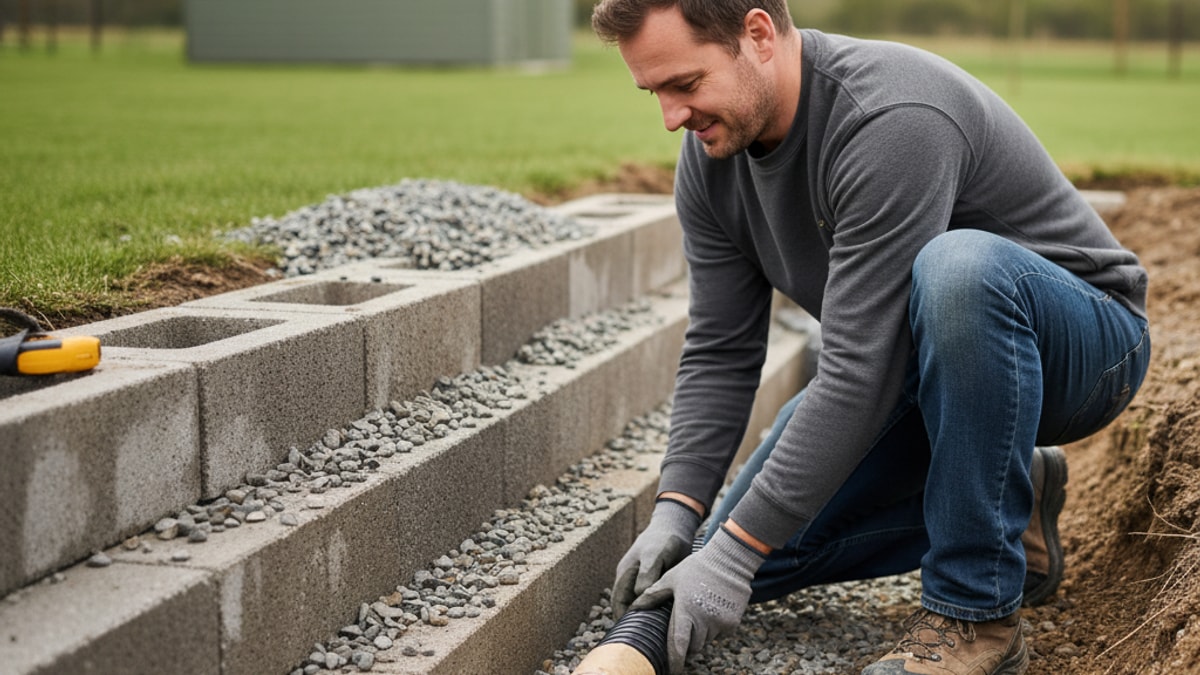
Now for the heart of the system. For a French drain style, lay your perforated drain pipe along the base of the wall, directly on top of your compacted gravel foundation. The perforations should face downwards or slightly to the sides, allowing water to enter from the soil above. Ensure the pipe has a slight slope (at least 1/8 inch per foot) towards your intended outlet. This gentle grade allows gravity to do its work, moving water effectively. If you're installing weep holes for a solid Concrete or masonry wall, these should be placed at the base, typically every 4-6 feet, extending through the wall face. We've found that integrating both—a subsurface drain pipe and weep holes—offers a robust, belt-and-suspenders approach for how to build a retaining wall drainage, particularly for taller walls or areas with heavy rainfall.
Backfilling with Granular Material
This is where the drainage aggregate comes in. Place a layer of clean, washed gravel (at least 12 inches thick, extending the full height of the back of the wall) directly behind the wall and over the perforated pipe. This gravel provides a highly permeable zone for water to collect and move freely towards the drain pipe. We often recommend extending this gravel zone significantly for larger walls, sometimes up to two or three feet wide, to maximize its effectiveness. Proper backfilling is crucial to how to build a retaining wall drainage that lasts.
Geotextile Fabric: The Unsung Hero
Before you backfill with soil, you must wrap the entire gravel drainage zone with geotextile fabric. This fabric acts as a filter, preventing the fine soil particles from migrating into your clean gravel and clogging the drain pipe. Overlap the fabric generously at the seams (at least 6-12 inches) to ensure full coverage. It's a simple step, but one that dramatically extends the life and efficiency of your drainage system. Seriously, don't skip it. It's a small investment that pays huge dividends in the long run for anyone figuring out how to build a retaining wall drainage.
Managing Surface Water
Remember, surface water management is equally important. Grade the soil above and behind the retaining wall so that it slopes away from the wall. This prevents water from pooling directly against the top edge, which can lead to saturation of the backfill and eventual erosion. Consider installing a swale or a small Pavers channel at the top of the wall to divert runoff if you have a significant slope or large area draining towards it. We design Landscape Lighting and other features to complement these critical drainage solutions.
Integrating with Your Overall Landscape Design
Finally, think about how this drainage system integrates into your broader outdoor vision. The outlet for your drain pipe needs to be discreet yet functional, discharging water safely away from walkways, patios, or your Pools and Spas. Our team considers the entire flow of your property, ensuring that water management enhances, rather than detracts from, your Outdoor Kitchens or Fire Features. This holistic approach is what sets Modern Yardz apart; we're not just building walls, we're crafting enduring, functional outdoor living spaces. We're dedicated to helping you create an outdoor space that truly brings your vision to life, down to every essential detail.
Drainage System Comparison Table
When we're discussing how to build a retaining wall drainage, clients often ask about different approaches. Here's a brief comparison of common drainage methods:
| Drainage Method |
Description |
Pros |
Cons |
Ideal Use Case |
| French Drain |
Perforated pipe surrounded by gravel, wrapped in geotextile fabric. |
Highly effective for subsurface water; hidden; long-lasting. |
Requires significant excavation; proper slope is critical. |
Most retaining walls, especially taller or longer ones. |
| Weep Holes |
Small openings directly through the wall face. |
Simple to install (during construction); visible outflow. |
Can clog; less effective for high volumes of water; may stain wall face. |
Smaller walls, supplementary drainage, solid masonry/concrete walls. |
| Gravel Backfill |
Layer of clean, washed gravel behind the wall. |
Essential for reducing hydrostatic pressure; enhances French drain. |
Not a complete solution on its own; still needs an outlet for water. |
All retaining walls (should be used with other methods). |
| Surface Grading |
Sloping the soil away from the wall. |
Prevents water pooling; simple and cost-effective. |
Only addresses surface runoff; doesn't manage subsurface water. |
All retaining walls (fundamental initial step). |
Common Mistakes to Avoid When Building Retaining Wall Drainage
We've seen our share of drainage blunders over the years, and knowing what not to do is just as important as knowing how to build a retaining wall drainage correctly. Here are some of the most frequent pitfalls:
- No Drainage at All: This is the most egregious error. As we've discussed, it's a guaranteed path to failure. Just don't do it.
- Incorrect Pipe Placement: Laying the perforated pipe with holes facing up or without a proper slope renders it useless. Water won't enter efficiently, or it won't flow away.
- Skipping Geotextile Fabric: Without this filter, your drain pipe will inevitably clog with soil, turning your sophisticated drainage system into a simple, ineffective pipe buried in mud. This is a common, costly oversight.
- Using Dirty Gravel: Gravel with too many fines will impede water flow, essentially acting like compacted soil rather than a drainage medium. Always use clean, washed aggregate.
- Improper Outlet: Directing the drain pipe to simply dump water at the base of the wall or onto a neighbor's property is irresponsible and ineffective. The water needs to be carried away to a safe, designated discharge point. This is a crucial part of how to build a retaining wall drainage responsibly.
- Neglecting Surface Drainage: Focusing solely on subsurface drainage while allowing water to pool at the top of the wall is like patching one leak while ignoring another. You need both.
Maintenance: Keeping Your Drainage System Optimal
Even the best-designed drainage system isn't entirely maintenance-free. To ensure your investment continues to protect your wall for decades, a little proactive care goes a long way. We recommend checking your drainage outlets annually, especially after heavy rain events. Look for any debris, leaves, or soil that might be obstructing the flow. Clear these blockages immediately. If your system includes weep holes, ensure they remain clear of vegetation or accumulated soil.
Occasionally, you might need to flush your drain pipes if you suspect a clog, though this is less common with properly installed geotextile fabric. Remember, the goal is unimpeded water flow, always. Staying on top of this small maintenance routine is a simple, effective way to ensure the longevity of your retaining wall, a structure that frames your outdoor space, perhaps alongside a custom Patio Covers & Pergolas installation.
Partnering with Experts for Your Retaining Wall Project
Understanding how to build a retaining wall drainage is complex, demanding precision, specific knowledge, and often, specialized equipment. While this guide provides a comprehensive overview, the reality of execution requires significant expertise. That's where a professional landscape design and build company like Modern Yardz truly makes a difference. We approach every project, from concept to completion, with an unwavering commitment to quality and longevity.
Our team has a deep understanding of local soil conditions, water management, and the architectural principles required to build structures that are both beautiful and inherently stable. We handle every step of the process, ensuring that critical elements like proper drainage are meticulously integrated into your Seat Retaining Walls or any other outdoor feature. We're not just building yards; we're building spaces where memories are made, designed to last. Let's design the outdoor space you've been dreaming of, built with integrity from the ground up. Ready to upgrade your backyard? Our collective expertise ensures your retaining wall, and your entire outdoor living area, stands strong for years to come. Explore our full range of services on our website.
FAQs
What is hydrostatic pressure and why is it so damaging to retaining walls?
Hydrostatic pressure is the force exerted by standing water against a retaining wall. When soil behind the wall becomes saturated, the water fills the voids, increasing the weight and creating immense outward pressure. This relentless force can cause a wall to crack, bow, or even collapse if not properly managed by an effective drainage system.
Can I use just gravel backfill instead of a perforated pipe for drainage?
While gravel backfill is an absolutely essential component for drainage, it's rarely sufficient on its own. It allows water to filter, but without a perforated pipe to collect and channel that water away, it will still accumulate at the base of the wall, leading to hydrostatic pressure. A pipe provides a controlled exit point for the collected water.
How often should I check my retaining wall drainage system?
We recommend checking your drainage outlets and weep holes annually, ideally in late fall after leaves have dropped and again in early spring before heavy rains. After any significant storm, it's also wise to do a quick visual inspection to ensure nothing is obstructed. This proactive approach ensures continuous functionality and helps you learn how to build a retaining wall drainage system that truly lasts.
What kind of slope is needed for a drain pipe behind a retaining wall?
For effective gravity-fed drainage, your perforated drain pipe should have a minimum slope of 1/8 inch per foot (or about 1 inch over 8 feet). This gentle gradient is sufficient to ensure water flows consistently towards the designated outlet, preventing pooling within the pipe itself.
Is geotextile fabric really necessary, or can I skip it to save money?
Geotextile fabric is a critical, non-negotiable component. Skipping it is a false economy. Without the fabric, fine soil particles will inevitably migrate into your drainage gravel and perforated pipe, clogging the system over time. This renders the entire drainage effort useless, potentially leading to costly repairs and a failed wall.
Where should the drain pipe outlet be located?
The drain pipe outlet should be located at a lower elevation than the pipe's start, allowing water to exit safely and discreetly. It must discharge water away from the retaining wall's base, your property's foundation, and certainly not onto a neighbor's land. Sometimes, this means connecting to an existing storm drain system or a designated runoff area.
Can a DIY approach to retaining wall drainage be successful?
A DIY approach can be successful for smaller, less complex walls, provided you meticulously follow best practices and understand the engineering principles involved. However, for larger, taller walls, or those in areas with challenging soil or heavy rainfall, we strongly recommend professional assistance. The stakes are simply too high to risk a failure.
What if my soil is heavy clay? Does that change how to build a retaining wall drainage?
Yes, heavy clay soil significantly impacts drainage. It's less permeable and holds water, exacerbating hydrostatic pressure. In such cases, extending the width and height of your gravel backfill zone becomes even more critical. You might also consider using a chimney drain design, where gravel extends almost to the top of the wall.
What's the difference between a French drain and weep holes?
A French drain is a subsurface system using a perforated pipe surrounded by gravel, designed to collect and channel water away from the wall's entire length. Weep holes are individual openings through the wall face, allowing collected water to exit directly. They serve similar purposes but are different mechanisms, often used in conjunction for optimal results.
How does a poorly drained retaining wall affect other landscape features?
Poor drainage can have a cascading effect. Saturated soil can lead to root rot in nearby plants, damage to adjacent Pavers or Concrete patios, and even destabilize other structures like Patio Covers & Pergolas. It's a systemic issue that impacts the entire outdoor environment, which is why we consider holistic Landscape Design vital.
Are there any new drainage technologies for retaining walls in 2026?
While the core principles of how to build a retaining wall drainage remain consistent, we're seeing advancements in drainage composites—geocomposite drains that combine a filter fabric with a dimpled or channeled core. These are often thinner and faster to install than traditional gravel, offering an efficient alternative for specific applications. Our team stays current with these innovations.
Can I connect my retaining wall drain to my home's downspout system?
Potentially, yes, but with careful planning. You'd need to ensure your home's downspout system has the capacity to handle the additional water volume without becoming overwhelmed, which could lead to basement flooding or other issues. Consulting with a professional is crucial here to assess the existing system and ensure proper integration.
What if I already have a retaining wall with no drainage? Can it be added?
Adding drainage to an existing wall is significantly more challenging and costly than incorporating it during initial construction. It typically involves excavating behind the wall, which can be disruptive. However, for walls showing signs of distress, it's often a necessary intervention to prevent further damage. We assess such situations on a case-by-case basis.
What's the cost implication of proper drainage for a retaining wall?
The cost of integrating proper drainage is a relatively small percentage of the overall retaining wall project, often around 10-20%. However, the cost of not including it, leading to wall failure and subsequent repair or replacement, can be several times the original investment. It's an essential insurance policy for your outdoor living space, truly.
How does Modern Yardz ensure proper drainage in their retaining wall projects?
At Modern Yardz, our process for how to build a retaining wall drainage begins with thorough site analysis, including soil composition and water flow patterns. We then design a comprehensive drainage plan, selecting the right components and ensuring correct installation techniques—from precise excavation and base preparation to proper pipe sloping, gravel backfill, and geotextile fabric. Our expertise guarantees a robust, long-lasting solution that protects your investment.
Building a retaining wall is a substantial undertaking, a commitment to enhancing your property's functionality and aesthetic appeal. But without an unwavering focus on its drainage, that investment, quite frankly, is at risk. We've seen it too many times not to emphasize this crucial aspect. Our goal at Modern Yardz is always to deliver outdoor spaces that are not only stunning but are also built to endure, structurally sound for years, even decades. It's why we meticulously plan every detail, ensuring your retaining wall – and your entire landscape – can withstand the elements, beautifully. We believe in crafting outdoor environments where you can truly live, relax, and make memories, without worrying about the integrity of your hardscaping. Your peace of mind is our priority.



.webp)
.webp)