
Smart Irrigation Controllers: What Actually Saves Water
Discover how smart irrigation controllers significantly reduce water usage. Learn tips for choosing the right system and maximizing savings.
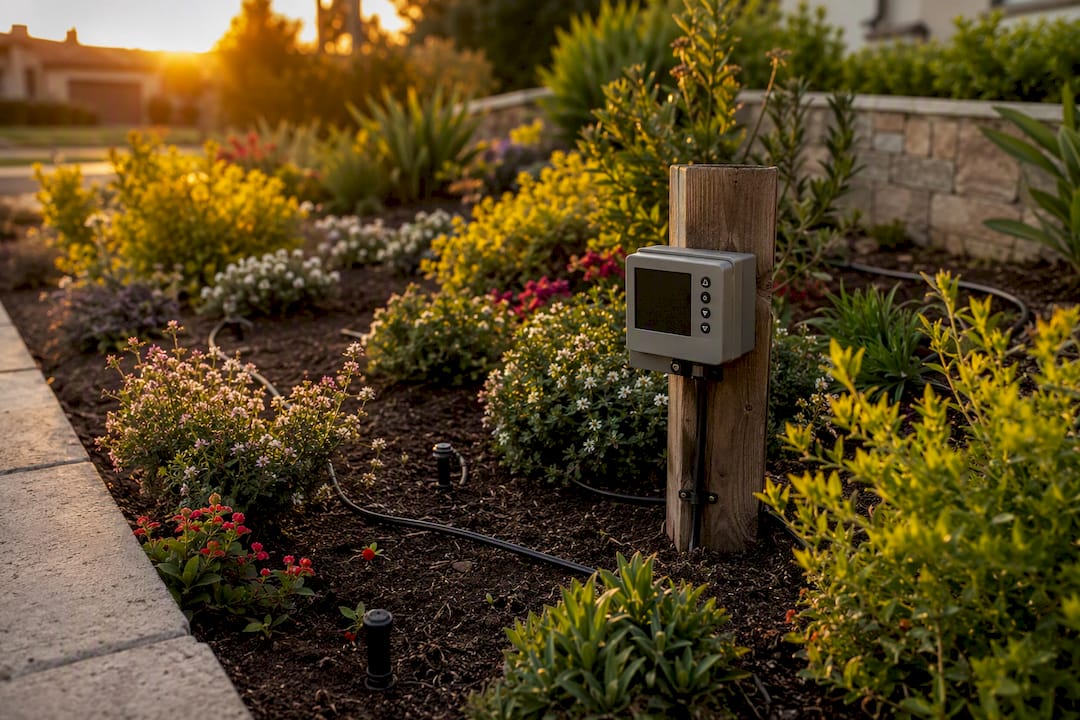
Smart irrigation controllers typically cut outdoor water use by a substantial margin, with well-maintained residential systems often achieving notable savings, according to UCANR research. The number depends heavily on your system's design, not just the controller you buy. A high-quality controller bolted onto a poorly zoned irrigation system will underperform, while the same device paired with proper zone design and head placement approaches the top of that range.
Before shopping, take three steps:
- Count your irrigation zones and note which run drip lines versus spray heads.
- Check whether candidate controllers carry the WaterSense label, which many rebate programs require.
- Confirm your home Wi-Fi reaches the controller's mounting location, or plan for a cellular or hardwired alternative.
The rest of this guide walks through how these devices work, which features actually matter, and where a professional irrigation audit outperforms a do-it-yourself install.
Key Takeaways
Smart irrigation controllers reduce outdoor water use most reliably when weather-based or soil-moisture feedback, cycle-and-soak scheduling, and sound zone hydraulics are all in place together.
| Point | Details |
|---|---|
| Savings depend on setup | Expect about 20% typical savings; higher savings are possible with sensors and proper design, per UCANR field research. |
| WaterSense drives rebates | Confirm certification before buying if you plan to apply for a utility rebate program. |
| Flow monitoring catches leaks early | Prioritize this feature on properties with many zones or high-value landscaping. |
| Cycle-and-soak fixes slopes | Set multiple short watering cycles per zone rather than one long run on any graded property. |
| Hardware cannot fix hydraulics | A professional irrigation audit resolves zone and pressure issues no controller can override. |
Table of Contents
- How Do Smart Irrigation Controllers Adjust Watering?
- Which Features Actually Move the Needle on Water Savings
- What Does Installing a Smart Controller Involve?
- Which Controller Setup Fits Your Property Size?
- How Much Water Do Smart Controllers Actually Save?
- What Do Smart Controllers Cost, and Are Rebates Available?
- How Do You Maintain and Troubleshoot a Smart Controller?
- How Modern Yardz Approaches Smart Irrigation in Luxury Design-Build
- An Editorial Take on Smart Irrigation for High-Value Landscapes
- Sources
How Do Smart Irrigation Controllers Adjust Watering?
A controller earns the label "smart" only when it adjusts watering based on real feedback rather than a fixed calendar. That is the core distinction UF/IFAS extension research draws: a timer that runs Tuesday and Friday no matter what is not smart, regardless of how sleek its app looks.
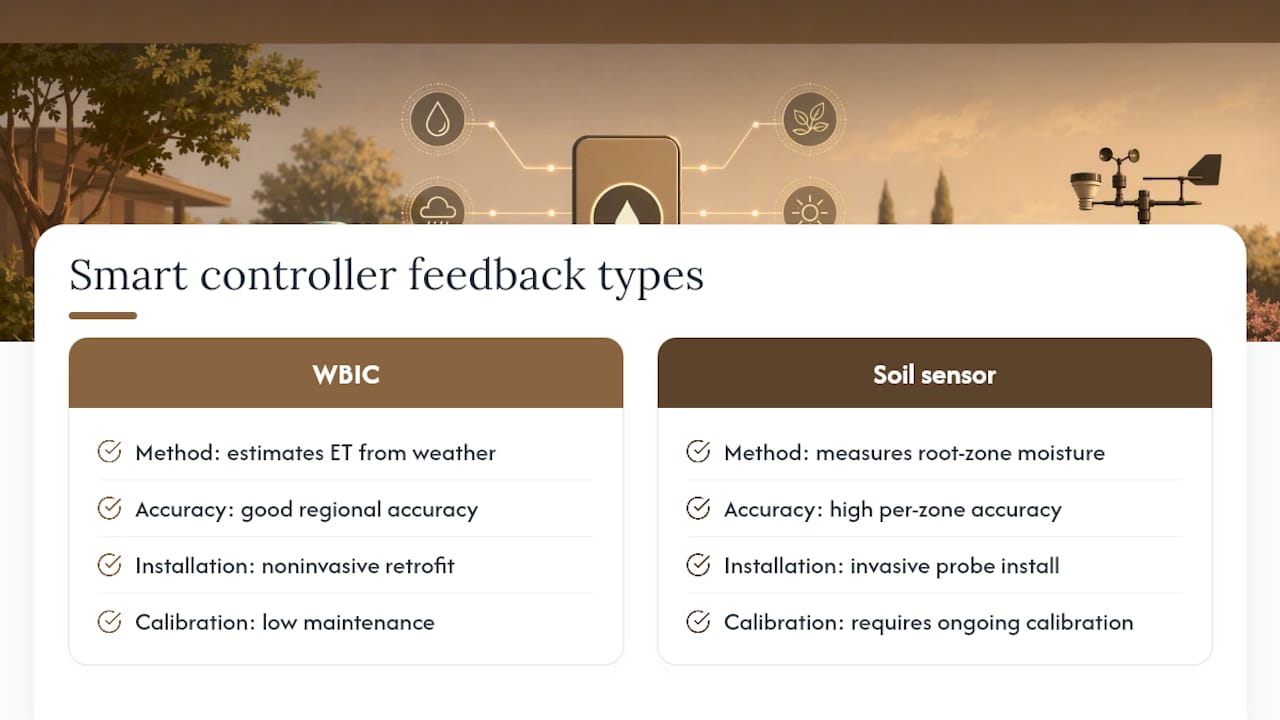
Most smart controllers use one of two feedback methods. Weather-based controllers, often called WBICs, pull local or regional weather data and calculate evapotranspiration, or ET, the rate at which plants and soil lose moisture to sun and wind. When ET is high, the controller adds runtime. When a storm just passed, it skips a cycle entirely. Soil moisture sensor systems take a different approach, burying probes directly in the root zone to measure actual moisture rather than estimating it from weather patterns. Soil sensors tend to be more precise on a single zone but require invasive installation and ongoing calibration, which is why IFAS extension researchers note that WBICs have become the preferred choice for residential retrofits, especially where local weather station density is good.
Cycle-and-soak is the other mechanism worth understanding. Instead of running a zone for twenty straight minutes, the controller breaks that runtime into three or four shorter bursts with soak periods in between. This matters enormously on slopes and compacted soils, where water runs off before it can infiltrate. Rachio's engineering guidance treats cycle-and-soak scheduling as essential for minimizing runoff on any property with grade changes.
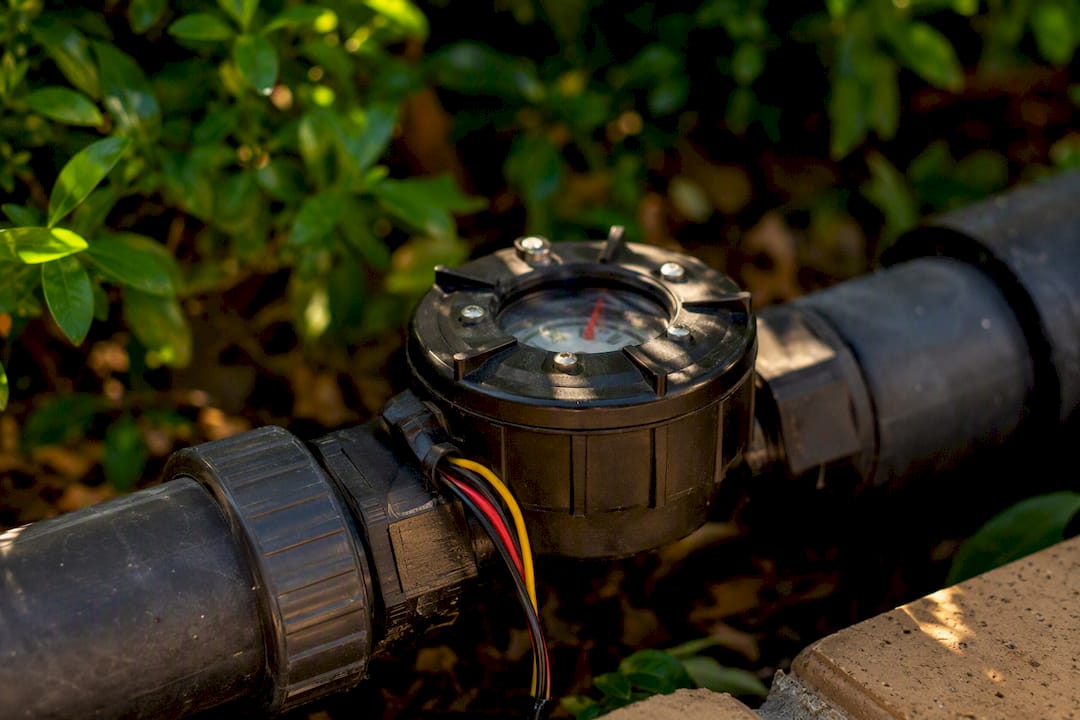
Flow monitoring adds a third layer. A flow sensor measures actual water moving through the mainline in real time, which means the controller can flag a zone using more water than its baseline. On a large property, that is often the first sign of a cracked lateral line or a broken head hiding behind a hedge.
Which Features Actually Move the Needle on Water Savings
Not every feature on a spec sheet affects your water bill. Some determine reliability. A few are simply convenient. Here is how to sort them:
- Zone or station capacity. Match the controller to your actual zone count, plus a margin for future expansion. A four-zone budget model will not serve a property with sixteen valves, and modular controllers that let you add stations later avoid a full replacement down the road.
- WaterSense certification. This EPA-backed standard applies specifically to weather-based irrigation controllers and confirms the device meets minimum scheduling and water-savings criteria. It is also the credential most utility rebate programs check first.
- Flow sensing. This is the feature homeowners with high-value landscaping most often skip and most often regret skipping. It is the difference between finding a leak in an app notification and finding it three weeks later in a water bill.
- Soil moisture sensor compatibility. Even if you start with weather-based scheduling, buying a controller that accepts soil sensors as an add-on protects your investment if you later want zone-specific precision on a problem area.
- Cycle-and-soak scheduling. Confirm the controller lets you set multiple short cycles per zone, not just a single runtime. This one setting does more for runoff control than almost anything else on the list.
- Outdoor rating and housing. Consumer Reports testing flags weatherproofing as a recurring weak point. Some controllers are rated for direct outdoor exposure; others need a protective enclosure or an indoor mounting location entirely.
- App usability and manual override. You will want to pause a zone before a party or override a schedule during a landscaping project, and a clumsy app makes that a chore rather than a tap.
Pro Tip: Skip the voice-assistant integration and premium hyperlocal weather subscription unless you already use that ecosystem daily. Neither one saves a drop of water; both are convenience add-ons layered on top of the features that actually matter.
What Does Installing a Smart Controller Involve?
Wiring a smart controller is mostly a matter of matching zone terminals to your existing valve wires, one at a time, and landing a common wire and a transformer connection. Most modern controllers accept standard 24-volt valve wiring, so compatibility with your existing valves is rarely the obstacle. The obstacle is usually everything upstream of the controller.
- Indoor controllers need a nearby outlet and typically live in a garage or utility closet, protected from weather and temperature swings.
- Outdoor-rated controllers mount near the valve manifold but still benefit from a shaded, sheltered location even when the housing is weatherproof.
- Labeling each wire before you disconnect the old controller saves real time. Photograph the terminal layout first.
- If you find leaking valves, uneven head spacing, or zones that mix drip and spray on the same line, a controller cannot fix that. That is a signal for a professional irrigation audit before you spend money on smart hardware.
A straightforward swap onto existing wiring typically runs an hour or two for a handy homeowner. Retrofitting a system with hydraulic problems, adding flow sensors, or reworking zones for cycle-and-soak performance is a different project entirely, and it is where proper hydraulic design and head layout determines whether the controller can do its job at all.
Which Controller Setup Fits Your Property Size?
A quarter-acre suburban lot and a hillside estate in Rancho Santa Fe have almost nothing in common when it comes to irrigation design. The controller that serves one poorly will frustrate the other. Zone count is the first filter, but slope, plant mix, and drip versus spray coverage matter just as much.
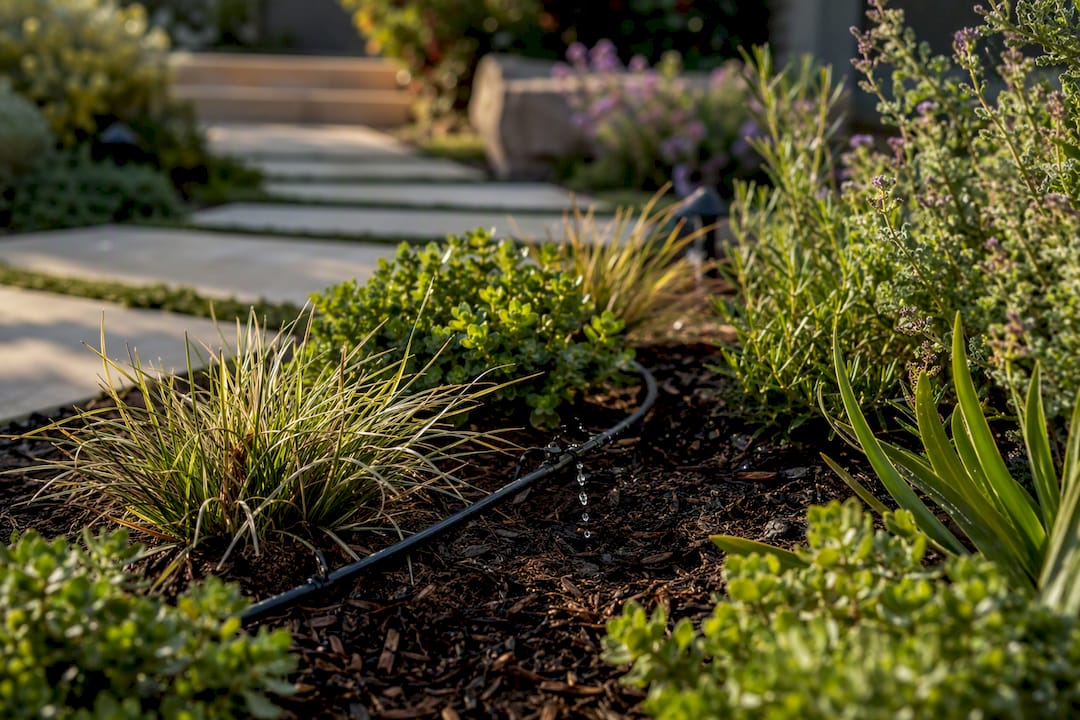
On drip irrigation versus sprinkler irrigation, the efficiency gap is real: drip systems deliver water directly to root zones with minimal evaporation loss, while spray heads lose more to wind and surface runoff. A landscape that mixes both needs a controller sophisticated enough to run separate schedules for each, not one blended cycle applied everywhere.
For large or luxury properties, flow monitoring stops being optional. Engineering literature on integrated residential irrigation systems notes that automation performance is capped by the hydraulic design underneath it, meaning a property with twenty zones and no flow sensing has no way to catch a failure until the water bill or a soggy lawn reveals it. Drought-tolerant and native plant beds also change the calculus, since their irrigation needs differ sharply from turf and require zone-specific scheduling rather than a single default program.
How Much Water Do Smart Controllers Actually Save?
It reflects a spread across site conditions, controller types, and how well each system was set up in the first place. Households at the low end of that range often have a controller running on default settings. Households at the high end typically combine weather-based scheduling with proper zone design and, in some cases, supplemental soil moisture sensors.
Three factors determine where you land:
- Setup accuracy. A controller programmed with the wrong plant type, wrong soil type, or wrong sun exposure for a zone will schedule watering based on bad assumptions, no matter how sophisticated its weather feed is.
- Ongoing maintenance. Savings decay if nozzles clog, heads tilt, or a zone gets bypassed after a repair and never gets reconnected to the schedule.
- System design quality. Cycle-and-soak configuration recovers water that would otherwise run off a slope, but only if someone sets it up correctly on install day.
The practical takeaway is that a smart controller is a multiplier on a good system, not a fix for a broken one. Homeowners who see disappointing results after installing a well-reviewed controller almost always have an underlying zone or hydraulic issue, not a software problem.
What Do Smart Controllers Cost, and Are Rebates Available?
Smart controllers themselves generally run somewhere in the low hundreds of dollars for a mid-range residential unit, with professional-grade models supporting more zones and flow sensing priced higher. Installation labor, when you hire it out, typically adds a modest amount on top for a straightforward swap, more if wiring or zone reconfiguration is involved.
- Estimate your payback. If your household currently spends a set amount monthly on outdoor water and a new controller delivers even a 20% reduction, the device often pays for itself within one to two irrigation seasons in many California water districts, though your exact payback depends on your local rate structure.
- Check your utility's rebate page directly. Many California water districts offer rebates that cover a meaningful share of a WaterSense-certified controller's cost, but eligibility almost always requires the WaterSense label and proof of installation.
- Confirm eligibility before buying. Some rebate programs require pre-approval or a specific model list, so check before you purchase rather than after.
- Factor in subscription costs. A few premium controllers charge an optional fee for hyperlocal weather data or extended historical analytics. It is rarely required for good performance, but read the fine print before assuming a device is subscription-free.
How Do You Maintain and Troubleshoot a Smart Controller?
A smart controller is not a set-and-forget appliance. Seasonal transitions are when most problems surface, and monthly app reviews catch issues before they become expensive.
- Spring startup: Flush lines, check for winter-cracked heads, and confirm every zone still activates on command.
- Summer checks: Watch for ET-driven schedule increases during heat waves and confirm cycle-and-soak settings are still active on slope zones.
- Fall and winter: Reduce or suspend schedules based on rainfall, and winterize exposed piping in any climate that sees frost.
- Monthly app review: Scan flow data for zones running above their normal baseline, a common early signal of a broken head or a developing leak.
- Connectivity troubleshooting: A controller that drops offline is usually a Wi-Fi range issue at the mounting location, not a device failure. Consider a Wi-Fi extender before assuming the controller is defective.
- Stuck valves: If a zone runs continuously or never activates, check the valve solenoid before assuming the controller's programming is wrong.
Pro Tip: If a single zone consistently uses more water than its scheduled runtime should account for, do not just shorten that zone's schedule. Investigate the line first. Masking a leak with a shorter cycle just delays a more expensive repair.
Call a professional when troubleshooting reveals a hydraulic issue rather than a settings issue: persistent pressure problems, a valve that will not fully close, or zones that flood despite correct programming.
How Modern Yardz Approaches Smart Irrigation in Luxury Design-Build
A smart controller is only as good as the system feeding it, and that is the gap most homeowners never see until after installation. Modern Yardz has spent years building complete outdoor environments across San Diego County, and irrigation performance is almost always a hydraulics problem before it is a software problem.
On every project we design, irrigation gets engineered alongside the hardscape and planting plan, not bolted on afterward. A controller cannot compensate for a zone with mismatched heads or a mainline sized wrong for a property's water pressure. That is why our design-build process includes 3D renderings before construction begins, so irrigation zones get mapped against real plant placement and slope conditions from day one.
Operating under California Contractor License #1082881 with more than 2,900 completed projects, Modern Yardz manages irrigation, drainage, and planting design as one coordinated system rather than handing pieces to separate subcontractors. For a hillside property in Rancho Santa Fe or a resort-style landscape in La Jolla, that integration is what turns a smart controller's savings potential into an actual result.
An Editorial Take on Smart Irrigation for High-Value Landscapes
The conventional advice on smart controllers treats them as a plug-and-play upgrade: buy a WaterSense model, download the app, and watch your water bill drop. That advice is not wrong, but it is incomplete for anyone with a landscape worth protecting.
The research is consistent on one point that gets buried in most buying guides: a controller's ceiling is set by the irrigation system underneath it, not by its feature list. Flow monitoring and cycle-and-soak matter more than any smart-home integration or voice-assistant compatibility, because they address failure modes, runoff and leaks, that quietly erode both water savings and the landscape itself.
If you own a larger property, prioritize a professional audit of your zones and hydraulics before you shop for a controller at all. The device is the easy decision. The system it controls is where the real money and water get saved or wasted.
Ready to see how irrigation, drainage, and design work together on your property? Schedule a consultation with Modern Yardz to start with a 3D rendering of your outdoor space before a single valve gets touched.
— Thomas Jackson
Sources
- Smart irrigation controllers and their importance in water conservation | UCANR
- AE442: Smart irrigation controllers: What makes an irrigation controller smart? | UF/IFAS
- WaterSense product search: Weather-based irrigation controllers | EPA
- Buying a smart sprinkler controller - Consumer Reports
Recommended
Start Your Free Design Consultation
Tell us about your project and we'll be in touch within 24 hours. No pressure, no obligation.
Ready to design your dream yard?
Tell us about your project. We'll send back a real plan, not a templated quote.
Book My Free Consultation→

