Artificial Turf vs Real Grass: What Homeowners Should Choose
Struggling to choose between artificial turf vs real grass? Discover key factors for San Diego homeowners to make the best decision for their yards.
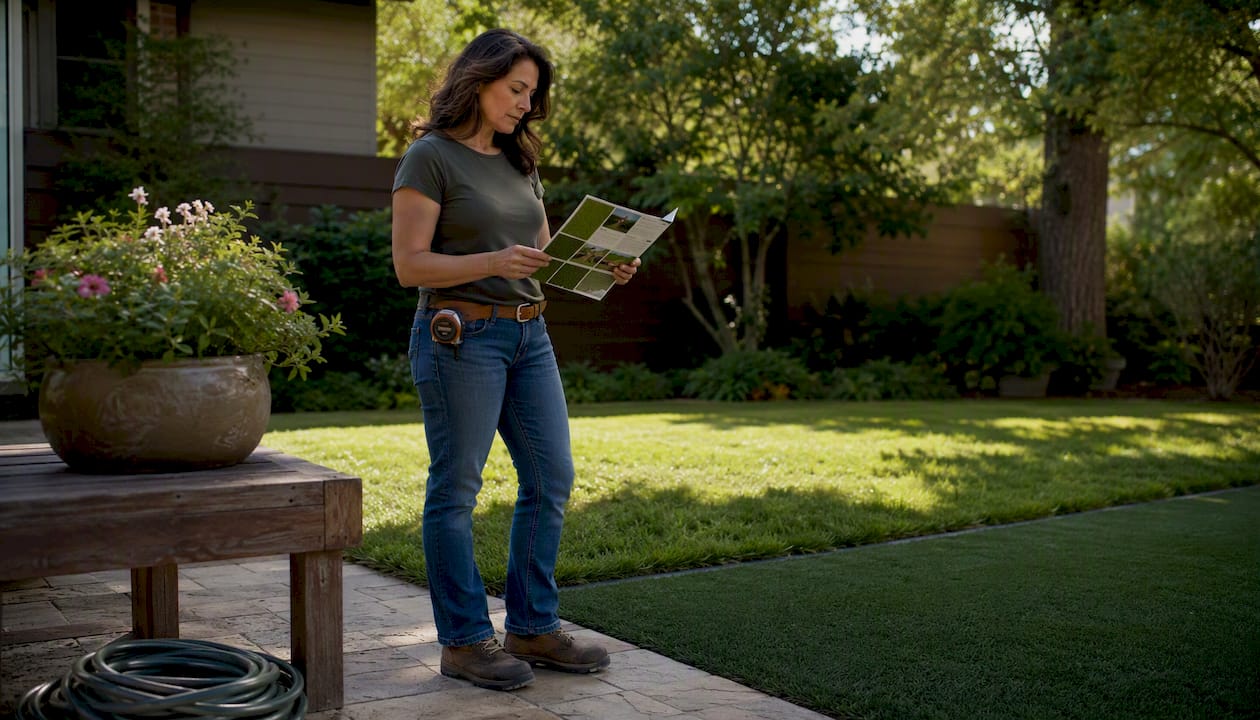
For most San Diego homeowners, the decision comes down to four factors: water cost, maintenance time, how the yard gets used, and what the property needs to look like year-round. Artificial turf wins for utility zones, steep or shaded side yards, dog runs, pool surrounds, and drought-restricted properties. Natural grass wins for primary entertaining lawns where cooling, biodiversity, and sensory experience matter. Neither surface is universally superior.
Quick recommendation matrix:
- Choose artificial turf for: high-traffic play areas, dog runs, steep slopes, shaded side yards where grass struggles, poolside surrounds, and water-restricted properties in San Diego County
- Choose natural grass for: central entertaining lawns, properties where evapotranspiration cooling is a priority, biodiversity-minded owners, and yards with consistent irrigation access
- Consider a hybrid: reserve living grass for the primary entertaining zone and use engineered turf for utility, pet, and play zones — this approach reduces water consumption while preserving the ecological and sensory benefits of a living lawn where they matter most
The hybrid strategy is particularly well-suited to luxury San Diego properties where a single surface rarely serves every zone equally well.
Table of Contents
- How do artificial turf and real grass compare side by side?
- What does it actually cost to install and maintain each surface?
- What does maintenance actually look like for each surface?
- What are the environmental trade-offs between turf and grass?
- Which yards and climates favor turf over grass?
- What should you expect during installation?
- How long does artificial turf last, and what should warranties cover?
- When does a hybrid design make the most sense?
- How do you choose a contractor and avoid common mistakes?
- Key Takeaways
- A design-build perspective on turf versus grass
- Modern Yardz brings precision to the turf vs grass decision in San Diego
- Useful sources for further research
How do artificial turf and real grass compare side by side?
The table below covers the seven dimensions that drive most homeowner decisions.
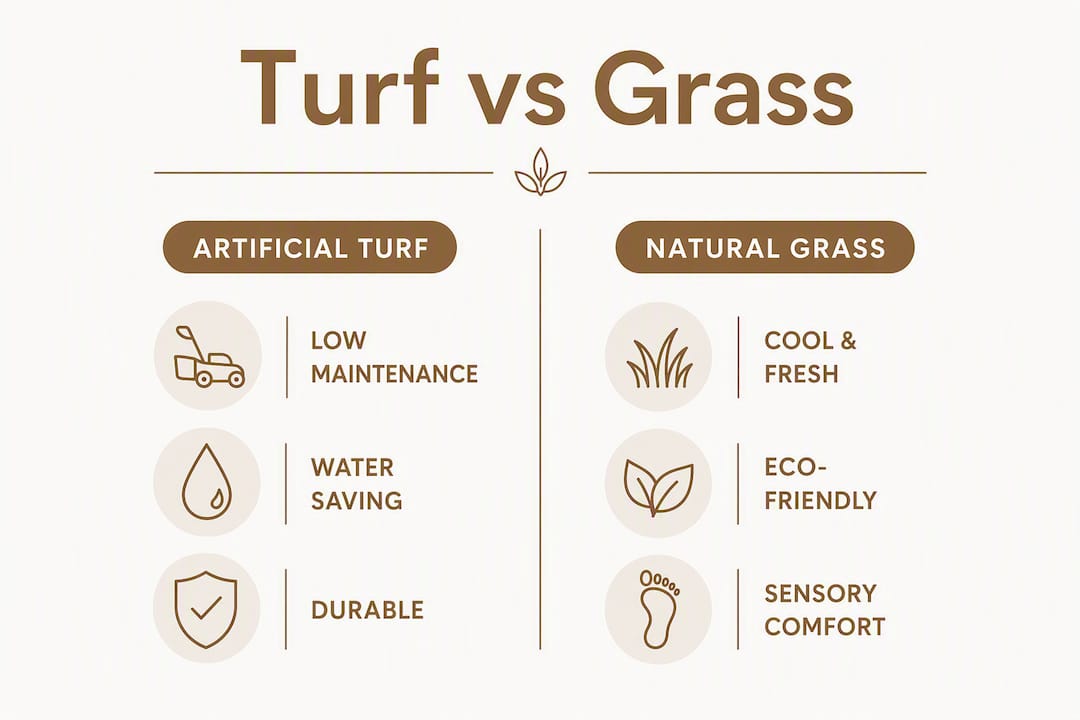
| Dimension | Artificial Turf | Natural Grass |
|---|---|---|
| Upfront cost (installed) | $5–$15 per sq ft | $0.50–$1.50 per sq ft (sod) |
| Annual maintenance time | Typically under 12 hours per year | 80–120 hours/year (high-input) |
| Annual maintenance cost | Generally lower due to no water or mowing requirements | Moderate to high (water, mowing, fertilizer) |
| Expected lifespan | About a decade or two depending on quality | Indefinite with proper upkeep |
| Heat/comfort in full sun | Surface temps can exceed 160°F | Stays cooler via evapotranspiration |
| Environmental impact | Water savings; microplastic and runoff concerns | Cooling, filtration, biodiversity, carbon sequestration |
| Pet/kid friendliness | Durable, cleanable; heat and odor require management | Soft, cool, natural; wears thin under heavy use |
Biggest trade-offs to weigh:
- Water savings versus surface heat: turf eliminates irrigation but can become uncomfortably hot in direct San Diego sun
- Upfront investment versus 10-year ownership math: sod costs far less on day one, but water and maintenance costs close the gap over a decade
- Durability versus ecology: turf handles heavy wear without bare patches, but living grass supports soil health, stormwater filtration, and local habitat
Before committing to either surface, measure your lawn square footage, map which zones receive full sun versus shade, and get a current estimate of your annual irrigation cost. Those three inputs will determine which surface pencils out for your property.
What does it actually cost to install and maintain each surface?
Installation cost ranges
Artificial turf typically runs $5–$15 per square foot installed, depending on product quality, pile height, infill type, and site conditions. Sod starts under a few dollars per square foot for material and installation on a prepared surface. Seed is less expensive upfront but adds months of establishment time and irrigation cost.
Ongoing cost categories
Artificial turf recurring costs:
- No irrigation (primary savings driver)
- No mowing or fertilizing
- Periodic infill top-offs every 2–3 years
- Quarterly rinsing for pet areas
- Occasional brushing and debris removal
Natural grass recurring costs:
- Irrigation (dominant cost in San Diego's Mediterranean climate)
- Mowing labor or service fees
- Fertilizer and soil amendments
- Aeration and overseeding every 1–3 years
- Pest and weed control
Break-even example
For a 1,000 sq ft yard in San Diego, turf installation at $10 per sq ft runs $10,000 upfront. Sod at $1.00 per sq ft costs $1,000 on day one. The annual water, mowing, and fertilizer costs for natural grass in a Southern California climate can easily reach $800–$1,200 per year. At that rate, the turf investment breaks even in several years, with water rate being the single most influential variable. Higher water rates accelerate the break-even; lower-use yards extend it.
The dominant cost variable is water. San Diego County water rates are among the highest in the nation, which compresses the turf break-even timeline compared to wetter markets.
Hidden and site-specific cost drivers
- Drainage engineering and base preparation: a properly engineered crushed aggregate base with geotextile fabric adds cost but is non-negotiable for long-term performance
- Removal of existing lawn: demo and haul-away of old sod or hardscape adds to day-one costs
- HOA and permit fees: some San Diego HOAs require design approval; certain municipalities require permits for large turf installations
- Pet-specific infill: antimicrobial or cooling infill products (cork, coconut blends) cost more than standard crumb rubber but perform better in pet zones
- Slope and drainage work: steep yards require additional grading and sub-surface drainage to prevent settling and runoff
What does maintenance actually look like for each surface?
Natural grass maintenance schedule
Natural grass in San Diego requires consistent attention across the growing season, with effort spiking in spring and fall.
Monthly tasks and time estimates:
- Mowing: every 7–14 days during growing season, roughly 2–4 hours/month for a 1,000 sq ft lawn
- Irrigation management: adjusting controller schedules seasonally, monitoring for dry spots
- Fertilizing: 3–4 applications per year
- Weed control: spot treatment or pre-emergent applications
- Aeration and overseeding: once per year, typically 2–4 hours
High-input natural grass systems can demand substantial maintenance time annually, not counting irrigation management time.
Artificial turf maintenance schedule
Synthetic turf is not maintenance-free, but the time commitment drops dramatically.
- Weekly: clear leaf litter and debris with a leaf blower or stiff brush
- Monthly: brush high-traffic lanes with a power broom to keep fibers upright
- Quarterly: rinse pet areas thoroughly with water to flush urine salts and prevent odor buildup
- Every 2–3 years: top off infill as it compacts or migrates, particularly in high-use zones
Total annual maintenance time for turf typically runs under 12 hours per year for a residential yard.
Pet-specific maintenance notes
For dog-friendly artificial grass, the quarterly rinsing schedule is the most important task most homeowners underbudget. Urine salts accumulate in the infill and cause persistent odor if not flushed regularly. Antimicrobial infill products and permeable backing reduce the problem but do not eliminate the need for rinsing. Solid waste should be removed promptly and the area rinsed immediately.
Pro Tip: Most homeowners underestimate seasonal maintenance spikes. Autumn leaf fall in yards with mature trees can require weekly debris clearing for 6–8 weeks straight — factor that into your time estimate before assuming turf is truly hands-off.
What are the environmental trade-offs between turf and grass?
How living grass cools and cleans
Well-managed natural turf moderates surface temperature through evapotranspiration and supports local biodiversity, stormwater filtration, erosion control, and carbon sequestration. These are ecosystem services that synthetic systems cannot replicate. In San Diego's coastal neighborhoods, where summer temperatures stay moderate, living grass in entertaining zones provides a measurable cooling effect that makes outdoor spaces more comfortable without supplemental cooling infrastructure.
Surface heat on synthetic turf
Synthetic turf surfaces can reach very high temperatures in full sun. That is hot enough to cause burns on bare feet and paws within seconds of contact.
This is the most significant safety concern for families with children and pets. The heat risk is real in San Diego's inland communities and during late-summer heat events, even in coastal zones. For a detailed look at heat mitigation strategies specific to San Diego, the Modern Yardz guide on artificial grass temperatures covers shade planning, cooling infill options, and misting integration.
Heat mitigation options for turf installations:
- Site turf where partial shade from structures or trees occurs during peak afternoon hours
- Specify cooling infill: cork or coconut-blend infill products absorb less heat than crumb rubber
- Integrate a pergola or shade structure over high-use turf zones
- Install a misting system for use during peak heat periods
- Detail turf edges so heat does not transfer to adjacent planting beds
Stormwater, runoff, and microplastics
The NJDEP's review of synthetic turf identifies stormwater runoff and microplastic migration as documented concerns, particularly when turf is installed over non-porous backing or without engineered sub-surface drainage. Properly designed systems with permeable backing and a graded aggregate base significantly reduce runoff. Some jurisdictions require compliance with stormwater management rules for turf projects; check local requirements before installation.
Environmental pros and cons summary:
| Factor | Artificial Turf | Natural Grass |
|---|---|---|
| Water use | Eliminates irrigation | High in dry climates |
| Pesticide/fertilizer use | None required | Regular applications typical |
| Surface cooling | None (heats significantly) | Active via evapotranspiration |
| Biodiversity | None | Supports insects, birds, soil organisms |
| Stormwater | Runoff risk if poorly installed | Filters and absorbs |
| End-of-life waste | Landfill disposal | None |
Pro Tip: Specify permeable backing and a 4-inch crushed aggregate base with geotextile separation fabric on every turf installation. [Proper drainage engineering](https://modernyardz.com/blogs/backyard-landscape-drainage-solutions-that-actually-work) is the single factor that separates a turf system that performs for 15 years from one that develops odor, settling, and runoff problems within three.
Which yards and climates favor turf over grass?
Use-case matching
Artificial turf performs best for:
- Dog runs and pet zones where grass wears bare quickly
- High-traffic play areas used daily by children
- Pool surrounds where wet grass creates slip and mud hazards
- Steep slopes where mowing is impractical and erosion is a risk (see slope landscaping strategies)
- Shaded side yards where grass struggles to establish
- Utility zones, narrow passages, and areas with poor soil
Natural grass performs best for:
- Central entertaining lawns where guests walk barefoot and comfort matters
- Front yards in neighborhoods where living lawns are HOA-required or aesthetically expected
- Properties where the owner values ecological function and biodiversity
- Yards with reliable irrigation access and moderate water costs
Climate match by region
| Climate Type | Artificial Turf Fit | Natural Grass Fit |
|---|---|---|
| Mediterranean/Coastal CA (San Diego) | Strong: water savings significant; heat manageable with shade | Good in coastal zones; high irrigation cost inland |
| Hot/dry desert (Phoenix, Las Vegas) | Very strong: grass survival requires extreme irrigation | Poor without significant water investment |
| Humid Southeast (Florida, Gulf Coast) | Moderate: heat concern amplified; drainage critical | Strong: rainfall reduces irrigation cost |
| Cold/seasonal (Midwest, Northeast) | Moderate: UV and freeze-thaw cycles affect longevity | Strong: natural dormancy reduces inputs |
San Diego-specific considerations
San Diego's coastal communities, including La Jolla, Del Mar, and Coronado, benefit from marine layer cooling that moderates turf heat compared to inland areas like Rancho Santa Fe or Carmel Valley. Salt spray near the ocean can affect some infill products over time; specify marine-grade or salt-resistant materials for properties within a mile of the coast. San Diego County's tiered water pricing makes irrigation-heavy natural grass increasingly costly, which strengthens the financial case for turf in larger yards. Coastal fog also means some shaded or north-facing areas struggle to grow dense grass, making turf a practical choice for those zones regardless of water cost.
What should you expect during installation?
Step-by-step installation timeline
- Site demolition (Day 1–2): remove existing lawn, hardscape, or vegetation; haul debris off-site
- Grading and drainage engineering (Day 2–3): establish proper slope (minimum 1–2% grade) for water flow; install sub-surface drainage if required
- Base installation (Day 3–4): lay 3–4 inches of crushed aggregate base; compact in lifts with a plate compactor
- Geotextile fabric (Day 4): install weed barrier and separation fabric over compacted base
- Turf installation (Day 4–5): roll out turf, cut to fit, seam panels with adhesive and seam tape
- Infill application (Day 5): spread and brush infill (silica sand, cork, crumb rubber, or blends) to specified depth
- Final brushing and inspection (Day 5–6): power-brush fibers upright; inspect seams, edges, and drainage
A typical residential installation of a few hundred to over a thousand square feet takes several days from demo to completion with a professional crew.
DIY versus professional installation
| Phase | DIY Risk Level | Professional Advantage |
|---|---|---|
| Site grading and drainage | High: improper slope causes standing water and odor | Engineered drainage plan, proper equipment |
| Base compaction | High: under-compaction causes settling and seam failure | Plate compactor, lift-by-lift verification |
| Seaming and cutting | Moderate: visible seams reduce aesthetics and resale value | Precision cuts, heat-bonded or glued seams |
| Infill application | Low: manageable with proper tools | Correct depth and distribution by zone |
| Warranty coverage | None: most manufacturer warranties require professional install | Full product and workmanship warranty |
HOA, permit, and utility checklist
Before signing any contract, confirm the following:
- HOA approval: many San Diego HOAs require design review for turf installations; some restrict turf on front yards or require specific pile heights and colors
- City or county permit: large installations or those involving drainage modifications may require a grading or landscape permit
- Utility locates: call 811 before any excavation; irrigation lines and electrical conduit are common in San Diego yards
- Water district rebates: some San Diego County water districts offer turf replacement rebates; confirm current program availability with your local district
- Stormwater compliance: municipal guidance recommends engineered, permeable systems to avoid creating impervious surfaces
Design-build advantage for luxury projects
On high-end San Diego properties, the design-build model changes the scope and quality of a turf installation significantly. A single team that handles drainage engineering, hardscape integration, planting design, and turf installation in one coordinated sequence avoids the miscommunication and scope gaps that occur when separate contractors hand off work. Drainage is designed before the base is laid, not corrected after problems appear. Material selections are coordinated across surfaces so turf, pavers, and planting beds read as a unified composition rather than separate installations.
How long does artificial turf last, and what should warranties cover?
Artificial turf typically lasts 10–20 years in residential applications, with lifespan depending on product quality, UV exposure, traffic volume, and installation quality. Natural grass is indefinite with proper maintenance, though it requires ongoing inputs to stay healthy.
Warranty checklist for turf products and installations:
- UV and colorfastness warranty: confirms the turf will not fade or degrade under direct sun exposure; look for 8–15 year coverage on premium products
- Seam integrity: workmanship warranty should cover seam separation and edge lifting for a minimum of 2–5 years
- Drainage and permeability: confirm the backing maintains its permeability rating over time; some low-grade products compact and block drainage
- Infill performance: some premium infill products carry separate warranties for odor control and antimicrobial performance
- Pro-rated replacement terms: understand whether the warranty pays full replacement cost or depreciates over time; most manufacturer warranties are pro-rated after year 5
Manufacturer warranties cover the product. Installer workmanship warranties cover the installation. Both are necessary. A product with a 15-year UV warranty installed on a poorly compacted base will fail in 3–5 years regardless of what the warranty says. Always request a written workmanship warranty from the installing contractor and confirm it covers drainage performance, seam integrity, and base settling.
When does a hybrid design make the most sense?
A hybrid approach, combining living grass in primary zones with engineered turf in utility and play zones, often delivers the best outcome for luxury San Diego properties. It preserves the ecological and sensory benefits of natural grass where they matter most while eliminating maintenance burden in zones where grass performs poorly.
Pro Tip: When planning a hybrid layout, zone the yard by function first, then by sun exposure. Turf belongs where the ground takes the most punishment or where shade prevents grass establishment. Living grass belongs where guests gather and where the cooling effect of evapotranspiration improves comfort.
Design principles for hybrid layouts:
- Reserve natural grass for the central entertaining lawn, where guests walk barefoot and the cooling effect is most appreciated
- Use turf for the dog run, side yard passage, play structure zone, and pool surround
- Transition between surfaces using a clean hardscape edge: a paver border, a steel edging strip, or a low seat wall creates a crisp visual separation
- Select turf products whose color and pile height match the natural grass variety as closely as possible to avoid a jarring contrast
- Incorporate native planting buffers between turf zones and natural areas to support biodiversity and reduce the visual footprint of synthetic material (see native plant design strategies)
What to request in a design meeting:
When working with a design-build firm on a hybrid project, ask for 3D renderings that include shadow studies at peak afternoon hours, material texture comparisons across turf and grass zones, and drainage section drawings that show how water moves through and off the site. These three deliverables reveal heat exposure, visual coherence, and drainage risk before construction begins. For inspiration on how turf and hardscape integrate in full-yard luxury environments, the design principles that govern resort and high-end community landscapes apply directly to residential projects of this scale.
Material choices for hybrid assemblies:
- Permeable infill options: cork, coconut-blend, or silica sand perform better than crumb rubber in pet zones and reduce heat absorption
- Transition details: a 4-inch paver border or steel edging strip prevents turf from migrating into grass zones and simplifies mowing
- Irrigation zoning: keep turf zones outside the reach of irrigation heads to prevent infill saturation and drainage issues
How do you choose a contractor and avoid common mistakes?
Contractor questions to ask before signing
- What is your base specification? (Expect: 3–4 inches of crushed aggregate, compacted in lifts, with geotextile fabric)
- How do you engineer drainage for this site? (Expect: a written drainage plan with slope calculations)
- What infill product do you recommend for this use case, and why?
- What warranties do you provide on both the product and your workmanship?
- Can you provide references from projects of similar scope and site complexity?
- What is your contractor license number? (In California, verify at the CSLB website)
- Have you pulled permits for similar projects in this jurisdiction?
- How do you handle seaming on irregular shapes or around obstacles?
Red flags to watch for
- Vague base specifications: "we'll put down some gravel" is not a drainage plan
- Promises of zero maintenance: no turf installation is maintenance-free; any contractor who says otherwise is not being accurate
- No written drainage plan: drainage failure is the leading cause of turf system problems; a contractor without a written plan is guessing
- Missing permits: unpermitted work can create problems at resale and may void warranties
- No references or portfolio: a contractor who cannot show completed projects of comparable scope should not be managing a luxury installation
- Unlicensed work: in California, always verify the contractor's license at the Contractors State License Board before signing
Decision flow for homeowners
- High water cost + low maintenance time available + pet/play zone: turf is the clear choice
- Central entertaining lawn + coastal climate + biodiversity priority: natural grass with efficient drip or smart irrigation
- Mixed-use property with multiple zones: hybrid layout, designed as a unified composition
- Luxury San Diego property with pool, hardscape, and outdoor kitchen: design-build approach that integrates turf, drainage, and hardscape in a single coordinated scope
Modern Yardz approaches the initial consultation for a luxury San Diego property by mapping each yard zone against sun exposure, function, drainage conditions, and the homeowner's maintenance preferences. From that site analysis, the team produces 2D architectural plans and photo-realistic 3D renderings before any material is specified or purchased. Permitting, drainage engineering, and material procurement are handled by a single team under California Contractor License #1082881, with no subcontractor handoffs.
Key Takeaways
Artificial turf wins on maintenance time and water cost; natural grass wins on cooling, ecology, and sensory comfort — and a hybrid layout often delivers the best outcome for luxury San Diego properties.
| Point | Details |
|---|---|
| Turf suits utility and pet zones | High-traffic, shaded, or drought-restricted areas favor turf over natural grass. |
| Grass wins for entertaining lawns | Living grass cools via evapotranspiration and supports biodiversity where guests gather. |
| Water is the dominant cost variable | San Diego's high water rates compress the turf break-even to roughly 7–10 years. |
| Drainage determines long-term performance | A 3–4 inch compacted aggregate base with a written drainage plan separates lasting installs from failures. |
| Modern Yardz integrates both surfaces | Modern Yardz designs hybrid turf and grass layouts as unified architectural compositions, with 3D renderings and single-team execution under License #1082881. |
A design-build perspective on turf versus grass
The binary debate, turf or grass, misses the more useful question: which surface belongs in which zone, and how does the whole yard perform as a system?
At Modern Yardz, we evaluate turf and grass decisions the same way we evaluate any material choice: by function, microclimate, drainage behavior, and how the surface reads within the broader architectural composition of the property. A turf installation that ignores drainage engineering is not a design decision; it is a deferred maintenance problem. A natural grass lawn that requires 100 hours of annual labor on a property where the owner entertains three nights a week is not a lifestyle fit, regardless of how it looks in photographs.
What we consistently find across 2,900+ completed projects is that the most successful outcomes come from treating the yard as a series of distinct functional zones, each specified for its actual use. The central lawn where guests gather at a Rancho Santa Fe estate gets living grass, proper irrigation zoning, and a soil program that keeps it dense and cool. The dog run, the side yard passage, and the area around the pool get engineered turf with permeable backing, a proper base, and infill selected for the specific use. The two surfaces meet at a clean hardscape edge that makes the transition intentional rather than accidental.
The credentials that make this possible: California Contractor License #1082881, a 5.0-star rating across 2,900+ projects, and a design-build process that produces 3D renderings before a shovel breaks ground. Every drainage plan is written. Every material is specified before it is ordered. No subcontractors interpret the design after the fact.
The homeowners who get the best results are the ones who come to the consultation with a clear sense of how they use their yard, not just how they want it to look. That conversation, function first and aesthetics second, is where the right surface choice becomes obvious.
Modern Yardz brings precision to the turf vs grass decision in San Diego
Choosing between synthetic grass and a living lawn is an architectural decision, not just a maintenance preference. Modern Yardz is San Diego's luxury landscape design-build firm that handles the full scope: site analysis, 2D architectural plans, photo-realistic 3D renderings, drainage engineering, permitting, material procurement, and construction, all under one team with zero subcontractor handoffs.
With 2,900+ completed projects, a 5.0-star rating, and California Contractor License #1082881, Modern Yardz has the track record to specify the right surface for every zone of your property and build it to perform for decades. Whether the project calls for engineered turf around a custom pool, living grass in a central entertaining lawn, or a hybrid layout across a multi-zone estate, the process starts with a 3D rendering you approve before construction begins.
Bring site photos, your current irrigation plan, and any HOA guidelines to the consultation. Schedule your free consultation with Modern Yardz to get a site-specific recommendation for your San Diego property.
Useful sources for further research
The figures and recommendations in this article draw from the following authoritative sources:
- **Considering synthetic turf? What homeowners should know before installation — UF/IFAS News**: University of Florida's extension service covers surface temperature data, maintenance requirements, and ecological trade-offs in plain language for homeowners.
- **Synthetic turf factsheet — NJDEP Division of Science and Research (2025)**: New Jersey's environmental agency reviews stormwater runoff, microplastic concerns, and regulatory guidance for turf installations; useful for understanding drainage compliance requirements.
- **Artificial Grass and the Environment: A Florida-Friendly Perspective — UF/IFAS Extension Orange County**: Examines synthetic turf through the lens of Florida-Friendly Landscaping principles, covering water, biodiversity, and soil health considerations.
Recommended
Start Your Free Design Consultation
Tell us about your project and we'll be in touch within 24 hours. No pressure, no obligation.
Ready to design your dream yard?
Tell us about your project. We'll send back a real plan, not a templated quote.
Book My Free Consultation→