Pool Permit in San Diego: What the City Requires (2026)
Every in-ground pool or spa at a single-family home in the City of San Diego needs a building permit under Information Bulletin 712. You submit engineer-stamped plans - either a city-approved master plan or a custom design with structural calculations - a detailed site plan, and often a soils report, then pass inspections that include California's required drowning-prevention safety features.
Key takeaways:
- In the City of San Diego, private pools, spas, and hot tubs need a building permit; the rules are in the city's Information Bulletin 712.
- You can permit a pool using a city-approved master plan (faster review for standard designs) or as a custom pool with structural calculations.
- All plans need an engineer- or architect-stamped site plan showing dimensions, setbacks, equipment, depths, and barriers.
- A geotechnical report is required on sites with expansive soils, fill, slopes, or high groundwater, and for deeper retained walls.
- New pools must include at least two of California's listed drowning-prevention safety features before final approval.
Getting a pool permit in San Diego is one of the first milestones on any pool project, and the requirements are more detailed than many homeowners expect. At Modern Yardz, we design pools as part of complete backyards across San Diego County, and the permit drawings are built into our design process from the start.
This guide walks through what the City of San Diego requires, the documents you will need, setbacks, safety features, inspections, and what changes if you live in another city or unincorporated county area.
Do you need a permit for a pool in San Diego?
Yes. In-ground pools, spas, and hot tubs serving single-family homes and duplexes need a building permit in the City of San Diego. The city's Information Bulletin 712, How to Obtain a Permit for Private Swimming Pools, Spas, and Hot Tubs, explains the process and the codes that apply: Section 3109 of the California Building Code, the San Diego Municipal Code, the California Swimming Pool Safety Act, and the International Swimming Pool and Spa Code.
Electrical, plumbing, and gas work for pumps, lights, heaters, and fire features is reviewed and inspected as part of the project. Public pools at apartments, condos, hotels, and gyms are regulated separately by the County of San Diego Department of Environmental Health.
Master plan pool vs custom pool: which permit path?
A master plan pool uses a design the city has already approved; a custom pool is reviewed from scratch.
| Master plan pool | Custom pool | |
|---|---|---|
| What it is | A pre-approved standard design registered with the city | Any design that does not fit a master plan |
| Review | Faster, because the structure is pre-approved | Full plan review with structural calculations |
| Limits | Soil retained behind the pool wall cannot exceed 6 feet; must be built in native soils and match the plan exactly | Any depth or shape, designed for site loads, slopes, and surcharges |
| Engineering | Plans stamped by the engineer or architect of record | Plans and calculations stamped by a California civil or structural engineer |
Most luxury and design-driven pools - infinity edges, raised spas, unusual shapes, pools on slopes - are custom pools. If a master plan pool hits expansive soil or fill during construction, the city requires a geotechnical report as a construction change.
What documents does a San Diego pool permit require?
At minimum: stamped construction plans, a stamped site plan, and, for custom pools, structural calculations. IB 712 requires the site plan to show:
- Maximum exterior dimensions of the pool
- Distances from the pool edge to all structures, embankments, and property lines
- Location of pool equipment and its distance to property lines
- Location and depth of the deep and shallow ends
- Location, extent, and height of all safety barriers
- Gate swing directions and which gates are self-closing and self-latching
When is a soils report required?
When the site has conditions such as expansive soils, unstable ground, slopes, fill, liquefaction risk, or high groundwater, or for certain foundation designs. Pool walls retaining more than 6 feet of soil must also be designed for seismic earth pressure from a geotechnical report. San Diego has plenty of expansive clay and hillside lots, so many custom pools need one.
What are the setback rules for pools in San Diego?
Under the San Diego Municipal Code, a pool that projects 3 feet or less above grade needs a minimum 3-foot front, side, and rear setback. Pools projecting higher need at least a 4-foot rear setback, with front and side setbacks set by your zone. Pool equipment above grade needs at least 4 feet from side and rear property lines, and vents need 4 feet from all lines unless adjoining a public way.
Our guide to San Diego pool setbacks covers how these rules shape pool placement on smaller lots.
What safety features does a new pool need?
California's Swimming Pool Safety Act requires a new or remodeled pool at a single-family home to include at least two of the listed drowning-prevention features, inspected before final approval. The options include:
- An enclosure that isolates the pool from the house
- Removable mesh fencing with a self-closing, self-latching gate
- An approved safety pool cover
- Exit alarms on doors with direct access to the pool
- Self-closing, self-latching devices on those doors
- A pool alarm that sounds when someone enters the water
- Other means of equal or greater protection verified against recognized standards
The full text is in California Health and Safety Code section 115922. Good design hides most of this: a gate integrated into a fence line, an automatic cover in a coping pocket, or alarms built into existing doors.
IB 712 also notes that when you remodel an existing pool, the permit requires upgrading suction outlets to anti-entrapment covers meeting current standards.
What inspections happen during pool construction?
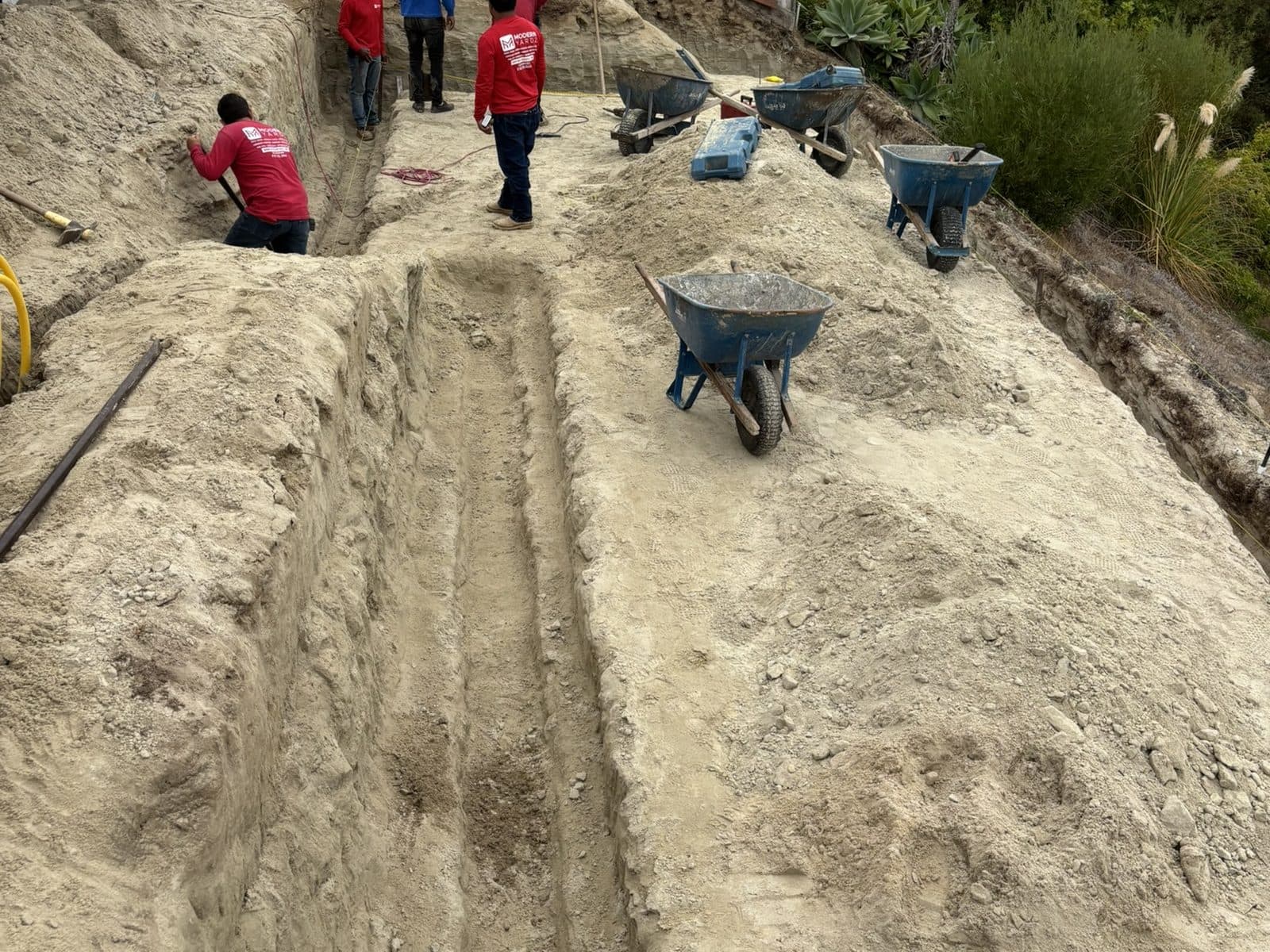
Expect inspections at key stages before anything is covered up, typically including the excavation and steel before the shell is shot, plumbing and electrical rough-ins, gas lines, barriers and safety features, and a final inspection before the pool is approved for use. Your engineer or soils engineer may also require special inspections for compaction or excavation.
Do coastal or historic rules affect a pool permit?
They can. Homes in the Coastal Overlay Zone, which covers much of La Jolla and other coastal neighborhoods, may need a Coastal Development Permit for pools, grading, and walls. IB 712 also notes that if there is a structure 45 years old or older on the site, the project may be subject to Potential Historical Resource Review.
Building near a bluff or on a steep lot adds geotechnical review. See our guide to La Jolla backyard ideas for how coastal rules shape pool design.
What if you live outside the City of San Diego?
Each city has its own building department and rules, and unincorporated areas use the County of San Diego. Carlsbad, Encinitas, Del Mar, Coronado, Oceanside, Escondido, Poway, and Chula Vista all permit pools through their own departments, and some add design review or coastal permits. The core state requirements, including the safety features, apply everywhere in California.
What happens to the water when you drain or remove a pool?
Do not drain chlorinated water to the street. The City of San Diego's pools and spas fact sheet explains sewer discharge with Public Utilities approval. Removing a pool entirely requires a demolition permit, breaking the shell, and compacted fill, with engineer observation if you plan to build on the spot later.
Let your designer handle the permit
A well-prepared permit set prevents costly redesigns and delays. Modern Yardz designs custom pools with the engineering, site plan, and safety features planned from the first sketch, and shows you the result in a 3D rendering with a line-item cost. Call 619-775-9554 or book a free design consultation.
Start Your Free Design Consultation
Tell us about your project and we'll be in touch within 24 hours. No pressure, no obligation.
Common questions
- Do I need a permit to build a pool in San Diego?
- Yes. In-ground pools, spas, and hot tubs at single-family homes in the City of San Diego require a building permit, following the city's Information Bulletin 712. Electrical, plumbing, and gas work is also reviewed and inspected.
- What is a master plan pool?
- A master plan pool uses a design the City of San Diego has already approved, which speeds review. It must be built exactly to the plan, in native soils, with no more than 6 feet of soil retained behind the pool wall. Anything else is a custom pool.
- How close can a pool be to the property line in San Diego?
- A pool projecting 3 feet or less above grade needs at least 3 feet from front, side, and rear property lines. Pools projecting higher need at least 4 feet at the rear, and above-grade equipment needs 4 feet from side and rear lines.
- What safety features are required for a new pool in California?
- At least two of the drowning-prevention features listed in Health and Safety Code section 115922, such as an isolating enclosure, a safety cover, door exit alarms, or a pool alarm. They are inspected before final approval.
- Do I need a soils report for a pool in San Diego?
- Often. A geotechnical report is required where there are expansive soils, fill, slopes, unstable ground, or high groundwater, and for deeper pool walls retaining more than 6 feet of soil.
Ready to design your dream yard?
Tell us about your project. We'll send back a real plan, not a templated quote.
Book My Free Consultation→