
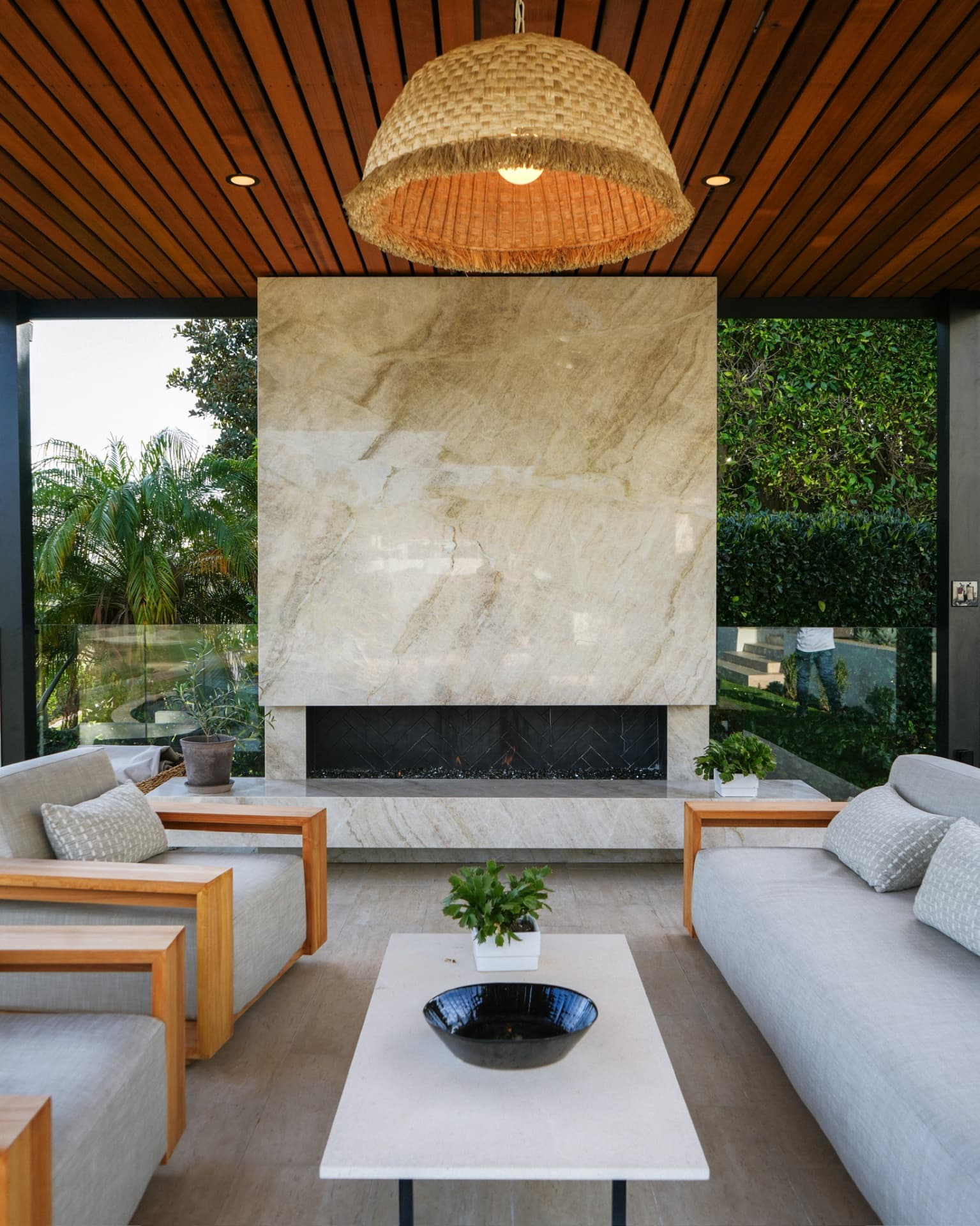
Luxury Fire Feature Builder
in San Diego
Outdoor Fireplaces, Bowls & Walls
What is a luxury fire feature builder in San Diego?
A luxury fire feature builder in San Diego is a licensed contractor that designs, permits, and builds architectural outdoor fire elements — masonry outdoor fireplaces, linear fire troughs, fire bowls, and fire-and-water features — with correctly sized gas, listed burners, and the footing, chimney, and clearance work California's residential code requires. Modern Yardz is a California-licensed landscape design-build firm (CSLB #1082881, Landscaping) that builds fire features as part of an overall landscape project, handling design, masonry, gas permits, and inspection under one contract.
Why Choose Modern Yardz
for Luxury Fire Feature
Modern Yardz designs and builds the architectural fire elements that give a San Diego backyard its center of gravity: full-masonry outdoor fireplaces that anchor an outdoor living room, linear fire troughs that run along a seat wall, sculptural bowls, and fire-and-water combinations that reflect flame off a pool's surface.
A fireplace is a different animal from a fire pit, and not only in looks. A masonry or wood-burning prefabricated fireplace requires a building or combination permit in the City of San Diego — the City's Information Bulletin 201 says so plainly — and it brings real engineering with it: a footing sized to carry it, a chimney that terminates correctly above the roofline, and specified clearances to anything combustible. It is a small building, and it should be built like one.
Coastal San Diego is unusually hard on fire features, and the manufacturers say so themselves. Fireplace warranties routinely exclude salt-air and humidity corrosion outright — Enviro's warranty states that damage caused by salt air or high humidity is not covered. That is not a reason to avoid a fire feature near the water; it is a reason to specify the metal, the veneer, and the drainage for the exposure your lot actually has.
We build across San Diego County — La Jolla, Del Mar, Coronado, Carmel Valley, Rancho Santa Fe, Encinitas, and inland through Poway and Rancho Bernardo — and we design a bluff-top fireplace differently from an inland canyon one. Wind, salt, and sightlines are the variables that decide the design.
Masonry Outdoor Fireplaces
Full-masonry and stone-veneer fireplaces with custom mantels, hearths, and chimneys — engineered with a proper footing and a code-correct chimney termination, not stacked as decoration.
Linear Fire Troughs
Contemporary linear burners that draw a ribbon of flame along a seat wall, a water feature, or the edge of a terrace. Listed burners, correctly sized gas, and a clean architectural line.
Fire Bowls & Tables
Sculptural bowls and fire tables in concrete, copper, and steel — standalone focal points, or repeated in pairs to frame a view or an entry.
Fire & Water Combinations
Fire bowls that spill into a pool, fire walls mirrored in still water, and scupper-and-flame details. The most demanding builds we do, and the most photographed.
Coastal-Grade Materials
Near the water we specify 316 stainless, which carries 2–3% molybdenum that 304 lacks — the alloying element that resists chloride pitting. Veneer and mortar are chosen to shed water rather than wick it.
Engineered, Not Improvised
Footings, clearances to combustibles, and chimney height are set by California's residential code — including the rule that a chimney terminate at least two feet above anything within ten feet of it. We build to that, then pass inspection.
Smart Ignition
Electronic ignition with remote, timer, and smart-home control on gas features. Push a button; no kindling, no ash, no waiting.
Gas Done Under One Contract
Correctly sized gas runs from the meter, permitted and inspected as part of the landscape contract — a scope CSLB's Building Official Information Guide sets out for licensed landscape contractors.
From Concept to Completion
Fire Design Consultation
We walk the property and work out what the feature has to do: throw heat at a seating group, block the afternoon wind, frame a view, or all three. Then we check gas capacity, the run from the meter, and clearances.
3D Visualization
Photo-realistic renderings put the fireplace in context — scale against the house, seating orientation, veneer, and how the chimney reads from the patio and from indoors.
Permits & Engineering
We confirm the permit scope for your lot with Development Services, pull the gas and building permits the design calls for, and schedule inspections — rather than leaving you with an un-permitted fireplace to explain at resale.
Masonry & Gas Construction
Footing, firebox, veneer, and chimney built to the approved plan, with the gas run sized and installed to the appliance's requirements.
Testing & Walkthrough
Full system test, safety review, and a walkthrough covering operation, seasoning, and — if you're near the coast — what to rinse and how often.
Start Your Free Design Consultation
Tell us about your project and we'll be in touch within 24 hours. No pressure, no obligation.
See it in 3D before we build it
Every luxury fire feature project starts as a photo-realistic 3D model, so you can walk through the finished space and change it before anything is poured or planted. This is one of those walkthroughs.
A narrow side yard turned into a lounge: a linear fireplace with a mounted screen, built-in seating, stepping-stone paving and uplit olive trees.
See all 3D design walkthroughsRecent Luxury Fire Feature Projects

Luxury Fire Feature FAQ
Full outdoor fireplaces with chimneys and mantels range from $15,000 to $40,000+, depending on height, veneer, and whether the design carries a full masonry chimney. Linear fire troughs, fire bowls, and fire-and-water features are quoted from the design, since the gas run and the burner length drive them more than the footprint does. These are our own completed-project ranges rather than national averages.
A masonry fireplace or a wood-burning prefabricated fireplace does — the City of San Diego's Information Bulletin 201 states that a building or combination permit is required to construct one. The nuance most pages miss is the other half of that bulletin: some gas-burning decorative fireplaces and fire pits do not require a building or combination permit, though they may still require a plumbing or electrical permit. So the fuel and the construction type decide it, not the word 'fireplace'. We confirm the scope for your specific lot with Development Services.
The sharpest difference is regulatory: a masonry fireplace needs a building permit and real structural engineering, while some gas fire pits need no building permit at all. The design difference matters just as much. A fireplace is directional — it throws radiant heat one way, blocks wind, and works as vertical architecture, so seating faces it. A fire pit is 360 degrees: social, conversational, low, and it keeps sightlines open. On a coastal lot with a view corridor, that last point usually decides it. If a fire pit is what you're picturing, see our custom fire pit page.
Yes. This is the most commonly misstated fact in San Diego outdoor-living content. The San Diego County Air Pollution Control District does not currently prohibit burning in fireplaces, fire pots, fire rings, grills, or chimineas, and San Diego has no residential wood-burning curtailment program — the mandatory 'no-burn day' regimes people cite are Bay Area and San Joaquin Valley rules, not ours. San Diego's burn-day system governs agricultural and permitted open burning. Excessive smoke can still draw a nuisance complaint, so siting matters, and many of our clients still choose gas for convenience rather than compulsion.
California's residential code sets it: a chimney must terminate at least two feet higher than any portion of a building within ten feet of it, and at least three feet above the highest point where it passes through a roof. Builders call it the three-two-ten rule. It is why a fireplace tucked against the house often needs a taller chimney than the same fireplace out in the yard — and it's a detail worth resolving at design, not at inspection.
No — and this is worth clearing up, because the 25-foot number gets quoted constantly. That clearance comes from the California Fire Code's rules for recreational fires, and San Diego Fire-Rescue's own definition of a recreational fire expressly excludes fires contained in an outdoor fireplace, barbecue grill, or barbecue pit. A permanent built-in fireplace isn't a recreational fire; it's governed by the building and residential code instead — footing, clearances to combustibles, and chimney termination. Setbacks from property lines are zone-dependent, so we confirm yours with Development Services rather than quoting a number that may not apply to your lot.
It corrodes it, and the manufacturers are blunt about it. Enviro's warranty states that salt air in coastal areas or high humidity can be corrosive to the finish and cause rusting, and that damage caused by salt air or high humidity is not covered by the limited warranty — an exclusion that's standard across the industry rather than one brand's fine print. Practically: specify 316 stainless where spray reaches, detail the veneer and cap to shed water, and rinse the metal with fresh water. Marine grade resists pitting; it isn't immune.
Gas for almost every architectural feature — instant ignition, adjustable flame, no smoke, no ash, and it suits linear troughs, bowls, and fire-and-water designs, which simply cannot be done in wood. Wood-burning belongs in a traditional masonry fireplace where the smell and the crackle are the point, and where the design carries a proper chimney. We build both, and the choice usually follows how often you'll actually light it.
We handle it. CSLB's Building Official Information Guide states that a licensed landscape contractor may obtain permits and contract for gas line and electrical work when it is part of or incidental to an overall landscaping project — which is exactly how we build. The fireplace, the hardscape around it, the gas, and the ignition circuit sit under one contract, with one company accountable at inspection.
A gas fire bowl or linear trough integrated into existing hardscape typically runs 2 to 4 weeks from approved design, including the gas work. A full masonry fireplace with a chimney generally runs 4 to 8 weeks, since the footing and masonry cure on their own schedule. Built as part of a wider outdoor room with seating, hardscape, and shade, the whole project usually runs 6 to 12 weeks. Permit and inspection timing is the variable we can't compress, so we start it first.
Explore related specialties
Custom Fire Pit Builder
Looking for a fire pit specifically? Gas, wood-burning, and sculptural pits with integrated seating walls.
Luxury Outdoor Kitchen Builder
A fireplace wall flanking a built-in kitchen — one outdoor room, one contract.
Paver Installer & Hardscape
The terrace and seating area the fire feature anchors.
Backyard Design & Remodel
Whole-backyard design and build, with the fire feature placed from the first sketch.
Go deeper on the details
Does an Outdoor Kitchen Need to Be Covered?
Shelter options compared — and why a solid roof changes both the ventilation rules and the clearances.
How to Landscape a Steep Slope Without Retaining Walls
Grading and terracing approaches that create the flat pad a fireplace and seating group need.
Ready for Your
Luxury Fire Feature Project
in San Diego?
Schedule your complimentary design consultation. We'll visit your property, walk your space, and show you exactly what's possible.