Artificial Turf Cost in San Diego: 2026 Pricing Guide
Discover the true artificial turf cost in San Diego for 2026. Get insights on installation pricing, material grades, and yard size impacts!
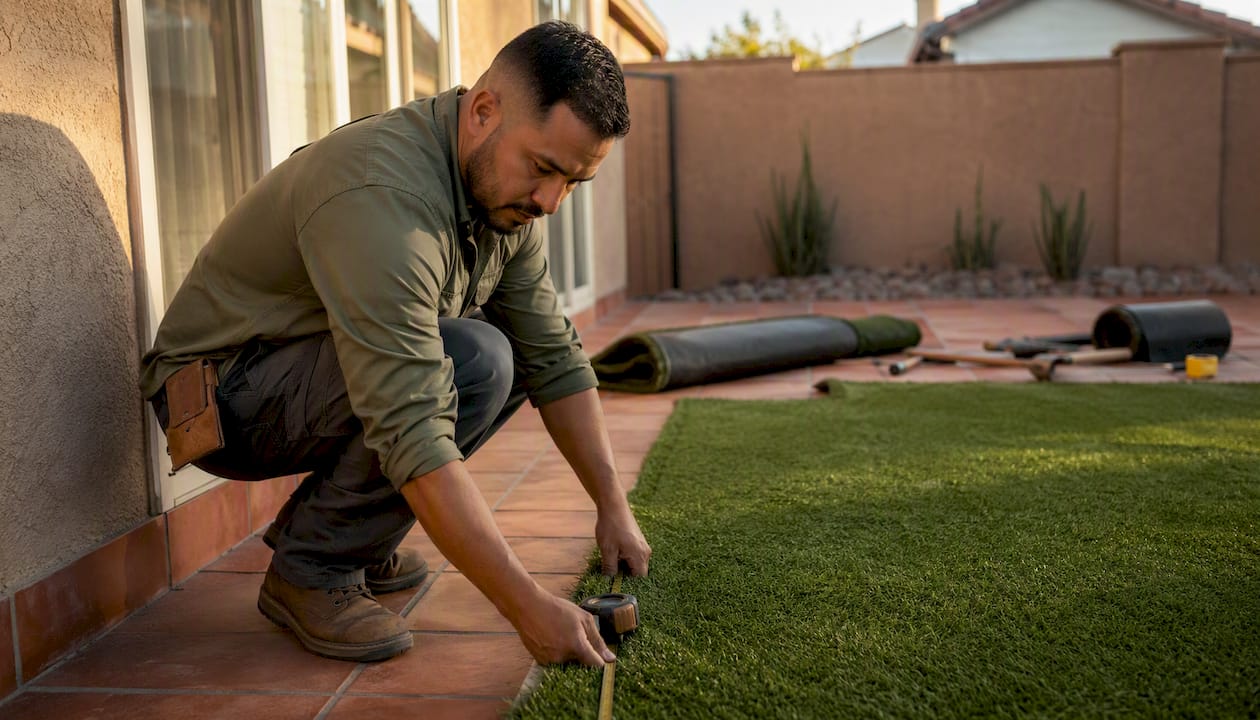
Professionally installed artificial turf in San Diego costs a variable amount per square foot installed, depending on material grade, base engineering, and drainage requirements. A standard 600 sq ft backyard lawn costs a substantial sum installed; a premium pet or cooling-system installation on the same footprint can be significantly higher. Those numbers reflect the full scope: demo, Class II base, compaction, drainage, infill, seaming, and labor. Material-only pricing you see at retail stores tells you almost nothing about what a finished project will cost.
The table below maps common yard sizes to realistic installed totals across three specification levels. These ranges come from published San Diego installer data and reflect complete installed scopes, not materials alone.
| Yard Size | Entry-Grade Installed | Mid-Grade Installed | Premium / Pet-Cooling Installed |
|---|---|---|---|
| — | low to moderate cost range | moderate range | higher cost range |
| 300 sq ft | low to moderate cost range | moderate range | higher cost range |
| 600 sq ft | low to moderate cost range | moderate range | higher cost range |
| 1,000 sq ft | low to moderate cost range | moderate range | higher cost range |
The recommended next step: request a scoped, line-item estimate from a licensed design-build firm. Ask specifically for base depth, drainage method, and infill spec. Modern Yardz (California Contractor License #1082881) prepares detailed written scopes and 3D renderings before any work begins, which is the clearest way to compare bids accurately. San Diego's clay soils and hillside lots also mean drainage engineering, including DS-560-style subsurface drainage, can be a significant price driver that low bids routinely omit.
Table of Contents
- What does the per-square-foot price actually include?
- What do sample budgets look like for common yard sizes?
- What factors raise or lower your installation price?
- How do you choose the right San Diego contractor?
- What does the installation process look like, and how long does it take?
- What maintenance and lifespan should you expect?
- How do HOA rules and permits affect your project in San Diego?
- Why a design-build approach protects your investment
- Key Takeaways
- The real cost of cutting corners on turf installation
- Modern Yardz brings full design-build precision to every turf project
- Sources and further reading
What does the per-square-foot price actually include?
Retail turf material costs and installed project costs are two entirely different numbers. When a contractor quotes you a per-square-foot price, that figure should bundle every component required to produce a finished, performing surface. Understanding the line items helps you read an estimate critically and spot what is missing.
A complete installed scope typically includes:
- Turf material (face weight, pile height, and fiber type determine this cost)
- Demolition and haul-away of existing sod, gravel, or hardscape
- Excavation to the required depth (usually 3–4 inches for residential, deeper for engineered bases)
- Imported Class II base material and mechanical compaction in 2-inch lifts
- Sub-drain or French drain installation where site drainage requires it
- Geotextile weed barrier between native soil and imported aggregate
- Infill material (silica sand, crumb rubber, antimicrobial, or cooling infill)
- Seaming adhesive and seam tape
- Bender board or steel edging at perimeter transitions
- Labor for layout, cutting, and finishing
- Debris disposal fees
- Permit fees where grading or drainage work triggers county review
As a rough guide, turf material typically accounts for 35–45% of the installed total, base preparation and drainage together represent 25–35%, and labor and finishing make up the remainder. Those proportions shift on complex sites: a hillside lot in Rancho Santa Fe with clay soil and a required sub-drain will push base and drainage costs well above that range.
Pro Tip: Insist on a fixed-price, line-item scope before signing anything. Ask the contractor to show photos of completed projects with similar base conditions to yours. The most common failure mode in San Diego turf installs is a thin base, inadequate compaction, and skipped drainage, all of which are invisible once the turf is down but show up as surface dimpling, pooling, and seam separation within two to three years.
The gap between a $9/sq ft bid and a $16/sq ft bid almost always lives in the base and drainage line items. A contractor who omits those details from a written scope is telling you something important about how they build.
What do sample budgets look like for common yard sizes?
The table below shows installed totals across three specification tiers for the most common residential project sizes. Entry-grade reflects a standard landscape turf with a basic compacted gravel base. Mid-grade reflects a contractor-grade turf with a full engineered base and standard drainage. Premium reflects a high-performance pet or cooling-system turf with antimicrobial infill, sub-drain, and geotextile separation.
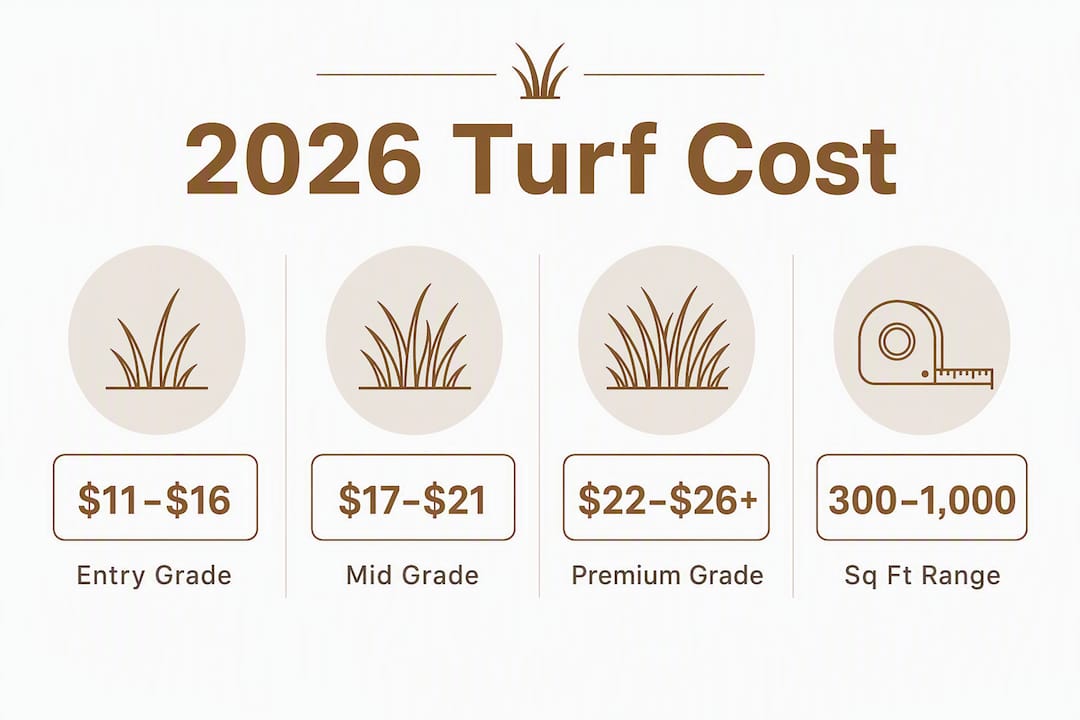
| Spec Level | Per Sq Ft (Installed) | 300 sq ft | 600 sq ft | 1,000 sq ft |
|---|---|---|---|---|
| Entry-grade landscape | $11–$14 | — | — | — |
| Mid-grade / pet-ready | $15–$19 | — | — | — |
| Premium pet / cooling | $21–$26+ | — | — | — |
A 500 sq ft example, line by line
A mid-grade 500 sq ft backyard install in a neighborhood like Carmel Valley or Del Mar includes several components such as demolition and haul-away of existing sod, excavation to depth, base material and compaction, weed barrier, sub-drain if required, turf material, infill, seaming and edging, labor and finishing, disposal and permit fees, all contributing to the total cost.
That range reflects real San Diego conditions. A pro's line-item breakdown for local projects confirms these figures align with what licensed contractors actually charge once base engineering and drainage are properly scoped.
Common add-ons that expand the budget:
- Putting green contours and cups: $1,500–$4,000+ depending on complexity
- Pet drainage systems with urine-resistant sub-base: $800–$2,500
- Private sub-drain tied to existing drainage infrastructure: $600–$2,000
- Hillside grading on sloped lots: $1,500–$5,000+
- Custom edges around travertine or paver transitions: $300–$900
What factors raise or lower your installation price?
Turf material and face weight
The turf product itself is the most visible variable. Face weight (measured in ounces per square yard) and pile height determine how the turf looks, how it performs under foot traffic, and how long it holds up under San Diego's UV exposure. A 40 oz product costs meaningfully less per square foot than an 80 oz premium fiber, and the difference compounds across a large yard. Pet-specific and cooling-infill products carry a further premium because of the antimicrobial treatments and specialized fiber construction.
Base and subgrade engineering
This is where most of the performance difference lives. Engineered sub-bases and geotextile separation between native soil and imported aggregate protect against subsidence, surface dimpling, and long-term seam failure. San Diego's expansive clay soils in areas like Chula Vista and Santee require deeper excavation and more imported aggregate than sandy coastal soils. Mechanical compaction in 2-inch lifts is the professional standard; skipping it is the single most common technical cause of early failure.
Drainage and sub-drains
Non-absorbent turf requires a drainage path. On flat or low-permeability sites, that means an engineered open-graded gravel retention field or a private sub-drain tied to the property's existing drainage infrastructure. San Diego's local soil and drainage conditions make this a genuine engineering question, not a checkbox. Coastal moisture, hillside runoff, and clay subsoils all push drainage costs upward. A DS-560-style subsurface drainage approach adds to the scope but is often necessary for luxury properties where pooling or stormwater runoff would be unacceptable.
Site access and demolition
A backyard accessible only through a side gate requires wheelbarrow hauls for all material in and out. That adds labor hours. Existing concrete, pavers, or compacted decomposed granite require more demolition time and heavier haul-away fees than a simple sod removal. Hillside lots in La Jolla or Rancho Santa Fe can add $1,500–$5,000 to the base scope just for grading.
Seams, patterns, and edge details
Every seam is a potential failure point. A yard with multiple angles, curves around a pool deck, or custom cuts around travertine pavers requires more seaming labor and more precise adhesive work. Contractors who underbid often reduce seam count or use lower-grade adhesive tape, which shows up as visible seam lines or separation within a few years.
Infill type
Standard silica sand is the entry-level option. Antimicrobial infill adds cost but is worth it for pet areas. Cooling infill products, which reduce surface temperature in San Diego's summer sun, carry the highest per-pound cost but make a real difference in yards used by children or pets during afternoon hours.
The single-line reminder worth repeating: the lowest bid almost always omits proper base prep and drainage. Those are the two components you cannot see after installation and the two that determine whether your turf lasts 8 years or 18.
How do you choose the right San Diego contractor?
Questions to ask during the estimate
- What depth do you excavate, and what base material do you import?
- Do you compact in 2-inch lifts with mechanical equipment?
- How do you handle drainage on this specific site, and will you provide a drainage narrative?
- What is your seaming method, and what adhesive do you use?
- Can you show me completed projects in similar San Diego neighborhoods with comparable site conditions?
- What does your written warranty cover, and for how long?
- Are you licensed with the California Contractors State License Board, and can I verify your license number?
- Will the scope be fixed-price and line-itemized before I sign?
Red flags to watch for
- Verbal estimates with no written line-item scope
- A price significantly below the market range with no explanation of what is excluded
- No local portfolio photos or before-and-after documentation
- Warranty limited to materials only, with no workmanship coverage
- Pressure to sign quickly before a site visit is complete
- Subcontractors managing key phases without your knowledge
Trust signals to require
A credible San Diego turf contractor should provide all of the following before you commit:
- Verified California Contractor License (check the CSLB database directly)
- Written, fixed-price scope with every line item named and priced
- Portfolio with before-and-after photos and, for luxury properties, 3D renderings
- Written warranty covering both materials and workmanship
- Local references from projects in comparable San Diego neighborhoods
- Proof of general liability and workers' compensation insurance
Modern Yardz provides all of these as standard. Every project begins with a portfolio-backed design-build process that includes 3D renderings the homeowner approves before excavation starts, a fixed-price written scope, and a single point of contact from consultation through final walkthrough.
What does the installation process look like, and how long does it take?
Step-by-step sequence
- Site visit and scoped estimate — contractor assesses soil, drainage, access, and existing surface; produces a written line-item scope (1–3 days after visit)
- HOA and permit review — if grading or drainage changes are required, permit applications are submitted; HOA packets prepared if needed (1–4 weeks depending on jurisdiction)
- Demo and excavation — existing sod, gravel, or hardscape removed and hauled; site excavated to specified depth (1–2 days for most residential projects)
- Base import and mechanical compaction — Class II aggregate imported and compacted in 2-inch lifts to required density (1–2 days)
- Drainage and sub-drain installation — perforated pipe, gravel retention field, or French drain installed where site conditions require (1 day, or longer on complex sites)
- Geotextile and bedding layer — weed barrier placed over compacted base; fine bedding sand or decomposed granite screeded level (half day to 1 day)
- Turf layout and seaming — rolls positioned, cut, and seamed with adhesive; edges secured with bender board or steel edging (1–2 days)
- Infill application — infill spread and worked into fibers with a power broom (half day)
- Brushing, finishing, and final walkthrough — fibers brushed upright, edges inspected, drainage tested, homeowner walkthrough completed (half day)
Typical timeline by project size
- Small projects under 400 sq ft: 2–4 days of active work; total elapsed time 1–3 weeks including estimate and any HOA review
- Medium projects 400–1,000 sq ft: 4–7 days of active work; total elapsed time 2–5 weeks
- Large projects over 1,000 sq ft: 7–14+ days of active work; total elapsed time 4–8 weeks
Common scheduling delays in San Diego include HOA architectural review (which can run 2–4 weeks in communities like Rancho Santa Fe or Covenant), county permit processing for grading work, and material lead times for specialty turf products. A design-build firm that manages permitting and HOA submissions in-house shortens this timeline considerably because there is no handoff between designer, permit expediter, and contractor.
What maintenance and lifespan should you expect?
Properly installed synthetic turf in San Diego requires far less upkeep than natural grass, but it is not zero-maintenance. The maintenance tasks that matter are straightforward.
Routine maintenance checklist:
- Remove leaves, debris, and organic matter regularly (a leaf blower works well)
- Rinse pet areas with water after use; apply enzymatic deodorizer monthly for pet systems
- Top up infill annually or as needed (infill settles and migrates over time)
- Inspect seams and edges twice a year for lifting or separation
- Brush fibers upright with a stiff-bristle broom or power broom once or twice a year
- Check drainage outlets after heavy rain to confirm they are clear
For homeowners who prefer professional maintenance, annual service contracts from local landscape companies typically run a few hundred dollars per year for a standard residential yard. Pet-specific systems with odor control and drainage management require more frequent attention and may warrant a dedicated service schedule.
Realistic lifespan by product tier:
Typical lifespan varies by turf grade: entry-grade turf has a moderate lifespan under normal residential use; contractor-grade turf lasts longer; premium cooling or pet turf with UV-stabilized fiber offers the longest lifespan.
San Diego's UV intensity is one of the most significant lifespan variables. Turf installed in full southern exposure without UV-stabilized fiber will fade and degrade faster than the same product in a shaded courtyard. Poor base compaction accelerates surface deformation. Inadequate drainage causes fiber mat deterioration from moisture retention.
What warranties should cover:
- Material warranty: typically 8–15 years on fiber color and integrity, depending on manufacturer and product tier
- Installation/workmanship warranty: 1–5 years is standard; premium design-build firms often offer longer coverage
- Verify in writing that the warranty covers seam failure, edge separation, and drainage performance, not just fiber color fading
How do HOA rules and permits affect your project in San Diego?
Many San Diego luxury communities, including those in Rancho Santa Fe, Covenant, and coastal La Jolla, require HOA architectural committee approval before any significant landscape change. Permit requirements at the county level typically apply when a project involves grading, significant drainage modifications, or hardscape alterations that change stormwater flow.
Documents commonly requested by HOAs or the county:
- Site plan showing existing and proposed conditions
- 3D renderings or elevation drawings of the finished landscape
- Drainage narrative explaining how stormwater is managed post-installation
- Materials specification sheet (turf product, infill type, base spec)
- Contractor license and insurance certificates
When permits are required, they add both time and cost to the project. A grading permit for a hillside lot can add several weeks to the schedule and several hundred to a few thousand dollars in fees, depending on the scope of work. Drainage modifications that alter stormwater flow to adjacent properties or the street typically require engineered plans and county review.
Professional design-build firms prepare HOA packets and permit applications as a standard part of their scope. That means 3D renderings, drainage narratives, and materials specs are produced during the design phase and submitted on the homeowner's behalf, rather than requiring the homeowner to coordinate separately with a designer, a permit expediter, and a contractor. For luxury properties in gated communities, this single-team approach reduces approval risk and keeps the project on schedule.
Why a design-build approach protects your investment
A turf install on a luxury San Diego property is rarely just turf. It ties into paver edges, pool deck drainage, retaining walls, and the overall grading of the site. When those elements are designed and built by separate teams, coordination gaps create problems: drainage that conflicts with the pool deck slope, paver transitions that lift because the turf base was not coordinated with the hardscape subgrade, or seams that fall in the wrong place because the turf contractor did not see the final paver layout.
Modern Yardz approaches every turf project as part of a complete outdoor environment. A recent integration in Carmel Valley combined premium pet turf with travertine paver transitions, a coordinated sub-drain tied to the pool deck drainage, and landscape lighting, all designed in 3D before a shovel broke ground. The homeowner approved the full rendering before any work began. One team executed every phase.
The design-build model reduces risk in specific, measurable ways:
- A single contract covers design, permitting, and construction, eliminating scope gaps between vendors
- 3D renderings let you see turf placement, paver transitions, and drainage paths before excavation
- Coordinated drainage engineering prevents conflicts between turf sub-drains and adjacent hardscape
- One dedicated team means no miscommunication between a designer's intent and a contractor's execution
Pro Tip: When requesting a turf estimate for a property with existing pavers, a pool deck, or a sloped lot, ask specifically how the turf drainage ties into the existing site drainage. A contractor who cannot answer that question in detail is not equipped to build on a luxury property.
Modern Yardz holds California Contractor License #1082881, has completed 2,900+ projects across San Diego County, and maintains a 5.0-star Google rating. Every project begins with a consultation, 2D architectural plans, and photo-realistic 3D renderings, and is executed by a single in-house team with no subcontractor handoffs.
Key Takeaways
Professionally installed artificial turf in San Diego costs $11–$26+ per square foot depending on material grade, base engineering, and drainage requirements, with base preparation and drainage being the most consequential cost drivers.
| Point | Details |
|---|---|
| Installed price range | San Diego installs run $11–$26+ per sq ft; a 600 sq ft yard costs $6,600–$15,600+ depending on spec. Mid-grade/pet-ready projects typically run $15–$19 per sq ft installed; premium pet or cooling system installs command $21–$26+ per sq ft. |
| Top cost drivers | Base engineering, drainage, and turf face weight account for the largest share of installed cost. |
| Contractor selection | Require a verified California contractor license, fixed-price line-item scope, and written warranty before signing. |
| Typical timeline | Most residential projects typically complete within several weeks from contract to walkthrough, depending on size and permit requirements. |
| Modern Yardz | Offers a full design-build turf process with 3D renderings, engineered drainage, and one in-house team across San Diego County. |
The real cost of cutting corners on turf installation
The most predictable failure mode in San Diego turf installs is not the turf itself. It is what is underneath it. A thin base, inadequate compaction, and skipped drainage are invisible at the time of installation and catastrophic within a few years. Surface dimpling appears first, usually within 12–18 months on a poorly compacted base. Seam separation follows, particularly on sites where the base shifts seasonally with clay soil expansion. Pooling and odor in pet areas develop when drainage was never properly engineered.
What separates a 15-year install from a 6-year one is almost entirely the quality of the base and drainage work, not the turf product. Homeowners who focus on the turf material cost and accept a low bid that skips the engineered base are making a false economy. The replacement cost of a failed install, including demo, haul-away, and a proper reinstall, typically exceeds the cost difference between a quality original install and the low bid that failed.
For properties in La Jolla, Del Mar, or Rancho Santa Fe, where the outdoor environment is an architectural extension of the home, a failed turf install is not just a maintenance problem. It reflects on the property. The right investment is a properly engineered install with a written warranty, executed by a team that has done it correctly hundreds of times before.
Modern Yardz brings full design-build precision to every turf project
For San Diego homeowners who want turf that performs, looks right, and holds up, Modern Yardz delivers the complete scope under one roof. From the first consultation through the final walkthrough, one dedicated in-house team handles design, permitting, base engineering, drainage coordination, and installation, with no subcontractor handoffs and no scope gaps.
Every project starts with photo-realistic 3D renderings so you see the finished result before excavation begins. Drainage is engineered to coordinate with existing hardscape, pool decks, and site grading. Materials are specified to perform in San Diego's UV environment and climate. Founded in 2018, Modern Yardz has completed 2,900+ projects across San Diego County, holds California Contractor License #1082881, and maintains a 5.0-star Google rating.
Request a free consultation and line-item scope to see your project in 3D before committing to a single dollar of construction.
Sources and further reading
- Artificial Grass Cost San Diego (2026): $8–$20/sq ft Installed | Modern Yardz — Local pricing context and a pro's line-item breakdown for San Diego installs.
- Artificial Turf Installation San Diego | Premium Synthetic Grass — Modern Yardz — Service page describing Modern Yardz's design-build turf offering and process.
- Drainage Engineering for Luxury Landscape Projects — Modern Yardz — Technical guidance on engineered bases, geotextile separation, and sub-drain strategies for luxury properties.
- Artificial Grass (Turf) Cost in San Diego (2026) — Install-It-Direct — Published installed price ranges and package examples by application type.
- Artificial Turf & Drainage Standards | San Diego 2026 | Install-It-Direct — Spec-based cost bands and drainage engineering guidance for San Diego conditions.
- How to Install Artificial Turf in San Diego | SD Turf Center — Practical guidance on local soil conditions, drainage requirements, and installer best practices.
- San Diego County Permit Portal — When grading or drainage changes are part of your project, verify permit requirements directly with the county before construction begins. Requirements vary by project scope and neighborhood.
Recommended
Start Your Free Design Consultation
Tell us about your project and we'll be in touch within 24 hours. No pressure, no obligation.
Ready to design your dream yard?
Tell us about your project. We'll send back a real plan, not a templated quote.
Book My Free Consultation→