
Pool LED Lighting: Energy-Efficient Choices That Last
Discover energy-efficient pool LED lighting options that last. Choose the best fixtures for vibrant colors and automated control, enhancing your outdoor...
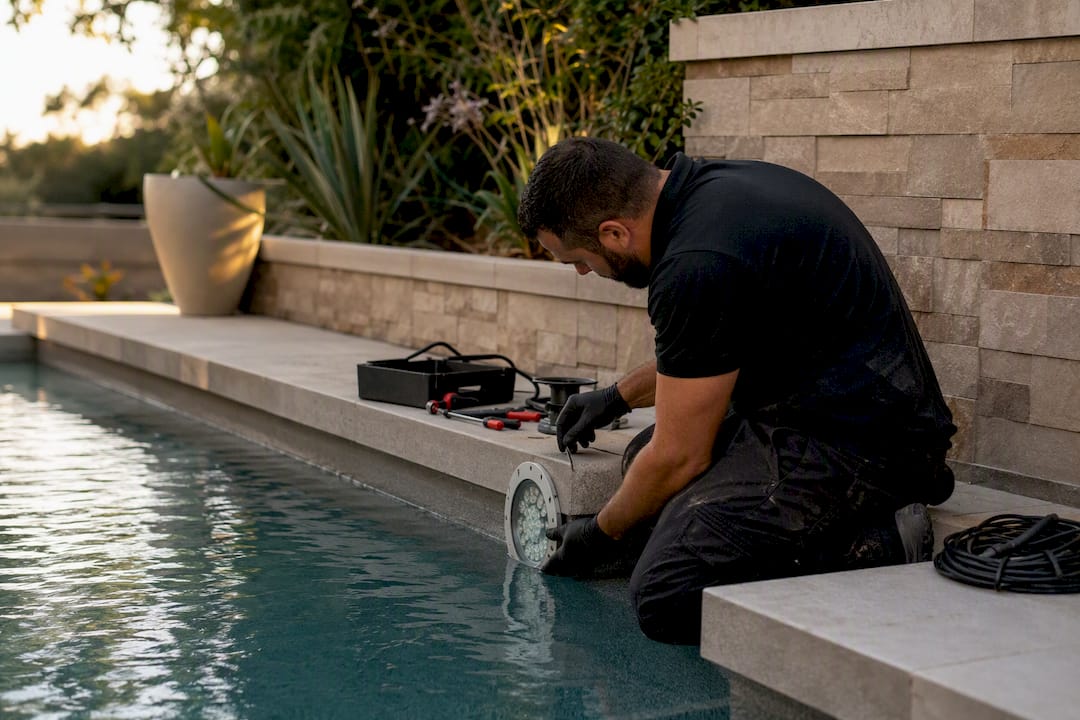
For most luxury pools, the best choice is an integrated LED fixture with an external driver, installed by a design-build contractor. This combination delivers the longest lifespan, cleanest light quality, and full compatibility with automated color and scene control.
Retrofit bulbs make sense for a healthy niche and a straightforward swap. A licensed contractor becomes necessary for niche repairs, nicheless installs, new construction, or whole-property automation. Two numbers worth knowing before you shop: LED fixtures use up to 90% less energy than incandescent lighting, and quality units commonly run 30,000 to 50,000 hours before replacement.
- DIY-appropriate: screw-in retrofit bulbs in a niche with intact gaskets and no automation upgrade planned
- Hire a pro: niche or conduit repairs, nicheless fixture installs, new pool construction, multi-zone automation, or any line-voltage work near water
Key Takeaways
External-driver LED fixtures installed through a design-build process deliver the longest lifespan, best light quality, and most reliable automation compatibility for luxury pools.
| Point | Details |
|---|---|
| Choose external drivers | External-driver LED fixtures report failure rates under 1% and lifespans above 50,000 hours. |
| Match color temperature to finishes | Use 2,700K to 3,000K warm white for stone and tile, 5,000K to 6,500K cool white for a crisper water look. |
| Know your voltage before buying | Confirm 12V versus 120V and niche compatibility before purchasing any replacement fixture. |
| Calculate real payback | A 300W to 40W LED swap can save roughly $114 per year in energy costs at typical residential rates. |
| Hire design-build for integration | Modern Yardz plans lighting, pool, and landscape design together with 3D renderings before construction begins. |
Where to Verify Product Specs and Code Requirements
- Manufacturer sites for Pentair and Hayward publish current UL/ETL listings and IP rating documentation for specific fixture models
- Local building department pages cover GFCI, bonding, and permitting requirements for pool electrical work
These sources are starting points for confirming exact specs and code compliance before you buy or build.
Table of Contents
- Which Type of Pool LED Lighting Fits Your Pool?
- How Much Light and Color Do You Actually Need?
- What Installation Approach Fits Your Pool?
- What Do Pool LED Fixtures and Installation Cost?
- What Makes a Pool Light Durable Enough to Last?
- Why Design-Build Matters for Complex Lighting Projects
- Step-by-Step: DIY Replacement vs Hiring a Contractor
- How Long Does a Pool Lighting Project Take?
- What Should You Ask Before Hiring a Contractor?
- Red Flags That Should Make You Walk Away
- Sources
Which Type of Pool LED Lighting Fits Your Pool?
Four form factors cover almost every pool on the market, and matching the right one to your construction saves money and rework later. Full submersible fixtures, either niche-mounted or nicheless, deliver the strongest output and suit inground gunite, shotcrete, and fiberglass pools built for a standard housing. Screw-in retrofit bulbs work inside that same niche when you want an upgrade without touching plumbing or concrete.
Surface-mount LED strips and fiber-optic illuminators serve a narrower purpose. Strip lights are often the only realistic option for above-ground pools and vinyl liners, where cutting a niche would void the shell warranty, and they produce 200 to 400 lumens per linear foot along steps and ledges rather than whole-pool illumination.
| Form factor | Best fit | Typical output |
|---|---|---|
| Full submersible fixture | Inground gunite, shotcrete, fiberglass | Thousands of lumens, whole-pool coverage |
| Screw-in retrofit bulb | Existing niche, no construction planned | Matches fixture wattage, moderate coverage |
| Surface-mount strip | Above-ground, vinyl liner, steps/ledges | 200-400 lumens per linear foot |
| Fiber-optic illuminator | Accent lighting, water features | Low, decorative only |
Before buying anything, check three things: niche size and cord length against your existing housing, whether your system runs on 12V or 120V, and whether the fixture needs to talk to an existing automation platform like Pentair or Hayward. Mismatching voltage or automation protocol is the single most common reason retrofit projects stall midway.
- Confirm niche diameter and depth match the new fixture's housing
- Check cord length reaches the junction box without splicing
- Verify voltage (12V low-voltage systems are standard for most residential pools)
- Ask whether the fixture supports your existing automation brand before buying
How Much Light and Color Do You Actually Need?
Wattage tells you little on its own. Lumens per watt is the number that actually predicts brightness, and a quality LED fixture delivers dramatically more light per watt than the incandescent or halogen units it replaces. That efficiency is why LED systems can use up to 90% less energy while still producing a brighter pool at night.
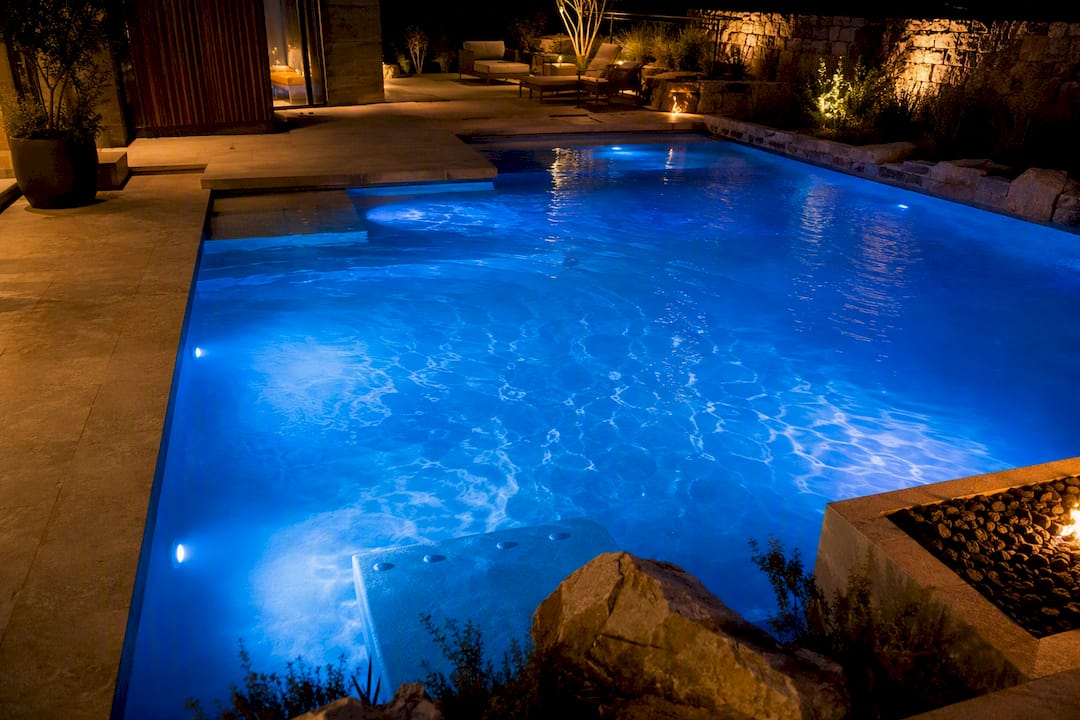
Small pools generally look best with two to three fixtures spaced for even coverage rather than one oversized unit creating a hot spot in the center. Medium and large pools benefit from multiple lower-output fixtures distributed along the walls, since diffused, even light reads far better at night than a single blinding point source.
Color temperature changes how your entire pool reads after dark. Warm white in the 2,700K to 3,000K range renders natural stone and tile with less glare, while cool white at 5,000K to 6,500K makes water look crisper and clearer but can wash out warmer finishes. RGBW fixtures add full color-changing capability on top of a clean white baseline, which matters if you want to sync lighting to entertaining scenes.
- Warm white (2,700K to 3,000K): flatters travertine, natural stone, and warm-toned tile
- Cool white (5,000K to 6,500K): makes water appear more crystalline, better for modern gray or blue finishes
- RGBW: full color range plus a true white mode for everyday use
Pro Tip: Match your pool light's color temperature to your deck and coping material before you commit. A cool white fixture next to warm travertine pavers creates a visual mismatch that shows up every single night, not just in daylight photos.
What Installation Approach Fits Your Pool?
A retrofit into an existing niche starts with an honest inspection. Pull the old fixture and check the gasket, the cord jacket, and the niche interior for corrosion or water intrusion before assuming a simple bulb swap will work. If the gasket is compromised or the cord shows cracking, a screw-in bulb replacement will fail again within months.
New construction and full renovations open up nicheless fixture options, which mount directly to the pool wall without a housing recessed into the shell. This approach gives a design-build contractor more freedom to plan multi-zone lighting, since fixture placement isn't locked to wherever a niche happens to sit.
Voltage is where most DIY projects should stop. Most residential pool lighting runs on 12V through a transformer, but transformer placement, GFCI protection, and bonding all fall under electrical code requirements near water.
Any modification to wiring within a pool's bonding grid, or any transformer relocation, should go through a licensed electrician or contractor. Water and line-voltage electrical work carry real risk, and code inspectors expect to see proper GFCI and bonding documentation before signing off.
- Inspect the existing niche, gasket, and cord condition
- Confirm 12V versus 120V and locate the transformer
- Verify GFCI protection and bonding grid integrity
- Call a licensed contractor for any niche repair, nicheless install, or automation wiring
What Do Pool LED Fixtures and Installation Cost?
Screw-in retrofit bulbs sit at the low end of the spectrum, while full nicheless fixture installs with new wiring and automation integration land at the high end. Strip lighting for steps or accent zones costs less per fixture but adds up across a full pool perimeter.
The lifespan math favors LED decisively. Quality fixtures with external drivers commonly reach 30,000 to 50,000 hours, translating to roughly 10 to 15 years of nightly use, versus a fraction of that for incandescent or halogen bulbs that also draw far more power the entire time they're running.
- Screw-in retrofit LED bulb: lowest upfront cost, fits existing niche
- Full submersible LED fixture: moderate to higher cost, includes housing and driver
- Strip lighting per section: lower cost per foot, limited to accent areas
- Full system install with automation: highest cost, includes wiring, transformer, and programming
A concrete example: swapping a 300W incandescent fixture for a 40W LED running eight hours nightly saves roughly $114 per year at $0.15 per kilowatt-hour. Multiply that across several fixtures on a large pool and the extra upfront cost of quality LED units typically pays for itself within a couple of seasons.
What Makes a Pool Light Durable Enough to Last?
Look for an IP68 underwater rating and UL or ETL listing before buying any submersible fixture. These certifications confirm the housing has been tested against water intrusion at depth, not just splash resistance.
Where the driver sits matters more than most homeowners realize. External-driver designs keep the power electronics outside the water in a dry, serviceable enclosure, which avoids the heat buildup that kills internal-driver fixtures early. Reported failure rates for external-driver systems run under 1%, against internal-driver units that typically last only 20,000 to 30,000 hours before heat stress takes them out.
Heat is the enemy of any submersible LED driver. Moving that driver into a dry, low-voltage enclosure changes the entire reliability equation, because the electronics never have to fight water intrusion and thermal cycling at the same time.
- Inspect gaskets annually, sooner if you notice fogging inside the lens
- Clean the lens surface to prevent calcium buildup from dimming output
- Check cord jackets and niche seals for cracking or corrosion
- Avoid uncertified fixtures with generic gaskets. They fail faster and cost more in repeat service calls than a properly listed unit
Why Design-Build Matters for Complex Lighting Projects
A retrofit bulb swap is a weekend project. A fully integrated lighting system, synced across pool, spa, and landscape zones, is an architectural decision. Modern Yardz has completed 2,900+ projects across San Diego County, holds California Contractor License #1082881, and maintains a perfect 5.0-star Google rating built on exactly this kind of complex, multi-system coordination.
Before hiring anyone for lighting work tied to a larger pool or backyard project, look for a verifiable license number, a real project portfolio you can walk through, written warranties on fixtures and labor, and confirmation that one team handles design through construction with no subcontractor handoffs.
The projects that go wrong are almost always the ones split between a lighting installer, a pool builder, and an electrician who never talk to each other. Integrated automation across pool, spa, and landscape zones only works when one team owns the entire plan from the first rendering to the final walkthrough.
Insist on a design-build approach whenever the project involves niche repair alongside new construction, multi-zone automation, or lighting that needs to coordinate with a broader landscape plan. That's the point where a single fixture purchase turns into a system, and where a project like the Chula Vista backyard and pool shows what integrated planning looks like in practice.
Step-by-Step: DIY Replacement vs Hiring a Contractor
Start by pulling the existing fixture and checking three things: gasket condition, cord integrity, and niche corrosion. If all three pass inspection and you're simply swapping a bulb for a brighter or color-changing LED equivalent, a straightforward retrofit is within reach for a handy homeowner.
The moment any of those three fail, or the moment you want more than a single-fixture swap, the calculation changes. Cracked gaskets mean water has likely reached the wiring. Corroded niches mean the housing itself may need replacement, which involves shell work most homeowners shouldn't attempt themselves.
Here's the decision path that actually holds up:
- Inspect first. Pull the fixture, check the gasket, cord, and niche before deciding anything.
- If everything's sound and it's a like-for-like swap: a retrofit bulb is a reasonable DIY project.
- If you're changing form factor, adding automation, or the niche shows damage: hire a licensed contractor.
- If the project touches transformer placement, GFCI wiring, or bonding grid modifications: hire a licensed electrician or design-build firm regardless of how simple the visible part of the job looks.
- If lighting is one piece of a larger pool, patio, or landscape renovation: bring in a design-build team from the start rather than layering lighting on after other trades finish.
That last point trips up more homeowners than any other. Lighting decided after pavers, coping, and landscape design are already finalized often ends up compromised, wired around obstacles instead of planned into the space. Coordinating pool lighting with a small backyard layout or a full outdoor living design from the beginning avoids that entirely.
How Long Does a Pool Lighting Project Take?
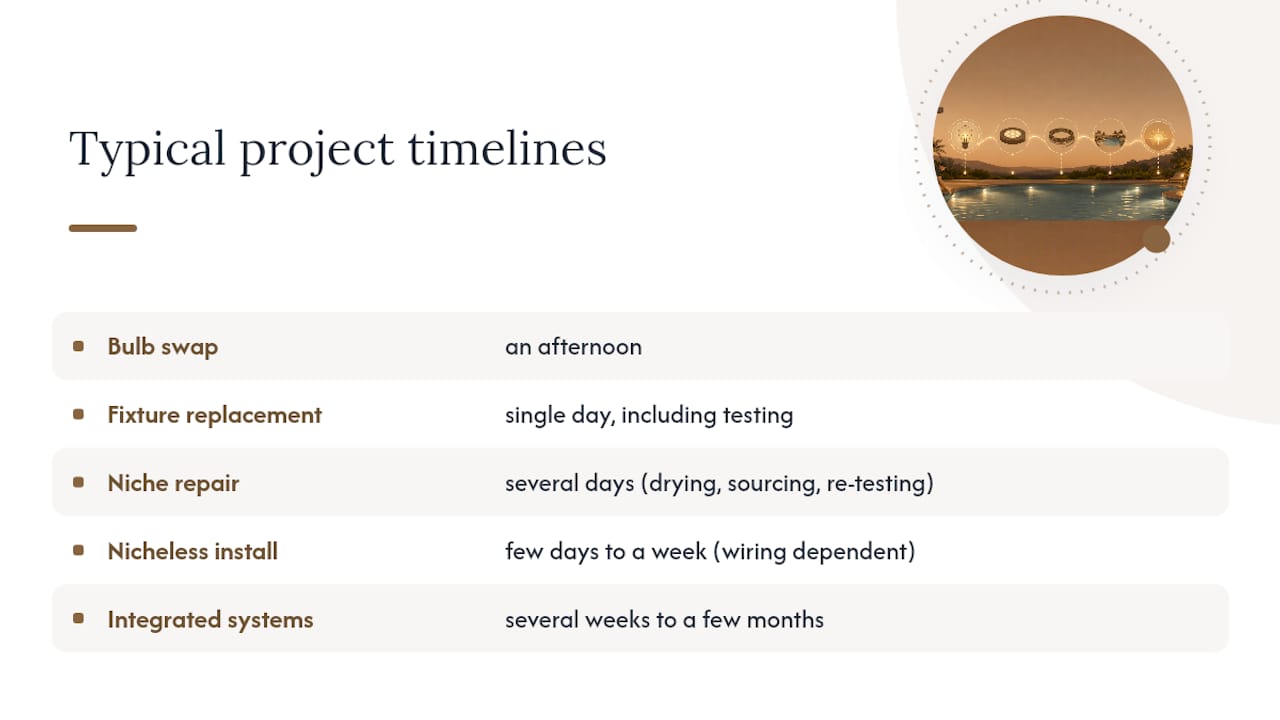
A simple retrofit bulb swap takes an afternoon. Replacing a handful of fixtures in healthy niches, without any wiring changes, typically wraps in a single day, including testing.
Niche repair or replacement adds real time. Expect several days once you factor in drying time for any shell work, sourcing a matching housing, and re-testing the seal before the pool returns to service. Nicheless fixture installs on an existing pool fall in a similar window, often a few days to a week depending on how much wiring needs to be run to reach the new fixture locations.
Full integrated systems, the kind paired with automation and multi-zone control across pool, spa, and landscape lighting, run on a longer timeline. For new pool construction, lighting installation happens during the plumbing and electrical rough-in phase, well before plaster or PebbleTec finish work begins, so it's baked into the broader construction schedule rather than tacked on at the end. For a full backyard renovation that includes lighting, expect the lighting-specific work itself to represent days within a project that, start to finish with design, permitting, and construction, commonly spans several weeks to a few months depending on scope.
The permitting step is where timelines slip most often. Any project involving new electrical circuits or transformer relocation needs to clear local permitting before final inspection, and that step is easy to underestimate if you're managing multiple trades yourself instead of working with one team that handles scheduling end to end.
What Should You Ask Before Hiring a Contractor?
The right questions separate a contractor who understands pool lighting from one who's simply installing whatever fixture is on the truck. Ask to see their California contractor license number and confirm it's active. Ask how many integrated lighting and pool projects they've completed, and ask to see actual portfolio examples, not stock photography.
Beyond credentials, the questions that matter most concern process and accountability:
- Do you provide 3D renderings before construction begins? A serious design-build firm shows you the lighting plan and pool design before anyone breaks ground.
- Is this a single-team project, or will you subcontract the electrical and lighting work? Subcontractor handoffs are where communication breaks down and timelines slip.
- What warranty comes with the fixtures and the labor? Manufacturer warranties on the fixture itself are separate from a contractor's labor warranty. Ask about both.
- Can your lighting system integrate with automation I already own, or plan to add? Automation protocol compatibility with platforms like Pentair or Hayward avoids costly rework later.
- Who is my single point of contact from consultation through final walkthrough?
A contractor who answers all five clearly, and has the portfolio and license to back it up, is worth far more than one offering the lowest number on a bid sheet.
Red Flags That Should Make You Walk Away
Some warning signs show up in the product itself. A fixture with no UL or ETL listing, no published IP rating, or a generic unbranded gasket is a fixture that will likely fail well before its advertised lifespan. If a seller can't tell you the driver location, internal or external, treat that as a missing answer, not a minor detail.
Other red flags show up in the contractor relationship. Be cautious of anyone who can't produce a license number on request, who won't show past project photos or portfolio examples, or who quotes a price without ever visiting the site or discussing your existing equipment.
- No UL/ETL listing or published IP rating on the fixture itself
- Contractor can't provide a license number or produce past project examples
- No written warranty on fixtures or labor
- Vague answers about automation compatibility with your existing equipment
- Pressure to sign before seeing any design plan or rendering
- Multiple subcontractors involved with no single point of accountability
Any one of these alone might be explainable. Two or more together usually means it's time to look elsewhere.
A Note From Modern Yardz
We specify external-driver LED systems because we've seen what heat does to internal-driver fixtures over years of use. Longevity and design intent go together, and that's exactly what our 3D rendering process is built to plan for before construction ever begins.
Bring Your Pool Lighting Vision to Modern Yardz
Modern Yardz designs and builds custom pools with integrated LED lighting as one cohesive system, planned in photo-realistic 3D renderings before construction starts, not bolted on afterward. Founded in 2018 and holding California Contractor License #1082881, our team has completed 2,900+ projects across San Diego County with a 5.0-star rating, and every project runs through one team from first consultation to final walkthrough. If you're planning a new pool or considering an integrated lighting upgrade, schedule a free consultation to see what a design-build approach looks like for your property.
Sources
- How to Choose the Best Pool Lighting for Night Swimming - Modern Pool Tools
- Pool LED Lighting Guide: Types, Colors, and Best Options
Recommended
Start Your Free Design Consultation
Tell us about your project and we'll be in touch within 24 hours. No pressure, no obligation.
Ready to design your dream yard?
Tell us about your project. We'll send back a real plan, not a templated quote.
Book My Free Consultation→

