Outdoor Dining Space Design: What Luxury Homes Need
Discover the crucial role of outdoor dining space design in luxury homes. Transform your backyard into a stunning, functional retreat today!
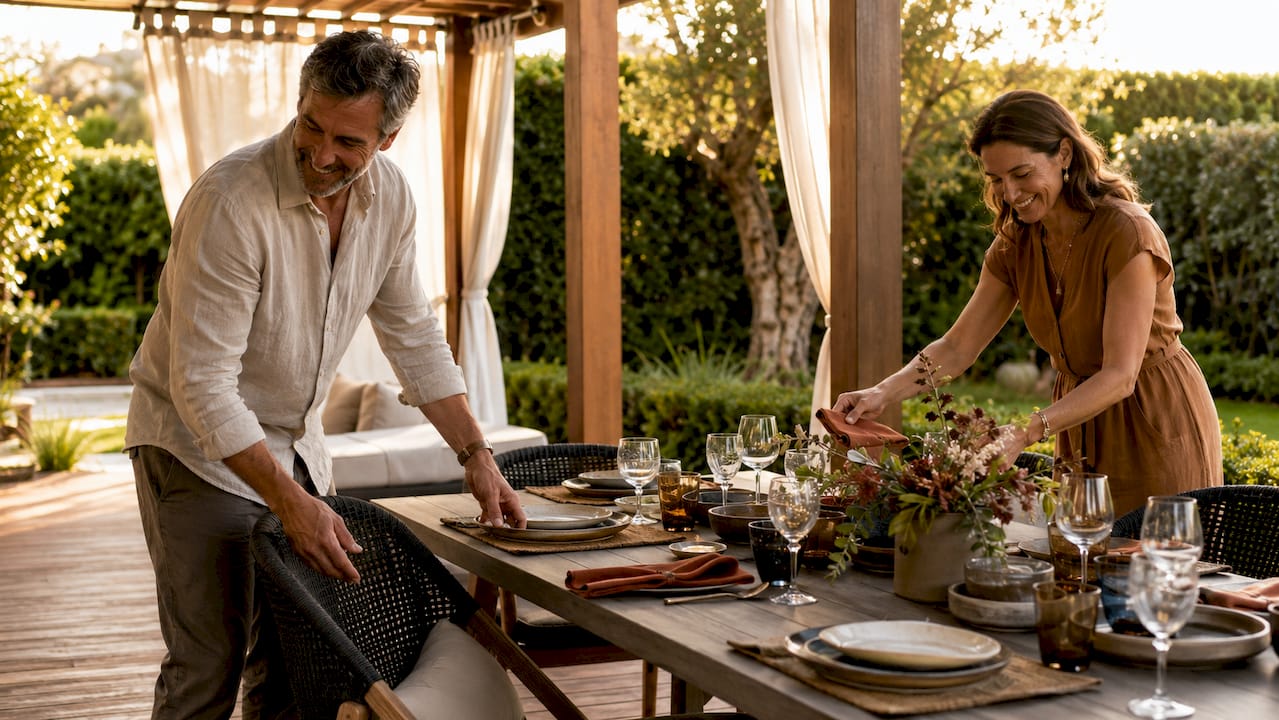
Outdoor dining space design is the discipline of engineering a functional, comfortable, and visually cohesive environment that extends your home's living area into the open air with architectural intention. The role of outdoor dining space design goes far beyond choosing furniture and string lights. It governs circulation flow, material durability, shade engineering, lighting integration, and the seamless connection between your indoor kitchen and your outdoor entertaining zones. Done right, it transforms a backyard into a private resort. Done poorly, it produces a space that looks good in photos but fails every time you actually use it.
How spatial layout shapes outdoor dining functionality
Layout is the foundation of every successful outdoor dining environment. Get it wrong and no amount of premium stone or custom lighting will save the experience.
The single most cited standard in professional outdoor dining design is the 36-inch clearance between tables. That spacing allows guests to move freely and servers to circulate without disrupting seated guests. In residential settings, the same rule applies: tight spacing between a dining table and a built-in bar creates a bottleneck that frustrates every gathering.
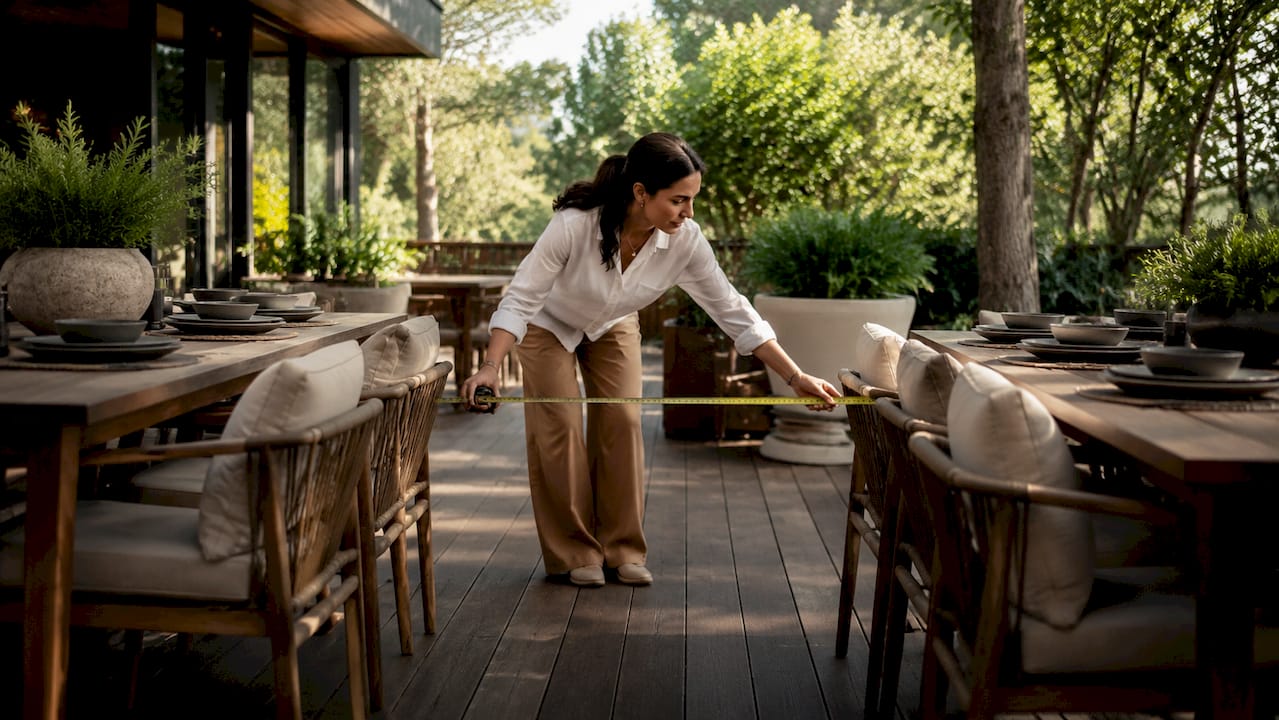
Bar seating follows its own dimensional logic. Each bar stool requires approximately 36 inches of linear counter space, and counter overhangs shorter than 12 inches force guests to sit at an uncomfortable angle. These are not aesthetic preferences. They are ergonomic requirements that determine whether your outdoor bar seating design actually works for extended entertaining.
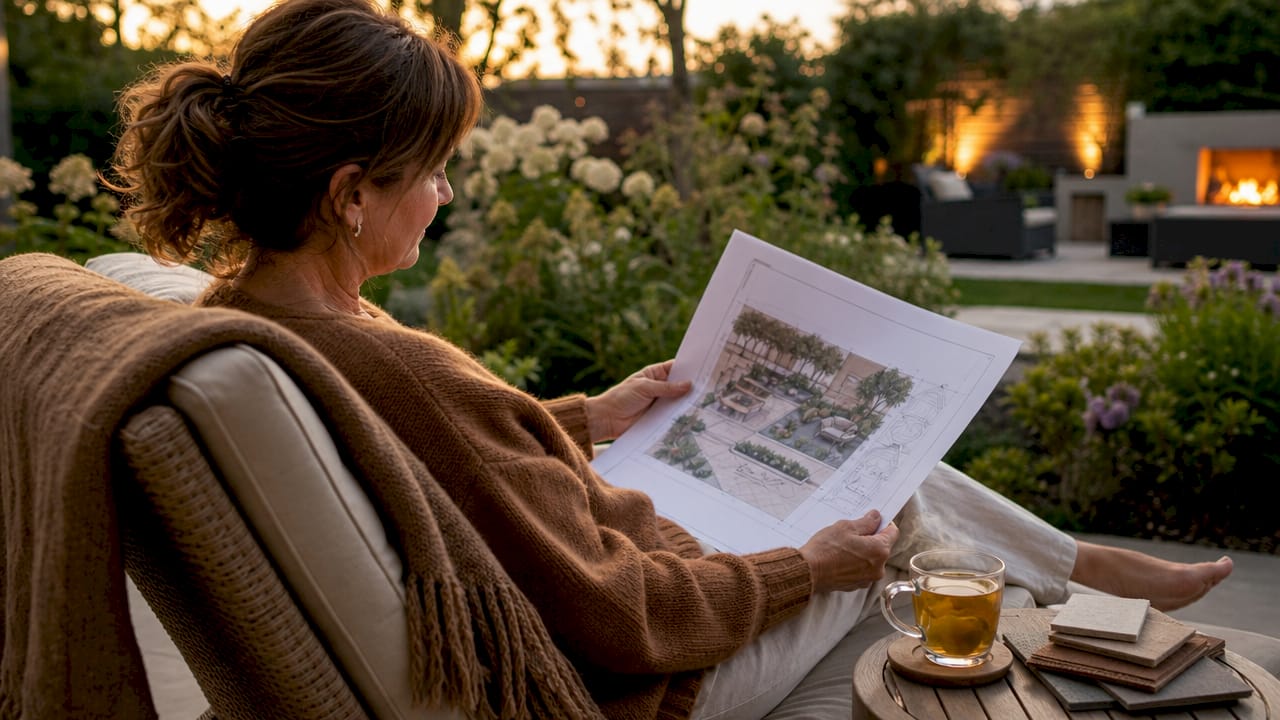
Pro Tip: Plan your outdoor dining layout on paper before any construction begins. Mark circulation paths at 36 inches wide and test them against your furniture plan. If the paths disappear when chairs are pulled out, the layout needs revision.
The table below shows how layout decisions separate a functional outdoor dining space from a frustrating one:
| Layout Factor | Cramped Design | Well-Designed Space |
|---|---|---|
| Table spacing | Under 24 inches | Minimum 36 inches |
| Bar stool spacing | Under 24 inches linear | 36 inches per stool |
| Counter overhang | Under 10 inches | 12 inches or more |
| Circulation path | Blocked by furniture | Clear 36-inch paths |
| Sightlines to service | Obstructed | Open and direct |
ADA compliance is worth considering even in private residential builds. Clear pathways and level transitions between zones make the space more usable for every guest, regardless of mobility.
What materials and engineering make outdoor dining last
Surface material selection is a structural decision, not a decorative one. The wrong material degrades within a few seasons. The right material performs for decades with minimal maintenance.
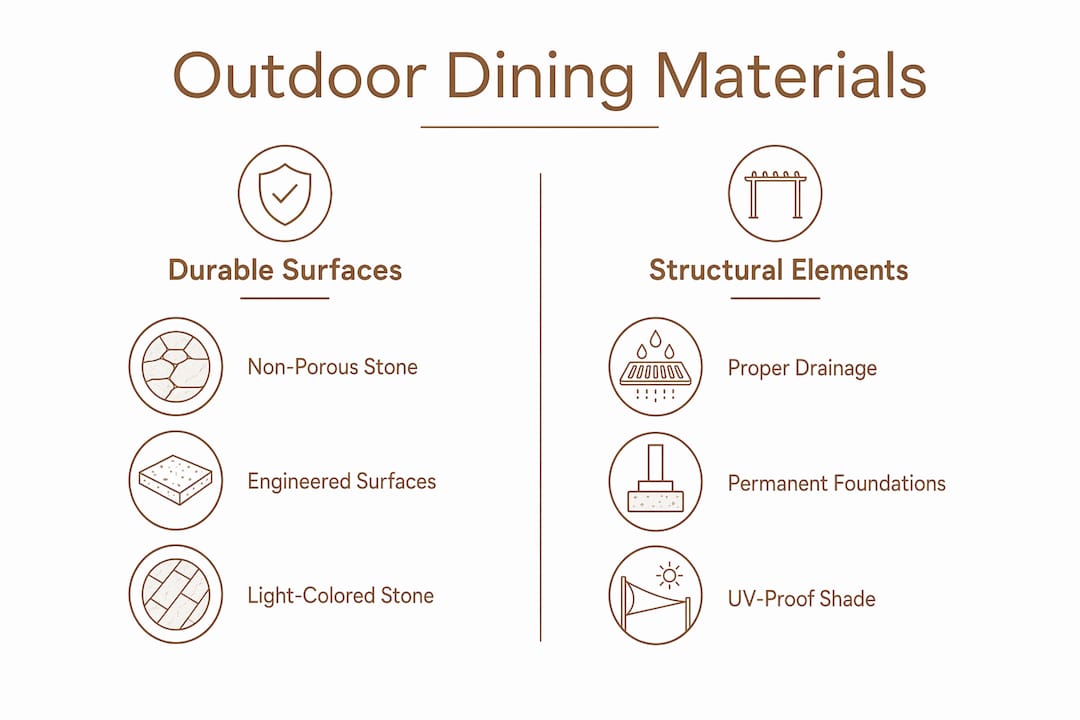
Non-porous stone and engineered surfaces resist the freeze-thaw cycles and heat extremes that destroy lesser materials. Design engineers recommend a 2% slope across all outdoor dining surfaces to channel water away from seating areas and prevent standing water. In San Diego's climate, drainage matters most during winter rains when a flat patio becomes a pond overnight.
Surface temperature is a safety and comfort issue that most homeowners overlook until it is too late. Metal and dark stone surfaces can exceed 150°F in direct sun, making them unusable and potentially dangerous during peak afternoon hours. Material selection and shade placement must work together to keep surfaces at a usable temperature throughout the day.
Key material and engineering considerations for year-round outdoor dining include:
- Non-porous stone and porcelain pavers resist moisture absorption, staining, and thermal cracking better than concrete or wood decking
- Travertine and natural stone provide natural thermal regulation and a surface temperature that stays cooler than dark engineered alternatives
- Structural drainage engineering with a 2% slope prevents water pooling that accelerates material degradation and creates slip hazards
- Shade structures rated UPF 50+ block ultraviolet radiation effectively and reduce surface temperatures beneath them by a measurable margin
- Louvered pergolas with automated slats allow you to control sun exposure and ventilation without removing the shade structure entirely
Pro Tip: When selecting stone for a San Diego outdoor dining surface, choose light-colored travertine or limestone over dark granite or slate. The color difference alone can reduce surface temperature by 20 to 30 degrees during peak afternoon sun.
Permanent outdoor bar structures require foundation work and drainage engineering comparable to an indoor room addition. Skipping that infrastructure to save time creates settling, cracking, and water intrusion within a few years. The external finishes you choose for any permanent outdoor structure must match the weather exposure of your specific site, not just look good in a showroom.
How does lighting and ambiance affect the outdoor dining experience?
Ambiance is not decoration. Sound and lighting levels directly influence how long guests stay and how much they enjoy the experience. Guests who are forced to raise their voices over background noise leave sooner and enjoy the meal less. That finding applies equally to a restaurant patio and a private residence.
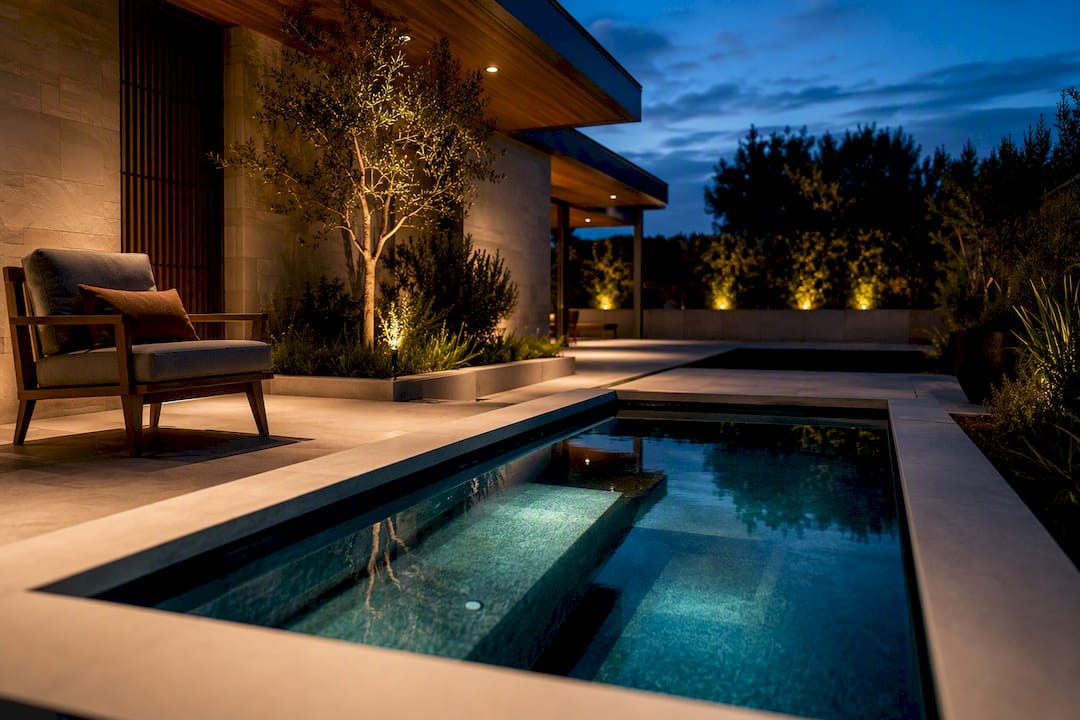
Integrated LED lighting built into structural elements outperforms string lights in every practical category. Built-in systems are waterproof, require less maintenance, and extend the usable hours of your outdoor dining space without creating visual clutter. String lights look appealing in photographs but fail quickly in coastal climates and require constant replacement.
The elements that define a high-performing outdoor dining ambiance include:
- Layered lighting combining overhead structure-mounted LEDs, low-voltage path lighting, and accent lighting for plants or architectural features
- Sound management using dense hedging, masonry seating walls, or acoustic panels to absorb ambient noise without creating a closed-in feel
- Living walls and planted borders that soften hard surfaces, add sensory depth, and create a visual boundary between the dining zone and surrounding yard
- Outward-facing seating orientation that positions guests toward landscape features or views rather than toward the house wall
Seating oriented toward landscape features rather than toward the home's exterior wall creates a fundamentally different dining experience. Guests feel connected to the outdoor environment rather than seated in a corridor. That orientation is one of the most impactful and least expensive design decisions you can make. For custom LED design integrated into pergola structures and seating walls, the architectural result is a space that functions beautifully after dark, not just at noon.
How to integrate outdoor dining with indoor architecture
The most common failure in luxury outdoor dining design is treating the outdoor space as separate from the home. Hybrid indoor-outdoor zones that synchronize flow and mechanical systems create a fundamentally different hosting experience than a disconnected patio.
Effective integration follows a logical sequence:
- Align the outdoor dining zone with the indoor kitchen door. The path from kitchen to outdoor table should be direct and unobstructed. Every extra step between the two spaces reduces how often the outdoor area gets used.
- Coordinate mechanical systems early. Gas lines, electrical conduit, water supply, and drainage must be planned before hardscape is installed. Retrofitting utilities through finished stone is expensive and disruptive.
- Design social anchors at transition points. A built-in outdoor bar or fire feature positioned near the indoor-outdoor threshold creates a natural gathering point that draws guests outside and keeps them there.
- Create a circulation loop. Guests should be able to move from the indoor living area to the outdoor dining zone to a lounge or fire feature and back without retracing their steps. A closed loop keeps a party in motion.
- Match architectural language. The materials, colors, and structural forms of the outdoor dining space should reference the home's interior finishes. A modern home with clean lines and concrete floors reads as disconnected from a rustic wood-and-stone patio.
Outdoor dining zones integrated early in the design process, aligned with kitchen access and social areas, perform better over time than spaces added as afterthoughts. The modular versus permanent question comes up often in this context. Permanent built-in structures always outperform modular units in terms of integration, durability, and architectural coherence.
What trends are shaping outdoor dining design in 2026?
The defining shift in outdoor dining design in 2026 is the move toward year-round usability rather than seasonal use. Homeowners in San Diego and similar climates are investing in spaces that function in January as well as July, which requires a different design approach than a summer-only patio.
The table below summarizes the trends reshaping outdoor dining design this year:
| Trend | Design Application | Primary Benefit |
|---|---|---|
| Four-season usability | Louvered pergolas, radiant heaters, weatherproof materials | Year-round return on investment |
| Integrated LED systems | Structure-mounted dimmable lighting | Extended evening use, lower maintenance |
| Multi-zone layouts | Distinct bar, dining, and lounge areas | Better guest flow and social variety |
| Ergonomic bar seating | 36-inch stool spacing, 12-inch overhangs | Comfort for extended entertaining |
| Living walls and planted borders | Vertical planting integrated into seating walls | Sound absorption and visual depth |
The four work zones concept from professional kitchen design, specifically hot, cold, wet, and dry zones, now applies directly to luxury outdoor kitchen and bar design. Organizing your outdoor kitchen around these zones eliminates the back-and-forth that makes hosting feel like work. Outdoor bar seating design in luxury homes increasingly reflects this logic, with refrigeration, prep surfaces, and serving areas positioned to minimize movement and maximize interaction with guests.
Garden building design trends in 2026 also show a clear preference for permanent structures with architectural finishes over temporary or modular solutions. That preference aligns with what Modern Yardz sees consistently across San Diego projects: homeowners who invest in permanent, engineered outdoor dining environments use them more, value them more, and recoup more of that investment at resale.
Key takeaways
Outdoor dining space design is a systems discipline that combines spatial engineering, material science, ambiance control, and architectural integration to create environments that perform year-round.
| Point | Details |
|---|---|
| Circulation clearance is non-negotiable | Maintain 36 inches between tables and 36 inches per bar stool to prevent bottlenecks. |
| Material selection is structural | Non-porous stone and engineered surfaces with 2% drainage slope prevent long-term damage. |
| Ambiance drives guest behavior | Controlled lighting and sound levels extend how long guests stay and how much they enjoy the space. |
| Indoor-outdoor integration requires planning | Align outdoor dining zones with kitchen access and utility systems before hardscape is installed. |
| Year-round design adds real value | Louvered pergolas, integrated LEDs, and weatherproof materials convert seasonal patios into permanent living space. |
What most outdoor dining guides get wrong
I have reviewed hundreds of outdoor dining projects over the years, and the pattern is consistent. Homeowners spend the most time choosing furniture and the least time on drainage, circulation, and utility placement. Those priorities are exactly backwards.
The spaces that fail are not the ones with the wrong chair color. They are the ones where the table is too close to the wall to pull a chair out comfortably, where water pools on the patio after every rain, where the outdoor kitchen has no gas line because it was added after the hardscape was finished. These are infrastructure failures, not aesthetic ones.
The spaces that work treat outdoor dining as a room with a ceiling made of sky. They have clear circulation paths, surfaces that drain and stay cool, lighting that works at 9 p.m. in December, and a direct connection to the indoor kitchen. They were designed as systems before a single paver was laid.
The most underrated element in outdoor dining design is sound management. A beautifully lit, perfectly laid travertine patio becomes unpleasant if ambient noise from a nearby street or pool equipment forces guests to raise their voices. Dense hedging, masonry walls, and even a well-placed water feature can solve that problem without any visible acoustic treatment.
My honest recommendation: before you spend a dollar on furniture or lighting, walk your outdoor space with a contractor who can read drainage, circulation, and utility access. The design decisions made in that first hour determine whether the space works for the next 20 years.
— Thomas Jackson
Build your outdoor dining space with modern yardz
Modern Yardz has completed 2,900+ luxury outdoor living projects across San Diego County, including La Jolla, Del Mar, Rancho Santa Fe, and Carmel Valley. Every project begins with a photo-realistic 3D rendering you approve before construction starts. There are no subcontractor handoffs and no miscommunication between design and build teams. One team manages everything from consultation through final walkthrough under California Contractor License #1082881.
If you are ready to build an outdoor dining environment that functions as a permanent architectural extension of your home, the luxury landscape design-build team at Modern Yardz is the right starting point. We also build the custom outdoor kitchens and pergola systems that complete a high-performing outdoor dining space. Contact us for a free consultation.
FAQ
What is the minimum spacing for outdoor dining tables?
A minimum of 36 inches between tables is the professional standard for comfortable guest movement and service circulation. Spacing below that creates a cramped experience that reduces how much guests enjoy the space.
What does outdoor bar design involve for luxury homes?
Outdoor bar design for luxury homes involves permanent structural foundations, utility connections for gas and water, ergonomic counter dimensions with 12-inch minimum overhangs, and 36 inches of linear space per bar stool. It also requires coordination with the indoor kitchen for efficient hosting flow.
How do i prevent surface heat problems in an outdoor dining space?
Choose light-colored non-porous stone such as travertine and install UPF 50+ rated shade structures above seating areas. Dark metal and stone surfaces can exceed 150°F in direct sun, making shade placement a safety requirement, not just a comfort preference.
Why does drainage matter in outdoor dining design?
A 2% slope across outdoor surfaces channels water away from seating areas and prevents pooling that damages materials and creates slip hazards. Flat surfaces without drainage engineering fail quickly in climates with seasonal rain.
How does lighting affect the outdoor dining experience?
Integrated LED lighting built into pergolas and structural elements extends usable hours, requires less maintenance, and creates better visual coherence than string lights. Controlled lighting levels also influence how long guests stay and how comfortable they feel during evening entertaining.
Recommended
- Luxury Outdoor Kitchen Builder San Diego | Custom Design-Build | Modern Yardz
- Luxury Landscape Contractor San Diego | Design-Build Firm | Modern Yardz
- Luxury Pergola Builder San Diego | Custom Aluminum & Louvered Patio Covers | Modern Yardz
- Luxury Landscape Contractor San Diego | Designer & Design-Build Firm | Modern Yardz
Start Your Free Design Consultation
Tell us about your project and we'll be in touch within 24 hours. No pressure, no obligation.
Ready to design your dream yard?
Tell us about your project. We'll send back a real plan, not a templated quote.
Book My Free Consultation→