
Pool Coping Options: How to Choose the Right Edge
Discover the best pool coping options to enhance comfort, style, and durability. Find the perfect edge for your swimming pool today!
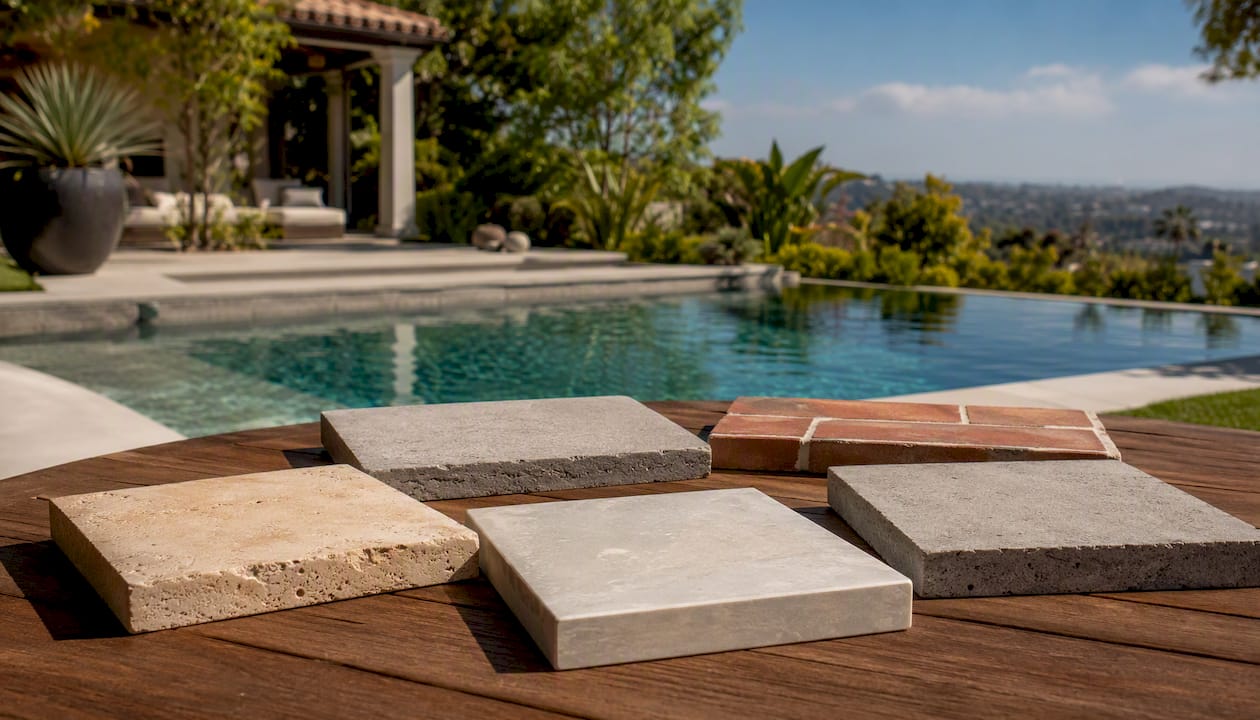
For cool, safe barefoot comfort, choose honed travertine. For a modern, low-maintenance edge, choose porcelain. For long-term durability in a demanding climate, dense granite or well-sealed travertine wins. For a heritage or traditional look, brick or a tumbled limestone edge fits best. For a cantilevered, cost-conscious structural edge, poured concrete does the job.
Here's the fast-reference version before we get into the reasoning:
- Barefoot comfort in full sun: Travertine (honed or tumbled finish) stays noticeably cooler than concrete or dark porcelain.
- Modern, low-fuss edge: Porcelain resists staining, chlorine, and salt, and never needs sealing.
- Maximum longevity, any climate: Dense granite or a properly sealed travertine with low water absorption.
- Classic or traditional aesthetic: Brick or a tumbled natural stone with softened edges.
- Budget-conscious structural edge: Poured, cantilevered concrete with a broom or knockdown finish.
Every one of those recommendations assumes the coping gets installed correctly. Pro Tip: A beautiful material poorly installed will fail faster than a modest material installed right. Waterproofing at the shell-to-coping joint, a proper bond beam, and correctly placed expansion joints matter as much as the stone or tile you pick. We'll cover exactly what that means for your contract further down.
Key Takeaways
Choosing the right pool coping depends on matching material and profile to your climate, barefoot comfort needs, and maintenance appetite, then verifying your contractor's installation details before signing.
| Point | Details |
|---|---|
| Match material to goal | Travertine for barefoot comfort, porcelain for low maintenance, concrete for cost-conscious cantilever edges. |
| Installation quality outranks material choice | A clean bond beam, wet-rated mortar, waterproofing, and movement joints prevent premature failure. |
| Maintenance is light but non-optional | Reseal natural stone every one to three years and inspect joints annually for gaps or cracking. |
| Vet contractors before signing | Ask for ASTM absorption numbers, mock-up samples, and a clear waterproofing and joint plan. |
| Modern Yardz builds it as one project | A design-build team delivers 3D-rendered coping plans, permitting, and construction under one contract. |
Table of Contents
- What Are Pool Coping Options and Why Do They Matter?
- Which Pool Coping Materials Should You Consider?
- Which Coping Material Fits Your Top Priority?
- What Edge Profiles Work Best for Pool Coping?
- What Are the Non-Negotiable Installation Requirements?
- How Much Does Pool Coping Cost?
- How Do You Choose the Right Coping for Your Pool?
- How Do You Maintain Pool Coping Over Time?
- Are Some Pool Coping Materials More Sustainable?
- How Long Do Different Coping Materials Actually Last?
- What Priorities Guide a Contractor's Coping Recommendation?
- How Modern Yardz Approaches Pool Coping and Pool-Edge Design
- Sources
What Are Pool Coping Options and Why Do They Matter?
Pool coping is the cap that runs along the top edge of your pool shell, the transition piece between the waterline tile and the surrounding deck. It's the material your hand lands on when you pull yourself out of the water, the surface your foot tests before stepping in, and the visual frame that makes a pool look finished rather than merely dug and filled.
Homeowners often assume coping is decorative trim. It's structural and functional first, decorative second. A well-specified coping system does five distinct jobs:
- Protects the bond beam — the reinforced concrete edge of the pool shell — from water intrusion and cracking.
- Controls water runoff, directing splash-out away from the pool rather than back underneath the deck.
- Provides a safe grip and seating surface for swimmers entering, exiting, or resting at the edge.
- Allows independent movement between the pool shell and the surrounding deck, which settle and expand at different rates.
- Finishes the design, tying the pool's waterline tile to the deck material and the broader landscape palette.
When you're discussing your project with a contractor or fabricator, take a photo that shows the waterline tile, the coping edge, and where the deck begins in one frame. That single image tells a stone yard or design team more about scale, radius, and finish requirements than a verbal description ever will.
Which Pool Coping Materials Should You Consider?
Six material families dominate residential pool coping, and each carries genuine trade-offs in comfort, durability, and upkeep. Here's how they actually perform once they've been in the ground a few years.
Travertine and natural stone. Travertine remains the top choice for luxury pools because it stays cooler underfoot than concrete or darker stones even in direct San Diego sun, and its naturally textured, honed, or tumbled finish provides excellent slip resistance. Granite and limestone offer similar comfort with different veining and color ranges. The trade-off: natural stone needs periodic sealing, and lower-grade stone with high porosity can absorb pool chemicals and stain if it isn't properly treated.
Porcelain. Porcelain has become the default for homeowners who want a crisp, contemporary edge with almost no upkeep. It offers near-zero water absorption and strong resistance to chlorine, saltwater, staining, and fading, and its manufactured consistency means every piece matches. The catch is installation precision. Porcelain doesn't forgive a sloppy base or uneven joints the way a natural stone with more texture can.
Precast concrete pavers. These deliver a stone-like look at a lower material cost and install faster because pieces arrive uniform and ready to set. Precast coping handles moderate climates well, though lower-end mixes can be more porous than natural stone or porcelain, which shortens lifespan in freeze-prone regions.
Poured, cantilevered concrete. A cantilevered pour creates a seamless, monolithic edge that reads as clean and minimal, and it's generally the most cost-effective way to achieve that look. The compromise is long-term cracking risk. Poured concrete is more prone to hairline cracks over a decade or two than dense stone or well-installed porcelain, particularly where the bond beam experiences any settling.
Brick. Brick coping delivers a traditional, warm aesthetic that suits Spanish, Mediterranean, and classic estate architecture. It grips well when wet and holds up structurally, though the mortar joints require more frequent inspection than a monolithic material.
Tile and composite coping. Pool-rated tile, distinct from standard floor or wall tile, can work as coping on smaller or budget-conscious pools, but it demands a rating specifically for wet, outdoor, load-bearing use. Standard interior tile used as coping is a common and costly mistake.
| Comparison Point | Travertine / Natural Stone | Porcelain | Precast Concrete | Poured Cantilever | Brick |
|---|---|---|---|---|---|
| Best for | Barefoot comfort, luxury builds | Modern low-maintenance edges | Moderate climates, faster installs | Minimalist budgets | Traditional/heritage design |
| Durability | High with sealing | High | Moderate | Moderate, crack risk over time | High with joint upkeep |
| Slip resistance (wet) | Excellent (honed/tumbled) | Good (textured finish) | Good | Moderate (depends on finish) | Good |
| Heat retention | Low (stays cool) | Moderate | Moderate to high | High | Moderate |
| Water absorption | Low if sealed, varies by stone | Near zero | Moderate | Low once cured | Moderate |
| Maintenance | Periodic resealing | Minimal | Low | Low | Joint inspection |
| Installation complexity | High (skilled fabrication) | High (precision-dependent) | Moderate | Moderate | Moderate |
| Typical cost range | Medium to high | Medium to high | Low to medium | Low to medium | Medium |
On cost banding: travertine and porcelain generally sit in the medium-to-high tier, precast concrete and brick land in the low-to-medium tier, and poured cantilever concrete is typically the least expensive per foot. Curved pools, custom radii, and premium stone selections push any material toward the top of its band.
Which Coping Material Fits Your Top Priority?
If you're narrowing a shortlist, it helps to rank materials against the single priority that matters most to you rather than trying to optimize for everything at once.
| Your Priority | Best Match | Runner-Up |
|---|---|---|
| Cool underfoot in full sun | Travertine (honed/tumbled) | Light-toned granite |
| Lowest ongoing maintenance | Porcelain | Precast concrete |
| Contemporary, minimal look | Porcelain or eased travertine | Poured cantilever concrete |
| Maximum longevity | Dense granite or sealed travertine | Precast concrete |
| Lowest installed cost | Poured cantilever concrete | Precast concrete |
Weigh your climate and how the space actually gets used before you weigh style. A pool that sees bare feet on hot afternoons all summer has different priorities than a pool used mainly at dusk for entertaining.
What Edge Profiles Work Best for Pool Coping?
The material is half the decision. The profile, meaning the shape of the edge itself, is the other half, and it changes comfort, safety, and how the whole pool reads visually.
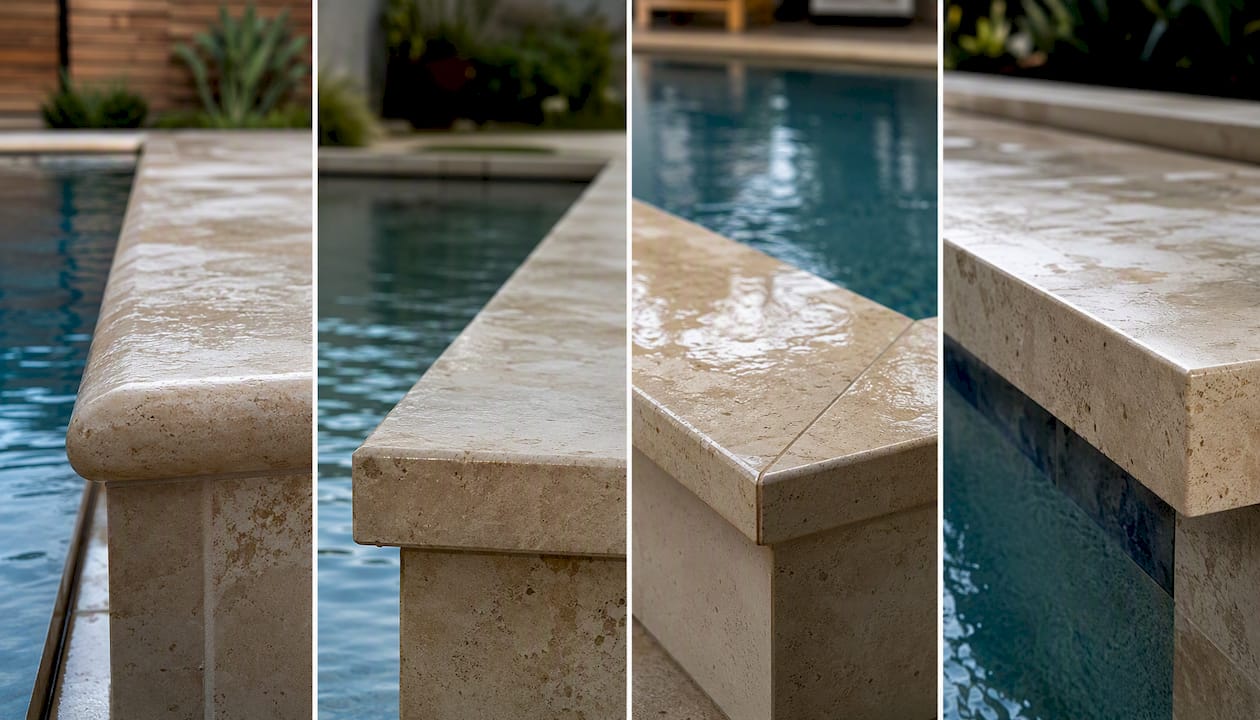
Bullnose is a fully rounded edge, the most common profile for residential pools because it eliminates sharp corners entirely. It's comfortable to sit on and forgiving for kids running near the water, and it pairs naturally with travertine, granite, and porcelain alike.
Eased or square edge softens just the top corner slightly rather than rounding the whole face. This profile is having a real moment in contemporary design because it preserves the crisp geometric line architects want without the harshness of a true 90 degree corner underfoot.
Mitered corners are cut at precise angles so the coping wraps a corner with a seamless, continuous line rather than a butted joint. They photograph beautifully on rectangular and geometric pools but demand exacting fabrication, since a poorly cut miter is one of the most visible flaws on an otherwise clean build.
Cantilever extends the coping material a few inches past the pool wall with no visible edge underneath, creating a shadow line that reads as floating. It's the signature look for modern infinity-adjacent and vanishing-edge designs.
Drop-face edge drops vertically at the pool-facing side rather than sloping, giving a tailored, architectural profile that's popular in geometric lap pools and minimalist courtyards.
For seating comfort, bullnose wins outright. For toe-catch risk, avoid a true square edge anywhere swimmers will walk barefoot; even a slight ease removes the hazard. For water diversion, cantilever and drop-face profiles shed water cleanly away from the deck.
Pro Tip: Require radiused rather than hard corners anywhere the coping meets a step, bench, or spa spillway. A hard 90 degree stone corner at a high-traffic pivot point is one of the most common places we see chipping within the first two years.
What Are the Non-Negotiable Installation Requirements?
Any competent coping installation rests on five non-negotiable elements: a clean, properly formed bond beam, mortar rated for submerged and wet-area use, a waterproofing membrane at the coping-to-shell interface, correctly placed expansion joints, and the right overhang and backcut for the chosen profile. Skip any one of these and you're financing a repair project, not a finished pool edge.
- Clean, level bond beam. The bond beam is the poured concrete ring at the top of the pool shell. It must be properly cured and free of debris before coping is set.
- Wet-area rated mortar. Standard thin-set is not built for constant moisture exposure at a waterline. Mortar and setting materials need a rating for submerged or wet-area application.
- Waterproofing membrane. A membrane at the shell-to-coping junction stops water from tracking behind the coping and undermining the bond beam over time.
- Expansion and movement joints. Coping needs joints filled with a flexible backer rod and sealant, in line with TCNA EJ171 movement-joint guidance, so the deck and pool shell can move independently without cracking the coping itself.
- Correct overhang and backcut. The overhang, typically an inch or so past the tile line, needs a backcut underneath so water drips off cleanly instead of tracking back toward the shell.
Treating coping as a purely decorative finish, rather than a structural transition, is the single most common mistake homeowners and even some contractors make. Skipped waterproofing and missing movement joints are the root cause behind most premature cracking, loose stone, and bond-beam damage seen in pool coping failures.
Pro Tip: Have natural stone pre-sealed in the fabricator's shop before it ever reaches your site, then request a routed drip groove on the underside of the overhang. That groove breaks the surface tension of water running along the bottom of the coping, keeping it from tracking back and staining the bond beam.
In colder-climate installations, stone selection also needs to account for freeze-thaw cycling. Stone with water absorption above roughly 5% under ASTM C97 testing is generally a poor fit for regular freezing conditions, since absorbed moisture that freezes and expands inside the stone accelerates spalling. San Diego's climate rarely tests this, but it matters if you're comparing stone sourced or recommended for other regions.
How Much Does Pool Coping Cost?
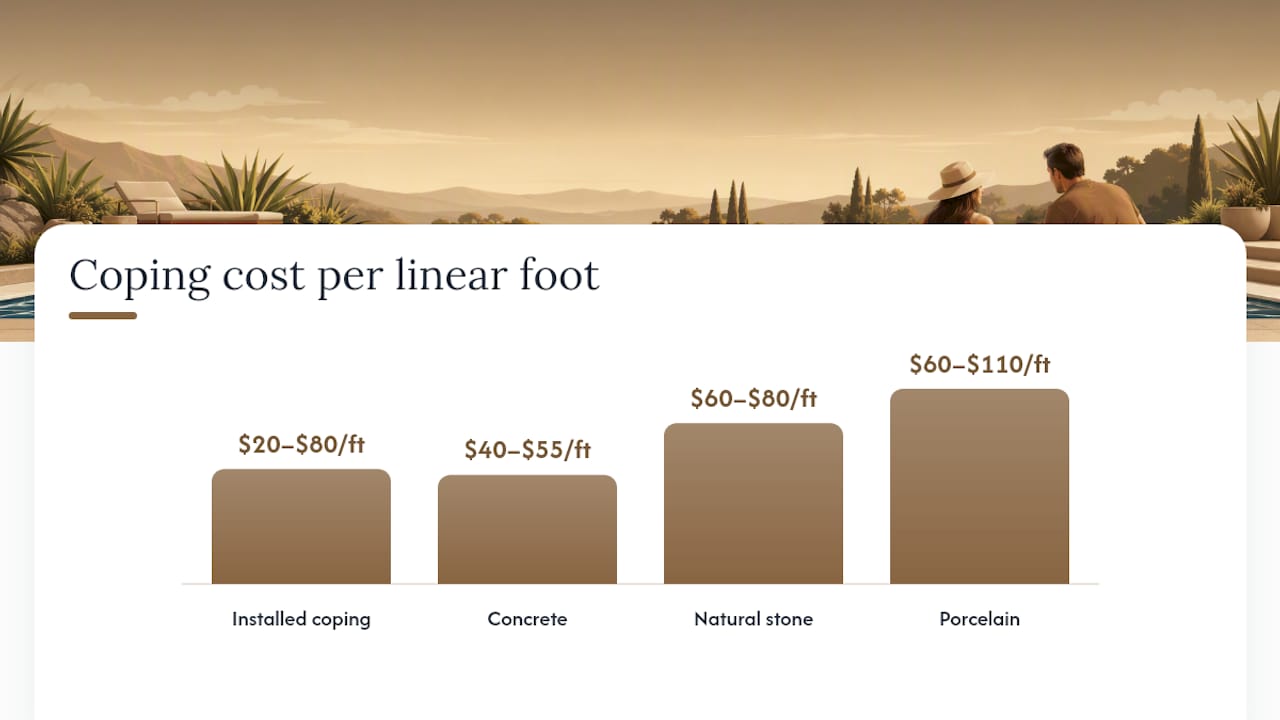
Installed coping typically runs $20 to $80 per linear foot depending on material, with most residential projects landing between $2,000 and $7,000 for a full perimeter. HomeGuide's cost data breaks that down further by material: concrete generally runs $40 to $55 per linear foot installed, natural stone $60 to $80, and porcelain anywhere from $60 to $110 depending on region and finish complexity.
Several factors push a bid toward the top or bottom of these ranges:
- Pool shape and curves. Freeform and kidney-shaped pools require more cutting and custom pieces than a straight rectangular lap pool.
- Removal of old coping. A remodel that demolishes and hauls away existing coping adds real labor cost before a single new piece goes down.
- Corner radii and custom fabrication. Mitered corners and radiused bullnose returns take a fabricator significantly more shop time than straight runs.
- Travel and hauling for heavy stone. Dense granite and thick travertine slabs cost more to transport and set than lighter precast or porcelain pieces.
- Site access. A backyard with tight side-yard access or no crane clearance adds labor hours that a straightforward front-loaded lot won't.
- Contractor experience and trade sequencing. Coping has to be coordinated with waterline tile, plaster or PebbleTec, and deck pours; a design-build team managing all of it under one schedule avoids the delays that come from juggling separate subcontractors.
Example scenario: a typical residential pool with a 90 to 100 linear foot perimeter, coped in travertine at roughly $65 per linear foot installed, lands in the $5,850 to $6,500 range for the coping line item alone, before waterline tile, decking, or the pool shell itself.
How Do You Choose the Right Coping for Your Pool?
Start by ranking your own priorities honestly, because the "best" material shifts depending on what you weigh first.
- Primary use of the pool — daily family swimming, entertaining, or a design showpiece changes how much traffic and bare feet the edge needs to handle.
- Barefoot comfort tolerance — if hot stone underfoot is a dealbreaker, that eliminates darker, denser materials in full-sun exposures.
- Climate — freeze-thaw cycling, intense UV, and coastal salt air each favor different materials and sealing schedules.
- Saltwater exposure — saltwater chlorination systems are harder on some natural stones and mortars than traditional chlorine.
- Desired aesthetic — contemporary, Mediterranean, and traditional styles each pull toward different materials and profiles.
- Maintenance appetite — be honest about whether resealing stone every couple of years is realistic for your household.
- Budget and timeline — cantilever concrete and precast pavers install faster and at lower cost than fabricated stone with custom miters.
Before you sign a contract, ask your contractor these questions:
- Can you show job-specific ASTM water absorption numbers for the stone you're proposing?
- Do you have mock-up photos or a sample board of the exact finish and profile?
- What's your method for waterproofing the coping-to-shell interface and placing movement joints?
- How do you fabricate mitered corners, and can I see examples from a prior project?
- What warranty covers the coping specifically, separate from the pool shell?
Watch for these red flags in a bid: no mention of waterproofing anywhere in the scope of work, vague or undefined joint detail, or a quote that specifies interior-rated tile for a coping application. Any of those should stop the conversation until the scope is clarified.
How Do You Maintain Pool Coping Over Time?
Coping maintenance is light compared to most exterior hardscape, but ignoring it entirely shortens the life of even premium materials. A simple annual check catches problems while they're still cosmetic rather than structural.
- Inspect joints and grout lines once a year for gaps, cracking, or missing sealant around expansion joints.
- Reseal natural stone roughly every one to three years depending on sun exposure and traffic; porcelain never needs sealing.
- Clean regularly with a pH-neutral cleaner rather than harsh acids, which can etch stone and dull porcelain glazes over time.
- Check saltwater systems more frequently, since salt chlorination is harder on unsealed stone and certain mortars than traditional chlorine.
Watch for these warning signs, and photograph them the moment you notice: rocking or loose coping pieces, repeating white efflorescence stains, chipped mitered corners, cracks running into the bond beam, or visible water sitting inside a joint after the deck has dried. A single hairline crack you can document and monitor is a homeowner task. Rocking coping or water tracking into the bond beam means it's time to call a professional before the damage spreads underneath.
Are Some Pool Coping Materials More Sustainable?
Material choice affects your pool's environmental footprint in ways most homeowners never think to ask about. Natural stone like travertine and granite is quarried and requires transport energy, but it's also essentially permanent. A properly sealed and installed stone edge can outlast the pool shell itself, which means the embodied energy of quarrying gets amortized over decades rather than a single remodel cycle.
Porcelain requires significant kiln energy to manufacture but produces a denser, more chemically inert final product that resists replacement far longer than lower-grade concrete pavers. Precast and poured concrete carry a smaller upfront manufacturing footprint but a shorter practical lifespan in many cases, which means more frequent replacement and more material heading to landfill over a 30 or 40 year ownership horizon.
The most sustainable coping decision, in practical terms, isn't about picking a single "green" material. It's about choosing a material and installation quality that avoids a premature tear-out. A cantilevered concrete edge that cracks and needs replacement in 12 years has a worse lifecycle footprint than a well-sealed travertine edge still performing at 30 years, regardless of which material took more energy to produce initially.
How Long Do Different Coping Materials Actually Last?
Longevity depends less on the material family and more on fabrication quality, sealing discipline, and climate exposure, but some patterns hold consistently across San Diego and coastal Southern California projects.
Dense natural stone with low water absorption, properly sealed and resealed on schedule, routinely performs for 30 years or more with only cosmetic touch-ups. Porcelain, given its near-zero absorption, holds up similarly well structurally, though its long-term performance depends entirely on installation precision at the outset since the material itself won't degrade. Precast concrete typically delivers a solid 15 to 25 years before surface wear or minor cracking becomes noticeable. Poured cantilever concrete is the most variable: some installations perform for decades, while others develop hairline cracking within 10 to 15 years, particularly where the bond beam experiences settling or where control joints weren't spaced correctly.
Coastal salt air, a factor for any pool near La Jolla, Del Mar, or Coronado, accelerates wear on lower-grade mortars and unsealed porous stone faster than inland installations see. It's a strong argument for specifying denser materials and tighter joint detailing anywhere near the coast.
What Priorities Guide a Contractor's Coping Recommendation?
When Modern Yardz specifies coping for a project, three priorities drive the decision before aesthetics ever enter the conversation: performance and durability under the specific site's conditions, tactile comfort and safety for the people who'll actually use the pool barefoot, and architectural alignment between the coping and the rest of the hardscape palette.
That order matters. A stunning stone that performs poorly in a coastal microclimate, or a profile that looks sharp in a rendering but catches toes at the top step, isn't a design win regardless of how it photographs. As a design-build firm holding California Contractor License #1082881 and having completed more than 2,900 projects across San Diego County, the firm has seen firsthand which coping decisions age well and which ones become expensive lessons.
On a recent backyard remodel, the original scope called for a poured concrete cantilever edge to match a strict budget target. After walking the client through the freeze-thaw irrelevance but salt-air relevance of the coastal site, along with a side-by-side sample comparison, the project shifted to a honed travertine bullnose with a routed drip groove. Five years later, that edge shows no cracking and has needed only its scheduled resealing.
[Author bio: Thomas Jackson writes on landscape design, hardscape materials, and outdoor construction standards for homeowners planning premium residential projects.]
How Modern Yardz Approaches Pool Coping and Pool-Edge Design
Modern Yardz delivers coping and pool-edge work as part of a single design-build process, not a bid handed to a separate subcontractor. You'll see photo-realistic 3D renderings of your exact coping material, profile, and corner details before construction ever begins, so there's no guessing at how a mitered travertine bullnose will actually look against your waterline tile and deck.
That's the real advantage over piecing a project together yourself across a pool builder, a stone fabricator, and a deck contractor: one team, holding California Contractor License #1082881 and a completed track record of more than 2,900 projects across San Diego County, manages consultation through final walkthrough with a single point of contact. Waterproofing, movement joints, and fabrication all get coordinated under one schedule instead of getting lost between three separate crews pointing fingers at each other.
If you're planning a new pool or evaluating whether your current coping needs replacing, start with a free consultation and design review. Bring photos of your existing edge or inspiration images, and the team will walk you through which materials and profiles fit your site, your climate exposure, and how you actually use your pool.
Sources
- Natural Stone Pool Coping: Selection, Fabrication, and Install – Dynamic Stone Tools
- Pool Coping Ideas: Materials, Edges & Costs for 2026 | PoolPad
- How Much Does Pool Coping Cost? (2026) | HomeGuide
Recommended
Start Your Free Design Consultation
Tell us about your project and we'll be in touch within 24 hours. No pressure, no obligation.
Ready to design your dream yard?
Tell us about your project. We'll send back a real plan, not a templated quote.
Book My Free Consultation→

