
The Best Outdoor Kitchen Countertop Materials for Every Climate
Discover the best outdoor kitchen countertop materials for any climate. Learn which options are durable, stylish, and low-maintenance.
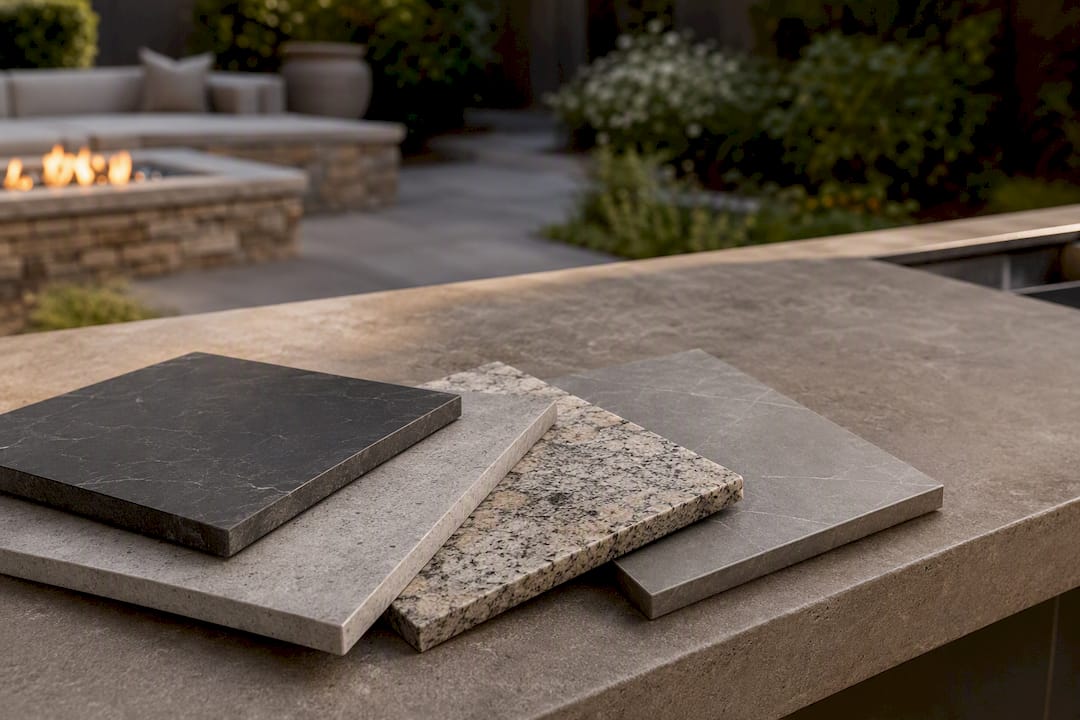
Seven materials hold up outdoors: porcelain (sintered stone), granite, stainless steel, soapstone, concrete, porcelain tile, and quartzite. For most outdoor kitchens, porcelain slabs are the strongest overall pick because they resist UV fading, survive freeze-thaw cycles without cracking, and never need sealing, a genuine advantage over every natural stone on this list. Two materials deserve an immediate warning: engineered quartz and marble. Quartz's resin binders yellow under direct sun within a year or two, and manufacturers generally won't warranty an outdoor installation. Marble stains and etches too easily to survive a working grill station.
Here's the full lineup worth considering for an exposed outdoor kitchen:
- Porcelain slabs (sintered/vitrified stone)
- Granite
- Stainless steel
- Soapstone
- Concrete (custom cast)
- Porcelain tile
- Quartzite
Key Takeaways
Porcelain slabs are the most reliable outdoor countertop material because they resist UV, survive freeze-thaw cycles, and never need sealing, while quartz and marble should be avoided outdoors entirely.
| Point | Details |
|---|---|
| Porcelain leads for most climates | Near-zero water absorption and no sealing make it the strongest all-around choice. |
| Avoid quartz and marble outdoors | Quartz yellows under UV within a couple of years; marble stains and etches too easily. |
| Match material to climate first | Coastal and freeze-thaw zones need porcelain, soapstone, or marine-grade 316 stainless steel. |
| Weight drives structural needs | Granite can weigh three to four times more per square foot than porcelain, changing framing requirements. |
| Professional installation prevents failure | Modern Yardz's design-build model unifies material selection and structural framing under one team, avoiding the handoff errors that cause premature cracking. |
Table of Contents
- Outdoor Countertop Materials Ranked by Climate Performance
- Comparing the Seven Viable Outdoor Countertop Materials
- How to Choose the Right Material for Your Climate and Layout
- Installation and Maintenance That Determine Longevity
- Why Material Selection Is a Structural Decision, Not Just a Style Choice
- What the Conventional Advice Gets Wrong
- Build It Once, Build It Right With Modern Yardz
- Sources
Outdoor Countertop Materials Ranked by Climate Performance
Ranking these by real-world durability rather than showroom appeal changes the conversation fast. Porcelain slabs test at less than 0.05% water absorption under ISO 10545-3, which is the industry benchmark for how a slab handles freeze-thaw exposure without micro-cracking. That density is why sintered stone dominates coastal and mountain projects alike.
- Porcelain slabs: near-zero absorption, no sealing, installed cost roughly $65 to $175 per square foot.
- Granite: excellent heat and UV tolerance, but porous enough to need resealing every 6 to 12 months outdoors.
- Stainless steel: unaffected by moisture or heat; coastal projects need 316 marine-grade alloy, not standard 304.
- Soapstone: dense, low-maintenance, heat-tolerant, but limited to dark, muted color tones.
- Concrete: fully customizable in shape and pigment, but vulnerable to cracking without proper reinforcement.
- Quartzite: a durable natural alternative to marble, though slab quality varies enormously.
- Porcelain tile: the lowest cost entry point, weakened by grout joints in freeze-prone regions.
Skip engineered quartz and marble entirely for any counter that sees direct sun, rain, or a grill's radiant heat. Both were engineered or quarried with indoor conditions in mind, and outdoor exposure exploits exactly the weaknesses their indoor use hides.
Comparing the Seven Viable Outdoor Countertop Materials
Porcelain and sintered stone
Porcelain slabs (the category that includes Dekton, Neolith, and SapienStone-style products) are manufactured by compressing mineral powders under extreme heat and pressure, which is why they behave nothing like ceramic tile. The result is a surface with virtually no porosity, so it won't absorb wine, oil, or salt spray, and it never needs sealing. Fabrication does require specialized diamond tooling and precise edge mitering, since ultra-dense porcelain can chip during standard cutting if the fabricator isn't experienced with the material. Expect $65 to $175 per square foot installed, and confirm your fabricator has handled sintered stone before hiring them.
Granite
Granite has earned its reputation the hard way, decades of outdoor use across every climate zone. It shrugs off heat from a grill sitting a few feet away and won't fade in direct sun. The catch is porosity: granite needs sealing roughly every 6 to 12 months outdoors, more often in coastal air, or it will absorb moisture and stain. Choose an un-resinated slab specifically rated for exterior use, since some granite is treated with resins that break down under UV exposure. Installed pricing runs $55 to $200 per square foot depending on rarity and finish.
Concrete
Custom cast concrete gives you shapes, edge profiles, and pigment options no slab material can match, integrated drainboards, waterfall edges, embedded lighting channels. The trade-off is real: concrete is prone to cracking without proper reinforcement, and it needs regular sealing to resist staining and moisture intrusion. The difference between a concrete counter that lasts decades and one that hairline-cracks within two seasons almost always comes down to whether the fabricator used adequate steel or fiber reinforcement before the pour.
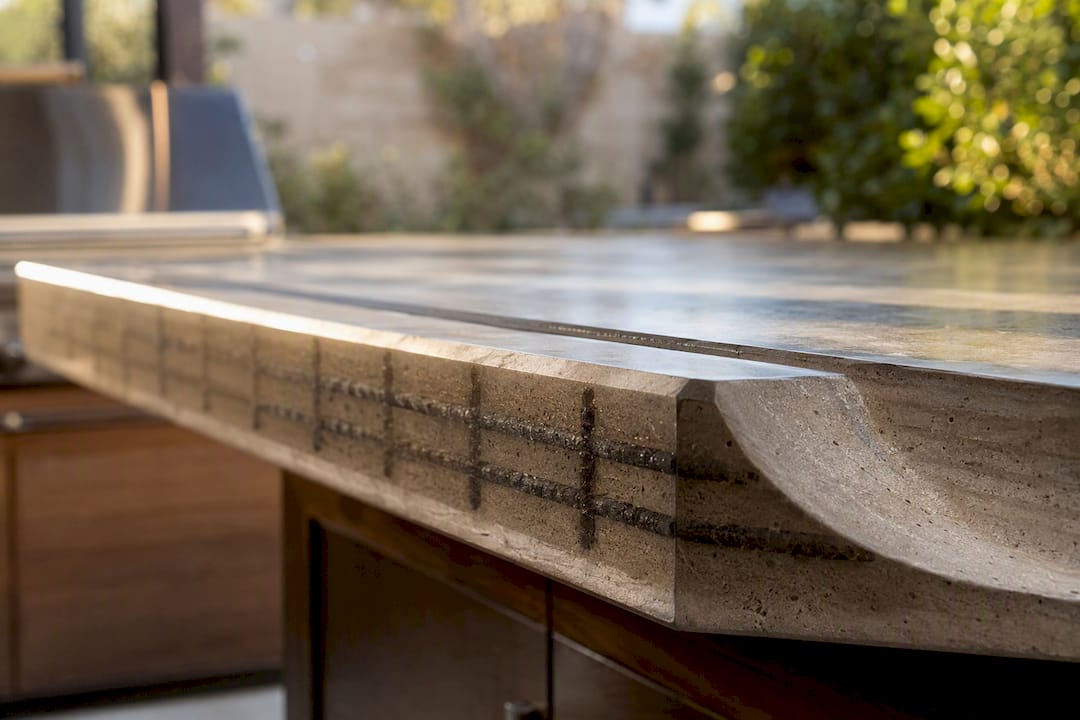
Pro Tip: Ask any concrete fabricator to show you a completed outdoor project that's at least three years old. Fresh concrete photos hide nothing; aged concrete reveals everything about their reinforcement technique.
Soapstone
Soapstone is the quiet performer on this list. It's dense, resists heat well enough to set a hot pan directly on it, and needs only occasional mineral oil rather than a structural sealer. Its limitation is color: soapstone comes almost exclusively in grays and dark greens, so it won't work for a homeowner set on a bright or light-toned island.
Stainless steel
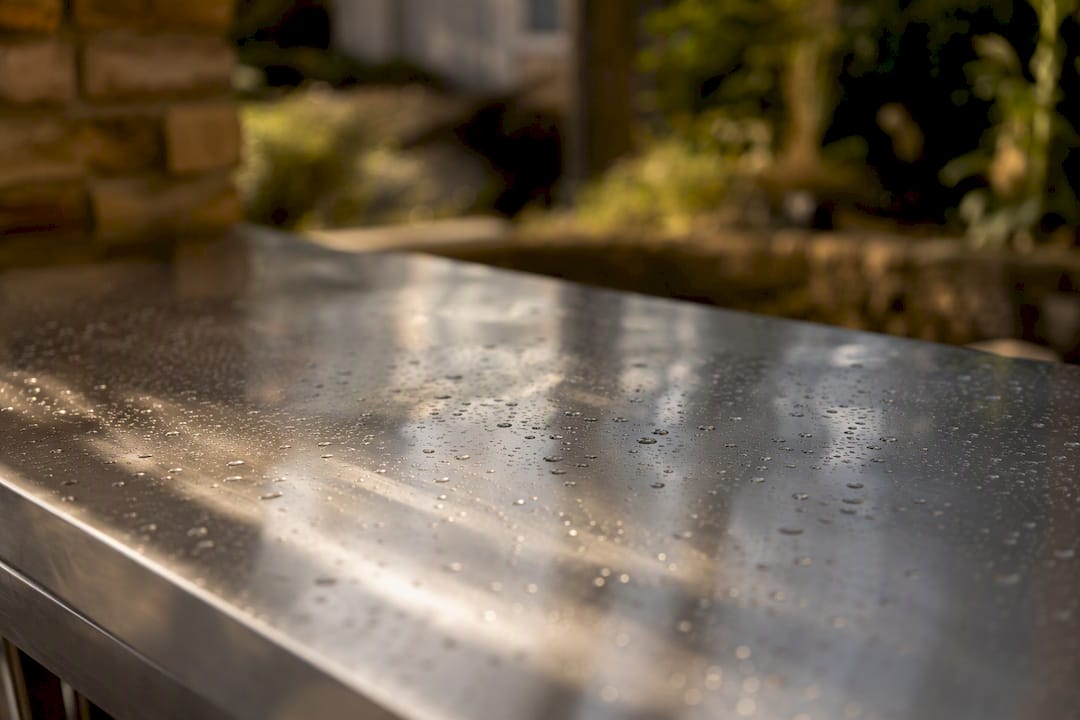
Stainless steel counters read as commercial-grade because they essentially are. Heat, moisture, and grease are non-issues. The one decision that matters is alloy grade: 316 stainless resists pitting and corrosion in salt air far better than standard 304, which makes it the required choice for any property within a few miles of the coast. The aesthetic trade-off is real, though. Stainless shows fingerprints and scratches more visibly than stone, and some homeowners find the look too industrial for a resort-style backyard.
Porcelain tile
Porcelain tile is the entry point for homeowners prioritizing upfront cost over long-term ease. It handles heat and UV reasonably well, but grout lines are the weak point, staining faster than the tile itself and cracking in true freeze-thaw climates. Tile works better as a mild-climate, covered-patio solution than as an install exposed to hard winters.
Quartzite
Quartzite is the natural stone version of the "marble look" without marble's fragility, but slab quality varies enormously by quarry. Some quartzite is nearly as hard as granite; other slabs sold under the same name are softer and closer to marble's porosity. Confirm the specific slab's hardness and sealing requirements before committing, since not every quartzite slab performs the same outdoors.
How to Choose the Right Material for Your Climate and Layout
Start with climate, not aesthetics. Freeze-thaw regions need dense, low-absorption materials, porcelain, soapstone, or a sealed granite, because water trapped in a porous surface expands when it freezes and cracks the stone. Coastal properties need either porcelain or 316 stainless steel; standard 304 stainless and resinated granite both degrade faster in salt air.
- Filter by climate first: freeze-thaw and coastal zones narrow you to porcelain, soapstone, or marine-grade stainless.
- Filter by use zone next: the section next to the grill takes the most direct heat and grease, so prioritize porcelain, stainless, or soapstone there; save granite or concrete for bar and serving zones with less thermal stress.
- Filter by maintenance willingness: porcelain, stainless, and soapstone require essentially none; granite, concrete, and quartzite need annual resealing.
A fully exposed island in direct sun and rain should lean toward porcelain or stainless. A shaded, covered kitchen has more flexibility. If it sits under a solid roof structure, granite or well-sealed concrete can perform beautifully with far less UV stress than an open-air layout.
| Priority | Best-fit materials |
|---|---|
| Freeze-thaw climate | Porcelain, soapstone, sealed granite |
| Coastal salt air | Porcelain, 316 stainless steel |
| Zero maintenance | Porcelain, stainless steel, soapstone |
| Willing to reseal annually | Granite, concrete, quartzite |
Installation and Maintenance That Determine Longevity
Weight changes everything about how a countertop gets supported. Porcelain runs roughly 6 pounds per square foot at 12mm thickness, while 3cm granite runs 18 to 24 pounds, which means granite islands need heavier substrate framing and stronger anchoring than porcelain ones.
- Reseal porous stone (granite, quartzite, concrete) every 6 to 12 months with a penetrating sealer rated for exterior use.
- Avoid citrus-based or acidic cleaners on natural stone; they etch the surface over time.
- Ask your fabricator directly whether the slab is rated for outdoor UV and freeze-thaw exposure, not just "durable."
- Confirm overhangs on porcelain are minimized or supported with hidden brackets, since unsupported ledges risk chipping under point load.
Pro Tip: If your contractor can't tell you the sealer's reapplication interval off the top of their head, that's a sign they haven't installed much stone outdoors.
Why Material Selection Is a Structural Decision, Not Just a Style Choice
Choosing a countertop material is really a structural engineering decision wearing an aesthetic disguise. A 3cm granite slab weighing 18 to 24 pounds per square foot demands framing calculations that a 6-pound porcelain slab never triggers, and getting that wrong shows up as cracked grout, sagging cabinetry, or a counter that separates from its base within a few seasons.
Modern Yardz has built outdoor kitchens across San Diego County for more than three decades, backed by California Contractor License #1082881 and over 2,900 completed projects with a 5.0-star Google rating.
A countertop is only as good as the structure underneath it. We've seen beautiful granite fail because the framing was calculated for porcelain's weight instead. Material selection has to happen alongside structural design, not after it.
Complex layouts, coastal corrosion risk, or heavy natural stone slabs are exactly the situations where a specialized design-build team earns its fee: one crew handling substrate, framing, and slab selection means nothing gets lost between the person who designed the island and the person who built it.
What the Conventional Advice Gets Wrong
Most guides to outdoor countertop materials rank options by looks first and durability second. That ordering is backwards for anyone building a kitchen meant to last twenty years in full sun. The judgment this research actually supports is blunt: porosity and UV stability should eliminate most of your options before color or veining ever enters the conversation.
The conventional advice also underplays installation risk. Every material on this list can fail prematurely, not because the material itself is flawed, but because it was installed by someone unfamiliar with outdoor-specific substrate and sealing requirements. A concrete counter with proper reinforcement outlasts a poorly installed granite slab, full stop.
What readers should prioritize first is climate fit, not showroom preference. Decide whether you're in a freeze-thaw zone or a coastal corridor before you fall in love with a slab pattern. Once that filter narrows your list to two or three materials, aesthetics can finally take the wheel. Skipping that order is how homeowners end up resealing granite every ninety days or watching a quartz island yellow by its second summer.
Build It Once, Build It Right With Modern Yardz
Reading about porcelain versus granite is useful. Getting the substrate, framing, and slab selection right on the first attempt is what actually protects your investment, and that's where most outdoor kitchen projects go wrong when multiple contractors are involved. Modern Yardz runs the entire process under one roof: consultation, 2D architectural plans, photo-realistic 3D renderings, permitting, material procurement, and construction, all with a single point of contact from the first conversation to the final walkthrough. There are no subcontractor handoffs where a stone fabricator's assumptions about framing don't match what the general contractor actually built.
Founded in 2018 and holding California Contractor License #1082881, Modern Yardz has completed more than 2,900 projects across San Diego County with a 5.0-star Google rating. Browse the completed outdoor kitchen projects in the portfolio, then schedule a consultation to start your own 3D rendering before a single stone gets cut.
Sources
- Outdoor Countertop Materials That Survive Weather (2026) | SlabWise
- Outdoor kitchen countertop options | HGTV
Recommended
Start Your Free Design Consultation
Tell us about your project and we'll be in touch within 24 hours. No pressure, no obligation.
Ready to design your dream yard?
Tell us about your project. We'll send back a real plan, not a templated quote.
Book My Free Consultation→

