Avoid Costly Repours: Design First Pool Equipment Placement for Homeowners
Learn how to place and size your pool equipment pad with a design-first approach homeowners can verify on site. Avoid costly repours and airflow problems.
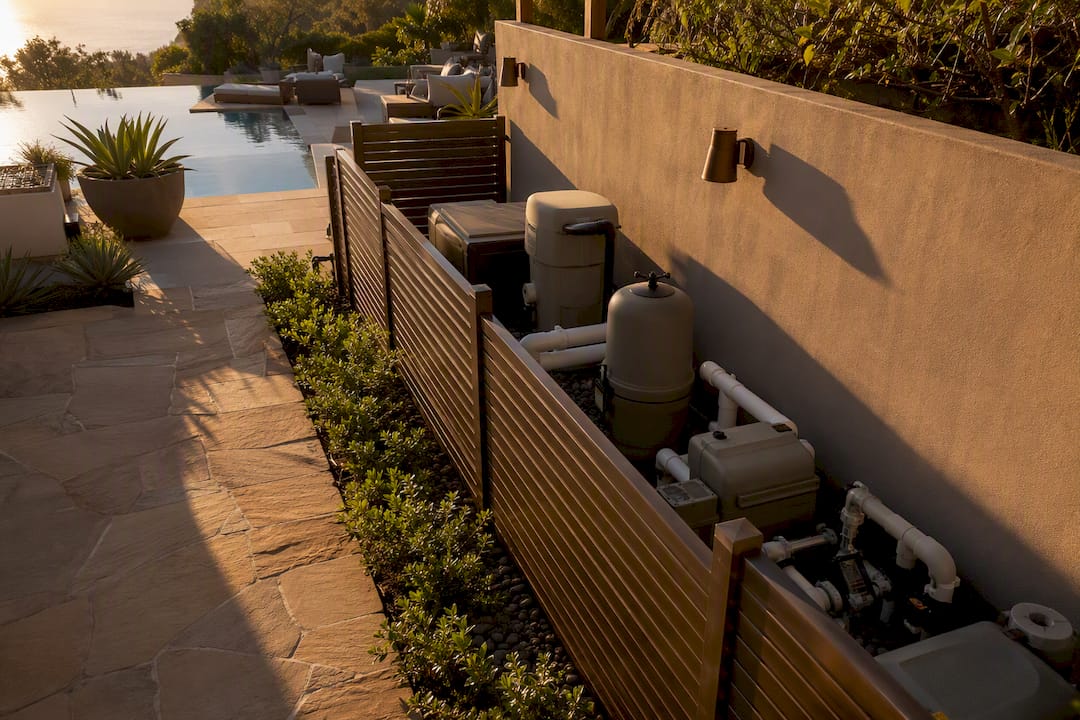
Place your pool equipment on a properly sized, drained pad set as close to pool water level as your site allows, and follow correct pipe and pump sizing when that elevation isn't possible. Everything else, screening, noise control, service access, follows from that one decision. Before you pour a slab, confirm your layout against NEC Article 680 and local heater clearance rules, or have a design-build professional verify it for you.
TL;DR: - Placing the equipment pad at or below pool water level with correct pipe sizing minimizes energy use, head loss, and priming issues. - Equipment should be sequenced with the pump first, then filter, heater, and sanitizer in a straight flow path to avoid pressure and repair problems. - The ideal pad size exceeds your current needs by at least 20 percent to allow future upgrades, with proper clearance, drainage, and electrical access. - Position the pad to optimize hydraulics, drainage, noise control, and ease of maintenance, considering site topography and surrounding structures. - Proper screening should balance aesthetics and airflow, using baffles or slatted fencing, while equipment placement should be integrated into overall landscape design.
Table of Contents
- Where Should Pool Equipment Be Placed?
- How Should Pool Equipment Be Sequenced on the Pad?
- What Is the Ideal Pump Elevation and Pipe Sizing?
- How Big Should the Equipment Pad Be?
- How Do You Hide Pool Equipment Without Blocking Airflow?
- How Modern Yardz Designs Equipment Pads for Luxury Pools
- What the Research Gets Right, and What It Leaves Out
- Ready to Plan Your Pool Equipment the Right Way?
- Sources
Where Should Pool Equipment Be Placed?
Every backyard has three realistic zones for a pool equipment pad, and each one trades something away. Choosing wrong means retrofitting sound walls later or, worse, re-trenching pipe.
A pad set near the pool at grade minimizes plumbing runs and head loss, which keeps your pump working less and your energy bill lower. A side yard location with a dedicated service path splits the difference: moderate pipe length, easy technician access, and enough distance from the patio that the pump hum doesn't compete with conversation. A rear corner tucked away from bedroom windows solves noise almost entirely but usually means longer pipe runs and a longer walk for anyone servicing the filter.
Before you commit to a spot, walk the site and check these:
- Distance from pad to pool wall (shorter is almost always better hydraulically)
- A clear, unobstructed service path wide enough for a technician with tools
- Slope and drainage away from the pad, not toward it
- Noise exposure relative to bedroom windows and neighboring patios
- Proximity to existing gas lines and the electrical panel
Leave room to grow. A heat pump, a second filter, or a chlorinator added later needs space now, and dense screening should never come at the cost of airflow around the equipment itself.
How Should Pool Equipment Be Sequenced on the Pad?
Water should flow through your system in one direction, and that order isn't arbitrary. Pump first, then filter, then heater, then sanitizer, then back to the pool through the return line. Reversing or scrambling that sequence forces water through unnecessary pressure changes, stresses the heater's flow sensor, and complicates every future repair.
Layout on the pad matters just as much as sequence. Crossed pipes and unnecessary elbows add friction loss and create the exact tangle a technician has to fight through six years from now when the heater needs replacing.
- Set the pump closest to the suction line, minimizing the distance water travels before filtration.
- Route filter, heater, and sanitizer in a straight line where possible, avoiding pipe crossovers.
- Leave dedicated clearance in front of the filter for lid removal without dismantling anything else.
- Install unions at every major connection so components can be swapped without cutting pipe.
- Label pipes and keep electrical disconnects visible and reachable, not buried behind equipment.
Pro Tip: Before the pad is poured, mock up your valve spacing with actual pipe fittings set on the ground. Professionals who plan [pipe routes down to the exact pad location](https://watershapes.com/fine-points-equipment-pad-plumbing-layout/) catch crossovers and airlock-prone loops before they're permanent.
What Is the Ideal Pump Elevation and Pipe Sizing?
Physics favors gravity. A pump positioned at or below your pool's water level runs on flooded suction, meaning water is pushed to the pump rather than pulled up and over. Pumps placed above water level rely on suction lift, which invites priming trouble and cavitation over time, according to pump placement guidance from the industry. If your yard's grade forces the pad uphill from the pool, sizing your suction pipe correctly becomes non-negotiable.
Distance and pipe diameter scale together:
| Run length | Pipe size | Typical pump range |
|---|---|---|
| Short (up to 20 ft) | 1 inch | Standard single-speed |
| Medium (over 20 ft) | 2 inch | 1 HP |
| Long (up to 100 ft) | 2 inch or larger | 1 HP and up, engineered |
| Extra long (over 100 ft) | Custom engineering | Requires professional hydraulic calculation |
The 100-foot threshold matters: runs approaching or exceeding 100 feet between pool and pump move outside standard sizing charts and into territory where a hydraulic calculation, not a rule of thumb, determines pipe diameter and pump horsepower.
Minimize fittings wherever you can. Long-radius sweep elbows move more water with less resistance than tight standard elbows, and every joint you eliminate is friction loss you don't have to pump against for the next twenty years. Variable-speed pumps raise the stakes further: running at lower RPM makes suction-side pipe diameter more critical, since undersized pipe causes head loss that erodes the efficiency you bought the variable-speed pump for in the first place.
How Big Should the Equipment Pad Be?
Size the pad for the equipment you'll own in five years, not just what you're installing today. A pad built to the bare minimum for a pump, filter, and heater leaves no room for the heat pump or automation panel you'll want later.
- Oversize by at least 20 percent beyond your current equipment footprint to accommodate future additions without repouring concrete.
- Clearance targets: most pumps and filters need roughly 24 inches of open space for lid and basket removal; gas heaters and heat pumps carry manufacturer-specified clearances for airflow and combustion venting that often exceed general equipment spacing.
- Electrical access: panels and disconnects need a clear, code-compliant approach zone, not equipment stacked in front of them.
- Grounding and bonding: NEC Article 680 requires equipotential bonding around pool equipment, and gas-fired heaters carry NFPA-derived clearance and venting requirements on top of manufacturer specs, per code and layout guidance for pool equipment pads.
- Drainage: the pad should sit slightly elevated and slope away from equipment, never toward it, to prevent standing water at motor bases.
Every one of these figures is a starting point, not a final answer. Local jurisdictions layer their own setback rules on top of the national code, which is why pad sizing and clearance guidance always comes with the caveat to confirm requirements with your local building department before pouring.
How Do You Hide Pool Equipment Without Blocking Airflow?
Screening solves an aesthetic problem, but done wrong, it creates a mechanical one. Heat pumps and heaters need to breathe, and a solid enclosure that traps heat will shorten equipment life and can trip safety shutoffs.
- Set pumps on rubber isolation pads to stop vibration from traveling into the ground or nearby structures.
- Use short flexible couplings near the pump rather than rigid pipe run straight into house framing.
- Choose baffle-style screens or slatted fencing over solid boxes; baffles block the direct line of sight that carries sound while still letting air move through.
- Keep landscaping and hardscape screening at or beyond manufacturer-listed clearance distances for heat pumps and gas heaters.
- Angle screening to deflect sound away from patios and bedroom windows rather than bouncing it back toward living space.
Pro Tip: A [baffle-style enclosure that permits airflow](https://tropicalescapesfl.com/pool-equipment-pad-placement/) will always outperform a solid decorative box. Solid enclosures look tidy on installation day and cause overheating complaints within a season.
How Modern Yardz Designs Equipment Pads for Luxury Pools
We treat the equipment pad as part of the architecture, not an afterthought bolted onto the side yard. Every Modern Yardz pool project integrates pad location into the full 3D rendering before construction starts, so you can verify service clearance, sightlines, and screening before a single yard of concrete gets poured.
That level of coordination is only possible because one team designs, permits, and builds the entire project, plumbing, electrical, pad, and pool alike, with zero subcontractor handoffs. Since 2018, we've completed more than 2,900 projects across San Diego County, holding California Contractor License #1082881 and a 5.0-star rating built on that discipline. In practice, that means premium pad finishes that match your travertine deck detail, lighting runs coordinated with the pad's electrical layout, and screening integrated into the landscape design rather than added as an afterthought.
What the Research Gets Right, and What It Leaves Out
Most equipment placement advice treats hydraulics and code compliance as the whole story. They're necessary, but they're not sufficient for a property where the equipment pad sits within view of a $200,000 outdoor living space.
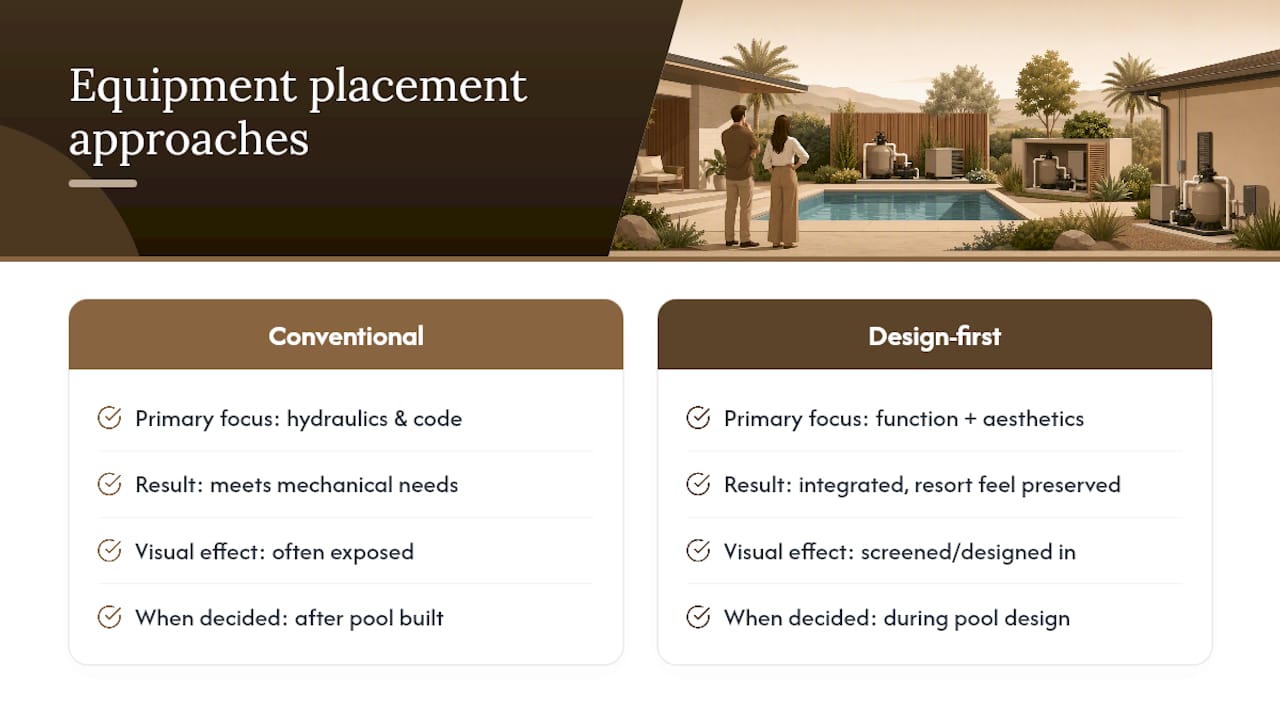
The conventional advice, minimize pipe runs, hit the clearance minimums, screen it with a fence, solves the mechanical problem while often creating a visual one. A pad that meets code but sits exposed next to a travertine patio undercuts the resort feel the rest of the yard is working to create. The homeowners we work with don't choose between function and aesthetics; they expect both solved at once, which is only possible when the pad is designed alongside the pool rather than located after the fact.
If you take one thing from this article, verify pump elevation and pipe sizing first, since those decisions are expensive to undo once concrete cures. Everything downstream, screening, noise control, future expansion, is far easier to adjust than a pad poured in the wrong spot with undersized suction line.
— Thomas Jackson
Ready to Plan Your Pool Equipment the Right Way?
A poorly placed equipment pad is one of the few pool mistakes that's genuinely expensive to fix after the fact, which is exactly why Modern Yardz builds equipment placement into the design phase rather than treating it as a construction afterthought. Because one team handles design, permitting, and construction under a single contract, your pad location gets resolved in the 3D rendering stage, before it becomes a costly change order mid-build.
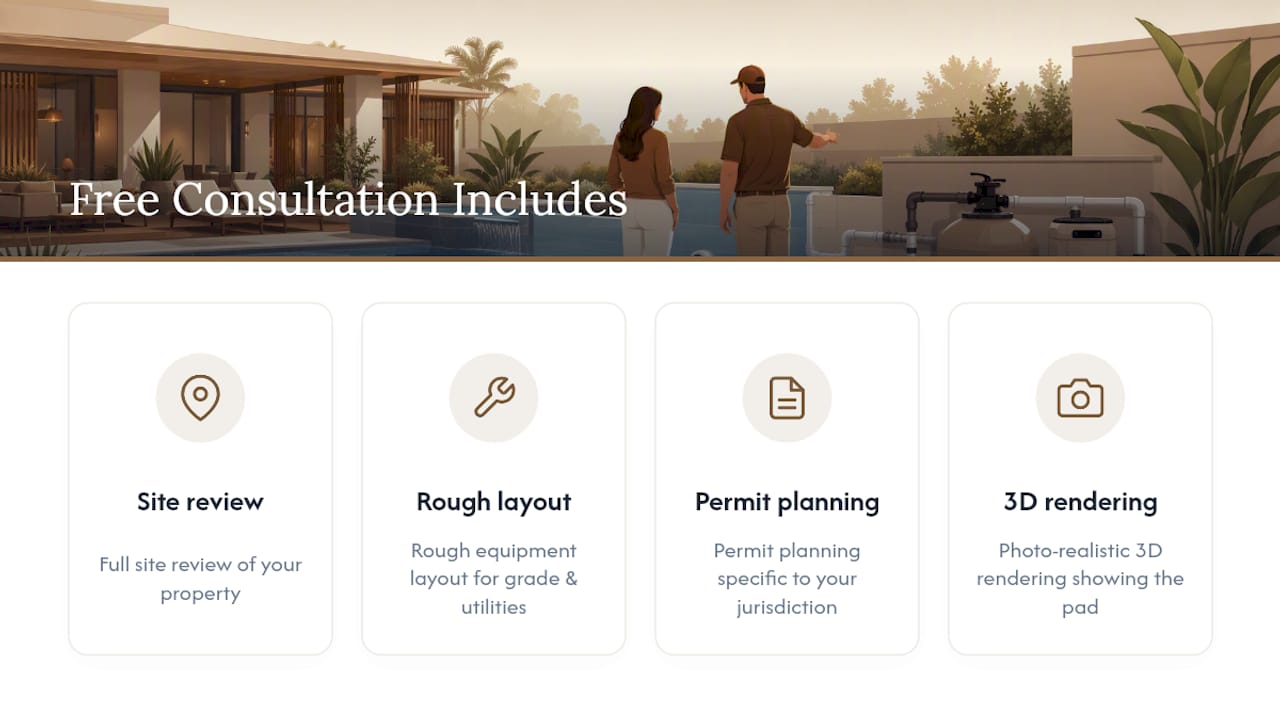
A free consultation with Modern Yardz includes a full site review, a rough equipment layout suited to your yard's grade and utility access, permit planning specific to your jurisdiction, and the option to see your entire project, pad included, as a photo-realistic 3D rendering before construction begins. If you're planning a new pool or reworking an existing outdoor living space anywhere from La Jolla to Rancho Santa Fe, schedule your free consultation and see your equipment pad solved as part of the whole design, not bolted on after.
Sources
- Pump distance and placement guidance
- Pool equipment pad layout and components (code and layout guidance)
- Fine points: equipment pad plumbing layout
Recommended
Start Your Free Design Consultation
Tell us about your project and we'll be in touch within 24 hours. No pressure, no obligation.
Ready to design your dream yard?
Tell us about your project. We'll send back a real plan, not a templated quote.
Book My Free Consultation→