Permeable Paver Driveways: A Complete Homeowner's Guide
Discover how permeable paver driveways manage stormwater effectively, enhancing your home's durability and compliance with local standards.
A permeable paver driveway is the right choice for most residential properties when three conditions align: your soil passes a basic infiltration test, your contractor specifies engineered aggregate layers, and you commit to a documented maintenance plan. Skip any one of those, and the system underperforms within two years. Get all three right, and you have a driveway that manages stormwater, meets local BMP standards, and holds its structural integrity for decades.
The EPA's BMP guidance treats permeable pavement as an engineered stormwater facility, not a decorative surface choice. That framing matters. It means the design must account for subgrade conditions, drainage area ratios, and outlet routing before a single paver is set. Permeable Interlocking Concrete Pavers (PICP) conforming to ASTM C936 and installed over AASHTO-specified aggregate beds can achieve an 80% total suspended solids (TSS) removal rate when all layers meet specification. That is a meaningful water quality outcome for a residential driveway.
Before you request bids: run a simple percolation test in your driveway footprint and photograph your lot's drainage patterns during a rain event. Those two data points will tell you whether you need a full infiltration design or an underdrained system, and they will help any qualified contractor give you an accurate proposal on the first visit.
That transition detail is where many residential permeable systems fail.*
For luxury properties in San Diego, Modern Yardz handles the full sequence: site assessment, engineered cross-section, 3D design visualization, permitting, and single-team construction with no subcontractor handoffs.
Key Takeaways
Permeable paver driveways perform as engineered stormwater facilities when soils, aggregate specifications, and a documented maintenance plan are all addressed before installation begins.
| Point | Details |
|---|---|
| Soil testing comes first | A percolation test determines whether you need a full infiltrating design or an underdrained system before any bid is valid. |
| Specify aggregate by AASHTO number | AASHTO No. 8 for bedding and joints, No. 57 for base, No. 2 for reservoir; sand in any of these layers causes clogging. |
| Maintenance is non-negotiable | Infiltration rates decline within two years without routine maintenance; high-debris sites need sweeping two to four times per year. |
| Cost reflects engineering depth | PICP installed costs can vary significantly, with underdrain requirements and subbase depth as the primary cost drivers. |
| Modern Yardz | Provides site assessment, engineered cross-sections, 3D renderings, and single-team installation for permeable paver driveways in San Diego. |
Table of Contents
- Which permeable pavement types work best for residential driveways?
- How is a permeable paver driveway actually built, layer by layer?
- Is your site actually suitable for a permeable driveway?
- What should you require in contractor bids?
- How do you maintain a permeable paver driveway, and what causes it to fail?
- What does a permeable paver driveway cost, and how long does installation take?
- Permeable paver driveways: benefits and real limitations
- Permits, stormwater credits, and local code checkpoints
- What experienced design-build teams want you to know before you sign
- Modern Yardz handles permeable paver driveways as precision drainage projects
- Sources
Which permeable pavement types work best for residential driveways?
The industry recognizes four main surface types for residential driveways. Each has a different structural profile, aesthetic character, and maintenance demand.
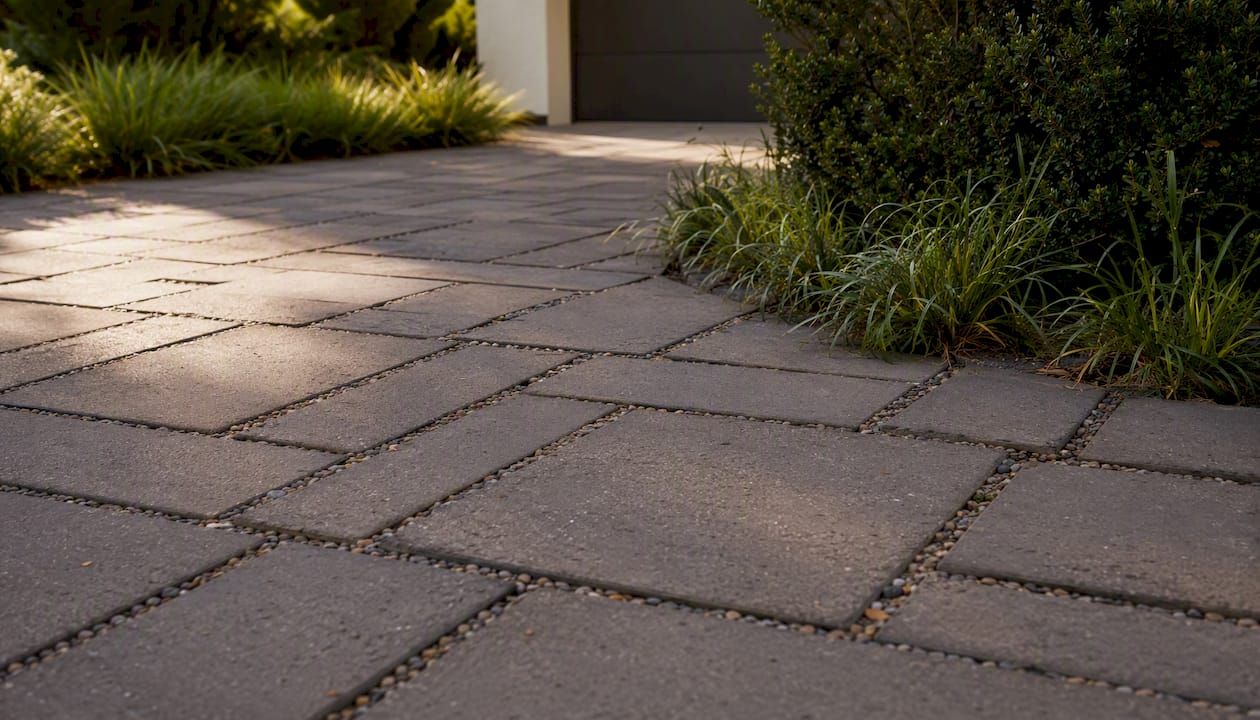
Permeable Interlocking Concrete Pavers (PICP) are the most design-flexible option. Individual concrete units conforming to ASTM C936 sit over a choker course of AASHTO No. 8 stone, with water moving through the joints rather than through the pavers themselves. PICP handles vehicular loads well, allows individual unit replacement, and offers the widest range of colors, shapes, and patterns. Joints require periodic refilling as stone settles, particularly in the first six months.
Pervious concrete pours as a single monolithic surface with a deliberately open void structure. It typically shows the highest initial infiltration rate of any permeable pavement type, though that rate declines faster without maintenance. The surface texture is coarser than standard concrete, and cracking or spalling in freeze-thaw climates can be a concern.
Porous asphalt uses an open-graded mix that allows water to pass through the mat itself. It performs well in cold climates and is less prone to freeze-thaw damage than pervious concrete. Restoration by milling is possible when clogging becomes severe, though that is a contractor-level operation.
Plastic or concrete grid systems (often called geocell or paver-grid systems) use a structural grid filled with gravel or planted with grass. They work well for low-traffic areas and overflow parking but are generally not the preferred choice for a primary driveway that sees daily vehicle loads and requires a refined aesthetic.
Pro Tip: For a luxury residential driveway in San Diego, PICP is almost always the right starting point. The design flexibility, load capacity, and repairability make it the most practical long-term choice, and the joint pattern integrates cleanly with natural stone and travertine used elsewhere on the property.
How is a permeable paver driveway actually built, layer by layer?
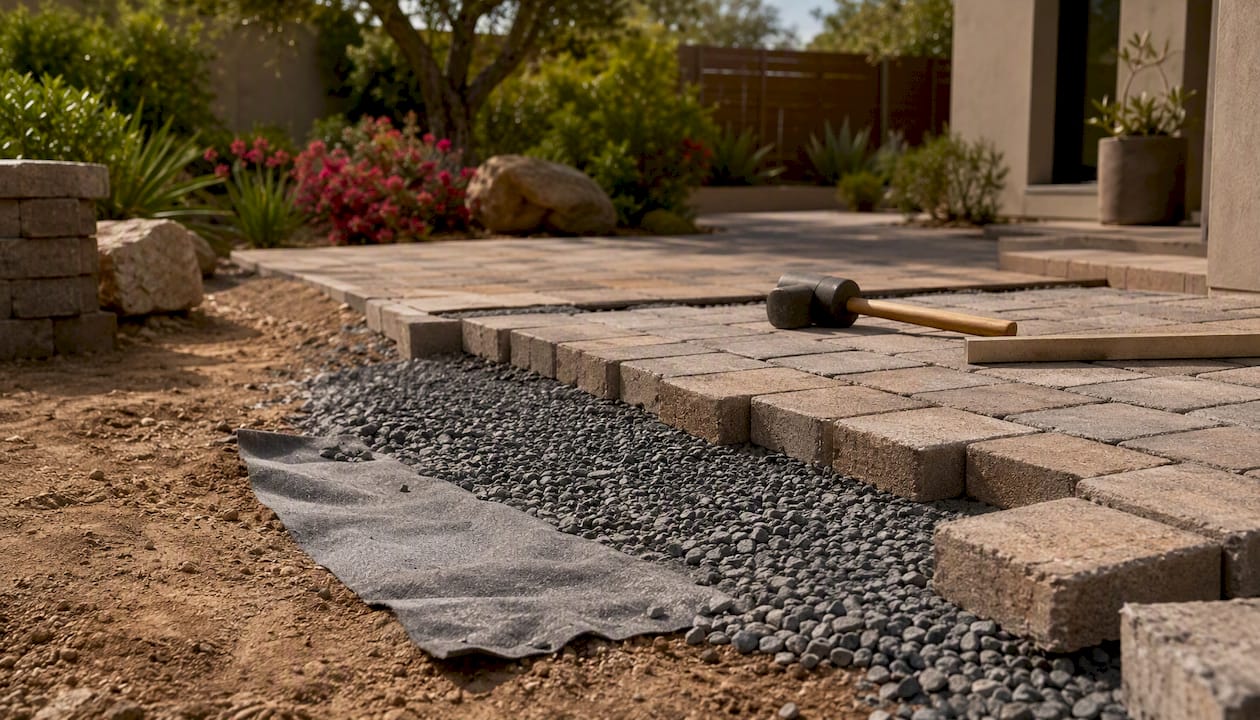
The structural and hydraulic performance of a permeable driveway depends entirely on what sits below the surface. Here is the standard layer sequence from top to bottom, with the specifications a homeowner should verify on any contractor's drawings.
- Surface course (PICP units or pervious concrete/asphalt mat): For PICP, concrete pavers per ASTM C936 with a minimum 80mm (approximately 3.15 inches) thickness for vehicular applications. The surface must be set to grade with consistent joint widths to allow uniform drainage into the bedding layer.
- Choker/bedding course: A 2-inch layer of AASHTO No. 8 stone (3/8-inch nominal). This layer levels the surface units and allows water to pass quickly into the base. No sand. Sand in the bedding course is one of the most common installation errors and will clog the system within months.
- Filter/base course: Typically 4 inches of AASHTO No. 57 stone (3/4-inch to 1-inch nominal). This layer provides structural support and begins the transition to the reservoir below.
- Subbase reservoir: The hydraulic heart of the system. AASHTO No. 2 or No. 57 stone in a depth sized to store the design storm volume, commonly 12–24 inches for residential driveways depending on local rainfall and soil infiltration rate. This is where stormwater is held while it infiltrates into the subgrade.
- Geotextile separation fabric: Placed between the reservoir stone and the native subgrade to prevent fines migration upward into the clean stone. The fabric must be permeable, not impermeable.
- Subgrade: Native soil, scarified and lightly compacted. Over-compaction of the subgrade reduces infiltration capacity. A qualified contractor will specify a target compaction level that preserves permeability.
- Underdrain (when required): A perforated pipe encased in No. 57 stone, routed to a suitable outlet. Required when subgrade infiltration is too slow to drain the reservoir within 48 hours of a design storm.
PICP joint stone settles during the first 3–6 months and must be refilled on a scheduled cadence. Any contractor proposal that does not include a post-installation joint refill visit is incomplete. Request a simple cross-section sketch from every bidder and confirm reservoir depth, underdrain routing, and outlet elevation before signing a contract.
Pro Tip: Ask your contractor to show you the geotextile specification. A non-woven fabric with the wrong flow rate will restrict drainage from the reservoir to the subgrade and turn your infiltration system into a slow-draining bathtub.
For projects where the driveway connects to a broader drainage engineering plan, the underdrain routing and outlet design should be coordinated with the full site drainage layout from the start.
Is your site actually suitable for a permeable driveway?
Site conditions determine whether you design an infiltrating system, an underdrained system, or a different BMP entirely. Run through this checklist before requesting bids.
- Soil infiltration rate: Conduct a percolation test or have a contractor run a double-ring infiltrometer test. A measured rate above 0.5 inches per hour generally supports an infiltrating design. Rates below that threshold typically require an underdrain to drain the reservoir within 48 hours of a storm event.
- Contributory drainage area: The permeable surface should not receive runoff from a significantly larger impervious area draining onto it. NJDEP guidance specifies a maximum contributory drainage area ratio; exceeding it overwhelms the reservoir. Confirm this ratio with your designer before finalizing the footprint.
- Slope: Permeable driveways function best on slopes below 5%. Steeper grades cause sheet flow across the surface rather than infiltration through it, and the reservoir may not fill uniformly.
- Depth to seasonal high water table: Maintain a minimum separation between the bottom of the reservoir and the seasonal high water table. A common standard is 2 feet of separation; confirm the local requirement with your stormwater authority.
- Adjacent landscaping: Slopes, planting beds, and mulched areas that drain onto the driveway surface are the leading cause of premature clogging. Review your backyard drainage patterns and plan source controls before installation.
- Proximity to utilities: Reservoir excavation depths of 18–24 inches can conflict with shallow utility lines. Confirm utility locations before design.
Pro Tip: In San Diego, expansive clay soils are common in inland neighborhoods. If your soil is clay-heavy, assume you need an underdrained design and size the reservoir accordingly. A contractor who does not ask about your soil type before proposing a system is a red flag.
What should you require in contractor bids?
Comparing permeable paver proposals on price alone is a reliable way to get a system that fails within three years. The technical content of a bid matters more than the line-item total.
Bid checklist — require all of these in writing:
- A dimensioned cross-section drawing showing every layer, its material specification, and its depth.
- Aggregate gradations called out by AASHTO number (No. 8 for choker, No. 57 for base, No. 2 for reservoir where applicable). Any bid that says "clean stone" without specifying gradation is incomplete.
- Underdrain details: pipe size, perforation pattern, encasement stone, outlet location, and outlet elevation relative to the reservoir bottom.
- Subgrade compaction criteria that preserve infiltration capacity (not standard proctor compaction targets used for impervious pavements).
- Jointing stone specification: AASHTO No. 8 or similar, never sand or decomposed granite.
- A post-installation joint refill visit scheduled at 3–6 months.
- A written maintenance plan or reference to a maintenance agreement.
Red flags to watch for:
- Sand specified in the bedding or joint course.
- No underdrain detail when you know your soils are clay or have a high water table.
- No aggregate gradation numbers anywhere in the proposal.
- A contractor who has not asked about your soil type, drainage area, or slope.
- No mention of sediment control during construction to protect the reservoir stone from fines.
Caltrans pervious pavement design guidance notes that maintainability and constructability require careful planning from the design phase, not as an afterthought. That standard applies equally to residential driveways.
Pro Tip: Request infiltration test reports from the contractor's previous permeable paver projects. A contractor who has never measured post-installation infiltration rates has no way to verify their systems are performing as designed.
How do you maintain a permeable paver driveway, and what causes it to fail?
The primary failure mode for any permeable pavement is sediment accumulation in the joints or surface voids. Fines migrate in from adjacent landscaping, construction activity, vehicle tracking, and atmospheric deposition. Once fines pack below the joint plane, surface maintenance alone may not restore infiltration.
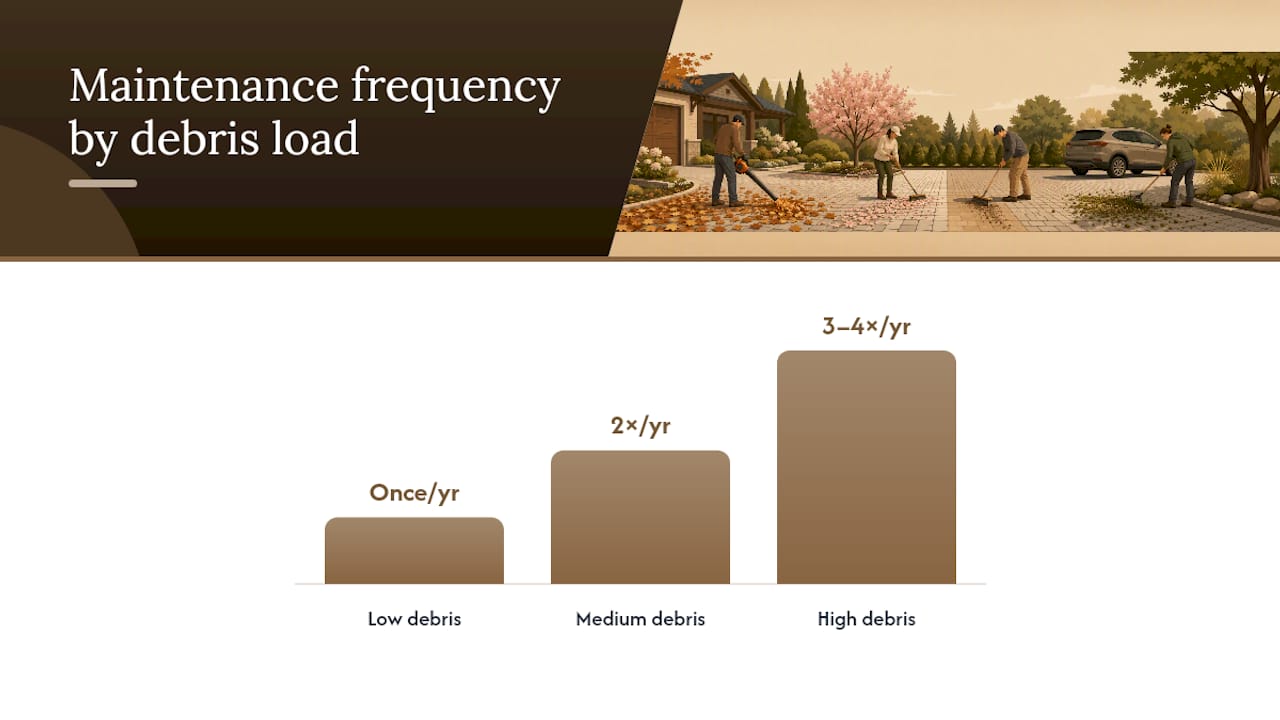
A systematic review of permeable pavement clogging found that infiltration rates commonly decline within two years without routine maintenance, and that maintenance frequency in high-rainfall settings may need to be two to four times per year. San Diego's dry season concentrates particulate deposition, making a pre-rainy-season sweep particularly important.
| Debris Load | Recommended Frequency | Equipment |
|---|---|---|
| Low (minimal adjacent landscaping, paved surroundings) | Once per year | Bristle broom or handheld vacuum |
| Medium (some planting beds, occasional leaf fall) | Two times per year | Vacuum sweeper or regenerative-air sweeper |
| High (heavy tree canopy, mulched beds draining toward driveway) | Three to four times per year | Regenerative-air sweeper or vacuum truck |
Field trials confirm that suction-based sweepers consistently outperform mechanical broom sweepers for PICP maintenance. For small residential driveways, a handheld wet/dry vacuum with a crevice attachment works well for routine cleaning. Larger areas benefit from a regenerative-air sweeper or vacuum truck.
Restoration options when routine maintenance is not enough:
- Vacuum extraction: High-powered vacuum trucks can pull accumulated fines from joints and partially restore infiltration in moderately clogged systems.
- Pressure washing: Effective for surface fines on pervious concrete; less effective for deep joint clogging in PICP.
- Milling (porous asphalt only): Milling followed by pressure washing has been used to restore infiltration rates in aged porous asphalt pavements. This technique requires professional contractor involvement.
- Joint stone removal and replacement: For severely clogged PICP, removing the joint stone, vacuuming the choker course, and refilling with clean joint stone is a common method of restoration.
Pro Tip: Never use a leaf blower to clean a permeable paver driveway. Blowing debris across the surface drives fines into the joints rather than removing them. Always sweep or vacuum toward a collection point at the driveway edge.
Slope planting and mulching rules for adjacent beds matter as much as the sweeping schedule. Landscape areas that drain fine particles onto the driveway surface will overwhelm any maintenance program.
What does a permeable paver driveway cost, and how long does installation take?
Installed costs for permeable paver driveways vary by surface type, subbase depth, underdrain requirements, and site complexity. The ranges typically vary widely to reflect differing project scopes and regional costs.
For context on how these figures compare to conventional driveway options, the asphalt vs. concrete cost comparison on the Modern Yardz blog covers the baseline numbers for impervious alternatives.
Factors that move a permeable paver bid upward include: deep subbase required by slow soils, underdrain installation and outlet routing, complex grading to direct contributory runoff, premium paver materials (natural stone, large-format porcelain), and permit fees for engineered drainage plans.
Typical installation timeline milestones:
- Site assessment and soil testing: 1–2 weeks, including percolation test results.
- Design and permitting: 2–6 weeks depending on local stormwater authority review requirements.
- Excavation and base construction: 2–4 days for a standard residential driveway.
- Paver installation and joint fill: 1–3 days.
- Joint settlement and refill: Scheduled at 3–6 months post-installation.
Permit review is the most common source of delay. Some municipalities require a drainage plan stamped by a licensed engineer, which adds time and cost but also adds a layer of design verification that protects you. Material lead times for premium PICP units in specific colors or formats can add 2–4 weeks to the schedule.
Permeable paver driveways: benefits and real limitations
Benefits worth knowing:
- Stormwater infiltrates on-site rather than running off to storm drains, reducing peak flow and pollutant load to receiving waters.
- Local groundwater recharge occurs where soils allow full infiltration.
- Properly designed PICP systems can achieve 80% TSS removal, a meaningful water quality outcome.
- Surface temperatures run cooler than conventional asphalt, which matters in San Diego's warmer inland neighborhoods.
- Design flexibility in PICP allows integration with natural stone, travertine, and other premium materials used elsewhere on the property.
- Individual paver units can be removed and replaced without disturbing the entire driveway.
Limitations that affect the decision:
- Higher initial cost than pervious concrete or porous asphalt, and significantly higher than conventional asphalt.
- Maintenance is non-negotiable. A permeable system without a maintenance plan will clog and perform no better than an impervious surface within a few years.
- Poor upstream practices (mulch, soil, construction debris draining onto the surface) accelerate clogging and can cause failure that surface maintenance cannot reverse.
- Not suitable for sites with very slow soils and a high water table unless an underdrained design is used.
- Freeze-thaw cycling can affect joint stone stability in colder climates, though this is less of a concern in San Diego.
Decision rule: Proceed with a full infiltrating design when soils pass the percolation threshold and the drainage area ratio is within limits. Use an underdrained design when soils are marginal but the site otherwise qualifies. Consider a different BMP when the water table is within 2 feet of the proposed reservoir bottom or when the contributory drainage area cannot be controlled.
Permits, stormwater credits, and local code checkpoints
Permeable pavement installations in the U.S. typically require coordination with at least two local authorities before construction begins.
Who to contact:
- City or county building department: For grading and drainage permits. Most jurisdictions require a drainage plan showing how the system connects to the site's overall stormwater management.
- Local stormwater authority: Many municipalities have separate stormwater programs that review BMP designs for credit or compliance. In California, Caltrans and regional water quality control boards set the technical standards that local programs reference.
- Homeowner association: If applicable, confirm that permeable paver materials and joint patterns meet HOA aesthetic standards before finalizing the design.
Permeable pavements can earn stormwater treatment or volume credit under many municipal programs when the design meets local BMP standards, including the contributory drainage area limits and aggregate specifications. Document your infiltration test results and retain the contractor's cross-section drawings for the permit submission.
Action steps before you bid:
- Request a pre-application meeting with your local stormwater authority to confirm design requirements and credit eligibility.
- Document the percolation test with a written report, not just a field note.
- Confirm whether a licensed engineer's stamp is required on the drainage plan.
- Check whether your municipality offers a stormwater fee reduction for on-site infiltration BMPs.
Pro Tip: In San Diego County, the Regional Water Quality Control Board's Low Impact Development (LID) standards govern stormwater design for new and redeveloped impervious surfaces above certain thresholds. A driveway replacement that exceeds the threshold may trigger LID compliance, which a permeable design can satisfy. Confirm the applicable threshold with your building department before design.
What experienced design-build teams want you to know before you sign
The most consistent mistake we see on permeable paver projects is treating the system as a surface decision rather than a drainage engineering decision. A homeowner selects a paver color and pattern, approves a price, and assumes the contractor will handle the technical details. When the contractor does not specialize in permeable systems, those details get simplified in ways that compromise performance.
The two specifications that get dropped most often are aggregate gradation and joint stone material. Substituting sand for AASHTO No. 8 in the bedding or joint course is faster and less expensive for the installer, but it destroys the system's infiltration capacity within the first season. Specifying "clean crushed stone" without an AASHTO number leaves the door open for a gradation that does not perform as designed. Both errors are invisible once the pavers are set.
A single design-build team with direct control over material procurement and installation eliminates the handoff where these substitutions happen. When the same team that drew the cross-section is also ordering the aggregate and supervising the installation, the specified gradation is what actually gets placed. That continuity of accountability is the structural advantage of the design-build model for permeable systems on luxury properties.
When built correctly and maintained on schedule, permeable paver driveways perform exactly as designed. They integrate cleanly with premium landscape materials, meet stormwater requirements, and hold their structural integrity for decades. The investment is in getting the design and installation right the first time.
Modern Yardz handles permeable paver driveways as precision drainage projects
Permeable paver driveways require the same engineering discipline as any other stormwater facility on a luxury property. Modern Yardz approaches every permeable paver installation with a full site assessment, a specified cross-section drawing, and a 3D rendering the homeowner approves before excavation begins. Aggregate gradations, underdrain routing, and outlet details are documented in the design package, not left to field judgment.
With California Contractor License #1082881, 2,900+ completed projects, and a 5.0-star rating across San Diego County, Modern Yardz brings the technical depth and material relationships that permeable systems demand. Every project runs under one team with no subcontractor handoffs, from the infiltration test through the post-installation joint refill.
To schedule a no-pressure consultation, contact the Modern Yardz design-build team. Bring your lot plan, photos of your current driveway and adjacent drainage patterns, and any stormwater permit requirements your municipality has flagged. The consultation starts with the site, not the catalog.
Sources
The sources below were used in preparing this guide and are worth consulting directly for design standards, maintenance research, and regulatory requirements.
- Chapter 9.6 – Pervious Paving Systems (NJDEP)
- Maintenance measures for preservation and recovery of permeable pavement surface infiltration rate (NOAA repository)
- A Review of Permeable Pavement Clogging Investigations and Recommended Maintenance Regimes (MDPI)
- Permeable Pavements (EPA BMP guidance)
Recommended
Start Your Free Design Consultation
Tell us about your project and we'll be in touch within 24 hours. No pressure, no obligation.
Ready to design your dream yard?
Tell us about your project. We'll send back a real plan, not a templated quote.
Book My Free Consultation→