Backyard Putting Green: Design, Turf, Installation, and Cost
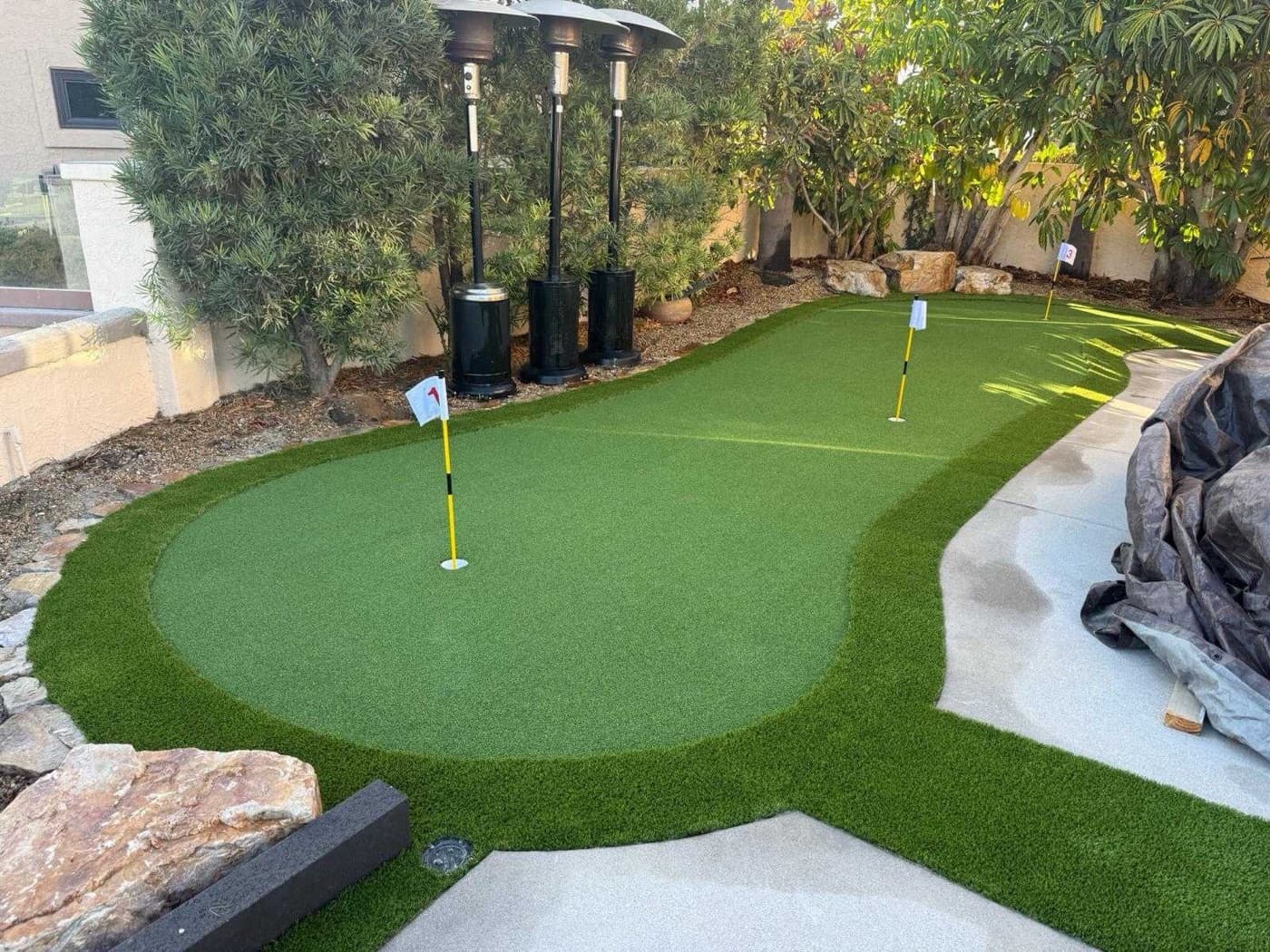
A backyard putting green is a short-game practice area built with putting-grade synthetic turf over a compacted, graded base, with cups, a fringe, and optional chipping areas. In San Diego, synthetic greens beat natural grass because they need no mowing, fertilizing, or irrigation. Cost depends on size, turf grade, contours, and base work; custom greens cost more per square foot than standard artificial lawns.
Key takeaways:
- Synthetic putting greens give consistent ball roll year-round with no mowing or watering.
- Plan at least 300 to 500 square feet for a useful green with multiple cups and breaks.
- The base, grading, and drainage determine how the green plays; turf choice determines speed and feel.
- Add a fringe, chipping area, or bunker to practice the full short game.
- Putting greens cost more per square foot than standard artificial lawns because of specialized turf and shaping.
A backyard putting green lets you practice every day without driving to the course, and in San Diego's climate you can use it year-round. Done well, it also becomes a striking design feature that the whole family uses. At Modern Yardz, we build custom putting greens and artificial turf across San Diego County using high-density nylon putting surfaces with authentic ball roll.
This guide covers planning, turf choices, installation, maintenance, and cost.
Why build a backyard putting green?
Practice, looks, and low upkeep.
- Daily practice: Ten minutes of putting most evenings does more for your score than an occasional range session.
- Year-round use: San Diego's climate means the green is playable almost every day.
- A design feature: A well-shaped green with a fringe reads like a manicured lawn and becomes a focal point.
- Low maintenance: No mowing, fertilizing, or watering the playing surface.
- Family use: Kids and guests use it as much as the golfer in the house.
Should you choose synthetic or natural grass?
For almost every home, synthetic. A natural bentgrass or bermuda green needs daily-level care: low mowing, top-dressing, fertilizing, disease control, and heavy irrigation. According to the EPA WaterSense program, the average U.S. household already uses more water outdoors than for showering and washing clothes combined, and a natural green would add to that. Synthetic greens deliver consistent speed with almost no upkeep.
| Synthetic green | Natural grass green | |
|---|---|---|
| Maintenance | Occasional brushing and infill top-up | Frequent mowing, fertilizing, top-dressing |
| Water | None for the green surface | High |
| Ball roll | Consistent; speed set by turf and infill | Varies with weather and care |
| Year-round use | Yes | Depends on growing conditions |
How big should a backyard putting green be?
About 300 to 500 square feet is a practical minimum for multiple cups and real breaks. Smaller greens of 100 to 200 square feet still work for straight putts. Larger greens of 1,000 square feet or more allow longer lag putts, multiple tiers, and chipping from several angles. Fit the shape to the yard; kidney and free-form shapes look more natural than rectangles.
Where should it go?
- Level or gently sloped ground that can be shaped with subtle breaks.
- Good drainage, away from downspouts that dump water across the surface.
- Chipping distance: leave room for a fringe and a hitting area 15 to 30 feet away if you want to practice chips.
- Views and lighting: a green near the patio gets used more; landscape lighting extends practice into the evening.
What design features should you consider?
- Multiple cups: Three to five cups on different breaks let you practice short, mid, and lag putts.
- Breaks and tiers: Gentle slopes and a second tier make practice realistic; keep slopes subtle so balls do not run off.
- Fringe and collar: A band of longer turf frames the green and slows missed putts.
- Chipping area or tee box: A hitting mat or fairway-length turf 15 to 30 feet away for chips and pitches.
- Sand bunker: Adds bunker practice and visual depth; plan drainage under it.
- Lighting: Low, shielded lights for evening practice; see our low voltage landscape lighting guide.
- Natural shape: Free-form edges and planted borders make the green feel part of the landscape.
What turf is best for a putting green?
Putting-grade turf has short, dense fibers designed for true roll.
- Nylon: Durable, consistent, and responsive; a premium choice for true putting.
- Polypropylene: Lower cost; can be less durable.
- Texturized vs non-texturized: Texturized fibers hold shots better for chipping; non-texturized fibers roll faster.
- Sand infill: Many putting surfaces use silica sand to tune speed and help the green hold approach shots.
A fringe of longer turf around the green and an approach or fairway area make chipping more realistic.
How is a backyard putting green installed?
- Design the shape, cup positions, and contours.
- Excavate and remove existing grass and roots.
- Install edging and any irrigation reroutes.
- Build the base: compacted aggregate with a finer top layer.
- Shape contours for breaks while keeping drainage paths.
- Compact and laser-check the surface; smoothness here determines roll quality.
- Set cups and lay the putting turf, then fringe and surrounding turf.
- Seam, secure, and infill, then brush and test speed.
The same base standards that make our artificial turf installations last apply here, but with tighter tolerances.
Should you use a kit or hire a professional?
Kits suit small, flat, temporary greens; professional builds suit permanent, contoured greens. Roll-out mats and DIY kits are quick and inexpensive, but they sit on existing ground, so they do not drain well, rarely roll true, and cannot include breaks or tiers. A professionally built green has an excavated, compacted base laser-checked for smoothness, designed contours, real cups, and a fringe, which is what gives it a true roll for years.
How long does it take to install?
A typical backyard green takes a few days to about a week once the design is approved, longer for large greens, multiple tiers, bunkers, or when it is built as part of a larger landscape project.
How much does a backyard putting green cost?
Cost depends on size, turf grade, contours, base work, and extras such as fringe, bunkers, and lighting. For reference, Modern Yardz's standard artificial turf projects in San Diego range from about $13 to $22 per installed square foot depending on product grade, site conditions, and complexity, and putting greens and multi-level installations run higher because of specialized surfaces and shaping. Small greens cost more per square foot than large ones because setup, edging, and cups are fixed costs.
| Cost driver | Why it matters |
|---|---|
| Size | More turf, base, and labor, though cost per square foot usually falls |
| Turf grade | Nylon putting surfaces cost more than polypropylene |
| Base and grading | Excavation, aggregate, compaction, and laser leveling |
| Contours and tiers | Shaping breaks takes more time and material |
| Cups, fringe, and chipping areas | Extra turf types, seams, and hardware |
| Bunkers and lighting | Sand, drainage, edging, wiring, and fixtures |
| Access and removal | Hauling out existing lawn or soil and tight site access |
National cost guides vary widely, so the most reliable number comes from a design for your yard.
How do you maintain a synthetic putting green?
- Brush periodically to keep fibers upright and infill level.
- Blow off leaves and debris.
- Top up sand infill in high-traffic areas.
- Rinse occasionally and check seams and cups.
See our guide on whether artificial grass gets hot for heat and comfort tips that also apply to greens.
Design a green that fits the yard
A putting green works best when it is designed with the patio, planting, and lighting around it. Modern Yardz designs and builds backyard putting greens as part of complete outdoor spaces, shown in a 3D rendering with a line-item cost. Call 619-775-9554, see more backyard ideas, or book a free design consultation.
Start Your Free Design Consultation
Tell us about your project and we'll be in touch within 24 hours. No pressure, no obligation.
Common questions
- How much space do you need for a backyard putting green?
- About 300 to 500 square feet allows multiple cups and real breaks. Smaller greens of 100 to 200 square feet work for basic putting practice, while 1,000 square feet or more allows tiers and chipping from several angles.
- Is a synthetic putting green better than real grass?
- For most homes, yes. Synthetic greens give consistent roll with no mowing, fertilizing, or irrigation, while natural greens require intensive daily-level care and lots of water.
- How much does a backyard putting green cost?
- It depends on size, turf grade, contours, and base work. Putting greens cost more per square foot than standard artificial lawns; Modern Yardz's standard turf runs about $13 to $22 per square foot in San Diego, and greens run higher.
- Can you chip onto an artificial putting green?
- Yes, with the right turf and sand infill. Texturized putting turf and a properly infilled surface hold chip shots better, and a fringe and approach area make practice more realistic.
- How long does an artificial putting green last?
- A quality putting green with a well-built base can last many years. Brushing, infill maintenance, and keeping debris off the surface extend its life.
Ready to design your dream yard?
Tell us about your project. We'll send back a real plan, not a templated quote.
Book My Free Consultation→