Black Strip Seams on Concrete Driveways in San Diego (2026 Explainer)
The black strip in your concrete driveway is an expansion joint — flexible filler that prevents thermal cracking. Replacement runs $15–$50 DIY or $150–$400 pro in San Diego.
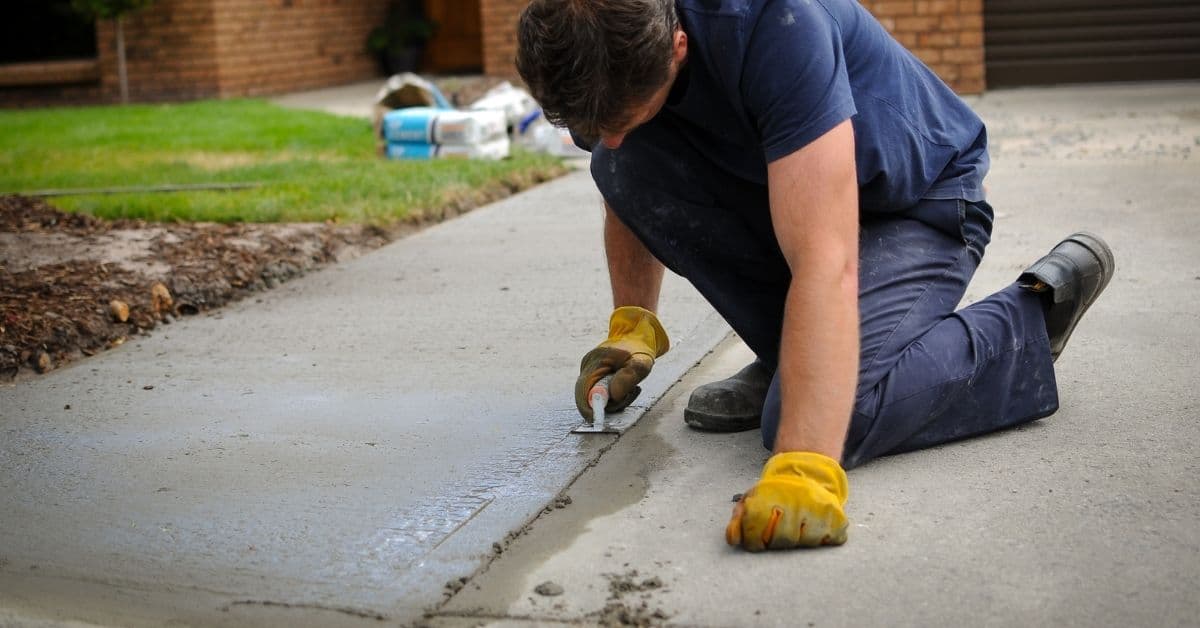
The black strip in your concrete driveway is an expansion joint — a flexible filler placed between concrete slabs so they can expand and contract without cracking against each other. The strip itself is usually asphalt-impregnated fiberboard or polyurethane sealant, sized 1/2 to 1 inch wide. It is not the same as the thinner sawcut control joints that divide the slab into smaller squares. In San Diego's mild climate, expansion joint filler typically needs maintenance every 5–10 years — the original material degrades from UV, daily thermal cycling, and dirt infiltration, and a locked or empty joint causes exactly the cracking it was meant to prevent. DIY replacement runs $15–$50 in materials for a typical 2-car driveway. Pro repair lands at $150–$400 for inspection, cleanup, and resealing.
Modern Yardz has poured 2,900+ concrete projects across San Diego County under California Contractor License #1082881. This guide explains what you're looking at, why it matters, and when to fix vs. ignore.
What is the black strip in my concrete driveway?
The black strip is the filler inside an expansion joint — a deliberate gap between two concrete slabs (or between a slab and a fixed structure like a garage slab, sidewalk, or foundation). Without that gap, thermal movement of the concrete would push directly into adjacent surfaces, causing cracking, heaving, or spalling.
The filler is compressible by design. It squashes when concrete expands in heat and rebounds when concrete contracts in cool weather. Standard fillers used in San Diego residential driveways:
- Asphalt-impregnated fiberboard: the classic black strip. Inexpensive, replaces easily, lifespan ~5–10 years before UV breakdown.
- Closed-cell polyethylene foam backer rod + polyurethane sealant: modern standard. Cleaner appearance, 10–15 year lifespan, blends into concrete color.
- Self-leveling silicone sealant: premium option, 15–20 year lifespan, slightly higher cost.
If your driveway has a clean, recessed dark line that looks intentional, that's an expansion joint. If you see a thin sawcut groove that's just the bare concrete edges, that's a control joint — different purpose, no filler needed.
What's the difference between an expansion joint and a control joint?
Both prevent cracking, but they solve different problems:
- Expansion joint — full-depth gap between two slabs, filled with flexible material. Solves thermal expansion and prevents the concrete from pushing against immovable objects (foundations, garages, sidewalks). Visually: a 1/2-inch-or-wider band, often with the visible black strip.
- Control joint — sawcut or troweled groove cut about 1/4 of slab thickness deep into a single continuous slab. Solves shrinkage cracking by giving concrete a designated weak line to crack along instead of cracking randomly. Visually: a shallow, thin straight line, typically every 8–12 feet on a residential driveway. No filler.
A standard San Diego 2-car concrete driveway has both: expansion joints where the driveway meets the garage and sidewalk (typically 2–4 of them) and a grid of control joints across the slab body itself (typically 4–8 of them).
Why does my driveway need expansion joints in the first place?
Concrete is rigid but never static. It moves in response to:
- Daily temperature swings. Even in San Diego's mild climate, surface temps can change 30–50°F between cool morning fog and full afternoon sun, especially in inland zones like El Cajon, Santee, and Escondido. That swing translates to small but real dimensional changes across a 20-foot slab.
- Moisture absorption and release. Concrete absorbs water during the rainy season and releases it during dry months. Wet concrete is slightly larger than dry concrete.
- Substrate shift. San Diego's expansive clay soils — common across Mira Mesa, Scripps Ranch, Rancho Bernardo, and similar inland neighborhoods — swell when wet and shrink when dry, pushing slabs above. Even modest seismic activity adds occasional pulses of stress.
- Curing shrinkage. New concrete shrinks ~1/16 of an inch per 10 feet during the first year as moisture leaves the slab.
Without somewhere to flex, all that movement concentrates on the weakest line in the slab and causes a random crack. Expansion joints give the slab a controlled place to flex; control joints give it a controlled place to crack. Together they're the reason your driveway looks intentional 20 years in instead of like a shattered windshield.
What happens when the black strip is missing or damaged?
Three failure modes, in escalating order of cost:
- Joint locking. The most common. An empty or partially empty joint fills with dirt, gravel, leaves, and pebbles. The accumulated debris is incompressible — when concrete expands, it can't move into the joint anymore. Pressure builds. Adjacent slabs spall (chip at the edges) or crack 6–12 inches in from the joint. Repair: $300–$1,200 for spall patching plus joint reseal.
- Slab heave. Locked joint plus expanding clay soil below. The slab lifts, creating a tripping hazard or a mismatched seam against the garage floor. Repair: $1,500–$4,000 for slab leveling (mudjacking or polyurethane foam injection) plus reseal.
- Slab failure. Long-term unsealed joint allows water infiltration into the substrate, eroding base material. Slab settles unevenly, develops major cracks, or fails entirely. Repair: $4,000–$10,000+ for partial or full slab replacement.
The fix gets exponentially more expensive the longer it's ignored. A $30 tube of polyurethane sealant applied at year 7 prevents the $4,000 slab leveling at year 12.
How often should the black strip be replaced?
In San Diego, plan on inspection every 2–3 years and replacement every 5–10 years depending on filler type:
- Asphalt-impregnated fiberboard: 5–8 years before UV cracking and edge separation
- Polyurethane sealant: 10–15 years
- Self-leveling silicone: 15–20 years
- Older fiberboard with no sealant cap: 3–5 years
Coastal driveways (Encinitas, Carlsbad, La Jolla, Coronado) tend to last longer because UV is buffered by morning marine layer fog. Inland driveways (Poway, Ramona, Alpine) age filler faster from concentrated afternoon sun.
Signs it's time to replace:
- Visible cracks running through the filler material
- The strip has shrunken below the slab surface and a gap is visible
- Filler is brittle and chips out when poked
- Weeds growing in or adjacent to the joint
- Standing water pooling at the joint after rain
How do I replace the black strip myself?
For a typical 2-car residential driveway with 2–4 expansion joints, DIY replacement runs $15–$50 in materials plus a few hours of work.
What you need:
- Utility knife or oscillating tool to cut out old filler
- Stiff wire brush and a shop vac
- Closed-cell foam backer rod sized to your joint width (~$8–$15 per 100 ft)
- Self-leveling polyurethane concrete sealant (~$10–$20 per 10.1 oz tube; one tube covers ~12 linear feet)
- Caulking gun
- Painter's tape (optional, for clean edges)
Steps:
- Remove old filler. Cut and pull out the existing strip or sealant. Dig out as much debris as your knife reaches.
- Clean the joint thoroughly. Wire-brush both sides, then vacuum. The joint walls must be dry and dust-free for sealant to bond.
- Insert backer rod. Press it into the joint at a depth such that the top of the rod sits about 1/4 inch below the slab surface. Backer rod prevents the sealant from bonding to the bottom of the joint (three-sided adhesion fails fast).
- Apply sealant. Run a smooth bead from the caulk gun, slightly overfilling. Tool with a wet finger or a smoothing stick.
- Cure. Most polyurethane sealants are skin-cured in 2–4 hours, fully cured in 24–48. Stay off the joint for 24 hours.
A typical homeowner does 4 joints in a long Saturday morning.
When should I call a contractor instead of DIY?
Bring in a pro if:
- The slab itself shows cracking, spalling, or heave near the joint — there's an underlying base problem to diagnose, not just a filler swap
- The joint width is over 1 inch, irregular, or partially blown out
- You have multiple joints with concurrent damage suggesting substrate movement
- You want a long-life self-leveling silicone install (specialized application)
- The driveway is over 20 years old and has never had its joints serviced
Pro joint maintenance for a typical San Diego driveway: $150–$400 depending on number of joints, filler type, and whether spall patching is needed.
How does San Diego climate affect driveway joint maintenance?
Three local factors to keep in mind:
- No freeze-thaw cycles. Unlike colder climates, San Diego concrete isn't subjected to water-into-ice expansion damage. That extends joint life by years compared to inland California or the Mountain West.
- High UV intensity. Even our mild winters carry strong UV, which is the #1 enemy of fiberboard and uncapped polyurethane sealants. Direct-sun driveways age filler ~30% faster than shaded ones.
- Seasonal moisture cycle. December–March rains followed by 6–8 months of dry summer create dimensional cycling in expansive clay soils. Joints near the garage entry typically show damage first because of concentrated moisture from sloped runoff.
How Modern Yardz pours and seals driveways
We're a design-build firm — one contract covers excavation, base prep, pour, and finishing. Every concrete driveway we build includes:
- 4 inches of compacted Class II road base
- 4 inches of 3,000–4,000 PSI concrete with #3 rebar on 18-inch centers (or wire mesh for budget builds)
- Expansion joints at every interface with garage, foundation, sidewalk, and curbing — backer rod plus self-leveling polyurethane sealant by default
- Control joints sawcut within 12–18 hours of pour at 1/4 slab depth, on a grid sized to slab dimensions
- Free first-year inspection and seal touchup
For a standard 2-car driveway in San Diego (roughly 600 sq ft), our pricing lands in the $5,500–$8,500 range for a broom-finish slab with full joint detailing. Stamped or decorative finishes run $9,000–$13,500. See our concrete services in San Diego for the full scope of related work, or our 20×20 patio cost guide for slab-pour pricing on smaller pads.
Maintenance checklist
Every 2–3 years on an existing driveway:
- Walk the joints. Look for shrinkage, cracks, or filler that's pulled away from slab edges.
- Pressure-wash the slab and joints. Don't blast directly into open joints if filler is intact.
- Inspect for surface damage at joint edges — spalling means the joint is locking.
- Reseal any joint where filler has dropped below slab surface or cracked through.
- Clean control joints of weeds and debris (no filler needed).
Want a free driveway inspection and a written maintenance plan? Book a consultation — we'll walk the slab, photograph the joint conditions, and quote any work in writing within 48 hours.
Start Your Free Design Consultation
Tell us about your project and we'll be in touch within 24 hours. No pressure, no obligation.
Common questions
- What is the black strip in my concrete driveway?
- It's the flexible filler inside an expansion joint — a deliberate gap between concrete slabs that absorbs thermal movement. Standard materials are asphalt-impregnated fiberboard or polyurethane sealant, sized 1/2 to 1 inch wide.
- What's the difference between an expansion joint and a control joint?
- Expansion joints are full-depth gaps between slabs filled with flexible material to absorb thermal movement. Control joints are shallow sawcuts within a single slab that direct shrinkage cracking to a clean line. Both prevent cracking but solve different problems.
- How often does the black strip need to be replaced in San Diego?
- Every 5–10 years for asphalt-impregnated fiberboard, 10–15 years for polyurethane sealant, 15–20 years for self-leveling silicone. UV exposure ages inland driveway filler about 30% faster than coastal driveways shaded by marine layer fog.
- How much does it cost to replace the black strip?
- DIY replacement runs $15–$50 in materials for a typical 2-car driveway with 2–4 expansion joints. Pro service is $150–$400 depending on joint count, filler type, and whether any spall patching is needed.
- What happens if I leave a damaged or missing black strip?
- Joint locking — debris fills the gap, concrete can't expand, and pressure causes spalling, slab heave, or cracking 6–12 inches from the joint. Repair escalates from $300 (joint reseal + spall patch) to $4,000+ (slab leveling) to $10,000+ (full replacement).
- Can I replace the black strip myself?
- Yes for routine maintenance. You need a utility knife, wire brush, shop vac, closed-cell backer rod, and polyurethane concrete sealant. A typical homeowner finishes 4 joints in a Saturday morning. Call a pro if the slab itself shows cracking, spalling, or heave.
- Why does my San Diego driveway need expansion joints if there's no freeze-thaw?
- Daily temperature swings (30–50°F between morning fog and afternoon sun, especially inland), moisture cycling from rainy season to dry, expansive clay soils swelling under inland slabs, and curing shrinkage all cause concrete to move. Expansion joints give it a controlled place to flex.
- What sealant should I use to replace the black strip?
- Self-leveling polyurethane concrete sealant is the residential standard — 10–15 year lifespan, around $10–$20 per tube, applied with a caulk gun over closed-cell foam backer rod. Self-leveling silicone is the premium upgrade for 15–20 year lifespan.
- How wide should an expansion joint be on a concrete driveway?
- 1/2 inch is standard for residential driveways up to 20 feet long; 3/4 to 1 inch for driveways over 20 feet or in high-temperature environments. Joint depth should match slab depth — 4 inches for a typical residential pour.
- Do control joints need filler?
- Typically no. Control joints are intentionally left unsealed so they can crack as designed. Some homeowners caulk them with flexible sealant for cosmetic reasons or to keep weeds out, but unfilled control joints work fine when kept reasonably clean.
- Can I drive on the joint right after I reseal it?
- Wait at least 24 hours for polyurethane sealant to fully cure. Skin cure happens in 2–4 hours, so foot traffic is fine sooner, but tire pressure and weight can deform a partially cured sealant bead. Self-leveling silicones often need 48 hours.
- Why is there water pooling at my driveway expansion joint?
- Filler has shrunk below the slab surface or cracked through, leaving a low spot. Water collects, accelerates erosion of the substrate, and worsens the gap. Replace the filler before the next rainy season — a $20 fix today prevents a $1,500 slab settling repair later.
Ready to design your dream yard?
Tell us about your project. We'll send back a real plan, not a templated quote.
Book My Free Consultation→