40–75 ft Lanes: Lap Pool Dimensions for Homeowners, with 3D Planning
Plan a fitness-first lap pool: pick the right 40–75 ft lane, width and depth, weigh swim-spa alternatives, and preview the fit with 3D renderings.
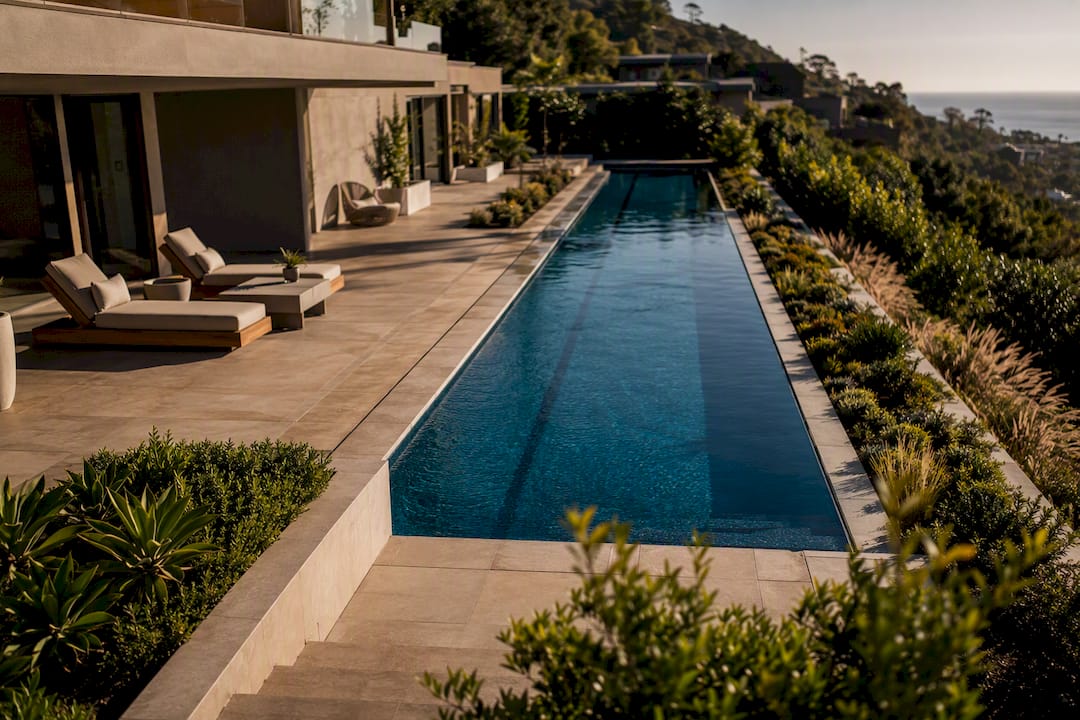
Most residential lap pools measure 40 to 75 feet long, 6 to 10 feet wide for a single lane, and 3.5 to 5 feet deep with a uniform bottom. The simplest decision rule: build the longest straight lane your lot allows, and if the site cannot support at least 40 feet, choose a swim spa or add a counter-current jet system instead. Everything else in lap pool design follows from that one trade-off between length and property size.
TL;DR: - Pools shorter than 40 feet limit stroke rhythm and are less effective for serious training, making 50 to 75 feet the ideal length for endurance. - Single-lane pools should be 6 to 10 feet wide, while two-lane pools generally need 16 to 20 feet to prevent elbows from clipping mid-lap. - Most residential lap pools are 3.5 to 5 feet deep with a uniform floor to support full stroke extension and safety. - For tight yards, swim spas 12 to 19 feet long offer a budget-friendly, year-round alternative, but they change stroke feel compared to traditional pools. - Building a custom lap pool costs between $40,000 and $110,000, with size, features, and materials significantly impacting the final price.
Table of Contents
- What Are the Standard Lap Pool Dimensions?
- How Wide Should a Lap Pool Be for One or Two Lanes?
- What Depth Is Best for a Lap Pool?
- Design Considerations Beyond the Basic Measurements
- Swim Spas and Counter-Current Systems: The Compact Alternative
- What Should You Budget For a Lap Pool Project?
- How Modern Yardz Solves Common Lap Pool Dimension Challenges
- Ready to Plan Your Custom Lap Pool?
- Sources
- FAQ
What Are the Standard Lap Pool Dimensions?
Length is the variable that actually determines whether a pool delivers a real workout. A lane shorter than 40 feet forces so many wall turns that stroke rhythm never develops, which is why most serious swimmers treat 40 feet as the practical floor rather than an ideal.
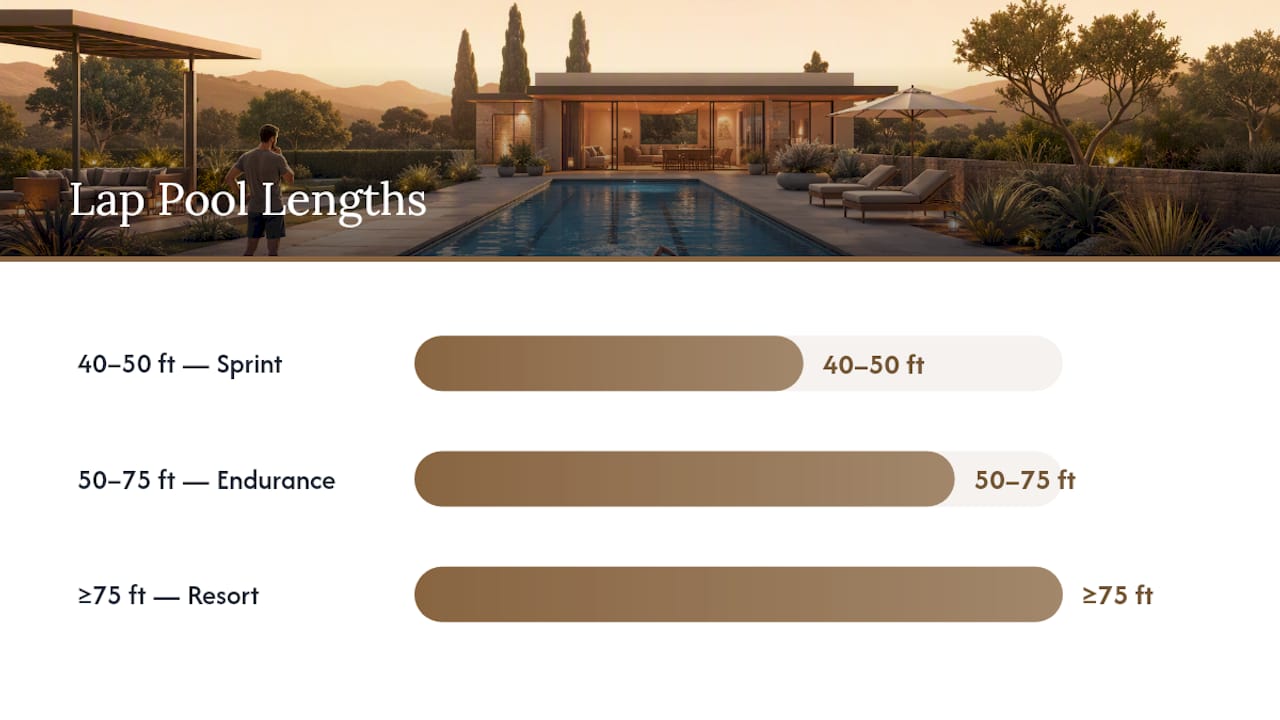
Three length bands cover almost every residential project:
- 40 to 50 feet works for compact training, water walking, and moderate fitness routines, though swimmers will flip walls roughly every 15 to 20 strokes.
- 50 to 75 feet suits serious lap work and gets close to the 25-yard (75 ft) short-course length used in competitive swimming standards, letting a swimmer settle into a rhythm before each turn.
- 75 feet and beyond is resort-scale territory, more common on larger estate lots than typical suburban yards.
Industry sizing guidance places most residential lap pools in the 40- to 75-foot range, and that band exists because it balances two facts: shorter pools multiply turns and interrupt stroke extension, while longer pools eat yard space fast. A swimmer doing freestyle intervals in a 40-foot pool might complete a lap in eight strokes and a flip turn every ten seconds. Push that lane to 60 feet, and the same swimmer gets a genuine glide phase before needing to turn, which matters enormously for technique work and endurance training.
Sprinters training for short, explosive efforts can get real value from a 40 to 50 foot lane since the workout is built around bursts, not sustained rhythm. Endurance swimmers and anyone working on stroke mechanics benefit far more from the extra 20 to 30 feet in the 50 to 75 foot band.
Once you settle on a length, leave 2 to 3 feet of setback around the pool shell for coping, decking, and equipment access. Orientation matters too: a lane that runs east to west can put morning sun straight in a swimmer's eyes, and a lane parallel to a prevailing wind corridor loses more heat overnight than one shielded by the house or a side yard wall.
How Wide Should a Lap Pool Be for One or Two Lanes?
A single-lane lap pool works best between 6 and 10 feet wide. Anything narrower starts to feel like swimming in a trench, cramping shoulder rotation and making sighting down the lane line difficult; anything wider than 10 feet for one lane wastes water volume without adding training value.
Two-lane pools, which give couples or families room to swim side by side, typically run 16 to 20 feet wide. That width accommodates two independent stroke paths without swimmers clipping elbows mid-lap, and it turns a fitness pool into something more social without sacrificing the training function.
Width decisions should account for more than swimming clearance:
- Keep steps, benches, and ladders outside the primary swim lane so a mid-workout glance down doesn't end in a stubbed toe.
- Plan skimmer and equipment access panels along the side that gets the least foot traffic.
- Remember that every additional foot of width adds meaningful water volume, which raises both construction cost and ongoing heating and filtration expense.
Pro Tip: If you're torn between a 7-foot and a 9-foot single lane, walk off both widths with painter's tape on your existing patio before committing. Two extra feet reads very differently on paper than it does standing in the actual space.
What Depth Is Best for a Lap Pool?
Most designers recommend a uniform depth of 3.5 to 5 feet for a residential lap pool, and that consistency is deliberate rather than a cost-cutting shortcut. A flat bottom in this range gives freestyle and backstroke swimmers enough clearance to extend their arms fully without touching bottom, while still letting an adult stand comfortably to rest or supervise a child.
Variable-depth designs, common in freeform recreational pools, rarely make sense for a dedicated lap lane. A sloped floor changes water resistance and buoyancy partway through a set, which works against the steady, repeatable stroke pattern a lap pool exists to support.
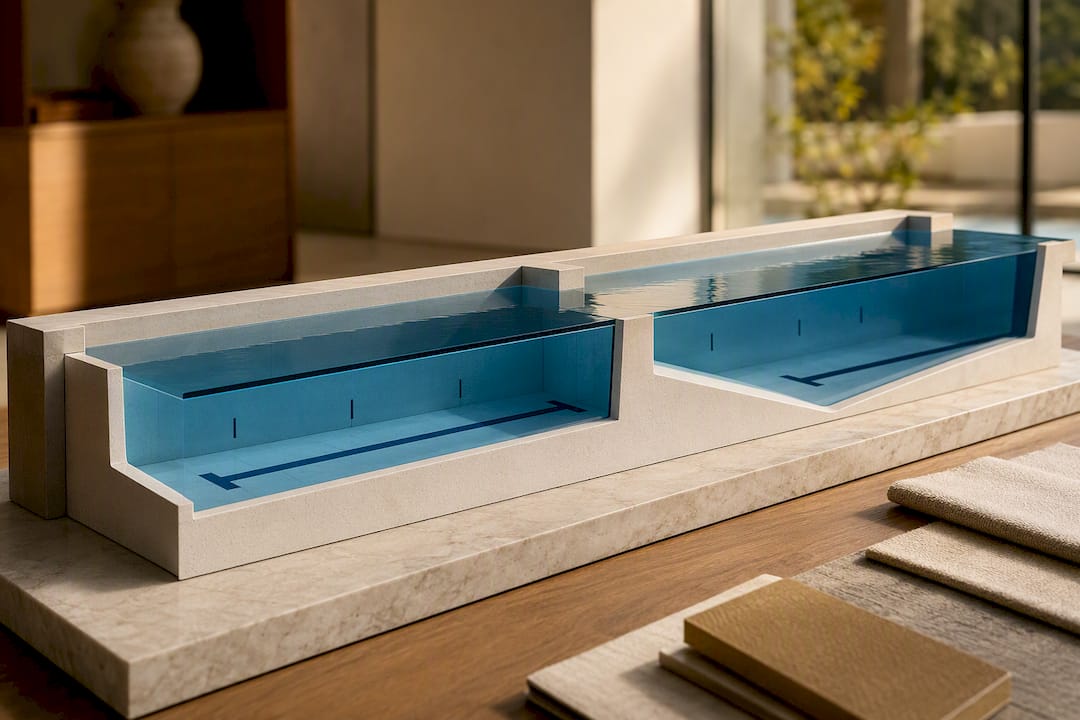
There are exceptions. Households mixing fitness swimming with water therapy sometimes ask for a shallow gradient near one end for aquatic exercises, or a foot deeper overall if a serious swimmer wants extra clearance for flip turns. Every added foot of depth also adds meaningful water volume, which translates directly into a larger heater, a bigger pump, and higher monthly operating costs.
Design Considerations Beyond the Basic Measurements
Dimensions on paper only matter once they translate into a buildable site plan. A handful of decisions turn a set of numbers into a lane that actually functions the way a homeowner expects.
- Placement and orientation. A narrow side yard often suits a lap pool better than a square backyard, since the linear shape naturally fits a long, narrow footprint and can preserve privacy from neighboring windows.
- Decking and coping. Non-slip stone or textured concrete along the full length keeps the training aesthetic intact; travertine and natural stone are popular choices for pool surrounds because they stay cooler underfoot and read as a genuine architectural feature rather than an afterthought.
- Equipment location. Pumps, heaters, and filters need service access, but a poorly placed equipment pad can also intrude on the swim lane's sightline. Planning that placement before excavation begins avoids expensive rework later.
- Heating and covers. Solar, heat pump, and gas heating each carry different operating profiles, and an automated cover meaningfully cuts both heat loss overnight and evaporation, which matters more on a long, narrow pool with more exposed surface area per gallon than a compact freeform shape.
- Safety basics. Fencing and self-closing, self-latching gates are standard requirements in most jurisdictions, and local pool fencing rules vary enough that it's worth confirming your specific requirements before finalizing a design.
Swim Spas and Counter-Current Systems: The Compact Alternative
A swim spa is a self-contained unit, typically 12 to 19 feet long, that generates a current so a swimmer can swim in place rather than swimming laps down a fixed lane. For a side yard too narrow to fit even a 40 foot pool, it is often the most realistic path to a genuine fitness feature.
- Footprint: roughly 12 to 19 feet, a fraction of even a compact lap pool.
- Cost: installed swim spas commonly run $15,000 to $45,000, well below a full custom lap pool.
- Usability: most swim spas double as a hot tub, extending year-round use beyond swim season alone.
- Training feel: swimming against a current changes stroke timing slightly compared to swimming through still water, something distance swimmers notice more than casual fitness swimmers do.
A middle path exists for homeowners who want a real pool but lack the yard for 50 feet: a shorter shell, in the 30 to 40 foot range, fitted with a counter-current jet system. It reads visually as a pool rather than a spa while still letting a swimmer train against resistance when the lane itself runs out.
What Should You Budget For a Lap Pool Project?
Custom lap pools commonly land in the $40,000 to $110,000 installed range, with size, finish selection, and features like automated covers or heating systems driving the number toward either end. A detailed cost breakdown is worth reviewing before you start collecting quotes, since line items vary more between builders than the headline number suggests.
Dimensions drive water volume directly, and volume drives equipment sizing. A 40 by 8 foot pool at 4 feet deep holds roughly 9,600 gallons; stretch that to 60 feet and the volume climbs past 14,000 gallons, which pushes both heater output and pump capacity up a tier. Smaller footprints heat faster and cost less to run month to month, a real consideration for anyone planning to swim through San Diego's mild but not tropical winters.
A typical project moves through site evaluation, design and permitting, excavation and plumbing, finish work, and final commissioning, in that order. Get quotes from more than one builder, and ask specifically whether the proposal includes a 3D rendering before construction starts. That single detail separates a firm that plans thoroughly from one that is guessing alongside you.
How Modern Yardz Solves Common Lap Pool Dimension Challenges
Most dimension mistakes get made on paper, long before a shovel touches dirt. Modern Yardz builds every lap pool from a 2D architectural plan into a photo-realistic 3D rendering first, so a homeowner can stand in their own yard, look at the render on a screen, and see exactly how a 55-foot lane will read against the fence line or where a coping edge meets the patio before construction begins.
Narrow lap pools reward specific material choices. PebbleTec finishes and travertine coping hold up to constant use while keeping the lane's clean, architectural line. Because one team manages design, permitting, and construction with zero subcontractor handoffs, equipment placement gets coordinated early. Nobody discovers a heater pad blocking the swim path after the concrete has cured.
— Thomas Jackson
Ready to Plan Your Custom Lap Pool?
A lap pool is one of the few backyard features that has to work as both architecture and equipment. Modern Yardz has completed more than 2,900 projects across San Diego County, holds California Contractor License #1082881, and maintains a 5.0-star rating across the luxury homes it has served since 2018, precisely because dimension decisions get made correctly the first time.
A consultation with Modern Yardz includes a site review to confirm what length and orientation your lot can actually support, rough sizing guidance based on your fitness goals, an example rendering so you can see the lane before committing, and a clear outline of next steps toward permitting and construction. If you're weighing a 45-foot lane against a swim spa, or trying to figure out whether your side yard can fit a true two-lane pool, schedule a free consultation and get a straight answer grounded in your actual property.
Sources
Readers who want to verify competitive-length standards can consult FINA's official rules for 25 and 50 meter course specifications. For residential sizing guidance and swim spa comparisons, the CPSA pool size chart and PoolPad's swim spa guide offer practical, homeowner-facing detail beyond what fits here.
- Swim Spa Guide: Cost, How It Works & Swim Spa vs Pool | PoolPad
- The Ultimate Lap Pool Buying Guide (What to Know Before You Build) - Swim Fastlane
- Fitness pool design: Build your ultimate pro home gym — iGarden Store
- FINA rules
FAQ
What Is the Minimum Length for a Lap Pool?
Most designers treat 40 feet as the practical floor for meaningful lap swimming, since shorter lanes force too many wall turns to develop real stroke rhythm.
How Wide Does a Lap Pool Need to Be?
A single-lane pool works well at 6 to 10 feet wide, while two-lane pools typically need 16 to 20 feet to let two swimmers move without interference.
How Deep Should a Lap Pool Be?
A uniform depth of 3.5 to 5 feet is standard for residential lap pools, giving enough clearance for full stroke extension while keeping standing depth safe and comfortable.
Is a Swim Spa a Good Substitute for a Full Lap Pool?
Yes, for yards that cannot fit a 40 foot lane. Swim spas run 12 to 19 feet long, cost roughly $15,000 to $45,000 installed, and offer year-round use through built-in current jets and hot tub function.
How Much Does a Custom Lap Pool Cost to Build?
Custom lap pools typically cost $40,000 to $110,000 installed, depending on length, materials, and features like automated covers or heat pumps. Modern Yardz provides site-specific estimates and 3D renderings during a free consultation before any construction begins.
Recommended
Start Your Free Design Consultation
Tell us about your project and we'll be in touch within 24 hours. No pressure, no obligation.
Ready to design your dream yard?
Tell us about your project. We'll send back a real plan, not a templated quote.
Book My Free Consultation→