Focal Point Backyard Design: A Luxury Homeowner's Guide
Discover the role of focal point backyard design to create an elegant outdoor space. Transform your yard and enhance your home experience today!

A focal point in backyard design is the primary visual anchor that organizes an outdoor space, draws the eye, and gives the entire yard a sense of intentional structure. Without one, even a well-planted, well-paved yard feels unresolved. The role of focal point backyard design goes beyond aesthetics. It determines how you experience the space from inside your home, how guests move through it, and whether the yard reads as a designed environment or a collection of unrelated elements. Applying principles like the Rule of Thirds and the Rule of 3 transforms that experience from random to architectural.
How does a focal point shape the perception of backyard space?
A focal point stops the eye from wandering and gives the brain a place to rest. Without a clear anchor, the eye moves restlessly across the yard, and the space feels smaller and less finished than it actually is. Locking visual attention onto a single dominant feature creates psychological depth. The yard appears larger because the eye travels toward a destination rather than scanning without purpose.
This effect is not just visual. A well-placed focal point creates a sense of completion. Homeowners consistently describe yards with strong focal features as feeling "done," while yards without one feel like they are missing something, even when they contain expensive materials and mature planting.
"A focal point functions as the garden's anchor, directing attention and creating a sense of intentionality that elevates the space from a random assembly to a designed environment."
The practical implication is significant. You do not need to redesign your entire yard to change how it feels. A single well-chosen, well-placed feature can reframe every element around it. That is why experienced designers treat the focal point as the first decision in any backyard project, not the last.
What design principles govern focal point placement and scale?
Placement and scale are the two variables that determine whether a focal point succeeds or disappears. Getting either one wrong produces a feature that feels lost, overwhelming, or simply out of place.

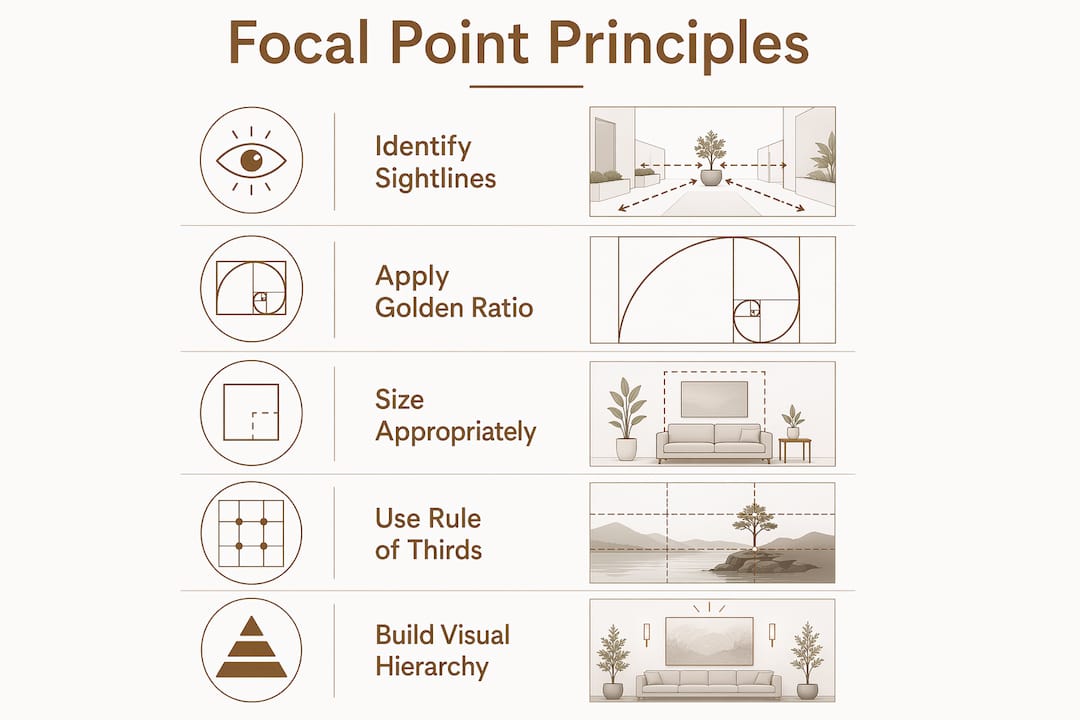
Designing for internal sightlines
Homeowners view their backyards from inside the home about 90% of the time. That single fact changes everything about how a focal point should be positioned. The primary viewing angle is not from a chair in the middle of the yard. It is from the kitchen window, the living room sliding door, or the dining area. Designing a focal point from the center of the yard, as many homeowners instinctively do, limits its daily visual impact to the rare moments you are actually standing outside.
Stand at your primary interior window before committing to any placement decision. Mark where your sightline lands naturally. That point, or the end of the axis extending from it, is where your focal feature belongs.
Applying the golden ratio and Rule of Thirds
The golden ratio places a primary focal point approximately two-thirds along a key sightline for visual satisfaction. Applying this ratio means allocating roughly 62% of a border to primary elements and 38% to secondary ones. In practice, this prevents the common mistake of centering everything symmetrically, which produces a static, flat composition.
The Rule of Thirds works the same way in three dimensions. Divide your yard into a three-by-three grid and place your focal feature at one of the four intersection points. This creates natural tension and visual interest that a centered placement cannot achieve.
Sizing focal points to viewing distance
Scale is where most homeowners make their most costly mistake. A feature that looks impressive at a garden center can disappear in a large yard, or overwhelm a compact one.
Statistic: A one-third ratio for focal point scale relative to viewing distance is the professional standard. For a viewing distance of 9 meters, the focal feature should stand 1.5–2 meters tall. At 4.5 meters, the correct height drops to 0.7–1 meter.
This rule solves the "lost feature" problem that plagues DIY backyard projects. Measure your primary viewing distance before selecting any focal element. Then size accordingly.
Placement at the end of a garden axis or path maximizes visual impact and guides movement through the space. A path that terminates at a fire feature, a specimen tree, or a water element creates a destination. The yard gains a narrative: you move toward something, not just through it.
How to use the Rule of 3 to build visual hierarchy
The Rule of 3 is the organizing framework that prevents a backyard from feeling either cluttered or empty. The principle establishes visual balance through three related elements: a primary anchor, a secondary support feature, and a connecting element that ties the two together.
A practical example: a custom fire pit serves as the primary anchor. A curved seating wall acts as the secondary support. Landscape lighting connecting the two creates the third element. Each piece reinforces the others. Remove any one of them and the grouping loses its resolution.
Overcrowding focal points with too many competing features is the most common design error in residential backyards. When two or three features compete for dominance in a single view, none of them wins. The eye cannot settle, and the space feels busy rather than designed.
Pro Tip: In larger yards with multiple outdoor zones, reveal focal points sequentially rather than all at once. Each garden "room" should have its own primary anchor, but no two anchors should be visible simultaneously from the same vantage point.
The Rule of 3 also governs the functional flow of outdoor spaces. A well-structured hierarchy does not just look balanced. It tells guests where to go, where to sit, and where to gather. That is the difference between a yard that photographs well and one that actually functions as a luxury outdoor living environment.
What types of backyard focal points work best?
The right focal point depends on your yard's size, your primary sightline, and how you use the space. The table below compares the most common categories across key decision factors.
| Focal point type | Best yard size | Primary value | Key consideration |
|---|---|---|---|
| Custom pool or spa | Large to very large | Visual drama, resort feel | Requires precise sightline alignment |
| Pergola or shade structure | Medium to large | Shade, defined gathering zone | Height must match viewing distance scale |
| Fire feature or fireplace | Small to large | Year-round use, evening ambiance | Works as primary or secondary anchor |
| Water feature or fountain | Small to medium | Sound, movement, visual depth | Needs drainage infrastructure |
| Specimen tree or sculpture | Any size | Vertical interest, natural focal anchor | Seasonal changes affect year-round impact |
Functional focal points such as pergolas and seating areas add practical value beyond aesthetics. A pergola that provides shade and defines a dining zone earns its place twice: once as a visual anchor and once as a usable structure. That dual function is what separates a well-designed backyard from one that only looks good in photographs.
Framing matters as much as the feature itself. A specimen tree planted in open lawn reads as a single object. The same tree flanked by low planting beds and lit from below reads as an architectural statement. Planting, paving, and lighting work together to frame the focal element and reinforce its dominance in the composition.
Uplighting a focal point at night extends its effect beyond daylight hours. For homeowners who view their yard most often from inside during evening hours, nighttime lighting is not optional. It is the mechanism that makes the focal point visible during the majority of its viewing time. Landscape lighting paired with a strong focal feature is one of the highest-return investments in any backyard design.
For ideas on how focal features integrate into complete outdoor environments, the backyard entertaining layout examples from Modern Yardz show how sightlines, zones, and anchors work together in real projects.
Key takeaways
A focal point is the single most powerful tool for making a backyard feel architecturally designed rather than assembled by chance. Apply the Rule of Thirds for placement, the one-third viewing distance rule for scale, and the Rule of 3 for element hierarchy to build a backyard that reads as a cohesive, intentional environment.
| Point | Details |
|---|---|
| Design for indoor sightlines | Position focal features where they are visible from primary interior windows, not from the yard's center. |
| Scale to viewing distance | Use the one-third rule: a 9-meter sightline calls for a 1.5–2 meter tall focal feature. |
| Apply the Rule of 3 | Pair every primary anchor with a secondary support and a connecting element to resolve the composition. |
| One focal point per view | Multiple competing anchors dilute impact. Limit each sightline to one dominant feature. |
| Light for evening visibility | Uplighting extends a focal point's visual impact through the hours when most homeowners view their yard. |
Why focal points are the first decision, not the last
I have reviewed hundreds of backyard projects over the years, and the pattern is consistent. Homeowners who struggle with their outdoor spaces almost always made the same mistake: they chose materials, plants, and features first, then tried to arrange them into something cohesive. The focal point became an afterthought, if it was considered at all.
The result is a yard that feels expensive but unresolved. Every element is quality. Nothing holds together.
The homeowners whose projects genuinely succeed think architecturally from the start. They ask one question before any other: what is the single thing I want to see when I look out my back door? That answer drives every subsequent decision, from paving layout to planting selection to lighting placement. The design-before-construction approach is not a luxury. It is the only method that produces a yard where every element belongs.
The other mistake I see repeatedly is designing for the wrong viewpoint. Homeowners walk to the center of their yard, look around, and plan from there. That vantage point represents a small fraction of their actual experience. The view from inside the home is where the focal point earns its value every single day, not just during weekend entertaining.
Luxury outdoor spaces feel the way they do because every decision was made with intention. The focal point is where that intention starts.
— Thomas Jackson
Modern Yardz: full design-build focal point expertise
Modern Yardz has completed more than 2,900 luxury landscape projects across San Diego County, including La Jolla, Rancho Santa Fe, Del Mar, and Coronado. Every project begins with photo-realistic 3D renderings so you see exactly how your focal feature, whether a custom pool, architectural pergola, or custom fire feature, integrates into the full yard before construction begins. One team manages consultation, design, permitting, and build with zero subcontractor handoffs. California Contractor License #1082881. 5.0-star Google rating. Contact Modern Yardz to schedule a free consultation and see your backyard vision in three dimensions before a single stone is placed.
FAQ
What is the role of a focal point in backyard design?
A focal point is the primary visual anchor that organizes a backyard, stops the eye from wandering, and gives the space a sense of intentional design. Without one, even well-planted yards feel unresolved.
Where should a backyard focal point be placed?
Place focal points at the end of a key sightline or garden axis, aligned with your primary interior window. Homeowners view their backyards from inside the home about 90% of the time, so internal sightlines take priority.
How large should a backyard focal point be?
Use the one-third rule: the focal feature should stand approximately one-third as tall as the viewing distance. A 9-meter sightline calls for a feature 1.5–2 meters tall.
Can a backyard have more than one focal point?
Yes, but no two focal points should compete within the same view. In larger yards, assign one primary anchor per outdoor zone and reveal them sequentially as you move through the space.
What makes a functional focal point better than a purely decorative one?
A functional focal point such as a pergola or fire feature serves a practical purpose in addition to anchoring the view. That dual role increases the feature's daily value and justifies the investment more clearly than a decorative element alone.
Recommended
Start Your Free Design Consultation
Tell us about your project and we'll be in touch within 24 hours. No pressure, no obligation.
Ready to design your dream yard?
Tell us about your project. We'll send back a real plan, not a templated quote.
Book My Free Consultation→