What Does 3D Landscape Rendering Show Homeowners
Discover what does 3D landscape rendering show homeowners. Visualize your outdoor space before construction for informed decisions!
3D landscape rendering is a photorealistic digital visualization that shows exactly how an outdoor space will look and feel once construction is complete, depicting realistic layouts, materials, lighting conditions, and plant growth stages before a single shovel breaks ground. Known in the design industry as landscape architectural rendering, this process replaces hard-to-interpret 2D plans with immersive, spatially accurate visuals that give homeowners and property developers a true preview of their investment. At Modernyardz, every project begins with a rendering the client approves before construction starts, because seeing the finished environment in full detail is the only way to make confident, informed decisions about a space worth hundreds of thousands of dollars.
What does 3D landscape rendering show in an outdoor space?
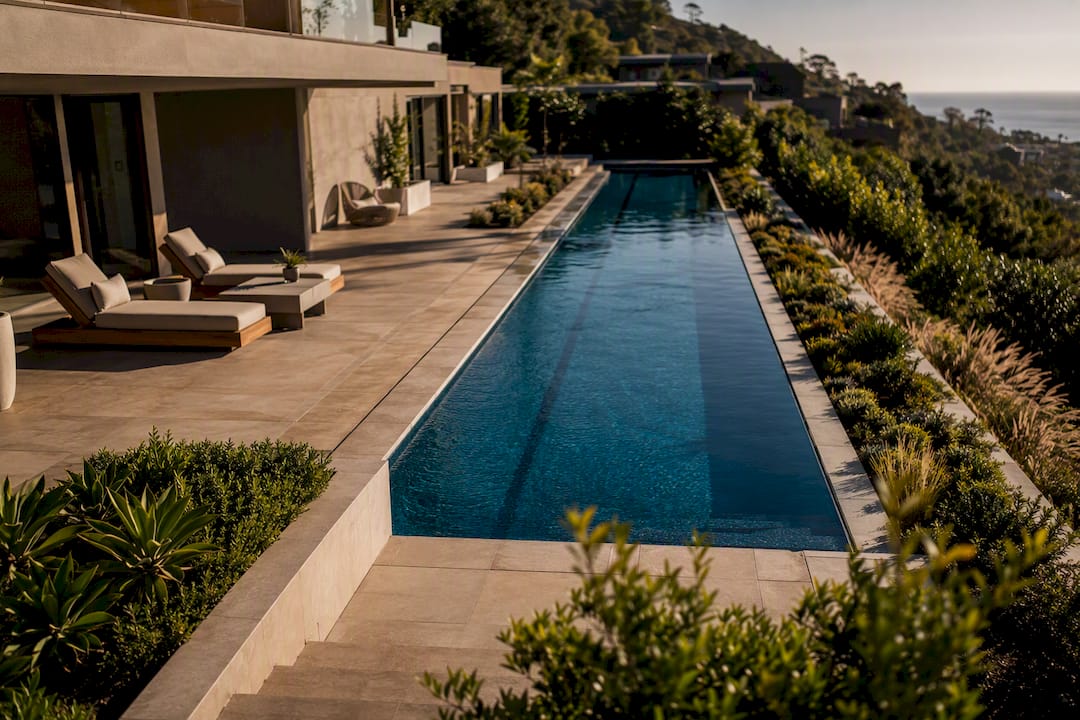
3D landscape rendering shows patios, retaining walls, outdoor kitchens, planting layouts, grading, and drainage corrections with realistic depth and scale, translating every design element into a visual you can evaluate before committing to construction. This level of detail goes far beyond what any 2D plan or hand sketch can communicate, and it covers the full scope of an outdoor environment.
Here is what a professional landscape architectural rendering typically depicts:
- Patio layouts and paver systems. The render shows the exact pattern, color, joint spacing, and surface texture of materials like travertine, natural stone, or porcelain. You can evaluate whether a herringbone travertine patio reads as warm or cold against your home's exterior before ordering a single pallet.
- Retaining walls and elevation changes. Grading and slope transitions are modeled accurately, so you can see how a tiered garden or a retaining wall with a seat cap integrates with the surrounding grade rather than guessing from contour lines.
- Hardscape features. Outdoor kitchens, fire pits, pergolas, and pool surrounds are rendered with their actual material finishes. A custom outdoor kitchen with a stone counter and built-in grill appears in the render exactly as it will appear in the finished yard.
- Planting layouts with species accuracy. Plants are placed at their correct mature sizes and forms, not as generic green blobs. A Mexican fan palm reads differently than a Brisbane box, and the render reflects that distinction.
- Drainage and grading corrections. Slope direction, swales, and drainage channels are visible in the three-dimensional model, allowing the design team to catch grading conflicts before excavation begins.
Pro Tip: Ask your designer to render the space from your primary entertaining viewpoint, not just a bird's-eye overview. The ground-level perspective reveals spatial proportions that overhead plans consistently misrepresent.
How technical site data shapes rendering accuracy

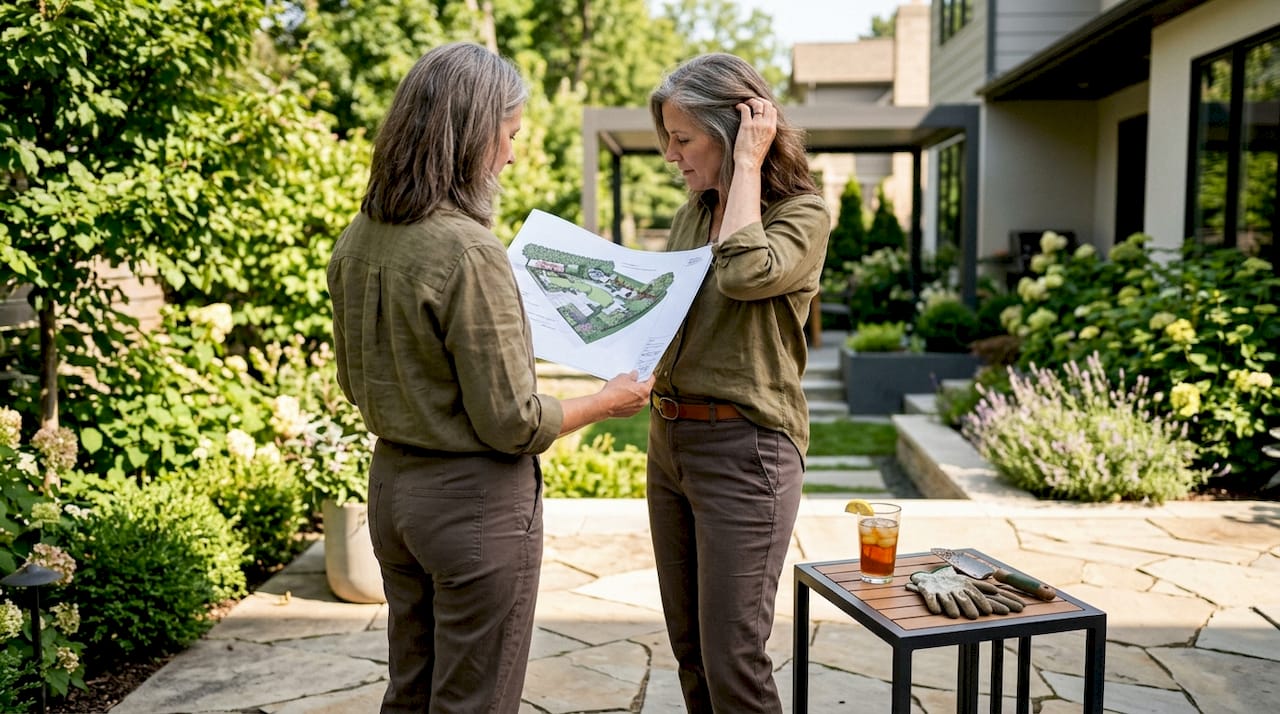
Professional 3D renders are produced from site survey data, landscape plans, and planting and material specifications to preserve design intent accuracy throughout the visualization. This is what separates a photorealistic landscape rendering from a decorative concept sketch or a stock photo composite.
The process of grounding a render in real site data follows a clear sequence:
- Site survey and topographic data. A licensed surveyor or design team measures the property's dimensions, grade changes, existing structures, and utility locations. This data becomes the base geometry of the 3D model, so every wall height and patio dimension reflects the actual site.
- CAD plan integration. The 2D architectural plan, drawn to scale, is imported into rendering software. Tools like Lumion and similar platforms use this geometry to build the three-dimensional environment accurately.
- Planting schedule input. Each plant species is selected from a library of botanically accurate 3D models. The designer assigns the correct species, size at installation, and projected size at five-year maturity to each planting zone.
- Material specification mapping. Paver samples, stone finishes, wood tones, and metal colors are mapped onto surfaces using high-resolution textures. A travertine paver from a specific quarry can be matched closely enough that the render functions as a material approval tool.
- Topography and drainage modeling. Slope data is applied to the model so that grading, drainage swales, and retaining structures sit at their correct elevations relative to the home and property boundaries.
This grounding in real data is why high-quality renders require accurate site surveys and material specs rather than approximations. A render built on guessed dimensions will mislead rather than inform.
What role do lighting and plant maturity play in a render?
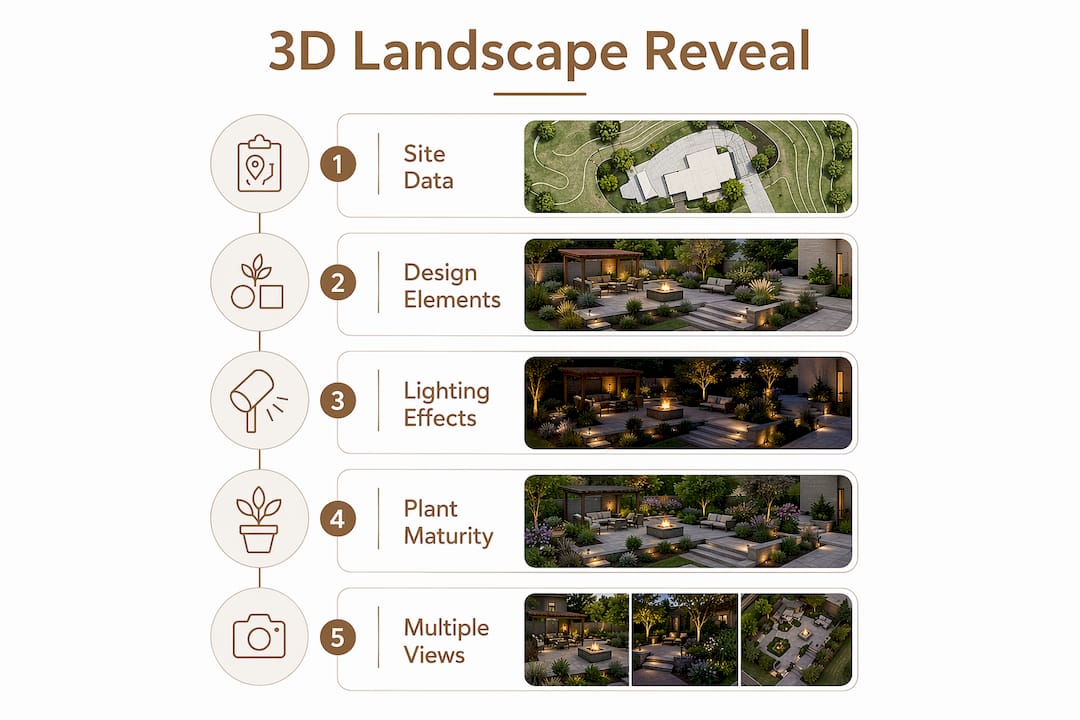
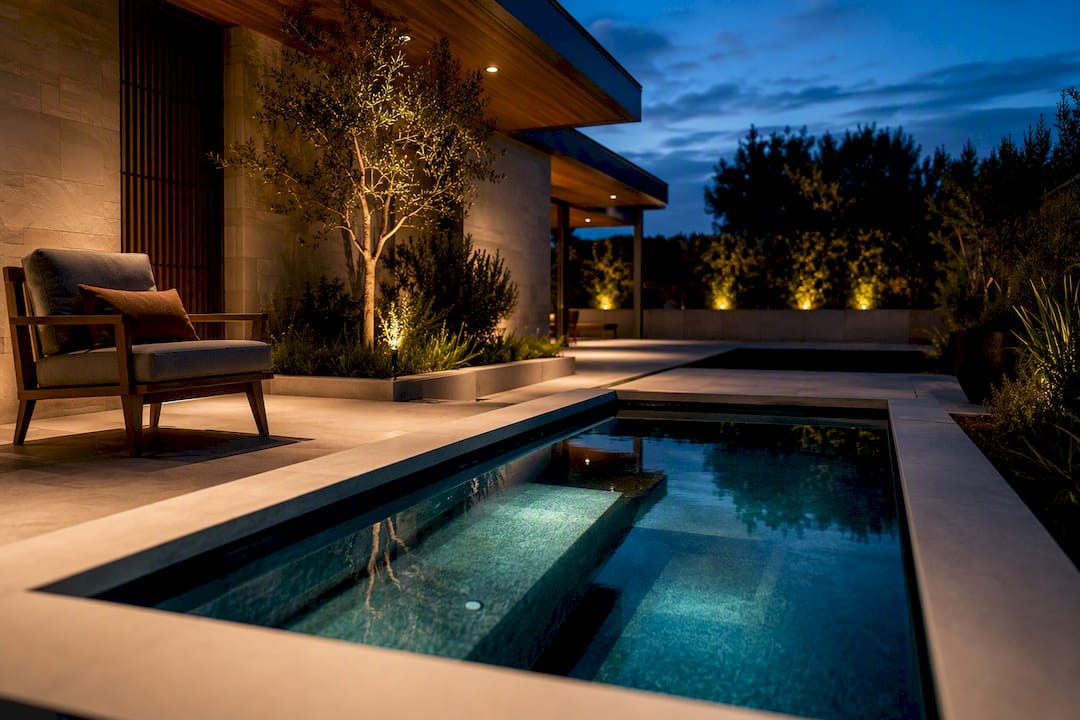
Advanced rendering software incorporates ray tracing to simulate realistic lighting effects such as sunlight filtering through tree canopies, water reflections in a pool, and the warm glow of LED landscape lighting after dark. This is not a cosmetic feature. Lighting realism directly affects how you judge whether a design works.
A render produced with accurate ray tracing shows you several things a flat plan cannot:
- Time-of-day variation. Morning light reads differently than late afternoon light on a travertine patio. A west-facing outdoor kitchen that looks inviting at noon may sit in harsh glare at 5 p.m. Renders showing seasonal and temporal lighting variations let you catch these issues before construction locks them in.
- Shadow patterns. A pergola that casts a pleasant dappled shadow in summer may block all light from a seating area in winter when the sun angle drops. Ray-traced renders make this visible.
- Landscape lighting atmosphere. Path lighting, uplighting on specimen trees, and LED pool lighting are all rendered in their actual positions and color temperatures. You see the nighttime environment as a complete composition, not as a list of fixture specifications.
- Plant maturity stages. Five-year maturity views show how a newly planted olive grove will read once the canopy fills in, preventing the common disappointment of a yard that looks sparse for years after installation.
- Seasonal foliage changes. Deciduous screening plants that provide summer privacy lose that function in winter. A render showing the winter condition of a planting plan reveals privacy gaps before they become a problem.
Pro Tip: Request both a day render and a dusk render for any project that includes [landscape lighting](https://modernyardz.com/services/landscape-lighting-san-diego). The two images together reveal the full atmospheric range of the design and make lighting placement decisions far more precise.
Why multiple viewpoints matter in 3D landscape visualization
3D landscape renderings depict outdoor spaces from key viewpoints that reflect how people actually move through and experience a property, revealing spatial relationships that a single overhead plan view cannot communicate. The street approach, the entry sequence, the view from the primary seating area, and the sightline from the kitchen window each tell a different story about the design.
Viewpoint-based renders increase homeowner decision leverage by showing true spatial experience and material cohesion that 2D plans cannot convey reliably. The table below shows how different viewpoints serve different decision-making needs.
| Viewpoint | What it reveals |
|---|---|
| Street approach | Curb appeal, driveway paver scale, entry planting proportions |
| Entry plaza or gate | Privacy screening effectiveness, gate material integration |
| Primary seating area | Spatial comfort, sightlines to pool or fire feature, shade coverage |
| Pool deck level | Water feature scale, paver-to-water edge transitions, lounge area layout |
| Interior window view | How the yard reads from inside the home, framing of key features |
Each viewpoint answers a specific question you would otherwise only be able to answer after construction. A seating area that appears spacious on a plan may feel cramped at ground level when furniture, a fire table, and a pergola column are all modeled at true scale. Seeing that conflict in a render costs nothing to fix. Seeing it after the concrete is poured is a different matter entirely.
How 3D renderings benefit homeowners and developers in the design-build process
3D rendering reduces misunderstandings, costly changes, and increases confidence by visualizing technical aspects like grading, drainage, and design sequencing before any work begins. For a homeowner investing $150,000 or more in an outdoor environment, this is not a convenience. It is a financial safeguard.
The practical benefits of 3D landscape visualization in a design-build process include:
- Error detection before construction. A grading conflict, a paver pattern that clashes with the home's exterior, or a pergola that blocks a valued view is far less expensive to correct in a 3D model than in a finished build.
- Shared visual language. Rendering acts as a shared visual reference among the homeowner, designer, and construction crew, eliminating the ambiguity that causes field changes and budget overruns.
- Phasing and sequencing clarity. A developer managing a multi-phase outdoor project can use renders to confirm that phase one construction does not compromise phase two design intent.
- Material approval before procurement. Seeing travertine versus porcelain pavers rendered on your actual property, at your actual scale, is a more reliable approval process than reviewing a 4-inch sample tile in a showroom.
- [Interactive 3D renderings](https://mrrendering.com/3d-landscape-rendering/), including 360-degree panoramas and VR walkthroughs, allow clients to move through the space digitally, increasing transparency and accelerating final design approval.
The detail in professional renders extends to paving textures, wall surface roughness, grass edges, and tree canopy density, producing images that are convincingly photorealistic rather than obviously computer-generated. That level of realism is what makes the approval process meaningful.
Key takeaways
3D landscape rendering is the most reliable tool available for translating a design plan into a decision-ready visual, integrating site data, material specs, lighting physics, and biological accuracy into a single photorealistic preview.
| Point | Details |
|---|---|
| Full spatial preview | Renders show patios, walls, plants, grading, and hardscape at true scale before construction. |
| Technical data integration | Accurate renders require site surveys, CAD plans, planting schedules, and material specs. |
| Lighting and seasonal realism | Ray tracing simulates time-of-day, shadow patterns, and nighttime lighting for valid design judgments. |
| Plant maturity visualization | Five-year maturity views prevent post-installation disappointment and support long-term planning. |
| Multiple viewpoints | Ground-level and seating-area renders reveal spatial relationships that overhead plans consistently miss. |
Why I think most homeowners underestimate what a render actually does
I have worked through enough projects to know that the most common homeowner assumption about 3D rendering is that it produces a pretty picture for marketing purposes. That assumption costs people money.
A render built on real survey data, accurate planting schedules, and specified materials is a design validation tool. It catches the pergola that would have blocked the master bedroom view. It reveals the paver pattern that fights with the home's stone facade. It shows the seating area that would have felt like a hallway once the furniture was in place. None of those corrections are free after construction begins.
The other thing most guides do not address is the maturity gap. A yard rendered only at installation day looks thin and unconvincing, and it sets unrealistic expectations for the first two years after planting. Requesting a five-year maturity render alongside the installation render gives you an honest picture of what you are actually buying. That is the render that should drive your planting budget decisions.
My recommendation: treat the rendering phase as seriously as the construction phase. Review every viewpoint. Question every material. Ask to see the dusk lighting render before approving the lighting plan. The render is the last moment when changes are free.
— David
See your San Diego outdoor space in full detail before construction begins
Modernyardz has delivered luxury landscape design-build services across San Diego County for 49 years, completing more than 2,900 projects under California Contractor License #1082881 with a 5.0-star Google rating. Every project begins with photorealistic 3D renderings reviewed and approved by the homeowner before construction starts. Our single-team design-build model covers consultation, architectural plans, 3D visualization, permitting, material procurement, and full construction with one point of contact and zero subcontractor handoffs. Whether your project centers on a custom pool and spa, an outdoor kitchen, premium travertine pavers, or a complete outdoor living environment, you will see it rendered in full detail first. Book a free consultation to begin your project.
FAQ
What does a 3D landscape rendering actually show?
A 3D landscape rendering shows a photorealistic preview of a completed outdoor space, including patio layouts, paver materials, planting arrangements, retaining walls, outdoor kitchens, fire features, grading, drainage, and lighting conditions. It depicts the space at true scale from multiple viewpoints, including ground-level perspectives that overhead plans cannot replicate.
How is landscape architectural rendering different from a sketch or photo?
Landscape architectural rendering is a purpose-built digital visualization produced from site survey data, CAD plans, planting schedules, and material specifications, making it spatially and biologically accurate. A sketch is interpretive and approximate; a photo shows an existing space rather than a proposed one.
Can a 3D render show how plants will look years after installation?
Yes. Professional renders can depict plants at installation size and at projected five-year maturity, giving homeowners a realistic picture of how the planting design will evolve over time and preventing disappointment during the establishment period.
What lighting conditions can a 3D landscape render depict?
Using ray tracing technology, renders simulate sunlight at different times of day and seasons, shadow patterns from structures like pergolas, water reflections, and the full nighttime atmosphere created by LED landscape lighting systems.
Why do multiple viewpoints matter in a landscape render?
Different viewpoints reveal different design qualities. A street-approach render evaluates curb appeal, a seating-area render reveals spatial comfort and sightlines, and a pool-deck render shows material transitions and water feature scale. Each viewpoint answers questions that a single overhead plan view leaves unanswered.
Recommended
Start Your Free Design Consultation
Tell us about your project and we'll be in touch within 24 hours. No pressure, no obligation.
Ready to design your dream yard?
Tell us about your project. We'll send back a real plan, not a templated quote.
Book My Free Consultation→