San Diego Pools: Avoid a Repour With Sheer Descent Waterfall Specs
Practical, contractor-minded guidance for San Diego pool owners on sheer descent waterfalls: pump and lip specs, installation rules, lighting,...
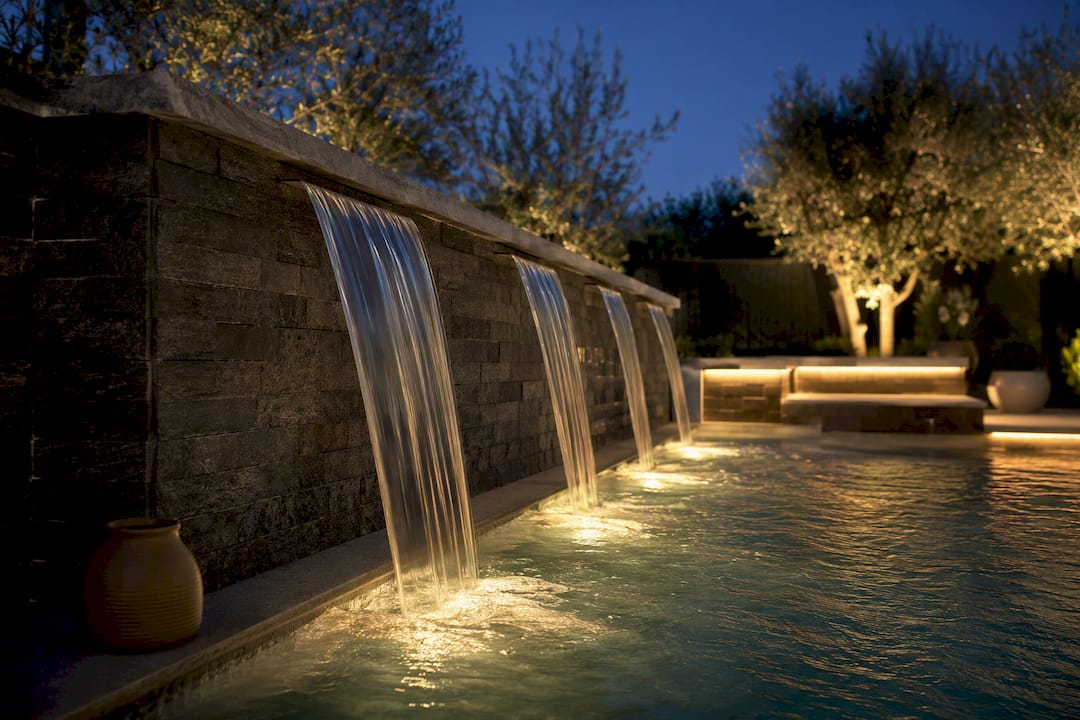
A sheer descent waterfall is an engineered lip mounted into a pool wall that releases water as one continuous, glass-like sheet rather than a splash or trickle. It suits homeowners who want a modern, architectural water feature with a sound and light profile they can dial up or down, rather than a naturalistic rock cascade. If your pool design leans clean and geometric, this is usually the right call.
TL;DR: - Sheer descent units should be proportioned to the wall span, with widths from 8 inches to 8 feet and a maximum height of 4 feet for a clean sheet. - Proper installation requires leveling the unit accurately, using a minimum of 40mm plumbing pipe, and carefully controlling water flow to maintain an even, cohesive sheet. - Contrast at night is key, so dark backgrounds and strategic lighting create a glowing, dramatic effect that enhances visual impact. - Regular maintenance involves rinsing the lip, balancing water chemistry, and draining the feed line to prevent scale buildup and freezing damage. - Using durable materials like stainless steel or natural stone for the lip and backdrop ensures longevity, while a coordinated design-build approach prevents costly construction mistakes.
Table of Contents
- What Is a Sheer Descent Waterfall and How Does It Work?
- Design Options: Placement, Rhythm, and Style
- How Wide, How Tall, and How Far Should It Project?
- Installation and Plumbing: What Actually Makes the Sheet Work
- Keeping It Running: Maintenance and Common Problems
- Lighting and Material Pairings That Make It Pop
- Environmental Considerations Worth Weighing
- Safety Measures and Regulations to Know
- Choosing Materials That Last
- Modern Yardz Perspective: Why Design-Build Matters Here
- Bring Your Sheer Descent Vision to Life
- Sources
What Is a Sheer Descent Waterfall and How Does It Work?
A sheer descent gets its effect from a precision-milled lip, usually bronze, stainless steel, or acrylic, fed by water pressure distributed evenly across the back of the unit before it ever reaches the edge. That internal chamber matters more than most homeowners realize. Uneven pressure inside the housing is exactly what produces the wobbly, broken sheet you sometimes see on poorly built installations.
Flow rate and lip profile together determine the final look. Push more water through and the sheet thickens into something closer to a rushing cascade. Dial it back and you get the thin, mirror-like curtain most luxury pools are built around. Manufacturers like Jandy build units ranging from 8 inches up to 8 feet, with the effect adjustable from a glass-like sheet to a rushing cascade depending on how the valve is set.
Compare that to the alternatives:
- Scuppers release water through a narrow spout, creating a rope-like stream rather than a sheet.
- Rock waterfalls rely on irregular stone ledges and produce a naturalistic, tumbling flow.
- Sheer descents hold a flat, uninterrupted plane of water, typically finished in bronze, stainless steel, or acrylic to keep the edge crisp.
Design Options: Placement, Rhythm, and Style
A single centered sheer descent reads as a deliberate architectural statement, especially against a raised wall or spa spillover. Multiple units spaced in a repeating rhythm create a different effect entirely, more like a curtain of columns than one focal point. Designers frequently align several units symmetrically, pairing them with matching lighting and dark backer materials to intensify the mirrored effect at night.
Wide spans work two ways. You can run a single long stainless-steel spillway, like the 72 inch Sutton model built for commercial-grade long spans, or space several shorter units tightly together with independent valve control for fine-tuning each one's sheet thickness. Curved pool walls generally call for the second approach since a single rigid spillway can't follow a radius.
A few placement principles worth remembering:
- Use one dramatic span for a minimalist pool where the waterfall should be the visual anchor.
- Use repetition (three or more units) when the goal is texture and rhythm along a longer wall.
- Match the backdrop material to the finish. Dark stone or tile behind a stainless lip amplifies contrast.
Pro Tip: If you're integrating a raised spa, position the sheer descent as the spa spillover itself. It solves two design problems at once and keeps sightlines cleaner than adding a separate feature.
How Wide, How Tall, and How Far Should It Project?
Proportion is what separates a sheer descent that looks intentional from one that looks like an accessory. Manufacturer catalogs run from 8 inches to 8 feet, and the right width almost always tracks the span of the wall behind it rather than an arbitrary preference. A unit that's too narrow for its wall looks like an afterthought; too wide and it overwhelms the sightline.
Height is where most first-time buyers overreach. Industry guidance consistently caps effective drop height around 4 feet to maintain sheet cohesion. Beyond that, wind drift and air resistance start breaking the sheet apart before it reaches the water, which undercuts the entire point of the feature.
Rules of thumb worth keeping on hand:
- Width: size to the wall span, generally within a range from small to larger units suitable for typical pool walls.
- Height: stay under 4 feet for a clean, unbroken sheet.
- Projection: plan for roughly 100 to 300 millimeters outward from the wall, since projection and height interact directly. A taller drop needs a slightly wider projection to keep the sheet from clinging to the wall face.
Installation and Plumbing: What Actually Makes the Sheet Work
Everything about a sheer descent's visual quality comes down to two things: how level it sits and how much water reaches it. Get either wrong and you'll see it immediately, not months later.
The unit has to sit level on the bond beam before tiling begins, and the notch for it should be cut to exact spec ahead of time rather than adjusted after the fact. Even a slight tilt causes the sheet to break into an uneven, stuttering flow, which is why experienced crews set the unit on shims during tiling and re-check level after the tile sets, not before.
On plumbing, installation manuals recommend a minimum of 40mm pipe for smaller units, stepping up to 50mm for wider or longer spans, with dual feed points for anything approaching the longer end of the size range. As a flow benchmark, a 1200mm sheer descent typically needs around 180 liters per minute to project a 300mm sheet at 900mm height, which gives contractors a working figure for sizing the pump.
A reliable startup sequence looks like this:
- Leave the factory grout guard in place through the entire tiling and construction process.
- Purge all air from the line before the first test run.
- Open valves gradually rather than at full flow, watching the sheet form evenly across the lip.
- Fine-tune with a 3-way valve setup so sheet thickness can be adjusted independently of the main pool circulation.
Pro Tip: Planning your equipment pad and plumbing runs before pouring the deck saves you from the single most expensive mistake in water feature construction: a repour. Our [equipment placement guide](https://modernyardz.com/blogs/pool-equipment-placement) walks through exactly what to map out first.
Keeping It Running: Maintenance and Common Problems
A dedicated pump line deserves its own dedicated strainer. Running the sheer descent off the main pool pump without a separate filter can work for small, low-flow units, but it invites debris and inconsistent sheet formation over time as the narrow lip clogs.
Routine upkeep is straightforward but non-negotiable:
- Rinse the lip and housing periodically to prevent mineral scale from narrowing the opening.
- Balance water chemistry consistently. Calcium buildup is the most common cause of a thinning or uneven sheet.
- Before winter shutdown, drain the feed line fully to prevent freeze damage in units exposed to cold nights.
Most complaints trace back to one of three causes: an unlevel base causing gaps in the sheet, scale buildup narrowing the lip, or a clogged strainer causing stuttering flow.
Pro Tip: A quarterly walk-through checklist catches most of these issues before they show up visually. A resource like [Trinity Inspections' seasonal pool safety checklist](https://trinityinspectionsllc.com/post/pool-safety-checklist) is a useful outside reference for building your own routine.
Lighting and Material Pairings That Make It Pop
The single biggest lever for how a sheer descent reads at night is contrast. Dark tile or natural stone behind the sheet makes the water read as a distinct, glowing plane rather than blending into the background, since dark backdrops intensify the visual separation between wall and water.
Backlighting has three common placements: fixtures mounted above the lip washing light downward through the sheet, fixtures set directly behind for a full silhouette glow, and submerged fixtures below that catch the water as it lands. Warm white tends to flatter natural stone backdrops, while cooler white or color-changing LED reads more dramatic against stainless steel.
Three layouts consistently perform well:
- Centered single span against a raised spa wall for a clean focal point.
- Triple rhythm of matched units spaced evenly along a longer wall for texture.
- Continuous wide span using one long spillway for a minimalist, resort-style statement.
Environmental Considerations Worth Weighing
Every water feature adds evaporation and pumping load to a pool system, and sheer descents are no exception. The larger surface area exposed to air as water sheets down the wall increases evaporative loss compared to a still pool surface, particularly in San Diego's dry coastal climate where low humidity accelerates the process.
The practical response is running the feature on a timer rather than continuously. Most homeowners find a few hours during evening entertaining hours delivers the visual and acoustic payoff without the round-the-clock water and energy draw. Pairing the dedicated feature pump with a variable-speed drive also cuts electrical consumption meaningfully, since the pump only needs to run at the flow rate the lip actually requires rather than a fixed high setting.
Water chemistry management ties in here too. A sheer descent aerates water as it falls, which can accelerate chlorine off-gassing and shift pH slightly faster than a still pool. That means slightly more attentive chemical monitoring, not a fundamentally different regimen. Homeowners drawing from well water or dealing with naturally hard water supplies should also expect faster mineral scale accumulation on the lip, since the constant sheeting action leaves calcium deposits exposed to evaporation at a higher rate than submerged pool surfaces.
None of this makes a sheer descent an environmentally costly choice relative to other water features. Rock waterfalls with pumps running larger volumes over greater elevation typically draw more power. The sheer descent's efficiency, when paired with smart controls and a timer schedule, is part of why it has become the preferred feature for design-conscious, resource-aware homeowners.
Safety Measures and Regulations to Know
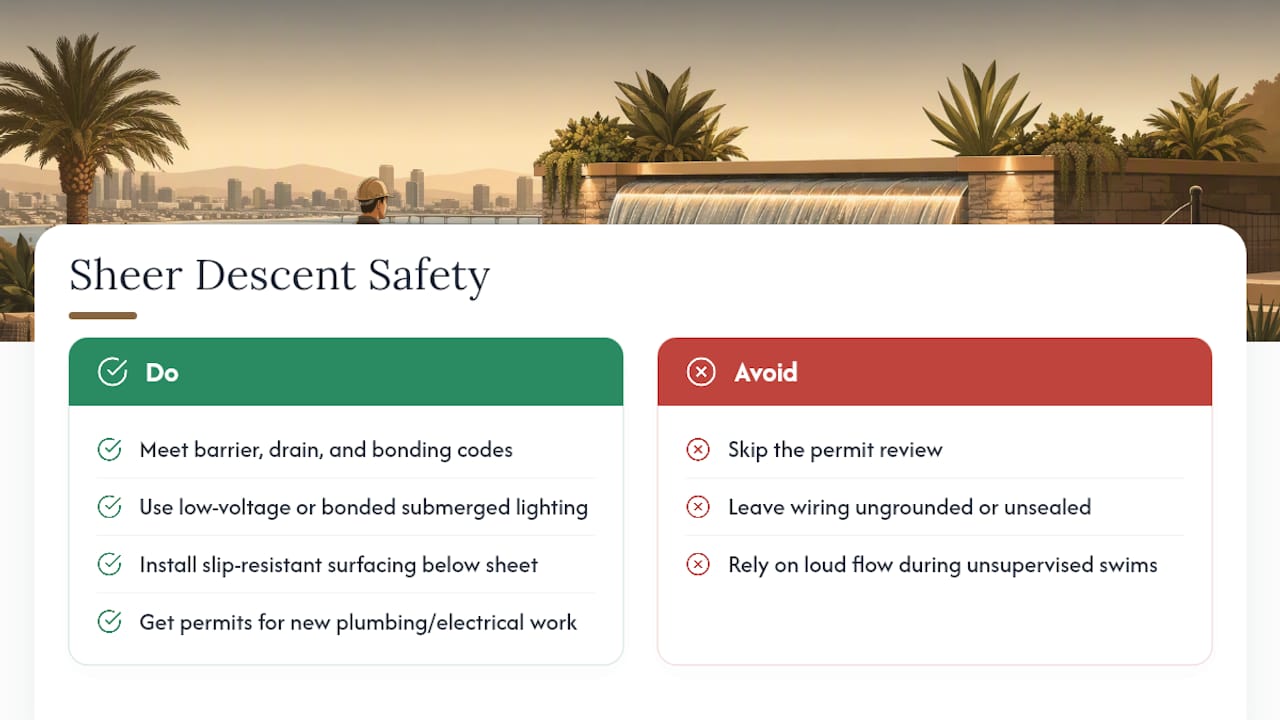
Local building and pool safety codes generally treat a sheer descent as part of the pool's water feature system, which means it falls under the same barrier, drain, and electrical bonding requirements that apply to the rest of the pool. Any water feature with submerged lighting must meet low-voltage or properly bonded electrical standards, since water and electrical fixtures in close proximity are a serious hazard if wiring isn't grounded and sealed correctly.
Slip resistance around the deck area near a sheer descent deserves particular attention. The zone directly below the falling sheet stays wet more consistently than the rest of the pool deck, and California building codes generally require slip-resistant surfacing in areas of frequent water exposure. Homeowners renovating an existing deck around a new sheer descent installation should confirm the surrounding paver or stone finish meets that standard, not just the finish on the rest of the deck.
Permitting is another piece that catches homeowners off guard. Adding a water feature to an existing pool, particularly one requiring new plumbing runs or electrical work for lighting, typically requires a permit review even when the pool itself is unchanged. San Diego County jurisdictions vary in how strictly this gets enforced, but skipping the permit step on electrical or structural modifications creates liability exposure that outlasts the installation itself.
Finally, if young children or elderly family members regularly use the pool, consider the acoustic and visual impact of the feature on pool monitoring. A loud, continuous cascade can mask the sound of someone entering the water unexpectedly, which is a reasonable argument for including a variable flow control that lets you reduce or silence the feature during unsupervised swim times.
Choosing Materials That Last
The lip material is the single most consequential durability decision in a sheer descent installation. Bronze and stainless steel dominate the premium segment because both resist the corrosive combination of pool chemicals and constant water exposure far better than lower-grade metals. Stainless steel, particularly in commercial-grade product lines like the Sutton spillway series, holds a crisp edge over years of continuous use, which matters because any pitting or corrosion on the lip directly distorts the sheet's uniformity.
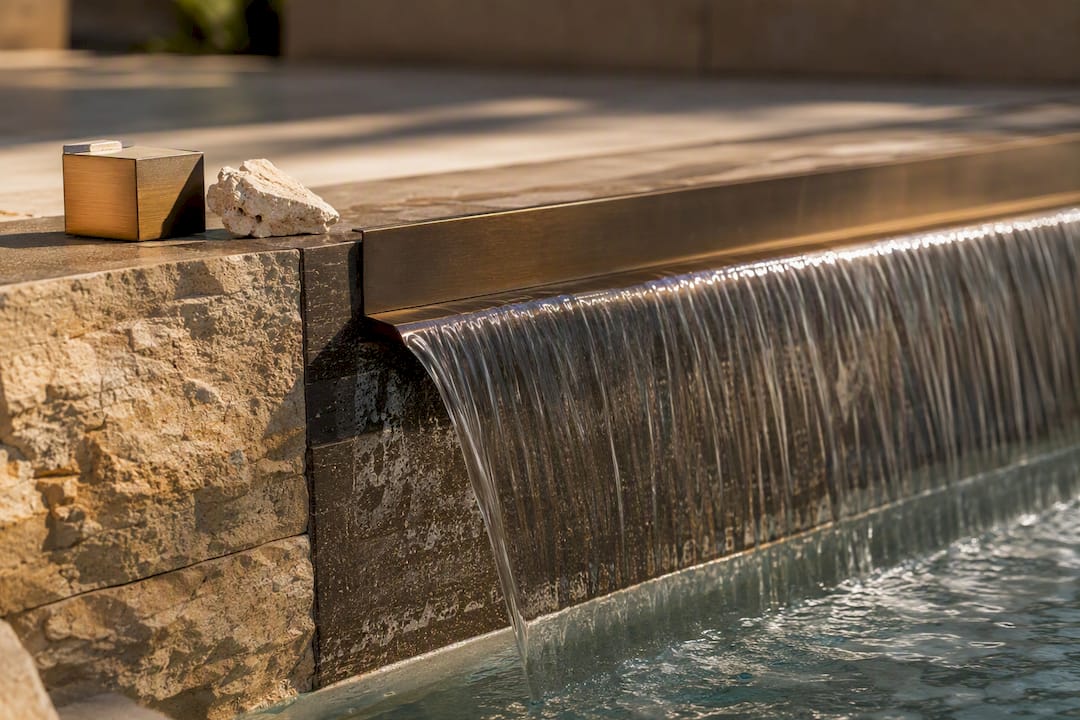
Acrylic lips exist as a lower-cost alternative but tend to show wear and discoloration faster under constant sun and chemical exposure, making them a less common choice for high-end installations meant to look flawless for decades rather than years.
The backdrop and surrounding structure matter just as much as the lip itself. Natural stone and travertine resist staining and mineral buildup better than porous concrete finishes, and they hold color consistency under years of water exposure. Tile backdrops need careful grout selection, since standard grout can discolor or erode faster than the surrounding stone when subjected to constant moisture and mineral-laden runoff.
Bond beam construction underneath the unit deserves equal attention. A structurally sound, properly waterproofed bond beam prevents the freeze-thaw and moisture infiltration issues that eventually crack tile and destabilize the notch where the sheer descent sits. Cutting corners here rarely shows up as a problem in year one. It shows up in year five, as hairline cracks and shifting grout lines around the feature.
Modern Yardz Perspective: Why Design-Build Matters Here
A sheer descent looks simple once it's running. Getting there without a repour is not. Coordinating pump location, plumbing runs, electrical bonding, and finish tile all at once requires the equipment pad, drainage, and structural details settled before a single wall gets built, not adjusted afterward.
That's the core argument for design-build. When one team handles the 3D rendering through final tile setting, sightlines and lighting placement get resolved on screen, not with a change order mid-construction. Modern Yardz builds every sheer descent installation this way, with specialized crews and premium materials under one contract, one point of contact, zero subcontractor handoffs.
— Thomas Jackson
Bring Your Sheer Descent Vision to Life
A sheer descent waterfall is one detail in a much larger architectural decision, and getting the proportions, plumbing, and lighting right the first time is what separates a resort-caliber pool from a feature that looks slightly off for the next decade. Modern Yardz has completed 2,900+ projects across La Jolla, Rancho Santa Fe, Del Mar, Coronado, and Carmel Valley since 2018, and every one of them starts with photo-realistic 3D renderings before construction begins, not after.
Our design-build process, backed by California Contractor License #1082881 and a 5.0-star rating, means the same team that renders your sheer descent's lighting and placement also plumbs it, tiles it, and stands behind it. No subcontractor handoffs, no miscommunication between designer and builder. Whether you're adding a single dramatic span to an existing pool or building a full resort environment around a custom pool and spa design, the process starts the same way: a consultation and a rendering you approve before anything is built.
See how a sheer descent could look against your own backyard by scheduling a free consultation with Modern Yardz.
Sources
For exact flow charts, lip dimensions, and plumbing specs, consult Jandy's Sheer Descent product page and the Clearpond installation manual, which cover pump sizing and notch dimensions in detail.
- Sheer Descent® Cascade Waterfall — Jandy
- Sheer Descents installation manual — Clearpond
- Sutton 72" Smooth Water Waterfall Spillway - Stainless Steel
Recommended
Start Your Free Design Consultation
Tell us about your project and we'll be in touch within 24 hours. No pressure, no obligation.
Ready to design your dream yard?
Tell us about your project. We'll send back a real plan, not a templated quote.
Book My Free Consultation→