What Does a Landscape Design Plan Include?
Discover what a landscape design plan includes and how it ensures a smooth construction process, guiding your outdoor project from start to finish.

A landscape design plan is a detailed, scaled document that maps every natural and built feature of an outdoor space, serving as the technical and visual roadmap for construction, permitting, and installation. In professional practice, this document is called a landscape architecture plan or site plan. It covers everything from property boundaries and grading to planting layouts, hardscape structures, irrigation systems, and lighting circuits. Understanding what a landscape design plan includes is the difference between a project that builds smoothly and one that stalls at the permit counter or drifts from your original vision mid-construction.
What does a landscape design plan include?
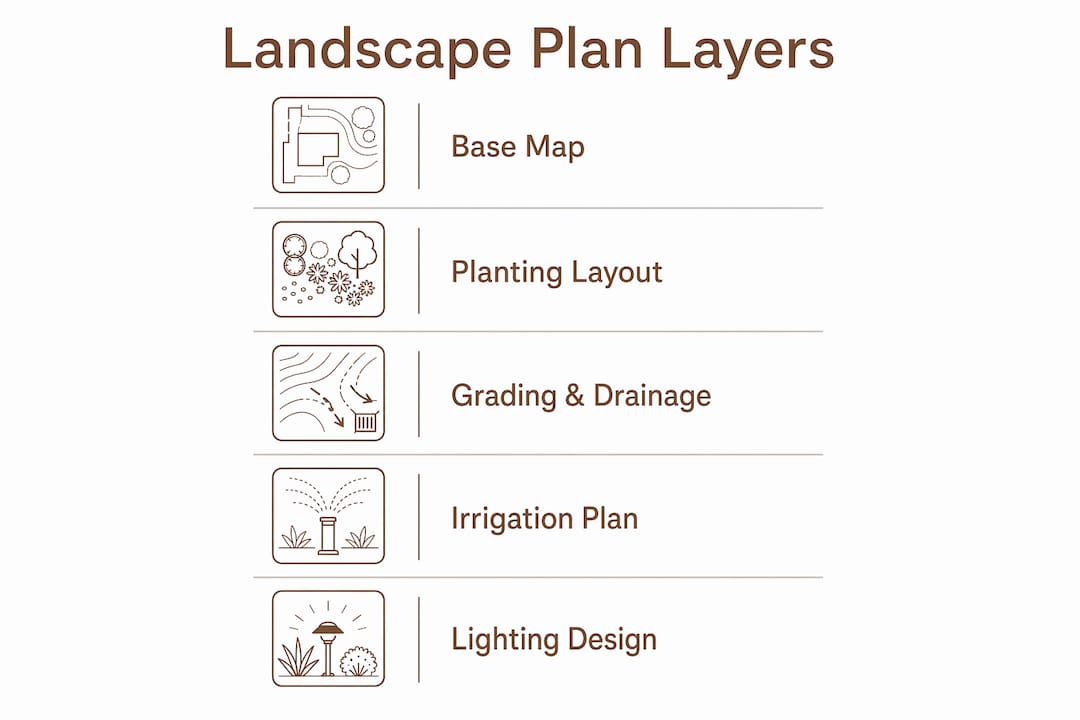
A complete landscape plan is a legal and technical roadmap composed of multiple coordinated layers, all anchored to a survey-based base map. Each layer addresses a distinct system, and together they prevent conflicts during construction. The core components are:
- Property lines and existing conditions: Accurate boundary surveys, existing structures, utility locations, and site topography form the foundation. No design layer can be accurate without this base.
- Planting plan: Species selection, container sizes, spacing, and placement are documented for every plant, tree, and ground cover. This layer is reviewed by certified horticulturists on professional projects.
- Hardscape features: Patios, walkways, retaining walls, seat walls, outdoor kitchens, and pool decks are drawn to scale with dimensions and material callouts.
- Irrigation plan: Sprinkler head layouts, drip lines, controllers, and water source details are required for permit submission in most California jurisdictions.
- Lighting plan: Fixture types, locations, electrical circuits, and photometric goals are specified to extend outdoor usability and meet permit standards.
- Grading and drainage plan: Elevation changes, swales, and drainage structures are documented to protect foundation stability and prevent water intrusion.
- Material schedules: Every stone type, paver, wood species, and structural element is listed to prevent substitution and maintain quality control through the build.
Pro Tip: Request a copy of the material schedule before construction begins. This single document prevents the most common source of mid-project disputes: unauthorized material substitutions that compromise design intent.
| Plan Layer | Primary Purpose |
|---|---|
| Base map / survey | Establishes accurate property boundaries and existing conditions |
| Planting plan | Documents species, sizes, and placement for all vegetation |
| Hardscape plan | Defines patios, walls, kitchens, and paved surfaces with dimensions |
| Irrigation plan | Specifies water delivery systems for efficiency and permit compliance |
| Lighting plan | Details fixture locations, circuits, and photometric targets |
| Grading and drainage | Protects site stability and directs water away from structures |
| Material schedules | Locks in every specified material to prevent substitution |

Material schedules prevent substitution creep by specifying every stone, wood, plant, and structural element. This keeps installations faithful to design intent without unauthorized changes.
How do design principles shape a landscape plan?
The five core elements of landscape design are line, form, texture, color, and scale. These are not decorative preferences. They are the structural logic that determines how your eye moves through a space, how features relate to the home's architecture, and how the finished environment feels at ground level.
Line defines movement. Curved lines in a walkway create a relaxed, organic feel. Straight lines signal formality and architectural precision. Form refers to the three-dimensional shape of plants and structures. A columnar Italian cypress reads differently than a spreading oak, and both communicate different things about the space they occupy.
Texture creates contrast and depth. Rough natural stone against smooth travertine pavers, or fine-leafed ornamental grasses beside broad-leafed tropical plants, produces visual interest without adding complexity. Color works seasonally and must be planned across bloom cycles, not just at installation. Scale is perhaps the most critical element for luxury properties. A pergola that is undersized for a 5,000-square-foot home reads as an afterthought, not an architectural feature.
Nearly 90% of homeowners value professionally designed outdoor spaces for their cohesion. That figure reflects something real: when design principles are applied correctly, the space feels unified without the homeowner being able to articulate exactly why.
| Design Element | Function in the Plan |
|---|---|
| Line | Directs movement and establishes formal or informal character |
| Form | Defines three-dimensional relationships between plants and structures |
| Texture | Creates contrast and visual depth across surfaces and plantings |
| Color | Sequences bloom cycles and material tones across seasons |
| Scale | Ensures features are proportional to the home and property |
Focal points like water features or outdoor kitchens create balanced, lower-maintenance environments. A well-placed focal point organizes the entire composition around it, reducing visual clutter and giving the eye a clear destination.
Pro Tip: When reviewing your design renderings, identify the primary focal point first. If you cannot find one within three seconds of looking at the plan, the design lacks visual hierarchy and will feel cluttered once built.
What technical details make a plan construction-ready?
A concept rendering and a construction-ready landscape plan are two different documents. Homeowners often confuse them. Skipping detailed construction plans leads directly to cost overruns and installation errors. The gap between a schematic sketch and a permit-approved construction document is where most project problems originate.
A construction-ready plan includes the following technical layers:
- Scaled drawings: Every element is drawn to a precise scale, typically 1/8 inch or 1/4 inch per foot, so contractors can measure directly from the plan.
- Grading and drainage overlays: Grading documentation is the first step in new construction because it determines foundation elevations and site stability for every feature built above it.
- Irrigation zoning: Zones are mapped by plant water requirements, sun exposure, and pressure zones. This prevents overwatering, underwatering, and system failures.
- Lighting circuits: Electrical load calculations, transformer sizing, and fixture placements are documented for both permit review and contractor installation.
- Permit compliance annotations: Notes referencing local codes, setback requirements, and material standards are embedded directly in the drawings.
The process moves in stages. Schematic design establishes the concept. Design development refines proportions and material selections. Construction documents translate all decisions into precise, buildable specifications. Each stage requires homeowner approval before advancing. This sequence protects your investment and prevents expensive corrections during the build phase.
A landscape plan submitted for permits must comply with local codes before building permits are issued. In San Diego County, this includes water-efficient irrigation requirements, grading permits for significant elevation changes, and in some neighborhoods, design review board approval.
How do you read and apply a landscape plan?
Reading a professional landscape plan is a skill, but you do not need to master it completely. You need to understand enough to verify that your design intent is captured accurately before construction begins.
Start with the plant schedule. This table lists every species by botanical name, common name, container size, and quantity. Cross-reference it against the planting plan to confirm that the plants shown in your 3D rendering match what is actually specified. Discrepancies at this stage are easy to correct. Discrepancies discovered after installation are expensive.
Next, review the hardscape dimensions. Confirm that patio areas, walkways, and pool decks are sized for how you actually intend to use them. A dining area for eight people requires a minimum of 12 feet by 14 feet of clear paver surface. Many homeowners approve plans without checking this and end up with outdoor dining spaces that cannot fit the furniture they own.
- Verify that grading and drainage direct water away from the home's foundation and any below-grade structures.
- Confirm that lighting fixture locations align with your intended use patterns, specifically path lighting, accent lighting on focal points, and task lighting at the outdoor kitchen.
- Check that irrigation zones separate turf, drought-tolerant plantings, and high-water-use areas. Mixing these zones wastes water and kills plants.
- Ask your designer to walk you through the material schedule line by line. Confirm that every specified material matches what you approved in the design presentation.
Pro Tip: Request a 3D photo-realistic rendering before approving the construction documents. A rendering reveals scale and proportion issues that flat plan drawings cannot communicate. Modern Yardz produces these renderings as a standard step before any project moves to permitting.
The design-build distinction matters here. When one firm handles both the plan and the construction, the design intent transfers directly to the build team without translation errors. When design and construction are split between separate firms, the construction documents become the only communication channel, and gaps in those documents become field decisions made without your input.
Key takeaways
A complete landscape design plan integrates technical precision with design principles to produce a construction-ready, permit-compliant document that protects your investment from concept through final installation.
| Point | Details |
|---|---|
| Plans are layered documents | Each system, planting, grading, irrigation, lighting, has its own coordinated layer anchored to a survey base map. |
| Material schedules prevent substitution | Specifying every material in writing locks in quality and prevents unauthorized changes during construction. |
| Grading comes first | Drainage and elevation documentation must be resolved before any hardscape or planting work begins. |
| Design principles create cohesion | Line, form, texture, color, and scale determine how the finished space feels, not just how it looks in a rendering. |
| Construction documents differ from concepts | Permit-ready plans include exact measurements, code annotations, and system specifications that schematic drawings do not. |
Why the plan is the project
I have reviewed hundreds of landscape projects over the years, and the ones that go wrong almost always share one characteristic: the plan was treated as a formality rather than the foundation of the entire build.
Homeowners often focus on the 3D rendering and assume the technical documents will handle themselves. They do not. The grading plan determines whether your outdoor kitchen stays level in five years. The irrigation zoning determines whether your drought-tolerant plantings actually survive San Diego's dry season. The material schedule determines whether the travertine you selected in the showroom is the travertine that gets installed.
The most common misunderstanding I encounter is the belief that landscape design is primarily aesthetic. It is not. Design principles solve functional problems. A well-placed retaining wall is also a drainage solution. A pergola positioned correctly provides shade during peak afternoon heat without blocking the view corridor you paid for. The aesthetic outcome is the result of solving functional problems well.
My advice to any homeowner investing in a luxury outdoor space: insist on seeing every layer of the plan, not just the rendering. Ask specifically about the grading overlay, the irrigation zoning map, and the material schedule. If your designer cannot produce all three before construction begins, the project is not ready to build.
— Thomas Jackson
How modern yardz delivers plans built to build
Modern Yardz produces every landscape plan as a complete, construction-ready document set before a single shovel breaks ground. The process covers 2D architectural drawings, photo-realistic 3D renderings, grading and drainage overlays, irrigation zoning, custom lighting design, and full material schedules, all managed by one team under California Contractor License #1082881. With 2,900+ completed projects and a 5.0-star rating across San Diego County, the firm's luxury design-build process eliminates the handoff gaps that cause most project failures. Schedule a free consultation to see your property transformed in 3D before construction begins.
FAQ
What is included in a basic landscape design plan?
A basic landscape plan includes a site survey, planting layout, hardscape dimensions, and grading notes. Professional plans also add irrigation zoning, lighting circuits, and material schedules required for permit submission.
Is a landscape design plan required for permits in san diego?
Yes. Most San Diego County jurisdictions require a landscape plan, including irrigation details and grading documentation, before issuing building permits for significant outdoor construction.
What is the difference between a concept plan and a construction plan?
A concept plan communicates the design vision through sketches or renderings. A construction plan includes exact measurements, code annotations, and system specifications that contractors and permit reviewers require.
How do grading and drainage fit into a landscape plan?
Grading and drainage overlays are foundational layers that determine site stability and foundation elevations. They must be resolved before hardscape or planting work begins to prevent water intrusion and structural settling.
What are the five elements of landscape design?
The five core elements are line, form, texture, color, and scale. Professional designers use these principles to create visual hierarchy, ensure architectural integration, and produce outdoor spaces that feel cohesive rather than assembled.
Recommended
Start Your Free Design Consultation
Tell us about your project and we'll be in touch within 24 hours. No pressure, no obligation.
Ready to design your dream yard?
Tell us about your project. We'll send back a real plan, not a templated quote.
Book My Free Consultation→